
Introduction
As we look at the growth of our business from a financial perspective it goes beyond just tracking revenue and expenses. We use the income statement to determine profitability and the balance sheet to see financial position, but the statement of changes in equity is what breaks down how the owners’ interest in the business changes over a certain accounting period. Also it details which profits are put back into the growth of the business, which are given out to the owners as dividends, and how other investments and withdrawals play a role.
For small business which is what we are talking about here this financial report gives you insight into how equity changes over time. We see that which reports, that they are a tool for entrepreneurs to use in determining if the business is in fact building up its value over time, which also allows investors to see the financial health of the company and for accounting students to study the relationship between profit, owner actions and retained earnings. Also which report is used by finance professionals in the analysis of a company’s financial health and sustainability.
If you are a novice in accounting, that which we are going to discuss may seem complex at first. But once you go over the individual elements and how they relate to the other financial reports, it isn’t as bad as it seems. This guide goes through each step in the preparation of the statement of changes in equity, we go into owner contributions, withdrawals, retained earnings, dividends, also we point out what to watch out for which are common mistakes and at the same time we include practical examples which are easy for small businesses to use.
For readers that are in search of a detailed overview of the statement of changes in equity we expand on the basic concepts and also present how to prepare it from start to finish.
What is Statement of Changes in Equity?
The report of changes in equity which is a financial report that which details out all the changes in owner’s or shareholder’s equity over a particular accounting period. It reports on what caused equity to go up or down between the start and finish of the reporting period.
Unlike what is reported on the balance sheet which reports equity at a point in time, this statement details out each element that has contributed to the change. Which include profit for the year, losses, owner’s additional investment, owner’s withdrawal of capital, dividends paid out, and adjustments from changes in accounting policies also included if relevant.
For what it’s worth in the case of sole proprietors the statement reports on owner capital, additional investments, withdrawals, and net income. In the case of partnerships each of the partners’ capital accounts is included separately, but for corporations they report share capital, retained earnings, additional paid in capital, treasury shares and accumulated other comprehensive income.
This report which acts as a link between the income statement and the balance sheet does so by showing how profits as reported on the income statement do in fact impact owners’ equity as it is presented on the balance sheet.
What is the Importance of the Statement of Changes in Equity?
Many business owners of a small scale focus mostly on profit which in turn they ignore the total ownership value. A business may record large incomes but at the same time see its equity fall due to large withdrawals by the owner, dividend payments, or past year’s losses.
Preparing this report provides a look at the financial progress which in turn allows owners to see if retained earnings are increasing, we also note if outside investments have improved the business and that we can still make our distributions as planned. Also this info is used by lenders and investors to study financial health and long term viability.
In the field of accounting we see this statement as a tool which brings out the connection between different financial statements and also which shows how business transactions in turn affect owner equity. Also it is a resource which finance professionals use to study dividend policies, capital structure, and reinvestment strategies.
Because equity is what remains after we subtract liabilities from assets which is true at any point in time, by tracking changes in equity we have a good indicator of financial growth over time.
Understanding the Components of Equity
Before we draft the statement it is important to go over the equity accounts.
Owner Contributions
Owner investments which include money, equipment, property, or other assets put in by the business owner. Each new investment raises owner equity which in turn increases the owner’s financial stake in the company. In the case of small businesses we see that owners’ invest more as they expand their operations, purchase new equipment, or improve cash flow. While these are investments which increase the equity they are not classified as revenue as they do not come from the business’ operations.
Retained Earnings
Retained earnings are the accumulation of profits that which the business has kept after paying out on expenses and dividends. Many companies choose to put some of what they make back into the business instead of sending it out to shareholders which may be used for growth, buying of assets, paying down debt, or improving working capital. Retained earnings go up with profit and down with loss or when the company issues dividends.
Owner Withdrawals
In a sole proprietorship an Owner drawing which is a common term for Owner withdrawals represent money or assets taken from the business for personal use. As opposed to operating expenses which decrease net income by covering business costs, withdrawals do not reduce net income instead they are a distribution of the owner’s equity. Also they reduce the owner’s capital account which in turn decreases total equity.
Dividends
Corporations pay out profits to shareholders via dividends. Dividends which come from the accumulated profits reduce retained earnings. Although dividends reduce equity they do not show up on the income statement as they are not classified as operating expenses.
Other Equity Adjustments
Larger companies may also see changes in equity from share issues, treasury stock, foreign currency translation and other comprehensive income. Although these are less typical in small firms, study of them is important for finance students which in turn give them a better picture of equity reporting as a whole.
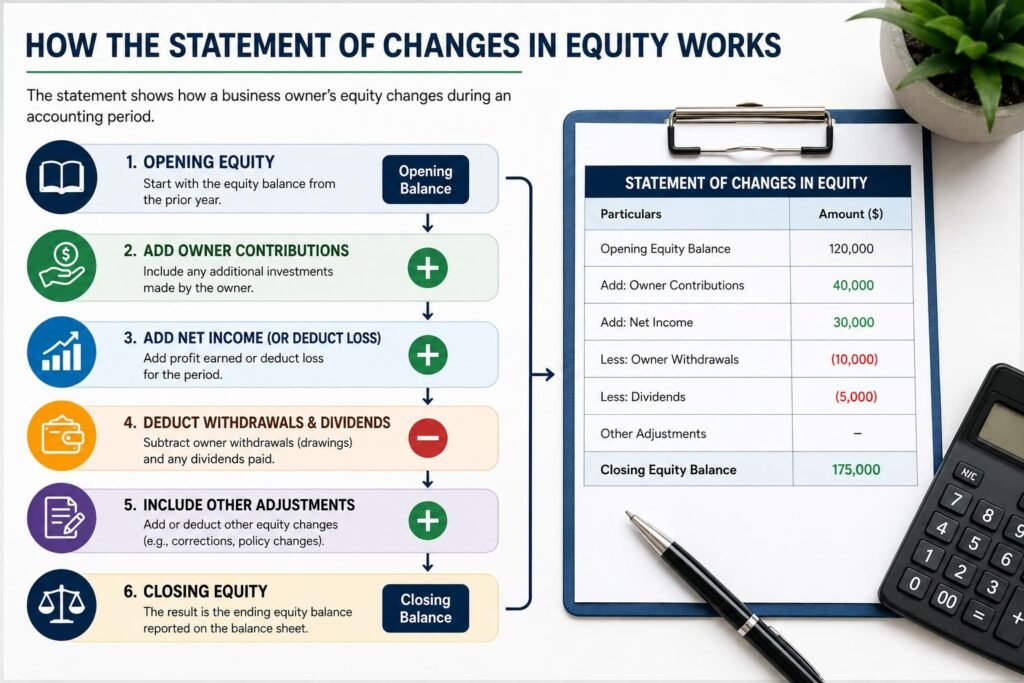
Information Needed Before Preparing the Statement
Preparation of the statement of changes in equity uses data from various accounting records. We get the beginning equity balance from the prior year’s balance sheet. Net income or net loss is reported on the income statement. We collect records of owner investments, additional capital transactions, withdrawals, and dividends from the general ledger or owner’s capital account.
Businesses should also note out any accounting corrections or from past periods which affect equity. Once that data is available the statement can be prepared systemically.
Throughout the year it is better to maintain full accounting records which in turn improve the quality of financial reporting.
Step by Step in the Preparation of the Statement of Changes in Equity
Step 1: Report Opening Equity Balance.
At the start of the accounting period we begin with the equity balance. This is taken from the prior year’s balance sheet which reports out the results of the business at the close of the last annual period. This then is the base we use to measure changes through the year.
At the beginning we have the total of owner investments and retained earnings which have been adjusted for prior withdrawals, dividends, and adjustments.
Step 2: Add also from the owners’ point of view.
During the reporting period which included any new investments the owner made into the company. This may have been in form of cash deposits, equipment the owner put into the business, vehicles, buildings or other qualified assets.
Each addition to the contribution raises equity.
For instance, we see that if the initial capital balance is 20,000 total owner capital goes up to $100,000 before we consider profits or withdrawals.
Step 3: Add to Net Income or Reduce by Net Loss.
Transfer this year’s net income to retained earnings.
If in the year the business reported a profit of 12,000 then retained earnings decreased by that amount.
This step connects the income report with the statement of changes in equity and also with the balance sheet.
Step 4: Withdraw out to Owner Dividends.
After the fact that we have profit reports, subtract out owner withdrawals and dividend payments.
For sole proprietors owner drawings decrease capital. For corporations dividend payments reduce retained earnings.
Suppose a single owner took out $8000 for personal use. This reduces owner’s equity but doesn’t affect net income as it is a distribution not a business expense.
Step 5: Also include other changes.
Some companies may have to report on past accounting errors, changes in accounting policies, or other comprehensive income adjustments.
Although for most small businesses these may be rare changes they do which report accurate financial equity for the reporting period.
Step 6: Determine Closing Equity.
After each change note it down and at the end determine the balance.
The formula is: The equation is:.
Opening Equity+ Owner Contributions +Net Income -Withdrawals – Dividends + Other Adjustments =Closing Equity.
This final figure reports to the owner’s equity section in the balance sheet at the end of the accounting period.
Practical Example
At the start of the year Bright Future Consulting has owner’s equity of $120,000.
During the year the owner puts in an extra 40,000 and the owner draws $10,000 for personal use. No other adjustments are made.
The calculation would be:
Opening Equity: $120,000
Plus Owner Contribution: $15,000
Plus Net Income: $40,000
Less Owner Withdrawals: $10,000.
Closing Equity: $165,000
This example reports on which transactions caused changes in ownership interest and also which ones which made the ending equity different from the beginning balance.
Relationship between Financial Statements
The Statement of Changes in Equity is a connected report which stands on its own as a separate document. Instead it is integrated with the primary financial statements.
The income statement reports what is the net income or net loss which in turn is used to adjust retained earnings. As for the balance sheet it reports the final owner’s equity from the statement of changes in equity. Also the cash flow statement details out how cash flows are related to financing activities like owner investments or dividend pay outs.
These relationships we see play a role in which business and academic students better interpret financial reports and also which individual transactions play a which large scale in financial performance.
Common Mistakes to Avoid
Many at the start of their journey they put forward incorrect versions of this statement which is due to a lack of difference they see between owner transactions and business operations.
One issue which we see is that at times we treat owner contributions as revenue. What we have is that these funds come from the owner which in turn increases equity and not income.
Another common error is to report owner withdrawals as operating expenses. Withdrawals which are a reduction in owner equity do not belong on the income statement as business expenses.
Some companies also don’t put in this year’s profit into retained earnings or they forget to deduct dividend payments before determining the ending balance. Also we see that some companies ignore prior period adjustments or they do math errors when they are preparing opening and closing balance sheets.
Reviewing all equity transactions in detail before preparing the report greatly improves accuracy.
Best Practices for Small Businesses
In preparation of the statement of changes in equity is made easier when businesses use organized accounting records through the year. We put owner investments apart from revenue which in turn prevents classification errors, also we track withdrawals separate from expenses which in turn produces accurate financial reports.
Using technology for accounting can do a great job of automating the calculation process which in turn reduces manual errors. Also we see that by performing monthly reconciliation of equity balances instead of annually we are able to catch issues before year end reporting.
Small business owners must look at changes in equity along with profitability and cash flow which is a different approach to evaluation of each statement in isolation. We see that a profit generating company which reports declining equity may in fact be a company which has been making large owner withdrawals or paying out large dividends which isn’t sustainable. Also we note that increasing retained earnings is a good indicator of stronger long term financial health.
When large ownership changes take place it is also a good idea to consult with qualified accountants which in turn improves compliance with accounting standards and increases financial transparency.
Conclusion
The equity statement is the most useful of the financial reports which detail how ownership interest changes over time. It reports on how profits, losses, owner investments, withdrawals, dividends, and other adjustments play out between reporting periods.
For small business owners this is a look into which are the profits going toward business growth or owner’s take home. Accounting students we see a greater detail into how financial reports play out and in turn that info is used by finance professionals to review capital management, reinvestment strategies and shareholder returns.
In the preparation of the statement we identify the opening equity balance, report owner contributions, include net income or losses, subtract withdrawals and dividends, and note other adjustments. Once complete it is a clear picture of changes in ownership interest which in turn supports better financial planning, decision making, and long term business growth.
Get more well researched information about Statement of Changes in Equity here.