Solar jargon has a way of turning one decision into five. You ask about inverters, and suddenly someone is talking about strings, MPPT, batteries, backup loads, time-of-use rates, and future EV charging.
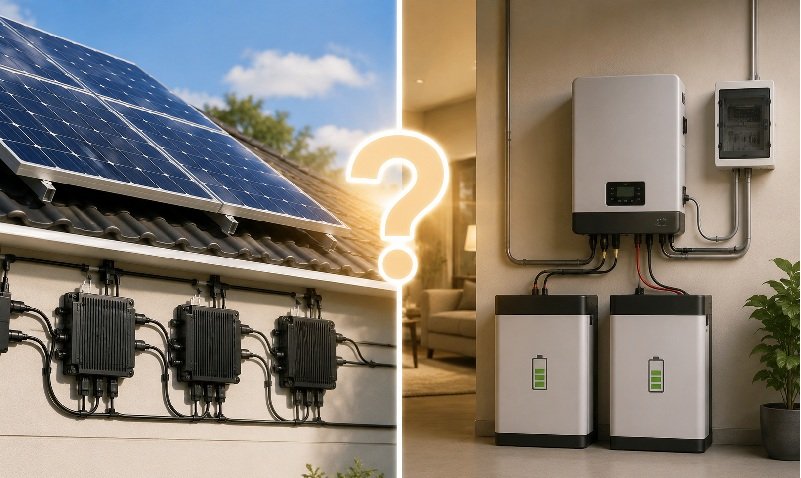
The good news: the first split is simple. A micro inverter is mainly about panel-level solar conversion. A hybrid inverter is about coordinating solar with battery storage and household energy flow.
What a micro inverter is best at
A solar micro inverter sits near a panel and converts that panel’s DC power into AC power close to the source. That setup is useful when panels do not all behave the same way.
Think shade, different roof directions, small sections of roof, or projects where panel-level monitoring is important. Micro inverters can make a solar array more flexible because each module gets more independence.
They are not automatically better for every project. On a wide-open roof with simple sunlight and no battery plans, the choice may come down to cost, installer preference, monitoring needs, and long-term service expectations.
What a hybrid inverter is trying to solve
A hybrid inverter connects solar generation with battery storage and home loads. It is the device that helps decide whether solar power goes to the home, charges the battery, or moves through the system in another way.
That is why hybrid inverters show up in conversations about backup power, energy independence, and time-of-use electricity plans. The goal is not only to produce solar electricity, but to control when and how the home uses it.
Sigenergy’s smart PV inverters category includes solar inverter options for different residential energy designs. According to Sigenergy, its Sigen Hybrid Inverter is available in single-phase and three-phase configurations, with listed nominal output power ranges of 3.0 kW to 6.0 kW and 5.0 kW to 12.0 kW depending on model family.
A quick way to compare the two
| Question | Micro inverter | Hybrid inverter |
| Main job | Panel-level conversion | Solar and battery coordination |
| Strong fit | Shaded or mixed roof layouts | Homes planning storage or backup |
| Monitoring focus | Often module-level | Whole-system energy flow |
| Design question | How does each panel perform? | How should energy move through the home? |
This table is intentionally simple. Real designs can combine different equipment types, and product ecosystems vary. Still, it helps homeowners avoid comparing two devices as if they were built for the exact same job.
The battery question changes everything
If you are only installing solar today but may add storage later, talk about that now. Retrofitting can be simple or awkward depending on the original design.
Ask whether the system is battery-ready, what backup loads can be supported, and whether the monitoring platform can show solar, battery, grid, and household consumption clearly. A hybrid inverter may be the better foundation if storage is likely.
On the other hand, if your biggest issue is roof complexity and you are not focused on storage, micro inverters may deserve more attention.
“Micro” sounds modern. “Hybrid” sounds future-ready. Neither label is a complete answer.
The right inverter depends on your roof, your storage plans, your utility rates, and how much visibility you want into system performance. A careful installer should translate those factors into a design instead of pushing one category as a default.
If you are at the comparison stage, Sigenergy’s Smart PV Inverters page is a useful starting point for seeing how micro and hybrid inverter choices fit into broader home energy planning.