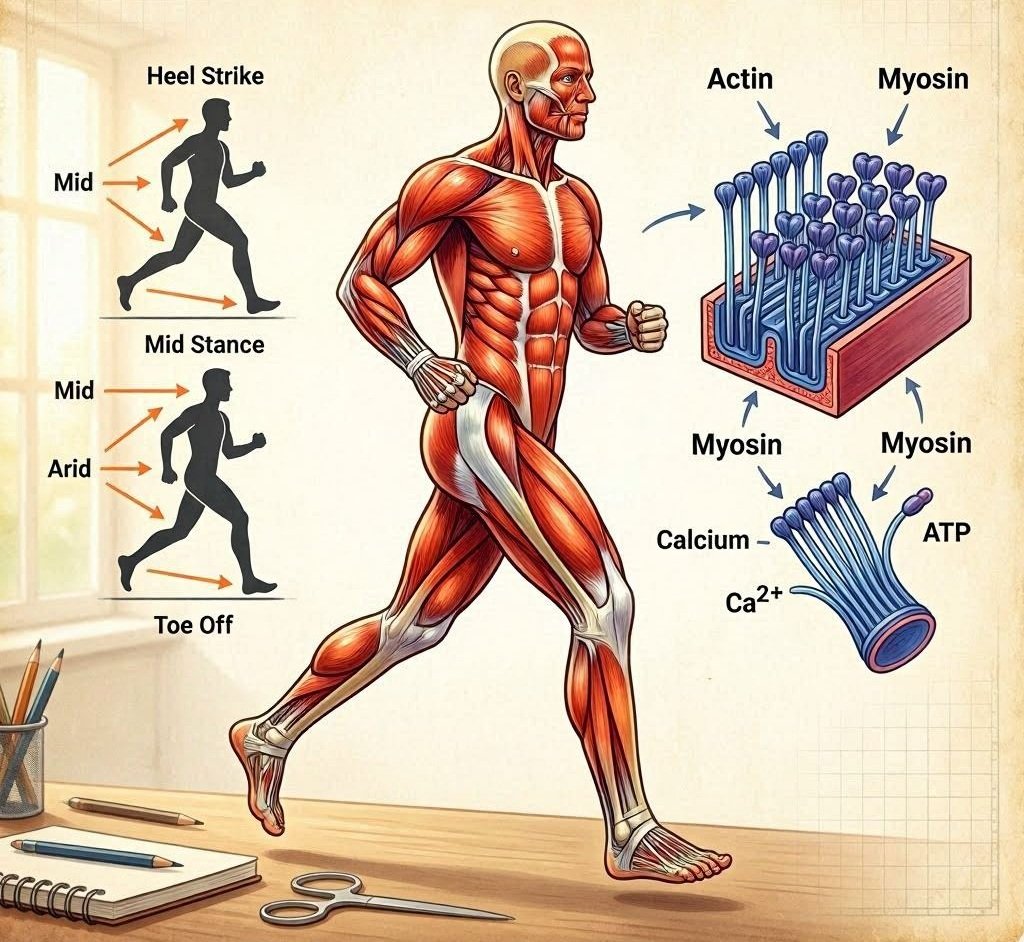
One of the greatest feats in biological design is the ability of humans to move. From blinking to walking, lifting weights to sprinting, all of these activities are reliant on a complex sequence of biochemical and physiological events that are coordinated perfectly. The movement is the result of the process that occurs in the center of the body, known as muscle contraction, which converts the chemical energy stored inside the body into physical movement. The force-producing and force-transmitting mechanical structures, energy producing molecules, muscle fibres and the nervous system all play a part in this transformation. Looking at movement, it looks simple, but in fact, there are highly organized microscopic processes that happen in a muscle cell every second. The ability to understand the conversion of biochemical energy to mechanical work gives a complete understanding of movement in the body during physical activity, how it adapts to exercise, and how the body performs in its life.
This article will explain how muscle contraction and human movement produce force:
When the muscles contract, they produce force and movement in the body. When special proteins that are called filaments in the muscle fibers interact and move against each other, the muscle contracts. The nervous system sends signals to control these contractions, and they utilize ATP, which is the body’s major source of energy. Smooth muscle movement is responsible for breathing, circulation, and other bodily functions, as well as for helping the body maintain its posture and movement.
When the brain sends a signal to the muscle fibers via motor neurons, movement occurs. These signals cause a series of biochemical processes that enable muscles to contract and produce force. The muscle tension generated during contraction is exerted on bones and joints, resulting in observable motion. This system shows how significant molecular events occurring on microscopic scales inside of cells can lead to physical events on macroscopic scales throughout the body.
Muscle Filaments: Structure
The structure of the skeletal muscle needs to be studied before understanding how muscles contract. Muscles are made up of bundles of muscle fibres, those are elongated cells that are specialised for making a force. Each muscle fiber contains myofibrils which contain the repeating functional unit, sarcomeres. The sarcomeres are the smallest contractile units of muscle tissue and these are composed of two major protein filaments, actin and myosin.
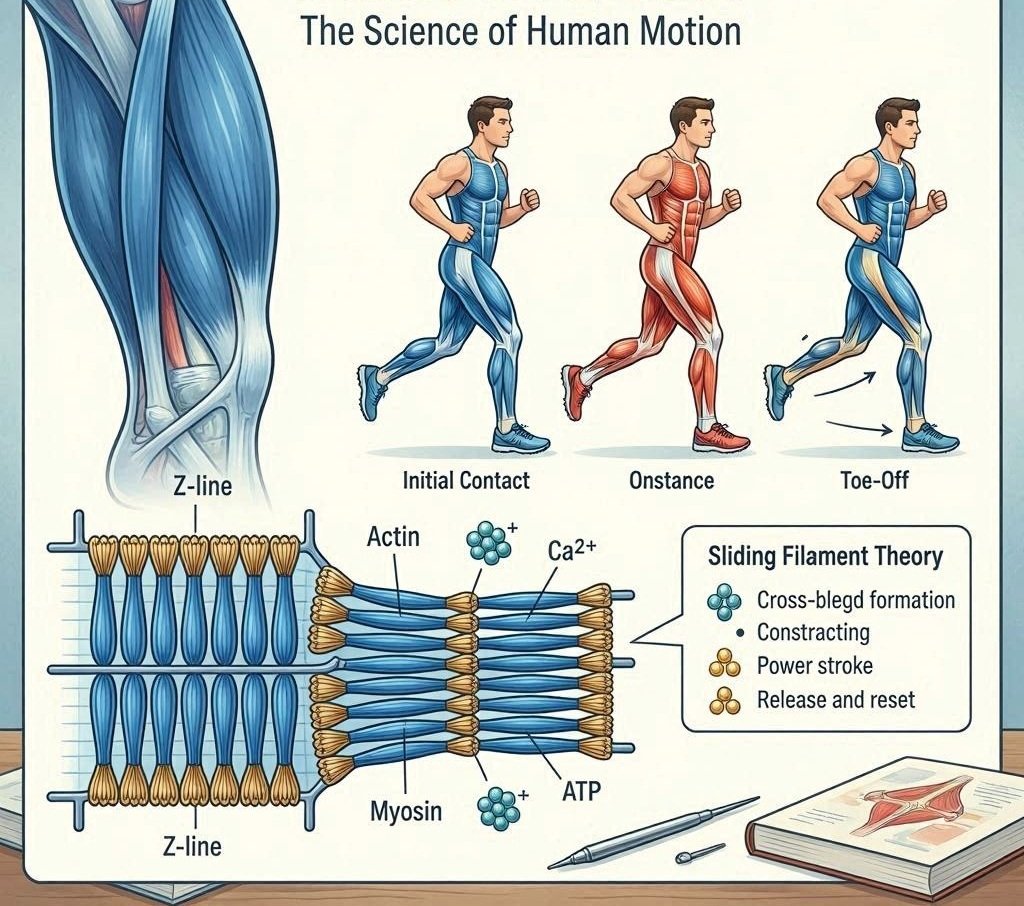
The thin filaments are made up of actin and the thick filaments are made up of myosin. These filaments are arranged in a very organized manner, so that they overlap and can interact during contraction. The structure of sarcomere is important because it allows the force to be generated by sliding filament mechanism. Millions of sarcomeres function concurrently to generate the contractions needed for movement, strength and stability.
The function of the nervous system and signal transmission
The neuromuscular system is one of the most important systems that initiates muscle contraction. Motor commands are initiated in the brain and then pass down the spinal cord to the motor neurons, which control movement. These neurons transmit electrical signals to the special junction between a nerve cell and a muscle cell, known as the neuromuscular junction.
Once the electrical signal arrives at the neuromuscular junction, it causes the release of acetylcholine, a chemical neurotransmitter which transmits the signal across the synaptic gap. ACETYLCHOLINE attaches to receptors on the muscle membrane, which creates an action potential that travels the length of the muscle fibre. This electrical impulse triggers biochemical changes that lead to contraction. The quick transmission of messages from nerves to muscles allows the body to react swiftly and to coordinate movement with amazing accuracy.
The activation of contraction depends on calcium
Calcium ions are important regulators of muscle contraction as they regulate actin/myosin interaction. The binding sites on actin are blocked by regulatory proteins in a resting muscle so that the muscle cannot contract. With an electrical signal, calcium is released from the muscles sarcoplasmic reticulum to enter the muscle cells cytoplasm.
Ca 2+ binds to troponin leading to a conformational change that facilitates the movement of tropomyosin away from the binding sites on actin. This reveals the location where myosin heads are able to attach and the process of contraction can start. Calcium thus functions as a molecular switch that allows a muscle to contract. If calcium levels are not maintained properly, muscles would not be able to work properly.
ATP is the biochemical fuel used for movement
The main fuel for muscle contraction is Adenosine Triphosphate (ATP). ATP is necessary for every movement that occurs in the body because it supplies the energy that is needed for the interaction of the actin and myosin filaments. There are several metabolic pathways for the production of ATP, such as aerobic respiration and anaerobic glycolysis.
In the process of contraction, ATP will bind to the myosin head, causing it to release from actin, after a power stroke. The dissociation of ATP re-energizes the myosin head, ready for another attachment/movement cycle. ATP is also needed for the uptake of calcium ions into storage when the muscle relaxes. The ATP stored in muscles is finite and during exercise ATP is continually replenished to maintain activity and prevent fatigue.
The Sliding Filament Mechanism is the name given to this process
The molecular mechanism of muscle contraction is known as the sliding filament theory. This theory proposes that the actin and myosin filaments slide over one another, causing the sarcomere to shorten with the generation of force. The length of the filaments changes not, but rather the overlap between the filaments is increased during contraction
The cross-bridges are produced when the myosin heads bind to exposed binding sites on actin. These heads then rotate, bringing the actin filaments towards the center of the sarcomere, which is the power stroke. Myosin head is then reset in preparation for the next stroke by ATP. The muscle fibers contain millions of these cross-bridge cycles, which cause smooth and coordinated action throughout the body.
Converting molecular events into whole body motion
Muscle contraction is a series of events that occurs on a microscopic level and results in a one on one correspondence level of gross movement. Muscle fibres contract and create tension within them which is passed on through tendons to bones. Tensions in muscles lead to joints moving and the body to carrying out physical actions, as muscles are connected to the skeleton
Multiple muscles move in a coordinated fashion to produce complex movements. Some muscles are prime movers (that produce the primary force for moving a joint) and others stabilize joints or assist in controlling or balancing movements. The nervous system is constantly regulating muscle activity to maintain accuracy and efficiency of movement, through sensory feedback. This coordination enables humans to undertake a variety of activities, from fine motor to explosive athletic activities.
Exercise and Adaptation in Muscle Functions
The physiological changes that occur throughout the body as a result of regular exercise make it more efficient at contracting muscles. Strength and muscle fiber size are enhanced by resistance training, and aerobic ATP production and mitochondrial density are enhanced by endurance training. The adaptations enable muscles to produce more force and fatigue less quickly during long periods of activity.
Exercise also promotes enhanced communication between the nervous system and muscles, which can include improved coordination and reaction time. Enhanced blood flow and enhanced delivery of oxygen to muscle will allow prolonged muscle activity, and enhanced ATP utilisation will enable muscle to work more efficiently. The changes are an indicator of the body’s ability to adapt to repeated physical challenges and maximize the ability of the movement
Fatigue and the Limits of Muscle Performance
The body has great efficiency in producing movement but muscle contraction can only be maintained for a limited period by the muscle being exhausted. Fatigue is the inability of muscles to maintain a level of force or function for extended periods of time. This downturn is caused by a number of factors such as: ATP depletion, build-up of metabolic waste products and disruption of ions in the muscle cell.
The nervous system also plays a role in fatigue by decreasing the strength of the message to the muscles when they are being used for a long period. These mechanisms are important to preventing excessive strain and injury to body. Knowing about fatigue emphasises the need for recovery, nutrition, hydration and rest for good muscular function and health.
Muscle Contraction is very important and plays a part in everyday life
The importance of muscle contraction is not just in sports and exercise. Muscles must work together for every daily activity, such as standing, walking, talking and breathing. Muscles also play a role in posture, joint stability and heat production during exercise.
Specialized forms of contracting muscle are used by even the internal functions like heartbeat and digestion. This is a continuous process that is essential for life and well-being, revealing the importance of muscles. An understanding of the science of movement can help people to appreciate the complexity of the human body and the need to keep their muscles healthy by engaging in regular physical activity and adopting appropriate lifestyle choices.
Conclusion
One of the most complex and integral processes in the body is the conversion of biochemical energy to physical movement. Muscles convert ATP’s chemical energy into mechanical force, which is used to produce movement, stability and physical performance. It’s a process that requires the coordinated action of the nervous system, calcium signaling, actin and myosin filaments, and energy metabolism. Whether it’s the molecular events that take place inside muscle cells, or the large-scale movements that occur in the body, each plays a crucial role in the body’s extraordinary function of carrying out physical activity. The interaction of these systems can be understood and a whole picture of human motion can be seen, leading to the incredible efficiency of the biological systems which provide the power for everyday life.