Introduction
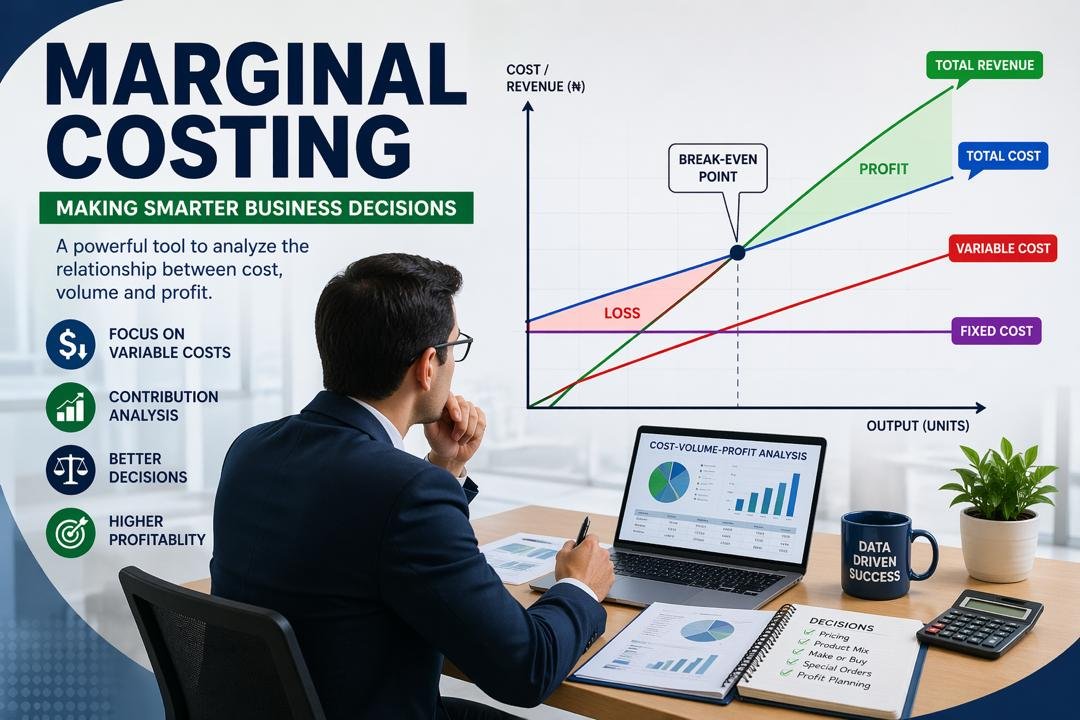
In present day’s ever changing business climate managers are asked to make fast yet informed decisions to preserve profitability and wealth in the marketplace. A key tool which managers use in this regard is marginal costing. To do well with marginal costing is of great importance to companies which want clarity on cost behavior, pricing policies and profit projection.
Marginal cost analysis looks at the connection between cost, volume, and profit and also provides a simple yet powerful tool for looking at financial performance. It is different from traditional cost methods in that it puts more focus on variable costs and in how it treats fixed costs which in turn makes it very useful for short term decision making.
To see how this approach works and why it is valuable do check out the discussion of the marginal costing concept which we cover in detail in this article we go into its principles, features, we also look at how it measures up against other methods and also look at real world examples.
Understanding Marginal Costing
In marginal costing variable costs are the only ones which are passed on to products, also at the same time fixed costs are recorded as period costs and fully written off as a part of that which reports the financial results for the period of their incurrence.
Key Idea
At the core of marginal costing is that:
- Costs are determined by their behavior not their function.
- In the short term only variable costs are relevant.
- Fixed costs do not change with production levels within a relevant range.
What is Marginal Cost?
Marginal cost is that which is added when production is increased by one unit. It usually includes:.
- Direct materials
- Direct labor
- Variable overheads
This issue is at the core of whether producing more units will raise or lower total profitability.
Key Features of Marginal Costing
Marginal cost accounting has unique features which distinguish it from other cost methods:
1. Cost Analysis
Costs can be put in terms of variable costs that fluctuate as per level of production, also that of fixed costs that do not change in the short term.
2. Focus in on Contribution
The concept of contribution margin is at the core. We calculate contribution as sales revenue minus variable costs. This amount is used to cover fixed costs and generate profit.
3. Fixed Costs of the Period
Fixed costs do not go into product totals. Rather they are recorded as expenses for the accounting period.
4. Simplicity
Marginal cost accounting does away with complex allocation of overheads which in turn makes the processes simple and easy to interpret.
5. Profit Fluctuation
Profit in marginal costing is a function of sales volume which is to say less of a role is played by production volume.
Marginal Costing vs. Absorption Costing
To get out of the full picture of what marginal costing is and do you must compare it to absorption costing.
What is Absorption Costing?
Absorption costing is that which includes both variable and fixed manufacturing costs in the product cost. Also, fixed over heads are applied per unit produced.
Key Differences Explained
In marginal costing only variable costs are included in product costs which in turn leave fixed costs to be recognized as period expenses. On the other hand in absorption costing both variable and fixed costs are included in product costs.
Another issue is how profits are determined. In marginal costing profit is a function of sales volume. But in absorption costing profit is a function of production levels which in turn includes some fixed costs.
Inventory valuation does also vary. In marginal costing we see lower inventory values which are a result of fixed costs being left out, in absorption costing us see higher inventory values which in turn includes fixed overheads.
Also in that which is presented is that marginal costing is a simple approach which does away with the issues related to allocation of fixed overheads. As for absorption costing it requires in detail the said allocation and is to that extent a more complex practice.
Example Illustration
Assume the following: It assumes that which the following:
- Fixed costs = ₦100,000.
- Variable cost per unit is of ₦50.
- Selling price of each unit ₦100.
- Units produced = 1,000
- Units sold = 800
In marginal cost accounting all fixed costs are charged to the present period. Profit in this case is a function of units sold.
In absorption costing fixed costs are included in the value of unsold inventory. What we see is that profit may report higher when production outpaces sales as some fixed costs are put off.
This variance may greatly affect financial reports and manager decisions.
Importance of Marginal Costing in Decision-Making
Marginal cost analysis is a key tool which managers use to make short term business decisions. What it brings to the table is a concentration on relevant costs which in turn presents decision makers with precise and relevant data.
1. Price Determinations
How It Helps:
- Determines the lowest price at which a product may be sold without losing money.
- Supports competitive pricing strategies
- Helps with special order decisions.
For instance if a business has over capacity it may accept a lower price which only covers variable costs and puts a dent in fixed costs.
2. Profit Projection
Marginal cost analysis is fundamental to Profit Volume (P&V) analysis.
Main Ideas:
Contribution Margin
This is what we see in terms of revenue which is put toward fixed costs and profit.
Break-even Point
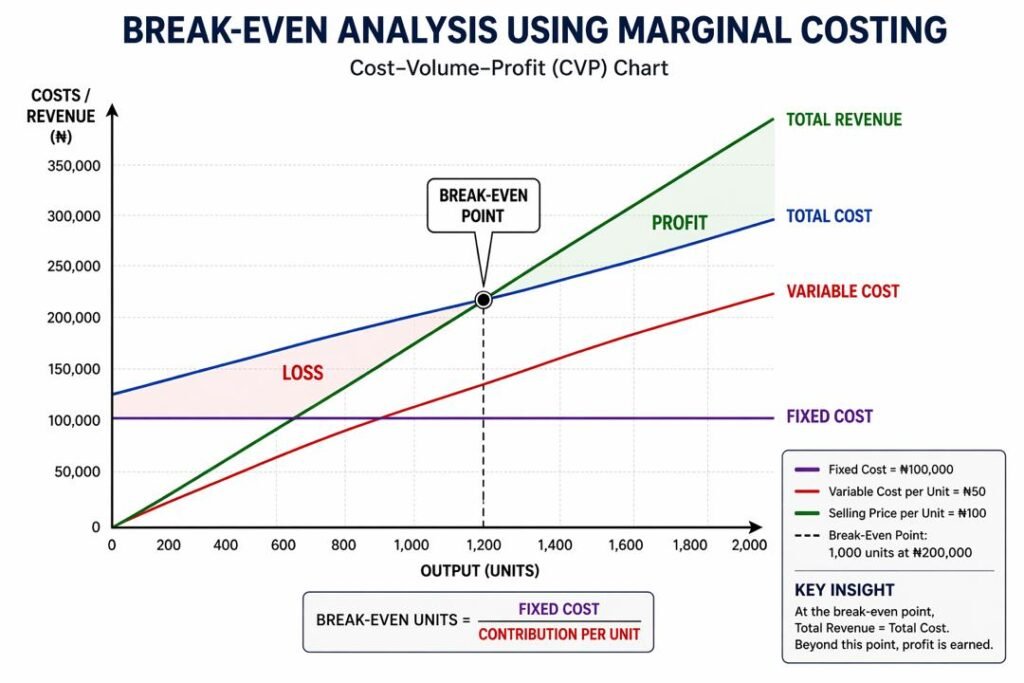
At the point where revenue total is equal to total costs we are at the break-even point. Also this can be determined by dividing fixed costs by contribution per unit.
Margin of Safety
This is what we see in terms of sales drop before the business heads into the red.
3. Decision related to Product Mix
When resource availability is an issue, marginal costing is a tool to determine the most profitable product mix.
Approach:
- Identify the per unit contribution of the limiting factor (e.g. labor hours).
- Prioritize products with higher contribution
4. Make or Buy Decisions
Firms at times have to choose between making a component in house or buying it from an external supplier.
Marginal Costing Insight:
Managers present the variable cost of production of the part and compare it to the purchase price, also if the decision changes what will be our fixed costs which will then play into this we do consider.
5. Termination Decisions
If some business segments are underperforming then marginal costing can be used to determine if they should be dropped.
Key Consideration:
If that segment is still positive it helps with fixed costs. Removal of it may reduce overall profitability.
6. Accepting Special Orders
Marginal cost analysis is used to determine if we should take in orders at prices which are below the regular sales price.
Decision Rule:
A special request should be accepted if:
- The price covers variable costs
- There is unused capacity
- It contributes toward fixed costs
Advantages of Marginal Costing
Marginal cost accounting is put forward as a preferred tool in managerial decision making.
1. Simplicity
It simplifies what can be very complex issues of overhead allocation which in turn makes it more accessible and easy to put into practice.
2. Improved Decision Making
It is on relevant costs which in turn results in better and more practical decisions.
3. Useful for short term analysis
It’s best for pricing, production levels, and cost control.
4. Aims for balanced absorption.
Since we do not allocate fixed costs, issue of incorrect overhead absorption does not arise.
5. Clarity on Cost Behavior.
It is to help managers see how costs react to changes in output.
Limitations of Marginal Costing
Although there are many good points to it, marginal costing has also some issues.
1. Omits Fixed Costs from Product Cost.
This may result in underpricing if variable costs aren’t at some point covered.
2. Not appropriate for long term decisions.
In the end all costs play a role, including fixed.
3. Not included in external reports.
Financial reporting standards usually require absorption costing.
4. Assumes Linear Relationship in Costs.
In fact cost behavior may not always be linear.
Practical Applications of Marginal Costing
Marginal cost analysis is used in many industries:
- Manufacturing: It also sets the best production levels and measures product profitability.
- Service Industry: Businesses set prices based on incremental costs.
- Retail: It is for discount and promotion pricing.
- Airlines and Hospitality: Companies use that which is unsold, for example empty seats or rooms, at reduced prices which still cover variable costs.
Marginal Costing and Managerial Efficiency
Marginal costing enhances managerial efficiency by:
- Providing quick insights into profitability
- Supporting flexible and timely decision-making
- Reducing dependency on complex accounting systems.
Managers may put their focus on what decisions produce in terms of contribution and overall profit which in turn will impact the bottom line.
Marginal costing and CVP Analysis Relationship
Cost-Volume-Profit analysis is a component of marginal costing which in turn uses contribution, study of fixed costs behavior, and sales volume.
Marginal cost data is what is required to do a good job of CVP analysis which in turn is a tool to see how variation in costs and sales will play out for profit.
When Should Marginal Costing Be Used?
Marginal costing is most effective when:
- Decisions are short-term
- Fixed costs remain unchanged
- There is unused production capacity
- Quick managerial decisions are required
When Should It Be Avoided?
It may not be suitable when:
- Long term pricing strategies are set.
- Full cost recovery is necessary
- External financial reporting is required
Conclusion
Marginal costing is an excellent and practical tool in managerial accounting which puts cost analysis in simple terms and improves decision making. It is into variable costs and contribution that it focuses which in turn gives clarity on how business decisions play out in terms of profitability.
Unlike what is done in absorption costing which passes off fixed costs to products, in marginal costing we put fixed costs down as period expenses. This is very much the case for short term decisions like pricing, profit planning, and evaluating business alternatives.
Although we see that it has issues which play out in the area of long term planning and financial reporting it is in the areas of simplicity and relevance that it excels thus proving very valuable for internal management.
In time of great change which businesses face, marginal costing gives managers the info they need to make quick and informed decisions which in turn keeps the business competitive and financial stable.
Get more well researched information about marginal costing here.



The yoast seo premium null from GitHub includes the internal linking tool that saved me hours of manual work.