Introduction
In today’s competitive business world companies must pay close attention to their costs in order to achieve profit, efficiency, and accurate pricing. Cost accounting is a key tool which businesses use to reach these aims. To that end we see the most popular methods are job costing vs process costing which are in fact different strategies put to use in varying production and service settings.
Between these cost systems it is important for managers, accountants, and business owners to have a distinction. Each method has a different structure, benefit, and what works best for the type of business you have. Picking the wrong one may result in in accurate cost report, poor pricing strategies, and also in a reduction of profit.
This article delves into job costing and process costing in detail which includes a comparison of their features, advantages, and practical applications. At the end you will have a full grasp of when to use each and how they play out in the business environment.
Understanding Job Costing
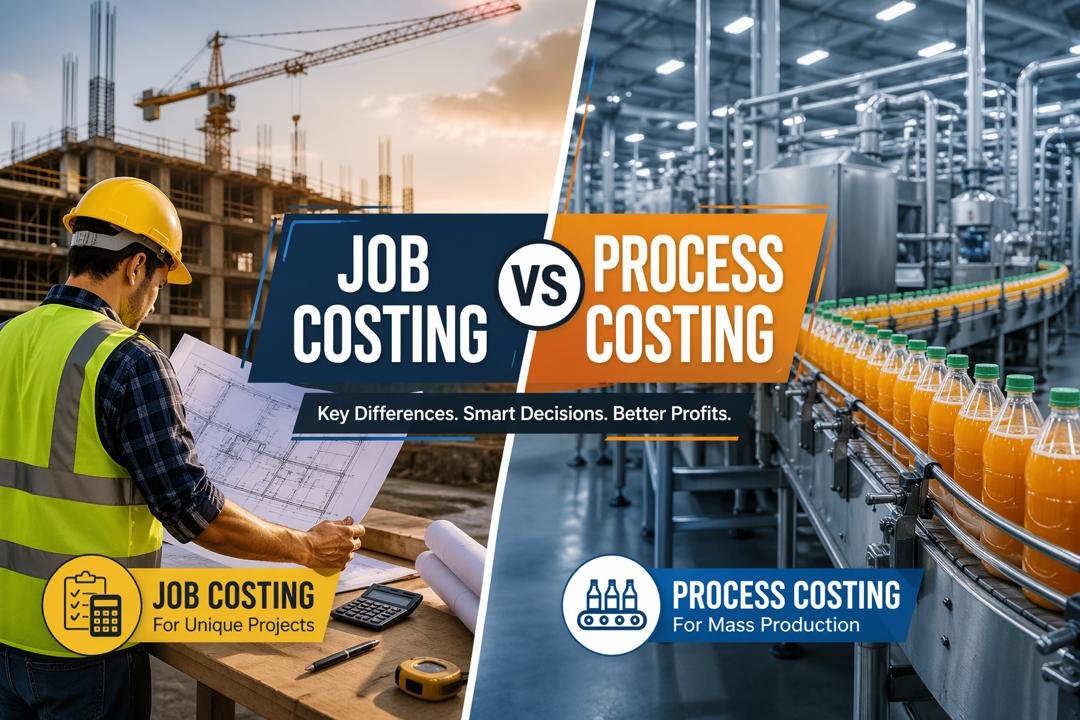
Job tracking is a cost accounting approach we use for individual projects, orders or jobs. We treat each job as a unique entity and assign costs separately.
Key Features of Job Costing
- Customized Production: Job cost structure works well for companies which produce custom or unique items.
- Individual Cost Tracking: Costs of materials, labor, and overhead are tracked separately for each job.
- Detailed Documentation: Each job has a separate cost report.
- Flexible Pricing: Prices for each job are determined by.
For instance a home builder will track all expenses, materials, labor, equipment for that particular project.
If you wish to study practical tools and techniques for effective job costing, you first need to understand its structure.
Advantages of Job Costing
Job billing reports which also apply to businesses that work with made to order products:
1. Proper Cost Allocation
In every job we track the expenses which in turn gives businesses in depth insight into what each project’s cost is.
2. Better Price Choices.
Knowing the precise cost of a job allows companies to set proper prices and maintain profitability.
3. Better Cost Control.
Managers may pay close attention to expenses which in turn will allow them to identify inefficiencies in certain jobs.
4. Profit Analysis.
Each job’s performance can be looked at separately which in turn allows companies to put more attention on high margin projects.
Disadvantages of Job Costing
Despite of what it does for us job costing also has some which:
- Time-Consuming: For each job we require in depth record keeping.
- Higher Administrative Costs: Keeping job records is expensive.
- Complexity: Running many jobs at the same time is difficult.
Industries That Use Job Costing
Job costing works best in industries that produce custom products or services. For example:.
- Construction companies
- Advertising and marketing agencies
- Consulting firms
- Custom furniture manufacturing
- Legal services
In each of these industries project to project variation is great which in turn requires individual cost tracking.
Understanding Process Costing
In fact in the case of mass production of the same or similar products we use process costing. Also instead of tracking costs per job, what we do is we accumulate the costs over a period and average them out per unit produced.
Key Features of Process Costing
- Standardized Production: In which products are the same.
- Continuous Production: Production is constant.
- Cost Averaging: Cost per unit of production.
- Department-Based Tracking: Costs are recorded by process or department instead of individual jobs.
For example a drink company that produces in bottles will use process costing to determine the average cost per bottle.
Advantages of Process Costing
Process costing works well in large scale production settings:
- Simplicity: Since we average out the costs the system is easier to maintain as compared to job costing.
- Cost Effectiveness: Less detailed tracking reduces administrative expenses.
- Repetition: Provides the same price info for the same products.
- Scalability: Suitable for large scale production.
Disadvantages of Process Costing
However, process costing also has drawbacks: Also in some cases process costing breaks down.
- Less Accuracy for Individual Units: Costs are reported as averages which does not include individual unit variations.
- Limited Flexibility: Not what we offer for custom items.
- Potential Cost Distortion: In many cases processes do not work as they should and that affects overall costs.
Industries That Use Process Costing
Process costing is best for industries that are in the business of continuous and uniform production such as:
- Food and beverage manufacturing
- Chemical production
- Oil and gas refining
- Textile manufacturing
- Paper production
In those industries products are the same, and it is not necessary to track costs per unit.
Key Distinctions between Job Costing vs Process Costing
Between these two systems it is important to know which one to choose.
Nature of Production character
- Job Costing: For custom products.
- Process Costing: For standard issue mass produced items.
Cost Accumulation
- Job Costing: Expenses by job.
- Process Costing: Costs are tallied up by department or process.
Cost Determination
- Job Costing: Total per job is calculated.
- Process Costing: Average price per unit is calculated.
Complexity
- Job Costing: More in depth tracking of.
- Process Costing: More basic and efficient.
Versatility
- Job Costing: Very adaptable.
- Process Costing: Less adaptable.

Similarities between Job Costing and Process Costing
Although different in many aspects these two systems also have some common elements:
- Both we track and report on direct materials, direct labor, and overhead costs.
- Both are used in cost control and decision making.
- Both in the determination of price and profit.
- Both require accurate record-keeping
Choosing between Job Costing vs Process Costing
Choosing which costing system to use is determined by a few factors:
1. Category of Product or Service
For your business that which you produce is custom, job costing will be what you use. If you are producing large quantities of the same product, process costing is the best option.
2. Production Output
- Low volume, high variety job costing.
- High volume, low variety Process costing.
3. Cost Control Needs
For businesses that require in depth cost tracking job costing is what you should use, for those that need efficiency and simplicity process costing is the way to go.
- Industrial Requirements
In some industries which practice which method is a given. In construction we see the use of job costing and in manufacturing process costing is the norm.
Real-World Examples
Example 1: Construction Firm (Job Costing).
A construction firm builds residential homes. For each project the company follows unique specs, materials and labor requirements. We track all costs per project which is why job costing is the best system.
Example 2: Soft Beverages Manufacturer (Process Costing).
A beverage company which produces thousands of daily bottles of the same product has for that reason to average costs over the production which in turn makes process costing the most efficient method.
Example 3: Print business (Hybrid model).
Some firms use a mix of different systems. A print shop may use job costing for custom orders and process costing for bulk printing.
Hybrid Costing Systems
In that which is practical many companies have implemented hybrid costing systems for their varied operations. This approach includes elements of job costing and process costing.
When Hybrid Systems Are Useful
- When a business offers both made to measure and stock items.
- When some production processes are the same while others are custom.
- When you need flexibility and efficiency.
For example some auto manufacturers may use process costing for engine production and job costing for custom vehicle features.
Importance of Accurate Costing Systems
Selecting the right costing system is a business issue which also falls under accounting.
- Financial Precision: Precise costing is the base for reliable financial reporting and budgeting.
- Affordable Prices: Firms can set prices to cover costs and also stay competitive.
- Resource Efficiency: Efficient tracking of costs identifies waste and improves productivity.
- Strategic Planning: Managers have at their disposal accurate cost data.
Common Mistakes to Avoid
In the implementation of costing systems we see that companies also make these mistakes:
- Selecting a system that doesn’t fit your production type.
- As the business grows out of using the current cost methods.
- Ignoring indirect costs
- Poor record-keeping
Avoid doing these and your costing system will perform at its best.
Future Trends in Cost Accounting
As technology advances, cost systems are becoming more.
- Automation: Software today has automated cost tracking which in turn reduces errors and saves time.
- Connection of systems to ERP: Cost present in systems that is of an integrated nature with enterprise resource planning (ERP) which in turn provides real time data.
- Business Intelligence: Advanced analytics provide in depth analysis of cost behavior and profitability.
- Personalization: Presently companies may tailor cost methods to their particular requirements.
Conclusion
Job cost vs process cost are elements of what is used in cost accounting which we have designed for different business functions. For instance job cost is best for very specific project based work which requires in depth cost analysis. On the other hand process cost is better for large scale production of the same product where we value efficiency and simplicity.
In some which of these systems business is to identify what best fits their particular set of needs. In some cases a hybrid approach will put forth the best solution which in turn will combine the benefits of both systems.
In the end which cost structure you choose will better financial performance, improve decision making and see improved long term business outcomes. Through the evaluation of what they put into production, what issues they have with cost tracking, and that they also look at what the market is doing which will impact them the most, companies are able to design a system that is in line with what they wish to achieve which also at the same time increases their profit.
Get more well researched information about job costing vs process costing here.