Introduction
Achievement of successful dental outcomes relies not only on clinical knowledge, but also the skill of effectively using and manipulating dental materials. The properties of the materials being used should be a consideration in every restorative procedure, impression, temporary restoration, cementing procedure and preventive treatment. Dental materials are expected to act in selected ways and the type and effectiveness of material depends largely upon the way it is mixed, handled, placed, set, etc. Pilates can still be defeated, regardless of the highest quality of materials used, if proper manipulation techniques are not followed.
Dental students need to learn how to manipulate and handle a variety of dental materials. Exact material management is often the distinction between success and failure in a restoration. By knowing working times, setting times, mixing ratios, environmental influence and how to apply, students are able to attain consistent and reliable clinical outcomes. With the thrust on teaching evidence-based dentistry and clinical skills in dentistry, students have to be confident in dealing with a variety of materials that have been used in modern dentistry. Educating them at a young age means improved patient care, reduced material wastage and increased efficiency in the duration of a dentist’s career.
How to handle materials effectively.
Dental materials have certain physical, chemical and biological properties that are the basis of their performance which is developed. However, the benefits of these properties will only be fully achieved if manufacturers’ instructions and accepted clinical procedures are followed. Strength, durability and clinical efficacy may be greatly changed if the ratio of powder to liquid is incorrect, or if mixing is done too long or too short, for powder contamination, or for delayed placement.
It should be explained to students that manipulation of the materials is not just a technical activity but also a scientific process. The mixing and setting processes result in physical or chemical change of each material. Understanding of these changes can then help a clinician predict potential difficulties and modify his or her technique. Students need to understand dental materials handling principles and evidence-based guidelines for successful outcomes in order to gain the best insight into the handling and manipulation of the various dental materials.
Patient safety is also enhanced through development of consistency in material handling. Thorough mixing of impression materials can result in distorted casts and inadequate mixing of restorative materials can result in leakage, postoperative sensitivity or failure of the restoration. This makes the techniques for manipulating media and materials vital for achieving the continuous and indubitably desired effects desired.
Mixing of some typical dental materials.
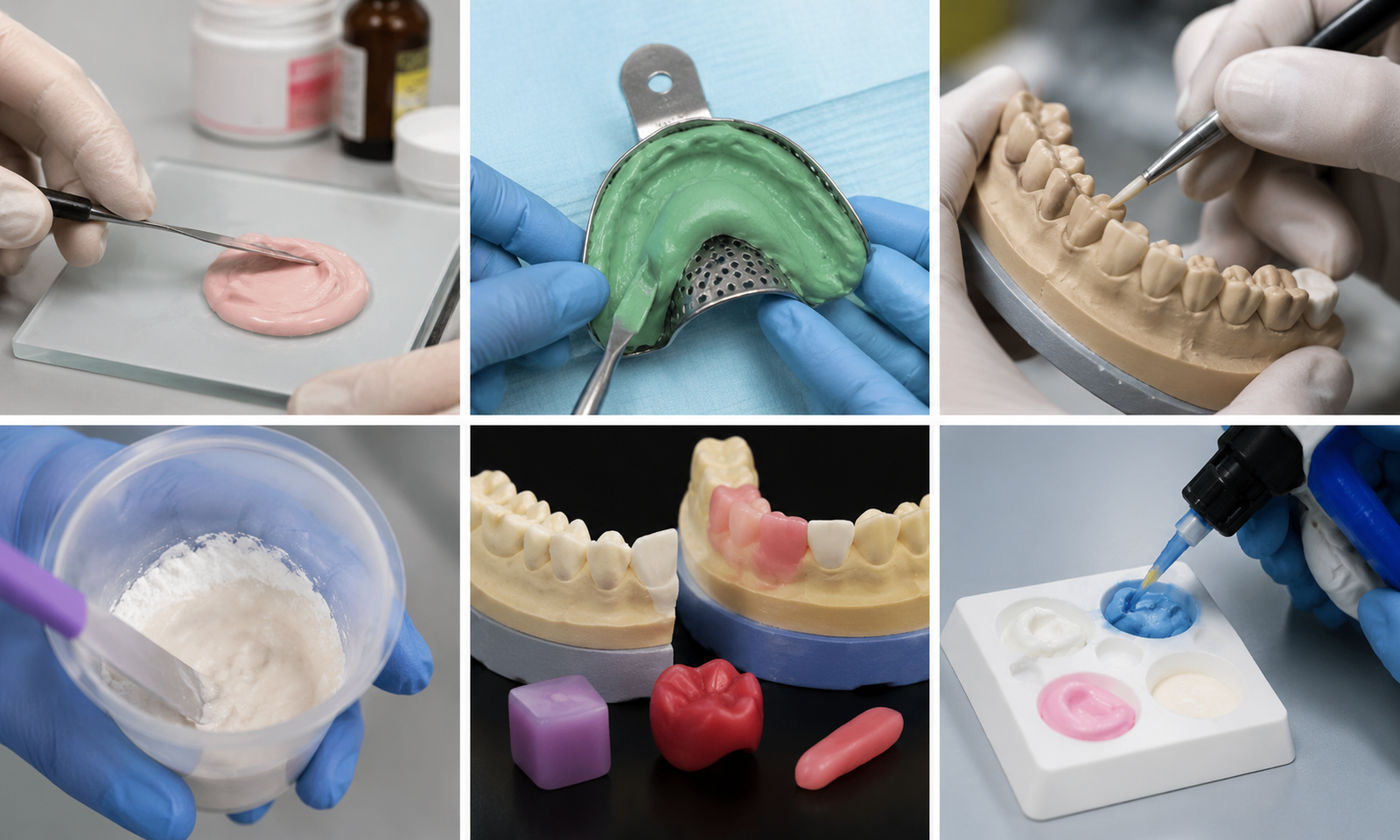
One of the most important steps in dental material manipulation is the mixing stage. When preparing various materials, there are often different ways of mixing them to obtain the desired result. There are distinct handling procedures that must be adhered to and these vary for dental cements, impression materials, restorative materials and gypsum materials.
Correct dose of liquid and powder are critical for dental cements like zinc phosphate and glass ionomer cements. Too much powder can result in a mixture that is hard to work with, and too much liquid can reduce the strength of the set material product. Mixing is best done on approved surfaces and frequently performed on a cool glass slab for some cements to allow maximum advantage to be taken of the exothermic reaction, gaining an extension in working time. Students should take care that the mixture created (spatulization) is smooth and uniform, with no air bubbles or irregularities in the mixture.
In general, the mixing is less intensive with composite materials because most composite systems use in-tubes syringes. But proper handling is still crucial to ensure that food is not contaminated and cured early. Materials used for impressions (alginates) need strong, yet controlled mixing to ensure that materials are mixed in a homogeneous manner without allowing too much air to be trapped. The same care with water to powder ratios and mixing is required for gypsum products to be used to prepare casts. Knowing the specific needs of each class should enable a student to have consistent clinical results.
Carbohydrate Technology and Clinical Precision
After a proper mix, ensuring placement of the materials is vital. Adaptation, retention and success of the restoration or procedure are directly affected by placement technique. They should be cultivating good hand control and eye coordination skills in dentistry at this point.
Incremental layering techniques are frequently recommended for placing restorative materials like composite resin to reduce shrinkage of the material during cure and optimize Curing depth. Cavity wall aspects should be carefully adapted for each increment, without allowing voids to form in the cavity. The risk of the improper placement includes marginal damage and diminished longevity of the restoration.
Placement of impression materials must prevent the beginning of set-up until the impression has come into contact with all desired structures. Distorted impressions caused by air entrapment, improper loading of trays, or delayed seating, may require remakes. Like other materials, a proper seating pressure and proper timing are also required for crown and bridge cementation to ensure optimal adaptation.
Another variability in placement is the requirement for understanding of the material’s working time. Students should set up instruments and clinical locations prior to mixing. Work flow is streamlined and delays are minimised, and materials will be placed at the optimal handling time. Placement techniques help increase accuracy, decrease clinical mistakes, and increase patient satisfaction.
Understanding of working and setting times.
An understanding of one of the most fundamental concepts in dental materials science is the difference between the working time and setting time of the material. The working time is the time within which a material can be effectively worked and setting time is the time needed for the material to reach its hardened final state.
Students often make mistakes due to the failure to pay attention to time. Manipulation of materials outside of recommended working time may result in properties that are adversely affected. Distortion and loss of detail, for instance, might occur if impression material sets before it is inserted in the tray. The same applies to delayed cements and flow properties and/or cements having impacted on their seating accuracy.
Setting reactions can be greatly affected by the environment. The setting time of materials can vary due to temperature, humidity and mixing rate. Reaction rates tend to rise as temperatures go up, thus decreasing working time. However, colder conditions can allow for longer manipulation sessions. Pupils should be aware of the implications of these factors on their performance in clinical activities and adapt themselves.
Good time management in the dental operatory is closely related to proper manipulation of materials. Manufacturers’ guidelines and the preparation of the instruments and organisation of the materials in an appropriate manner contribute to ensuring the procedures are completed within a time frame. This awareness improves efficiency, and aids in more predictable treatment results.
Common Errors in Dental Material Manipulation
Many dental students face some of the common errors in their clinical sessions while practicing. Being able to identify and understand these mistakes and how to avoid/solve them is crucial to learning and future success.
A common error is using the wrong materials, or the sizes of the materials. Just because you guess the amount of powder or liquid needed doesn’t mean it will be enough to make the needed product and effect the overall reaction process. An extremely frequent problem is an inadequate or an excessive mixing. This may lead to streaking in under-mixed materials, and air bubbles and/or fast setting reaction in over mixed materials.
Contamination is also a major problem. Moisture, body fluids (saliva, blood), or particle (salt and sterilisation tools) contact can disrupt bonding mechanisms and negatively affect material performance. It is, therefore, imperative to keep isolation and practice aseptic precautions. Students also need to be careful not to use instruments that have been contaminated when preparing materials.
Another common mistake is delayed placements. Others take relatively short times to set and may set too early if they are set too soon. In addition, if the manufacturer’s directions for curing time, storage or handling is not followed, the effectiveness of the material will be reduced. This can be avoided and treatment can be more successful by developing disciplined clinical habits.
How to work with specific classes of dental materials.
There are different handling techniques for different types of dental materials. Students must be aware of the challenges associated with these restorative materials, impression materials, cement, liner, base and gypsum products.
Care must be taken to ensure that composite resins are managed in terms of moisture and the correct light curing methods. Students need to keep track of curing distances, angles, and time to assure total polymerisation. The setting of glass ionomer materials is critical and must be protected from moisture until properly set.
The working time of impression materials is short and they need to be manipulated quickly and efficiently. Impression should be made with alginate as quickly as possible to minimize changes in dimension. However elastomeric materials tend to be more stable and sometimes will still need the correct storage and handling procedures.
When gypsum is a component in model making in the dental field, it is necessary to carefully select the slurry composition and to ensure that the air is driven out by using proper proportioning technology and vibration methods. The accuracy depends greatly on the correct manipulation during pouring. Students learn to be familiar with each type of material and become confident and improved centers.
Strategies for Developing Consistency and Precision
An important characteristic of a good dentist is having consistency. Consistent practice, careful attention to detail and adherence to procedure are the keys to consistent results. It is advisable for dental students to develop skills that enable precision in the process of manipulating the material in every step.
A key strategy is to have a consistent workflow. Ensuring materials, instruments are prepared and the steps taken in the correct order before treatment is started helps minimise, and enhances efficiency, errors. Students should also have practice taking the correct and precise measurements and following the recommended mixing times.
Drills and lab work are critical to learning. Repeating experiments gives the student an opportunity to get to know the properties of materials under different circumstances. Keeping track of observations and learning from the outcomes can be useful in finding out what needs to be changed.
It’s also helpful to get input from teachers and clinical experts. Students receive a good level of constructive feedback that promotes skills to be improved and confidence in their abilities. Sustaining these conducts over time leads to improved clinical proficiency and growth as a professional.
Conclusion
Proper manipulation and handling of dental materials are vital to dentistry. Every stage from mixing, placing, working time and avoiding common mistakes all have an impact on the clinical outcome and patient satisfaction. A mastery of these skills creates a solid base for dental students to pursue success in a variety of restorative, prosthodontic, preventive and cosmetic procedures in the future.
Science and technique must be used to handle and manipulate different dental materials effectively and efficiently during the practical aspect of Dentistry. Students who learn the material specific needs, follow the manufacturer’s recommendations and establish uniform clinical techniques will obtain predictable and consistent outcomes. With advances in dental materials science, technology and research, the skills to properly manipulate them will continue to remain some of the most essential competencies for the dental profession to learn.


