Operative dentistry is one of the most basic and complex clinical dental specialties. This includes understanding, planning, treating and monitoring the decayed, structurally compromised and traumatized dental tissues. This is especially difficult for beginners as there is a mix of theory, manual dexterity, precision and clinical judgment. Accurate technique is critical to create a restoration which will realize the clinician’s goals of patients’ comfort, no secondary caries, and restoration longevity. During the transition from a simulation lab to real patients, dental students might find it challenging where not as obvious as when they were in pre-clinical. The article discusses some of the most frequent problems of operative dentistry and offers simple, evidence-based solutions for young dentists to enhance their skills and increase their confidence in daily practice.
Common Problems in Operative Dentistry
A major challenge for the beginning dentists in the field of operative dentistry is the disparity between learning and application. Students may grasp the concepts of cavity design, material science, and the principles of restoration but putting the theory and knowledge to the clinical test may be more difficult. Limited visibility, patient motion, time constraints, and patient fear all can have a positive impact on performance. Also, insufficient experience in dealing with the instruments could produce inconsistent outcomes, particularly when conducting sensitive treatments such as caries removal or matrix placement. Yet another big challenge is using rote-learned steps, not relying on clinical “judging,” which is needed to adjust treatment for individual patients. These are not the indications of a lack of capability, but just an expected part of the learning curve. Through consistent practice, guidance, and thoughtful learning, these challenges can be overcome progressively, moving towards increased accuracy and efficiency in restorative practices.
Importance of Correct Preparation of Cavity
As is typical of many early students, a common problem is when the cavity is not adequately prepared, and this can have a tremendous impact on the success of the restorative treatment. Failure to remove carious tissue, overextending margins, or having the wrong depth can lead to poor restorations, or secondary caries. Often these errors are the result of inadequate visualisation, lack of tactile control and knowledge of tooth anatomy and Biomechanics. Excessive preparation can sacrifice too much sound tooth structure and under-preparation can cause failure later in life by leaving infected tissue. Click here to learn more about the principles and the clinical techniques of improper cavity preparation. Solving this problem needs repetitive practical training, careful preparation according to directions (guidelines), and the feedback from the tutors. The systematic technique that can be followed, such as referral to cavity patterns or magnification, where appropriate, will help to minimise errors and enhance long term restoration success rates.
Restorative dentistry and handling error of materials.
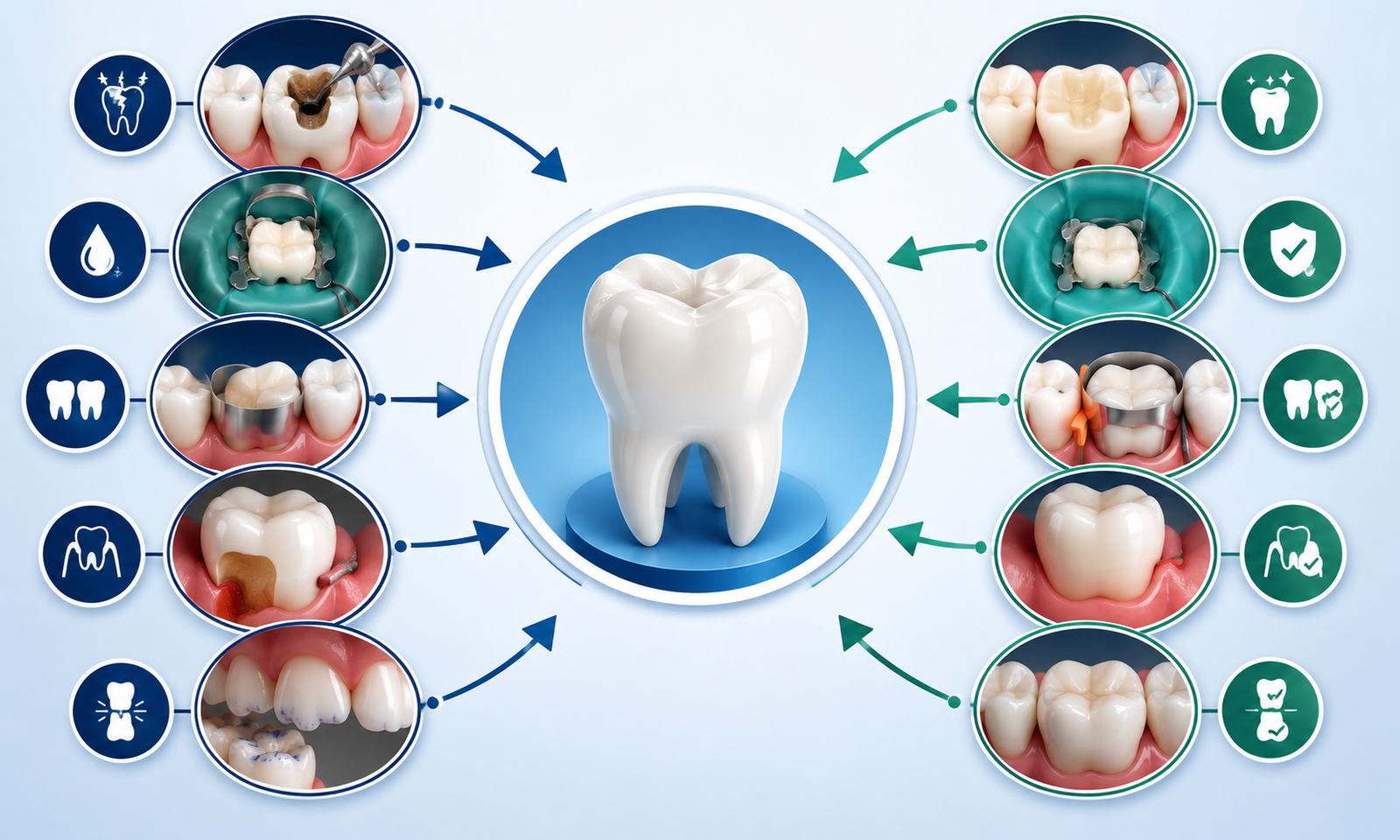
An important issue in the field of operative dentistry is the use of the wrong restorative materials. The use of dental materials like composite resins, glass ionomer cements, and amalgam depends on their physical properties and chemical characteristics, which depend on precise manipulation. Most new operators have a problem with mixing ratios, long periods of time for exposure or placement technique. For instance, by failing to position the lights correctly, the composite resin can not be polymerized completely, causing weak restorations and early failures. Likewise, if moisture is in the placement, it may have a significant impact on bond. These errors are frequently because of unfamiliarity with material properties or hurried procedures because of time pressures. To eliminate these problems, the clinician should become adept at material science and adhere to manufacturers directions. Some of the basic habits that will positively impact material performance and clinical outcomes include practicing incremental layering techniques, maintaining proper isolation with rubber dams and having a clean working field.
Prominent Restoration failures and causes.
Failure to restore is a frequent and onerous issue in operative dentistry, particularly for the novice who might be improving his or her technique. They may result in marginal leakage, fracture of the restoration or in development of secondary caries, or complete/chronic loss of the restoration. These occur far more often because of a mixture of issues, often overseen through the process, ranging from improper cavity design, material handling and inadequate adhesion protocols. Examples of this include having a short etch time or contamination during the adhesive stage. Occlusal discrepancies can also make aesthetic and functional stress breakdown of the restoration. The multi-factors cause of these failures must be understood if these failures are to be prevented. However, it is essential for clinicians to take an integrated approach to management, with accurate diagnosis, careful preparation, the correct material choice and finishing and polishing procedures. Systems of evaluation are also essential to be established from the previous cases to find common errors that may guide better performance in subsequent cases.
How to improve the skills on cavity preparations.
Regular practice and a systematic learning method are required to develop an improvement in cavity preparation skills. Beginning students should learn the basic principles of tooth preparation: outline form, resistance form, retention form and convenience form. The less hurried students should break down the job into stages and stop and think about the finished job before they start any preparation. Building confidence by using typodont models, simulation exercises can help before going to patients. More so, magnification systems like loupes can deliver a major boost in visibility and precision when working clinically. It is also important for the learner to receive consistent feedback from teaching staff, which can give them valuable and useful hints that they might never notice if it wasn’t reinforced with such feedback. Practicing self-assessment following each procedure promotes reflective learning and improvement. With practice these techniques eliminate the need to control cavity preparation purely mechanically and make it a predictable, reliable and clinical procedure.
Mechanical Advantage of Material Handling
Clinicians need to sharpen their material handling skills both theoretically and repetitively in order to be successful in delivering restorative services consistently. There is a difference in each dental material and understanding that is vital when in clinical conditions. For instance, the use of incremental layers is necessary to minimize the polymerization shrinkages in composite resins; moisture control is needed during cements setting in glass ionomer cements. Experienced learners should spend some time researching how to set times, how to mix material and protocols as well as the working windows for each material. Errors can be minimized by practicing on models prior to clinical use. Also, setting up instruments and materials prior to a procedure will allow for smooth operations and not create needless delays along the way. Rubber dams are, in particular, effective in preventing contamination and adhesion. With the development of disciplined habits and the application of knowledge of the material science principles, these technique-sensitive errors can be minimized, to result in long-lasting and esthetically pleasing restorations.
Care and attention must be taken at each step of the treatment from diagnosis to completion, to prevent failure of restoration. The main point is to get a strong and permanent bond between the tooth and restorative composite material. Correct surface preparation, application of the adhesive, and curing are very important in this. Also, occlusal adjustment is indispensable for both stopping early wear and breakage of the restoration because of functional forces. Finishing and polishing also help to minimize plaque, and enhance the marginal integrity. These steps are important to the success and failure of a restoration, and the beginner should not rush through them. Follow-up evaluations should also be scheduled to ensure long-term restoration success. By paying attention to the details of the procedures and maintaining quality at every step in between, the chance of failure can be drastically lowered, and the satisfaction of the patient increased.
Accelerating Clinical Skills and Sustainability
Operative dentistry is not only a technical competence but also a clinical confidence and decision making process that must be successfully achieved to achieve long lasting success in the example of dentistry. For many beginners, medical procedures induce anxiety and this can cause some hesitation to carry out the procedure and some mistakes. To build confidence, practice with clinical cases, positive feedback, and incrementally increasing cases. There is also any amount of help from senior clinicians which cannot be written in books, and that is of great benefit in mentorship. Maintaining a clinical notebook for documentational procedures, difficulties, and learning are another way to move forward with professional development. In addition, having access to new technologies and materials guarantees that clinicians aren’t using old methods. With practice, uncertainty evolves into competence, confidently and accurately handling cases with varying levels of complexity in restorative work. Finally, operative dentistry is an art that is ever evolving, constantly refining and growing with practice, reflection and the drive to provide the best possible care for the patient.
Conclusion
To practice as an operative dentist one has to have scientific knowledge, hand skills, and clinical judgment. Every new grad dentist encounters issues like improper cavity prep, material handling, etc., all in the name of gaining experience.
With an awareness of these challenges and a willingness to employ systematic solutions—including the competencies of good cavity design, better material handling skills, appropriate isolation and attention to finishing quality—young professionals can make a great impact on their clinical skills.
Finally, patience, practice, and the ability to learn continually will be key to success in operative dentistry. With time and experience these challenges turn into comfortable platforms to take off to clinical excellence.