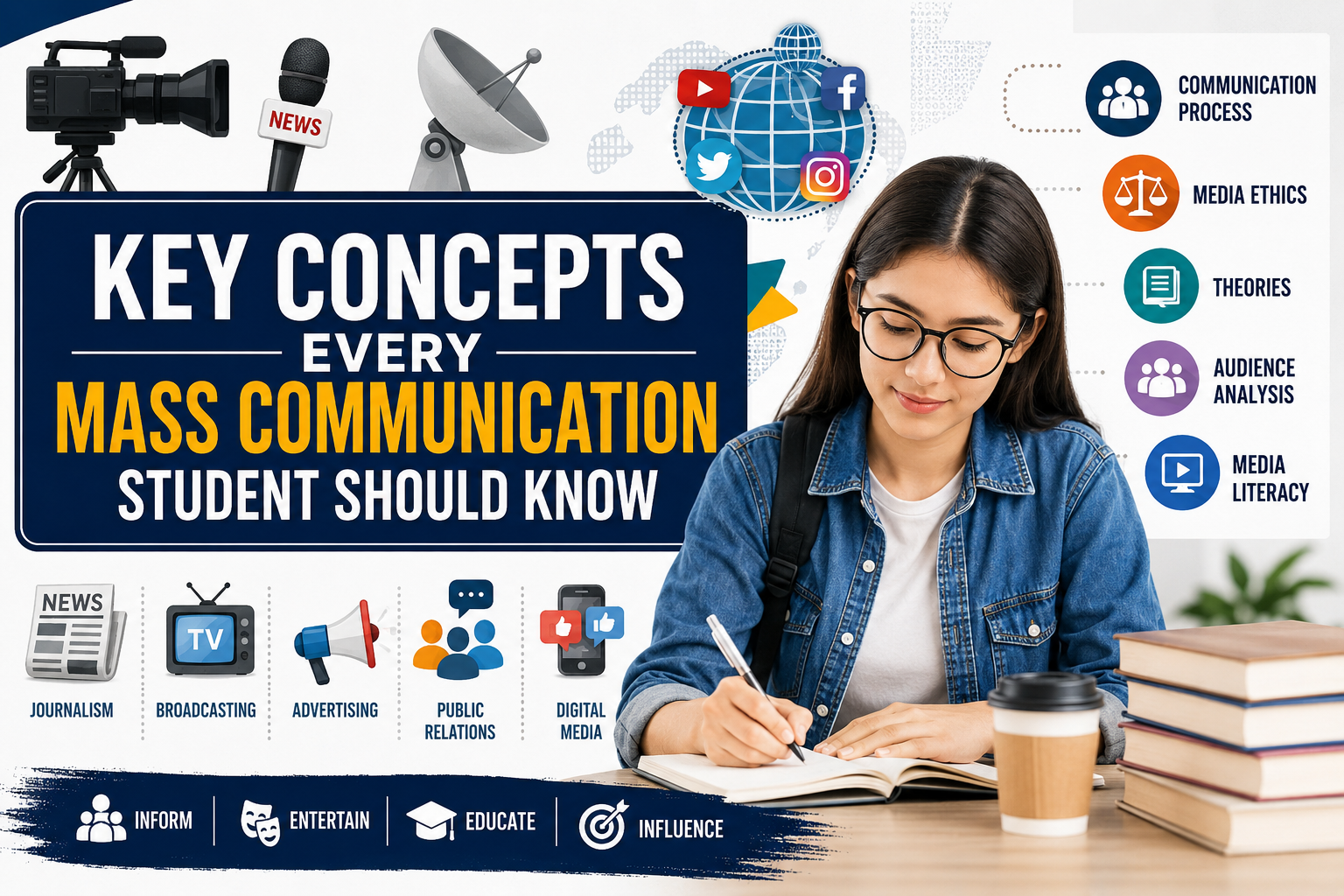
Mass communication is undoubtedly one of the most significant fields of study in the world today, which is driven by the media. It influences the way people process information and make judgments, as well as how they relate to society. Television and radio, news reporting, and social media have revolutionized the way messages are disseminated around the world.
The basic understandings are a must-know for students entering this profession, as mass communication isn’t about simply conveying a piece of news. It encompasses audience behavior, the influence of the media, ethics, and the strategic development of messages. These concepts are essential for students to develop their academic background for journalism, public relations, advertising, and digital media professions.
Mass communication is the field that is concerned with the process of making and conveying messages to large audiences via media. Mass communication does not require interpersonal communication; it is a form of communication through technology that reaches thousands or millions of individuals at the same time. This wide reach makes it one of the most potent weapons in the battle for public opinion, information, and culture. At the beginning, a novice should learn the principles to get started with communication strategies and media studies.
What is Mass Communication?
Mass communication is the dissemination of information to large heterogeneous masses through media. The platforms also encompass newspapers, magazines, television, radio, websites, and social media networks. The aim is to educate, entertain, or sell. The idea has been around for years and years, starting with print publications and then moving to broadcast and digital communication systems.
The uniqueness of mass communication is that it is able to reach many people at once. For instance, a TV news report can be seen by millions of people within minutes. Social media content can spread like wildfire, transcending borders and cultures in seconds. It is significant for students to grasp this extension because they learn how powerful an influence the media can have on society.
The Basic Elements of Communication
All communication processes are structured. Students who can grasp these components will be able to visualize the processes of creating and communicating a message.
Sender
The sender is the individual or institution that is producing the message. In mass communication, it may be a journalist or a radio/TV station, or an advertiser. The credibility of the sender is important because people will trust information from a credible source more than from an unknown or less credible source.
There’s a lot of influence that a trusted news organization has compared to an unconfirmed online account. It helps students understand that credibility is a powerful attribute of communication.
Message
The message is what you are communicating. It can be in writing, through words, or in a picture, or by a mix of all three. The message can be a news report in journalism. It can be a convincing campaign in advertising.
A good message is relevant, direct, and clear. If the message is not well organized, it may be confusing or ineffective.
Medium
The medium of transmission is how the message is conveyed. The traditional media are newspapers, television, and radio; in contrast, the digital media are websites, blogs, and social media platforms.
Message channels have an impact on message reception. A radio broadcast uses only sound, while a television broadcast uses both sound and pictures to engage audiences.
Receiver
The receiver is the audience that is taking the message. If there are no listeners, there is no communication. Knowing the needs of the audience enables communicators to create a more effective message.
Feedback
Feedback is the audience’s response. Feedback in traditional media can be delayed via letters and/or surveys. Feedback is immediate in digital media – comments, shares, and reactions.
Essential Mass Communication Theories
Mass communication theories are theories that describe the impact of media on people and society. Students learn to analyze communication in-depth with the help of these theories.
Agenda-Setting Theory
The first is agenda-setting theory, which states that the media affects people’s thinking by establishing an agenda for what they should pay attention to. Many people notice issues that they repeatedly see on news channels and think of them as important.
If the media has a continuous report on unemployment, the people might start to take the economic issues seriously. This theory demonstrates the influence of the media on public discussion.
Gatekeeping Theory
Gatekeeping theory is a theory that has to do with the selection of information that will be available to the public. Editors, journalists, and producers are gatekeepers because they determine what to publish or broadcast.
The concept is significant, as it indicates the role played by the media in controlling the flow of information. It also demonstrates the effect of personal or institutional bias on the reporting of news.
Uses and Gratifications Theory
This theory discusses “why people select some media.” It suggests that viewers make choices about what they consume, whether it’s for entertainment, education, or information.
For instance, one person can watch documentaries for educational purposes, while another watches comedies for entertainment. This theory assists in understanding the audience behaviour.
Cultivation Theory
According to cultivation theory, frequent media consumption influences people’s perception of reality. A person who sees a lot of crime shows on television might think that crime is more prevalent than it actually is. This theory is appropriate in the current digital media era that shapes attitudes and beliefs.
Understanding Media Literacy
Media literacy is the skill of critically analysing and interpreting media messages. It enables students to recognize bias, misinformation, and messages in content.
Media literacy is more significant than ever in today’s digital age. There is a speed at which fake news gains traction and a lack of reliability among all news sources. It’s time for communication students to learn how to seek out information before believing or sharing it.
Media literacy also enables students to recognize how visuals, headlines, and words impact the audience’s emotions. A sensational headline might get people to read, but it will misinform. Students learn to identify such tactics and develop their critical thinking skills, while also getting ready for professional media production.
The Importance of Media Ethics
Media ethics are the moral values applied by those who engage in communication. Ethics help to report and create content fairly, truthfully, and responsibly.
Journalists, for instance, are expected to report the facts accurately without misleading the public. Advertisers are not allowed to make false claims. PR pros need to be honest when communicating with their brands.
There are many ethical concerns, such as privacy, truth, and public interest. It is not ethically appropriate to publish private information without permission, unless there is a substantial public interest. Educating students in the context of ethical awareness will enable them to make ethical choices in their careers.
Ethics also fosters trust in the public. The audience requires proper information from the media, and any inaccuracy or sensationalism will destroy their trust in the media.
Types of Mass Communication
There are various types of mass communication, each with its respective purposes.
Journalism
Journalism is about collecting, writing, and reporting news. It provides information on current affairs, politics, business, and social issues to society. Good journalism is based on accuracy, fairness, and objectivity.
Broadcasting
Radio and TV are examples of broadcasting. It is able to broadcast sound and picture to large numbers of people. The power of broadcast media is that it reaches a wide range of people and reaches fast.
Advertising
Persuasive communication is employed in advertising to sell a product, service, or idea. It focuses on influencing consumer decisions. Students should know that advertising is a blend of creativity and strategy.
Public Relations
Public relations deals with the relationship between the public and organizations. It’s all about reputation, trust, and public image. PR practitioners develop campaigns, address crises, and develop brand relationships.
Traditional Media vs Digital Media
Newspapers, radio, and television are examples of traditional media. These platforms have been the backbone of communication for years and are still crucial due to the authenticity and the organization of their content.
Digital media encompasses social media, blogs, podcasts, and streaming. It is faster, more interactive and accessible.
The main difference is involving the audience. Traditional media is predominantly unidirectional, whereas digital media is bidirectional. Users can share, comment, and produce their own content. Students need to know both to understand modern communication, as it is a blend of the two systems.
Audience Analysis in Mass Communication
The audience analysis is the study of the recipient(s) of the message. This means age, gender, place, interests, and behaviour.
Knowing the audience will enable communicators to develop effective content. The message format for a teenager will be different from that of a business professional.
Audience analysis also helps to create content that resonates with specific audiences, thereby increasing audience engagement. In advertising, any campaign must be successful. In journalism, it facilitates journalists’ understanding of what readers are interested in. One of the greatest principles in communication is to know your audience.
Common Terms Every Student Should Know
Noise
Noise is defined as all that gets in the way of communication. It can be physical, technical, or emotional. Technical noise includes a poor Internet connection during live broadcast.
Encoding and Decoding
The process of converting the message is called encoding, and the process of comprehending the message is called decoding. Both processes need to be operating to communicate effectively.
Public Opinion
Public opinion is the general opinion about social and political issues. The media has a big influence on people’s views.
Propaganda
Propaganda: Communication designed to influence opinion, typically through emotional or biased messages. Students must be taught to recognize signs of propaganda in the media.
Conclusion
Mass communication is a strong domain which links people, disseminates information, and influences societies. Students learn the main concepts, which provide them with a solid foundation for academic and career achievement. The key concepts of communication components, media theory, ethical standards, audience response, and media literacy are crucial to success in the field.
These ideas are still applicable in today’s technology-driven world. These principles apply to all aspects of communication, such as journalism, broadcasting, advertising, and public relations, so students who learn them will be better equipped for the future. It’s not just learning about the media platforms; it’s learning about how information is actually creating the world.