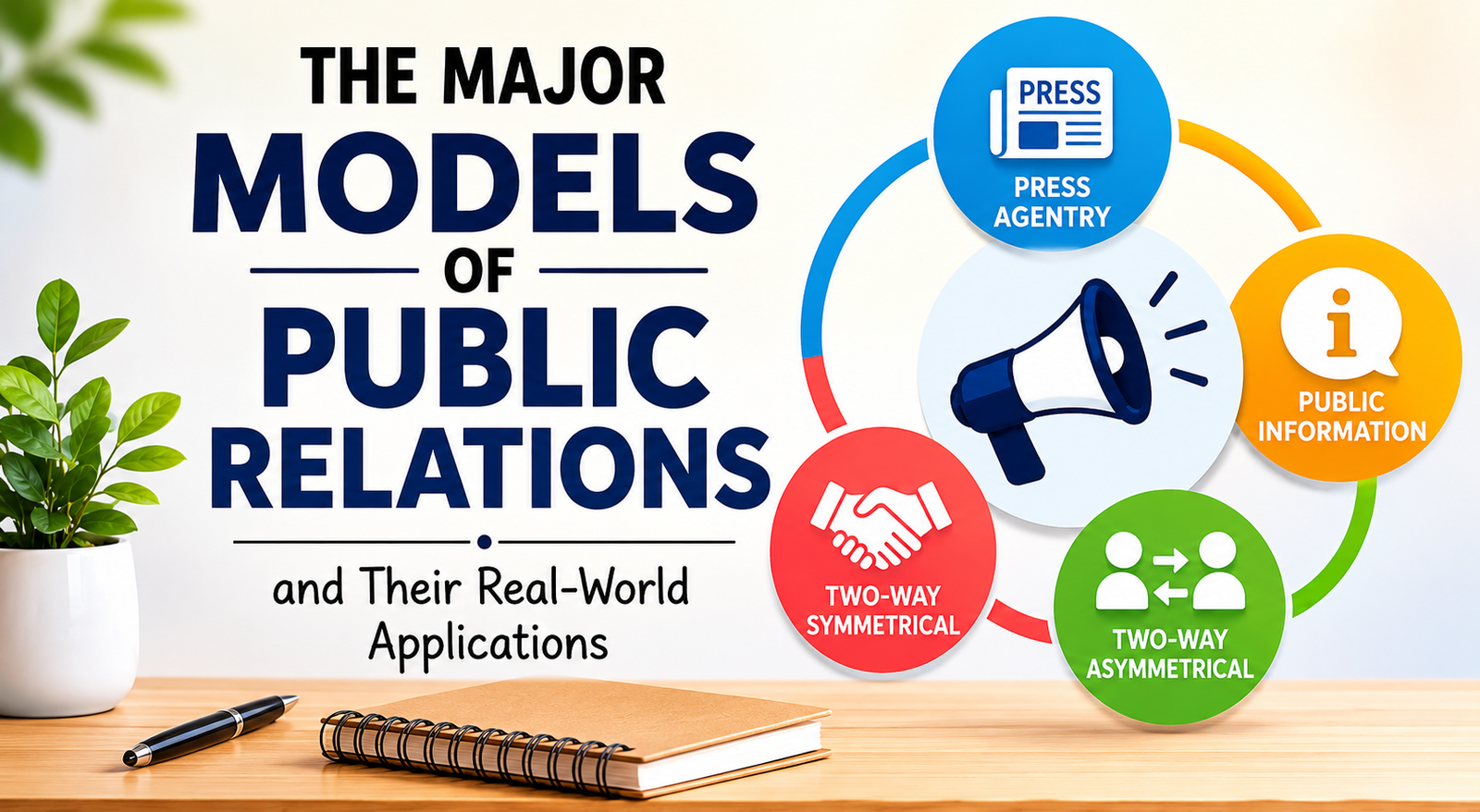
Public relations is the strategic communication field that supports and helps organizations build and sustain positive relationships with their audience. Public relations practitioners rely on theories and models of communication to apply to their work whether in the business and government sectors, entertainment, or in a nonprofit context. Public relations models outline the various approaches organizations can take when communicating with the public, are one of the most important concepts in public relations and can affect the trust, reputation, and engagement of a range of stakeholders.
Public relations models are significant because they underlie the theoretical foundations of PR communication and provide useful insights into how an organization chooses to communicate with its target group(s) by informing, persuading or collaborating with them. Such models, created by James E. Grunig and Todd Hunt, continue to be significantly relevant to PR education and practice. There are press agentry or publicity model, public information model, two-way asymmetrical model, and two-way symmetrical model. Each one of the models is based on a different philosophy of communication and has different organizational objectives.
It is important to explore the working of each model in real-life situations and how organizations modify these models to address communication problems today, to better understand the theoretical basis of public relations communication. However, with the evolution of digital media, these traditional strategies are still important, as they help communication professionals develop effective and ethical strategies.
Why Public Relations Models Are Important
Understanding Communication Strategy in Practice
Public relations models offer a structured approach that aids in identifying the communication strategy for an organization to adopt in order to communicate with stakeholders. They lead the way in determining the focus of communication, whether it be publicity, information sharing, persuasion, or dialogue. If these systems are not in place, then PR can be done without direction and without having a desired effect.
Organizations have more and more challenging communications today. They have to be ready to address crises promptly, to influence the outcome of global brands’ online reputation, and to keep the public satisfied in very competitive situations. The theoretical background of PR communication can be used to understand these situations and determine the best communication strategies for them.
Advantages of Understanding Public Relations Models
The advantages of being familiar with the public relations models are:
- Building communication planning and execution skills
- Making public relations (PR) objectives consistent with organizational goals
- Improving stakeholder engagement
- Establishing trust and organizational credibility
- Supporting ethical decision-making
- Enhancing reputation management practices
These advantages are all reasons that public relations (PR) models are still relevant in both research and practice.
The Four Major Models of Public Relations
1. Press Agentry/Publicity Model
Press Agentry Model Overview
The oldest and most publicity-oriented of all the models of public relations is called the press agentry model. Its main goal is to draw attention and create media coverage, typically done in a dramatic manner, an emotional way, or with a promotional event. The model of communication assumes that communication is a one-way process, with the organization sending information to the people without seeking their input.
The model has been utilized broadly in the entertainment, political, and commercial promotion sectors in the past. Publicity agents tended to be more concerned about attracting attention than giving a balanced perspective or full picture.
Press Agentry Real-World Applications
It is often used in the following ways by organizations:
- Celebrities who are doing publicity for a movie or album
- Political campaigns that want to be heard in the media
- Brands that are making viral marketing stunts
- Organizers of events that are creating excitement ahead of product launches
- Sports associations that market major events
Benefits of the Press Agentry Model
The model has a number of advantages, such as:
- Quick public awareness
- High media visibility
- Strong emotional audience impact
- Effective business promotion for short-term success
Limitations of the Press Agentry Model
Although effective, there are some disadvantages to the model:
- Can embellish or spin information
- Often lacks transparency
- May cause damage to public trust in the long run
- Does not engage the audience in conversation
Although it is still in use, the press agentry model may contradict the principles which lie behind the theoretical underpinnings of public relations (PR) communication.
2. Public Information Model
Defining Public Information Model
The public information model is interested in disseminating accurate, factual, and objective information to the public. It is not concerned with persuading people, but rather educating and being transparent, unlike the press agentry model. Communication is still unidirectional; however, there’s an emphasis on credibility and truthfulness. This model is also commonly used when conveying critical information to the public, such as by government institutions, healthcare providers, universities, and nonprofit organizations.
Public Information Model Real-World Applications
Examples include:
- Public health announcements by the government
- Corporate annual reports
- Changes to educational institution policy
- Nonprofit awareness campaigns
- Official press releases issued by regulatory agencies
Benefits of the Public Information Model
Key strengths include:
- Enhances public trust
- Builds organizational credibility
- Supports accountability
- Reduces misinformation
- Conforms to a code of ethics for public relations
Limitations of the Public Information Model
Some limitations include:
- Limited audience interaction
- Minimal feedback opportunities
- May appear impersonal or overly formal
- May be less active in a digital setting
While this model is extremely ethical, it doesn’t necessarily meet the expectations of today’s interactive communication.
3. Two-Way Asymmetrical Model
What Is Two-Way Asymmetrical Communication?
The two-way asymmetrical model adds the audience’s response to the communication process, but persuades the audience to adopt organizational objectives as his/her own. Organizations collect data via surveys, analytics, and market research, and apply the data to create compelling messages. This model is particularly common in commercial marketing and political communication.
Real-World Applications of the Two-Way Asymmetrical Model
Examples include:
- Brands that employ customer data to target advertising
- Political campaigns analyzing voting choices
- Companies conducting focus groups prior to product launches
- Social media campaigns tweaked with audience insights
- Organizations using surveys to measure the effectiveness of messages
Benefits of the Two-Way Asymmetrical Model
Benefits include:
- More effective targeting of the audience
- Improved campaign efficiency
- Increased message relevance
- Improved knowledge about audience reactions to content
Limitations of the Two-Way Asymmetrical Model
Challenges include:
- Communication remains unbalanced
- Respondents’ comments can be utilized only for the purpose of convincing
- Ethical issues of manipulation
- Limited relationship-building potential
This model is effective but may be at odds with the mutual respect emphasized in the theoretical bases of PR communication.
4. Two-Way Symmetrical Model
Understanding the Two-Way Symmetrical Model
The two-way symmetrical model is regarded as the most ethical and evolved of PR models. It is based on the principles of understanding, openness, and relationship building. Organizations actively seek input from stakeholders and are willing to adjust policies or practices as a result of public input. This model is based on the best aspects of the theory of PR communication, with a focus on collaboration instead of persuasion.
Real-World Applications of the Two-Way Symmetrical Model
Examples include:
- Businesses that interact with customers online through social media platforms
- Community consultation programs
- Corporate social responsibility programmes
- Employee feedback and internal communication systems
- Effective and clear communication with stakeholders in a crisis situation
Benefits of the Two-Way Symmetrical Model
Major benefits include:
- Creates long-term trust
- Strengthens reputation
- Encourages stakeholder loyalty
- Enhances organizational adaptability
- Respects ethical communication practices
Limitations of the Two-Way Symmetrical Model
Potential challenges include:
- Takes a considerable amount of time and resources
- Requires organizations to be open to change
- May slow down decision-making
- Hard to implement consistently in large organizations
Nevertheless, it is regarded as the best practice by many experts for contemporary PR practice.
Comparison of the Four Public Relations Models
The Key Differences Between the Four Models at a Glance
| PR Model | Communication Style | Main Goal | Audience Role |
|---|---|---|---|
| Press Agentry | One-Way | Publicity and attention | Passive |
| Public Information | One-Way | Information sharing | Passive |
| Two-Way Asymmetrical | Two-Way and imbalanced | Persuasion | Feedback provider |
| Two-Way Symmetrical | Two-Way and balanced | Mutual understanding | Active participant |
This is a comparison between the different levels of communication, from simple transmission of a message to collaboratively building a relationship.
The Contemporary Relevance of Public Relations Models in the Digital Age
The digital communication landscape has revolutionized the use of Public relations models in this day and age. Transparency and dialogue are demanded more and more due to the growth of social media, online communities, and instant feedback systems. Although information sharing and publicity are still relevant, there is growing demand for organizations to take part in meaningful conversations with stakeholders.
Many PR practitioners today use several of the models in different ways and in combination to achieve specific objectives. For example:
- Press agentry may be used in the launching of a product by a company
- Public information may be used in a regulatory update
- Two-way asymmetrical communication may be used for targeted advertising
- Two-way symmetrical communication may be used in the recovery phase of a crisis
The flexibility here serves as proof of the continued influence of the theory of PR communication on communication practice.
Conclusion
The four models of public relations offer valuable understanding of the communication and relationship-building process between organizations and their audience. Every model has its own set of benefits and pitfalls, from creating buzz and publicity to practicing ethical discussion and cooperation. These together form the theoretical underpinning of PR communication and enable professionals to comprehend how communication strategies affect trust, reputation, and stakeholder involvement.
These models are important in the context of organizations’ need to understand and produce effective, ethical, and adaptive public relations strategies in ever-changing media landscapes. Communication professionals who become adept at these core concepts will be better positioned to establish better relationships and make a greater organizational impact.
Frequently Asked Questions (FAQs)
What are the four major public relations models?
The four major types of models are:
- Press Agentry/Publicity Model
- Public Information Model
- Two-Way Asymmetrical Model
- Two-Way Symmetrical Model
These models describe various ways organizations communicate with the public.
Who invented the major models of PR?
The major public relations models were developed by James E. Grunig and Todd Hunt.
Why is it important to have Public Relations models?
PR models can be used to determine what communication strategies to use, how to build relationships with stakeholders, and the theory behind PR communication.
Which PR model is considered the most ethical?
The two-way symmetrical model is considered the most ethical since it encourages dialogue, understanding, and joint decision-making.