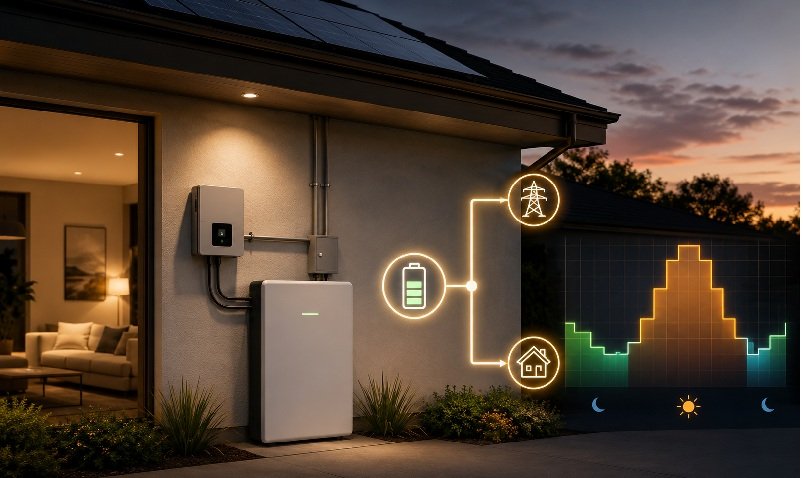
A battery can sit quietly in the garage and still change the rhythm of a house. It charges when electricity is cheaper, discharges when rates climb, and keeps a reserve for outages. That sounds simple until the utility bill arrives with three different price periods.
Time-of-use rates, often called TOU rates, charge different electricity prices at different times of day. They are meant to reflect the real stress on the grid: power is usually more expensive when demand is high and less expensive when demand is low.
Why batteries fit TOU pricing
The value of a battery under TOU pricing comes from load shifting. Load shifting means moving electricity use from an expensive time to a cheaper time without changing the service the home receives.
For example, a battery can charge from solar during midday or from the grid overnight, then discharge during the evening peak. If the home has an EV charger or heat pump, the savings opportunity may be larger because those loads can be significant.
The U.S. Energy Information Administration reports that the average U.S. residential customer bought about 10,791 kWh of electricity in 2022. As homes add EV charging, heat pumps, induction cooking, and electric water heating, the timing of that electricity becomes almost as important as the total amount.
The missing piece is control
A battery does not automatically save money just because rates vary. It needs a control strategy. If it empties too early, it may not cover the expensive period. If it stays too full, it may miss the chance to absorb solar. If it charges the EV at the wrong time, savings can disappear.
This is where software matters. Sigenergy Smart Home connects solar generation, storage, smart loads, and app-based control so homeowners can schedule high-load devices around solar production and rate windows. A system like Sigenergy Smart Home is not just about seeing energy flow. It is about making the timing of that flow useful.
The mySigen App is part of that experience. It gives homeowners visibility into solar production, consumption, storage, and device behavior. That matters because TOU savings are hard to manage by guesswork.
Outage reserve versus bill savings
There is one important tension. A battery used for savings wants to cycle often. A battery used for backup wants to stay ready. If the system drains itself every evening to avoid peak rates, it may not have enough reserve if the grid fails at night.
A sensible control plan sets a backup reserve. That reserve is the portion of the battery held back for outages. The homeowner can decide whether savings or resilience matters more during certain seasons. In storm season, reserve may be higher. In mild months, more capacity can be used for daily rate optimization.
The Department of Energy’s work on virtual power plants has also highlighted the growing role of distributed devices such as batteries, smart thermostats, EV chargers, and flexible loads. The same controls that help one home avoid peak prices can also help a grid avoid stress when aggregated at scale.
When TOU makes the battery case stronger
A battery is more likely to be worth considering when:
- Peak and off-peak prices are far apart
- Solar production is exported cheaply but evening power is expensive
- EV charging can be scheduled
- Heat pump or water heating loads can be shifted
- Outages make backup value meaningful
The case is weaker if the home has flat rates, low electricity use, little solar production, and few flexible loads.
The Sigen EVAC Level 2 charging layer can help connect the economic side with the comfort side when EV charging is part of the home load. The point is not to make homeowners obsess over every kilowatt-hour. It is to let the system do the boring timing work in the background.
On TOU rates, a home battery is not automatically worth it. But when the home has solar, EV charging, flexible loads, and smart controls, the math can become much more interesting.