
Introduction
Whenever you open a Web site, send an e-mail, or view a video, your device is interacting with other devices in an enormous world network. Nonetheless, such communication does not occur ad hoc. Rather it relies on a systemized approach which makes sure that the data goes to the right destination. This can be done with two fundamental elements: IP addressing and Domain Name System (DNS).
Firstly, IP addresses serve as digital addresses of homes to devices that are connected to the internet. In the meantime, DNS is similar to a phonebook that can convert the user-friendly names of web sites to these numbers. The internet would have been very hard to use without these systems, as people would have to remember numerous complex numbers in order to visit each and every site.
Moreover, these technologies are compatible with each other and operate in the background to ensure that the internet is fast, reliable and user friendly today. The article describes the use of IP addresses to identify the devices in a network and how DNS can enable users to access websites around the world in an efficient manner.
Understanding IP Addressing
What is IP Address?
An IP (Internet Protocol) address is a special ID, which is used to identify each device on a network. An example is your smart phone, laptop, server or even smart TV has its own IP address as long as it is connected to the internet. As such, IP addresses make sure that the information/data transmitted across the internet is directed to the right device.
The IP addresses are of two major types:
• IPv4 (Internet Protocol version 4) – has the format 192.168.1.1
• IPv6 (Internet Protocol version 6) – longer and more complex, such as 2001:0db8:85a3::8a2e:0370:7334
IPv4 is predominant, but IPv6 was brought in since IPv4 was soon depleted as the number of the devices in the world increased.
The IP Addresses and How they work.
Once you open a webpage, your computer connects with a server, and sends a request. Consequently, the said server will reply to your IP address by sending back the data requested. This is done in a matter of milliseconds although it is a process that has several steps.
Besides, routing cannot be done without IP addresses. The addresses are used by routers all over the internet on where to send data next. As an illustration, in sending a message in Nigeria to a server in the United States, routers make sure that the data travels in the right direction by the various networks.
The Static vs Dynamic IP Addresses.
IP addresses may as well be categorized into two:
• Fixed IP addresses – fixed and does not change with time
• Dynamic IP addresses – short-term and may be changed after some time
In the majority of cases, the internet service providers are dynamic in their IP addresses since they are more effective. Nevertheless, the servers commonly have fixed IP addresses to make them always available.
The function of DNS in the communication of the Internet.
Without IP addresses, the internet would be so inefficient to use as people would have to memorize the IP address of each site. An example to illustrate is that it is not feasible to remember something such as 142.250.190.14. As a solution to this issue, therefore, the Domain Name System (DNS) was developed.
Search engine names are translated into machine readable IP addresses through DNS which are easy to understand and read such as the name of the search engine, i.e. google.com. To get to know more about this system, you may want to read the official description of the Domain Name System that gives a step-by-step description of the Domain Name System in the background.
Also, DNS is a distributed directory service within the internet. DNS is distributed among various servers worldwide, rather than having all the information pertaining to a web site in a single location. Consequently, it is always quick, scalable and can support heavy traffic.
The reason why DNS is important.
There are a number of reasons why DNS is necessary:
• It eases the use of the internet to humans
• It caches web sites making them faster
• It enhances reliability, as data is spread out in servers
• It facilitates internet scalability of the contemporary internet
The internet would be much more inept with the absence of DNS. Further, companies would find it difficult to have sites that are accessible as users would be required to be conversant with raw IP addresses.
The process by which DNS works step by step.
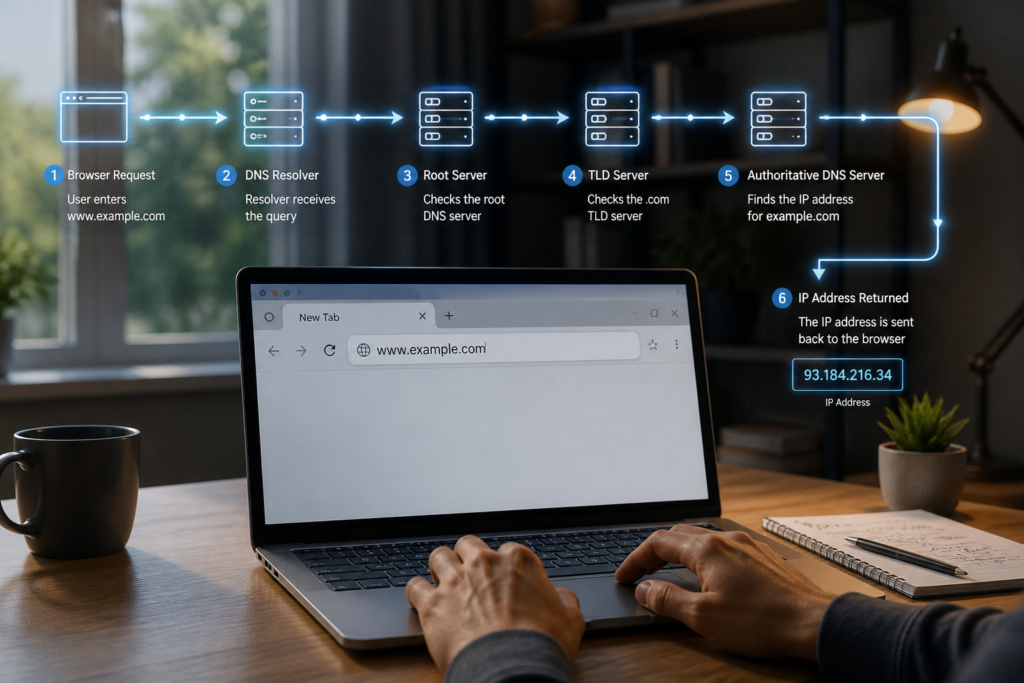
Knowledge in the working of DNS aids in explaining how websites are loaded so fast. The process may appear to be very difficult, but it takes place almost immediately.
Type a Name of a Website.
To start with, when you enter a domain name (such as www.example.com) into your browser, the process of locating its IP address starts in your device. But it is not aware of the address at the moment.
DNS Query is Sent
Your device will then make a DNS query with a DNS resolver. Your internet service provider or a free DNS service normally provides this resolver. As such, it is the initial step towards determining the right IP address.
Checking the Cache
The resolver consults its cache before going on to search. In case, the IP address is already stored, it gets it back instantly. This makes the web site load quicker.
Querying DNS Servers
In case of the address not being stored in the cache, the resolver will access other DNS servers. These include:
• Root DNS servers
• Top level domain (TLD) servers
• Authoritative DNS servers
With a series of steps, the system will be brought nearer to the right IP address. In addition, such a hierarchical structure guarantees efficiency and accuracy.
It is possible to send back the IP Address.
Lastly, the authoritative DNS server gives out the appropriate IP address of the domain being requested. This address is in turn sent back to your browser by the resolver.
Website Loads
Once the IP address has been provided to it, your browser links to the server. As a result, the site is loaded on your screen in a few seconds.
Relationship between IP Addressing and DNS.
The DNS and IP addresses are the two. On the one hand, IP addresses provide the devices to communicate using networks. DNS however, makes the work of humans much easier since they do not need to memorize the numbers in order to locate these devices.
one such case is when you visit a web site:
• DNS is used to locate IP address
• Delivery of data is through IP addressing
Therefore, the internet is an interaction of the two systems to make it work.
Furthermore, it is a relation which adds performance and usability. Without DNS, the internet would still be there but only to a smaller extent since it would not be accessible to the majority of ordinary users.
Types of DNS Servers.
DNS is not a master server-based. Instead, it utilizes different types of servers working together.
Recursive DNS Resolver
This is the first server that your query will be sent to. It goes out of its way to ensure that it finds the correct IP address on your behalf.
Root DNS Server
The one that is pointing the resolver to a top level domain server is the root server. As an example, it can be employed to distinguish between .com, .org or .net.
TLD Server
Top-Level Domain server is a type of server that accommodates such domains as .com or.org. Moreover, it also helps in further refining the search.
Authoritative DNS Server
Finally, this is the server which contains the actual IP address of the domain. It, therefore, provides the final answer to the question of the DNS.
The benefits of IP Addressing and DNS.
When used together, the IP addressing and DNS possess several useful benefits:
• Fast access to web sites that are better routed
• User-friendly domain names and not numeric addresses
• Large-scale network of internet of billions of devices
• Communicational soundness, between international networks
Also, the systems support the existing technologies such as cloud computing, streaming platform, and online gaming.
Common DNS Issues
Although DNS is highly reliable, some problems might occur. For example:
• DNS cache corruption
• Server downtime
• Incorrect DNS configuration
Most of these issues are temporary however, and they can be solved by clearing the cache or switching DNS providers. DNS is thus a robust system despite the occasional failures.
Conclusion

In conclusion, the internet communication is founded on IP addressing and Domain Name System. The IP addresses are implemented to ensure that they are able to identify each device distinctively and DNS simplifies accessing them since domain names are translated into addresses.
The two systems are also very compatible to assist websites to load quickly and efficiently. Without them, the internet would be a lot more complex and difficult.
As such, a more in depth understanding of how IP addresses and DNS operate will provide a clearer understanding of the way the whole world wide web operates behind the scenes.