Introduction
Importance of statistics in accounting and financial management has a very essential role in today’s world. Companies produce large sets of financial data on a daily basis which in turn must be analyzed for it to be of use in the decision making, planning and performance improvement processes. Statistics gives us the methods and tools to put this data to work in a useful way by which we may report on, and improve our financial information.
In the past the bulk of what accountants did was bookkeeping and preparing financial statements. Now though accountants and financial managers are put forward to do more advanced accounting functions which include forecasting, budgeting, auditing, financial analysis, and strategic planning. We see that they require statistical knowledge which is a element of today’s business environment in which business decisions must be based on solid data and measurable results.
Statistics play a role in which organizations reduce risk and improve financial efficiency. Via statistical analysis companies are able to identify trends, see through financial risk, compare performance, and predict business results. Thus making statistics an essential tool in today’s financial management.
This article focuses on the importance of statistics in accounting and financial management which also looks at how statistical tools support auditing, forecasting, budgeting, and performance evaluation in organizations.
Meaning of Statistics in Accounting
Statistics is the science of collecting, organizing, presenting, analyzing and interpreting data. In accounting and finance we use statistics to turn raw financial data into relevant information which supports decision making.
Accounting professionals apply statistics to sales reports, profit and loss, production costs, market trends, investment results, and other financial statements. We use statistical analysis which in turn helps us to better understand business performance and to identify financial patterns.
In accounting we see the use of:
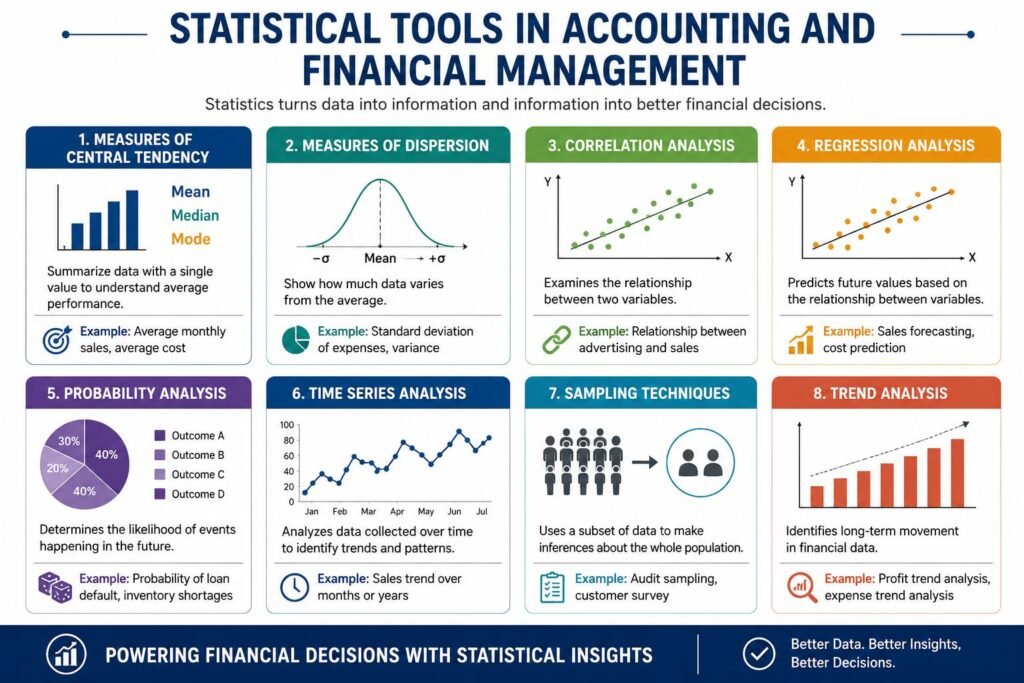
- Mean, median, and mode
- Standard deviation
- Probability analysis
- Correlation analysis
- Regression analysis
- Sampling techniques
- Trend analysis
- Time series analysis
These tools aid in the development of sound financial decisions.
Statistics’ Role in Accounting Functions
Statistics is a key component in the improvement of many accounting functions within an organization. In today’s accounting which is very data intensive, statistics provides the base for precise financial analysis and reporting.
Auditing
In the field of accounting statistics is put to large use in auditing. Auditors look at financial reports to determine that the financial statements are indeed accurate and free of fraud or error. Large companies see an everyday flow of many thousands of financial transactions. Also in most cases auditors do not have time to go over each and every transaction. This is where statistical sampling comes in. Auditors through the use of statistical sampling choose which sections of transactions to look at. We then take what we find in the sample to make generalizations about the full set of transactions.
Importance of Statistics in Auditing
- Saves time during audit procedures
- Reduces the cost of auditing
- Improves audit accuracy
- Helps detect fraud and irregularities
- Assists in risk assessment
In the field of auditing probability theory is used to determine the chance of errors in financial reports which in turn helps auditors to determine the extent of testing to be done during the audit.
Budgeting and Financial Planning
Budgeting is a process of forecasting future income and outgoings which in turn leads to better financial management. Statistics play a role in that it allows companies to put together accurate and reliable budgets by looking at past financial data.
Financial reports are used by managers to do trend and regression analysis which in turn is used to project future sales, production costs, and operational expenses. This in turn allows companies to better allocate resources and to avoid excessive spending.
Benefits of Statistics in Budgeting
- Improves budget accuracy
- Helps control costs
- Assists in cash flow management
- Supports financial planning
- Encourages efficient resource allocation
For instance a manufacturing company may look at past years’ production costs and sales trends in order to put together the next annual budget. Statistics also is used by companies to revise budgets which in turn is in response to inflation, market demand, and also changes in the economic climate.
Forecasting and Future Planning
Forecast out is the issue of what will happen in the future based on what we have seen in the past. Statistics plays a key role in forecasted modeling as it gives us the tools to predict financial trends and market action.
Businesses use statistical forecasting to estimate:
- Future sales
- Customer demand
- Profit levels
- Cash flow
- Investment returns
Time in series analysis, moving averages, and regression analysis is used for forecasting.
Importance of Statistical Forecasting
- Reduces uncertainty in decision-making
- Supports companies in preparing for future issues.
- Supports strategic planning
- Improves inventory management
- Enhances profitability
For example a retail company may look at past sales which vary by season to forecast future customer demand and in that way keep their inventory levels adequate. Banks and financial institutions use statistical forecasting for interest rates, credit risk, and economic trends.
Performance Evaluation
Organizations use statistics for the assessment of business performance. Financial managers compare actual results to what was expected to determine if we are reaching our organizations’ goals.
In the field of performance evaluation we use:
- Financial ratios
- Percentage analysis
- Variance analysis
- Trend analysis
- Benchmarking
Performance review which is used by companies to identify what is going well and what is not.
Importance of Statistics in Performance Evaluation
- Measures business efficiency
- Identifies areas requiring improvement
- Supports employee performance assessment
- Assists management decision-making
- Encourages accountability
For instance we see through variance analysis which is the comparison of budgeted and actual expenses which in turn tells us which departments are over or under performing.
Importance of Statistics in Accounting and Financial Management
Financial management is a function which includes planning, organizing, directing and controlling financial activities in an organization. Statistics supports financial management which in turn improves the quality of financial decisions.
Investment Decision-Making
Businesses have to choose which areas to put their money in for the best return and lowest risk. Statistics plays a role in this for companies which use it to determine expected returns and risk. Statistical tools like probability analysis and regression analysis which in turn aid investors.
For example:
- Probability analysis measures investment risk
- Correlation analysis looks at relationships between assets.
- Regression models project future market trends.
Statistics also play a role in that they allow investors to diversify their investment portfolios which in turn reduce financial losses.
Risk Management
Every company is exposed to financial risks which include inflation, economic recession, credit defaults, and market fluctuations. Statistics plays a role in that it helps organizations identify, measure, and manage these risks. Financial institutions apply statistical models which determine the chance of default on loans and of loss on investments.
Benefits of Statistical Risk Management
- Reduces financial uncertainty
- Improves business stability
- Assists in developing contingency plans
- Supports informed decision-making
- Minimizes financial losses
Risk assessment is a key element in banking, insurance, and investment management.
Cost Control and Profitability Analysis
Statistics plays a role in which companies control operational costs and improve profitability. Financial managers’ study cost behavior and revenue trends via statistics. Break at even point is a common technique which is used to determine the level of sales that will cover all costs. Businesses also do analysis of how changes in production costs and sales volume play out for profits.
Importance of Cost Analysis
- Helps reduce unnecessary expenses
- Improves operational efficiency
- Supports pricing decisions
- Enhances profitability
- Assists in financial planning
Financial Reporting
Financial reports which present financial info to investors, shareholders, creditors, and government agencies. Statistics improves the quality and clarity of financial reports. Statistical graphs, tables and percentages which present financial info in a simplified form and make reports more accessible. Accurate financial reports increase transparency which in turn helps stakeholders to make informed decisions.
Common Statistical Techniques Used in Accounting
Measures of Central Tendency
Measures like mean, median and mode report financial data as a single value.
Examples include:
- Average monthly sales
- Average production cost
- Average employee salary
Measures of Dispersion
Variance and standard deviation which are measures of dispersion indicate how far data is from the average.
These measures help businesses understand:
- Financial stability
- Investment risk
- Variability in expenses
Correlation Analysis
Correlation analysis studies two variables.
For example:
- Relationship between advertising and sales
- Relationship of inflation to production costs.
Positive relationship between variables goes up and down together, negative relationship which is the opposite.
Regression Analysis
Regression models project future trends based on the relationships between variables.
Businesses use regression analysis for:
- Sales forecasting
- Demand estimation
- Cost prediction
- Market analysis
Probability Analysis
Probability some events will occur in the future.
Examples include:
- Probability of loan default
- Probability of inventory shortages
- Probability of financial loss
Probability assessment is a base for risk management and investment planning.
Advantages of Statistics in Accountancy and Finance Management
- Improved Decision-Making: Statistics gives you the data you need to make informed business decisions.
- Better Financial Planning: Organizations apply statistics in developing long term financial plans and business strategies.
- Increased Efficiency: Statistical tools which in turn improve data analysis and enhance operational efficiency.
- Fraud Detection: Statistical audit methods which identify out of the ordinary financial transactions and fraud.
- Accurate Forecasting: Statistical models improve prediction accuracy and reduce uncertainty.
- Objective Analysis: Statistics supports evidence based financial evaluation instead of guesswork.
Challenges of Using Statistics in Accounting
Though very important, statistics also has some limitations.
- Dependence on Accurate Data: Statistical results are a result of the quality of the data which is used.
- Complexity: Some advanced skills and knowledge are required for certain statistical methods.
- Risk of Misinterpretation: Misinterpretation of statistics may lead to poor decisions.
- Changing Economic Conditions: Unpredictable market changes will reduce accuracy.
The Growing Importance of Statistical Knowledge
In today’s business world data is at the core of what we do. Companies are very much into data analysis for strategy and competition. Also as a result stats have become a key element for accountants and financial managers. Today’s accounting software and financial systems feature in depth statistics which in turn allow organizations’ efficient use of financial data.
Professionals with strong statistical skills can:
- Analyze financial trends
- Support strategic decision-making
- Improve business performance
- Interpret financial data accurately
- Assist in business forecasting
Statistics also plays a large role in financial analytics, artificial intelligence, and business intelligence systems. As companies in present economic unstable times and under high global competition, which we see today, there is a great growth in use of stats in accounting and finance.
Conclusion
Importance of statistics in accounting and financial management plays an essential role which improves data analysis, planning, forecasting, auditing and performance evaluation. In today’s world we see that companies use statistical methods to interpret financial info and make informed business decisions.
Statistical methods for what accountants and financial managers do are a game changer. We see stats play out in areas from audit and budgeting to forecasting and investment analysis which basically covers the full spectrum of financial management.
In that which regards statistics we see that they put forth issues like complexity and the need for accurate data but also report great benefit. In today’s competitive business world statistical knowledge has become a key requirement for account and finance professionals. Organizations that do well with the application of statistics in finance are more likely to see profitability, sustainability, and long term business success.
Get more well researched information about importance of statistics in accounting and financial management here.