Gaming is no longer just possessing a computer but to establish a system that is specially configured to be as quick, steady and attractive as ever imaginable. The games which are currently demanded are the ones of high frame rates, low latency and good utilization of hardware. It is a professional guide that will guide you on the procedure of installing your computer with the maximum gaming performance using the most optimization procedures. You can have the most demanding AAA titles running on your system, with this guide, without any issues.
Learning the Fine Arts of Gaming
Before delving into the technical nudging of the game, it is important to have the requisite elements that influence the performance of the gaming. Each element of your system is added to the frame rates, load times and visual fidelity.
Core Performance Factors:
• GPU Power: Determines the quality of the rendering, FPS and the graphic effects.
• CPU Efficiency: Physics, AI and game logic processes.
• RAM Speed and Capacity: This affects the multitasking and speed of data transfer.
• Storage Performance: It influences the asset streaming and load times.
• Cooling System: Stability is ensured and thermal throttling is avoided.
A balanced system should have a high performance—any area of weakness is prone to form a bottleneck. The one example is to put a high-end graphics card like the NVIDIA RTX 4090 and a low-end CPU together, which will result in bottlenecking of the CPU and will not be able to achieve FPS in games that are highly graphic.
Optimization of the GPUs with the Maximum Graphics Performance
The greatest component of gaming is the GPU. The frame rates, stutter and can be greatly improved with high-end tuning and provide a smoother gameplay. Even the slightest correction in real-time rendering may lead to a significant difference.
GPU Optimization: New Generation
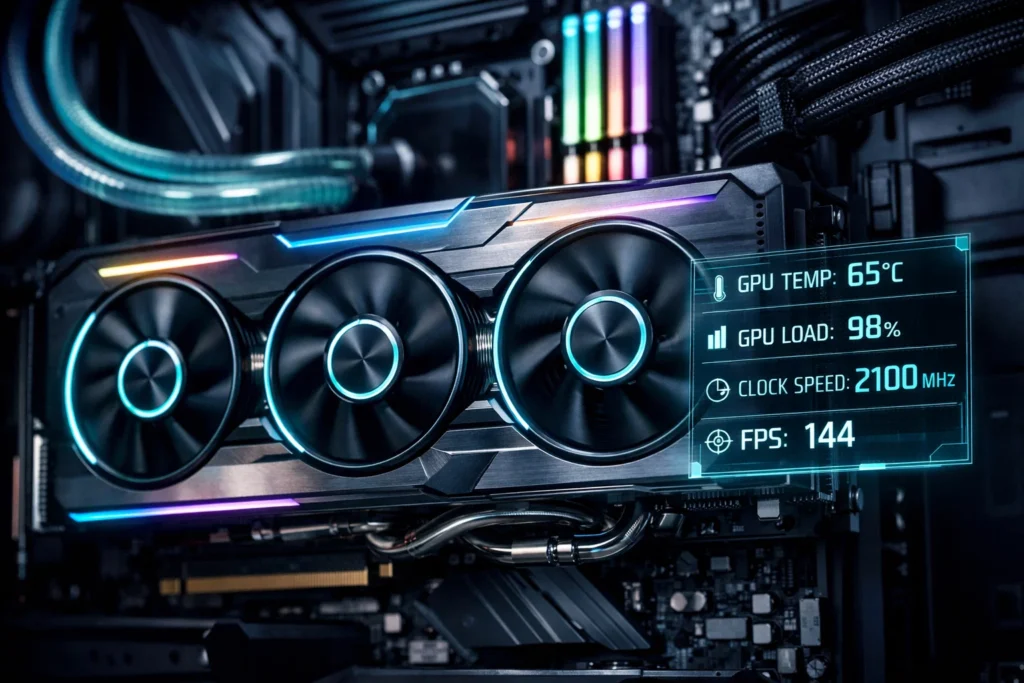
• Overclocking the GPU:
Tune the core and memory clock using any of the programs like MSI Afterburner or ASUS GPU Tweak. Check the stability with the assistance of such stress-testing packages as 3DMark or Unigine Heaven. Overclocking can be used to improve the performance of FPS by between 5–20 percentages depending on the type of the GPU model.
• Undervolting:
Decrease the voltage and does not deteriorate the performance. This reduces the production of heat, reduces noises of the fans and maximizes the effectiveness of systems. A large number of premium GPUs are capable of operating at stock speed at 10–15% lower voltage.
• Custom Fan Curves:
Choose profile of set fan speed to workload. There is no way that violent curves in vigorous gaming can permit thermal throttling without having the fans running at full blast all the time.
• Shader Cache Optimization:
Enabling shader caching on GPUs. This reduces stuttering in the in-game and load time of games that re-compiles shaders including the AAA open-world games.
• Multi-GPU Setup (SLI/CrossFire):
The performance of the GPUs can be enhanced by pairing with other GPUs in advanced users and is not available in modern games. Dual GPUs are significant to invest in case the benchmarks are targeted.
Graphics API Selection:
• DirectX 12: Better usage of a multi-core processor and up-to-date optimization of the graphics card.
• Vulkan: It is less expensive overhead-wise and has improved performance in games not using this API.
• OpenGL: Some titles are still being used although not as efficiently in high end gaming.
Random Access Memory Requirement and Memory Optimization
RAM is a significant feature of modern games, especially those of the open-world genre, simulators, and data-intensive games with a multiplayer. Inadequate or slow memory can cause stuttering or crashes or even low frame rate with high-end GPUs.
RAM Requirements: What You Require
• 16GB DDR4/DDR5: Minimum AAA gaming at 1080p and 1440p.
• 32GB: 4K gaming, VR or running a number of tasks simultaneously, streaming.
• 64GB+: It is necessary only in the process of creating professional content, and in case of gaming, too.
• Dual-Channel Setup: Two sticks are employed in the unlocking of memory bandwidth and reduction of latency.
Memory Optimization: Sophisticated Method
• XMP/EXPO Profiles:
Auto unlock rated RAM speeds during BIOS. This has several gaming motherboards with handy switches.
• Latency Tuning:
Lower CAS latency provides preferable responsiveness, particularly in competitive shooters, in which input lag is a problem.
• Background Process Management:
In order to reduce the number of applications that are not required during the gaming process, use Task Manager or even Process Lasso to reduce the use of unnecessary applications that use too much memory.
• Memory Overclocking:
Advanced users are able to drive the memory speeds to more than XMP. Add latency tuning to increase microsecond responsiveness.
Air Conditioning and Thermoregulation
The cooling must be done properly to prevent thermal throttling that will negatively affect the performance of the CPU and the graphics card when the temperatures are too high. Components are also subject to reduced life in case of overheat.
Installation and Plan of Cooling Systems
Liquid Cooling and Air Cooling:
• Air Cooling: Irritation-free, reliable and cheap. High quality tower coolers are able to cool most CPUs even in the state of overclocking.
• Liquid Cooling: All-in-one (AIO) or custom loops are superior thermal conductors, which are appropriate with CPUs or GPUs when they are highly loaded. The custom loops can also have the choice of per-CPU, per-GPU, and per-RAM cooling.
Thermal Optimization: Technological Processes
• Thermal Paste Application:
Apply high quality thermal paste and repeat after every 1-2 years. When used right it gives optimum heat transfer.
• Case Airflow Design:
• Front intake: Sucking in of cool air.
• Rear/top exhaust: Dispose off hot air.
• Positive Air Pressure:
Helps reduce the dust accumulation through a slight pressure difference in the case with more intake than exhaust.
• Cable Management:
Cables are laid well in order to facilitate the airflow and facilitate future upgrades.
• Temperature Monitoring:
Measure the temperature, control the fan curves in real time using programs like HWMonitor or NZXT CAM.
Games Performance Optimization
The poor performance in both in-game conditions and the powerful hardware may slack down the performance in a serious way.
Graphics Preferences: Adjustments: What is Required
High Impact Settings
• Resolution Scaling: Change it slightly downwards to attain a greater number of FPS without any major experience of loss of image quality.
• Shadow Quality: It is one of the hardest environments and it can be lowered in order to obtain a significant FPS.
• Anti-Aliasing: The conventional MSAA is not as excellent as anti-aliasing DLSS (NVIDIA) or FSR (AMD).
Advanced Settings Optimization
• Texture Quality: VRAM capacity should be equal to VRAM capacity: It is possible to stutter large textures with small VRAM capacity.
• Ray Tracing: Turn off or turn away until you can afford to buy one of the high-end graphics cards.
• Motion Blur, Depth of Field: On to make it seem sensible and tolerable.
Frame Rate Optimization
• V-Sync: No input lag, tearing.
• G-Sync/FreeSync: Tear-free gaming.
• Frame Rate Cap: Decreases thermal load and change.
Software and Optimization of Software
Drivers have to be constantly updated so that they can be compatible, stable and high performance.
Driver Updates: Importance
• Game Optimization: The releases of the game are also streamlined to work with the new releases and new drivers.
• Bug Fixes: Glitch and crash.
• Increase in Performance: By up to 5–15 percent.
Managerial: Advanced Practices
• Installation Cleaning: Install Display Driver Uninstaller (DDU) and after that install new drivers.
• Control Panel Tweaks:
• Power Mode: Preferred—optimum performance.
• Low Latency Mode: Ultra.
• Frequent Updates: You should constantly update on a regular basis of say monthly.
Optimization of Gaming Storage
The fast storage helps in the minimization of the load time besides the streaming of assets in the open world games.
Best Storage Options
• NVMe SSD: Best for costly systems.
• SATA SSD: Economic and effective.
• HDD: Employed only in large storage.
Storage Optimization Techniques
• Install Games on SSD: Minimizes the time on loading and streaming of assets.
• Deleting undesired temporary files.
• Defragment HDDs: Only for mechanical drives.
Advanced System-Level Optimization
Professional users can customize the systems to a higher extent and achieve higher performance.
Operating System Optimization
• Game Mode (Windows): Prioritizes gaming processes.
• Turning off Startup Applications: Reduces background loading.
• High-quality Power Scheme: Peak CPU/GPU power.
BIOS-Level Optimization
• Resizable BAR: Enables CPU to access GPU memory, improving performance.
• CPU Overclocking: Boosts processing in CPU-intensive games.
• Memory Frequency Tuning: Improves data transfer rates.
Optimization of Gaming Networking Online
Even the finest hardware may struggle due to latency affecting online performance.
Network Tips
• Ethernet over Wi-Fi: Smaller ping and less packet loss.
• Priority Gaming Routers (QoS).
• DNS Optimization: Reduced latency via high-speed DNS servers.
• Ping Monitoring: Tools like PingPlotter to diagnose network issues.
The Mistakes Which Are to Be Taken Care Of
These are some of the pitfalls that should be evaded during the derailing of the performance benefits.
Performance Pitfalls
• Thermal Throttling: Cooling is not taken into account.
• Instability: Crashes games.
• Old Drivers: Compatibility and performance are low.
• Single-Channel RAM: Limits bandwidth.
• Background Apps: Consume RAM, CPU, or network resources.
Conclusion
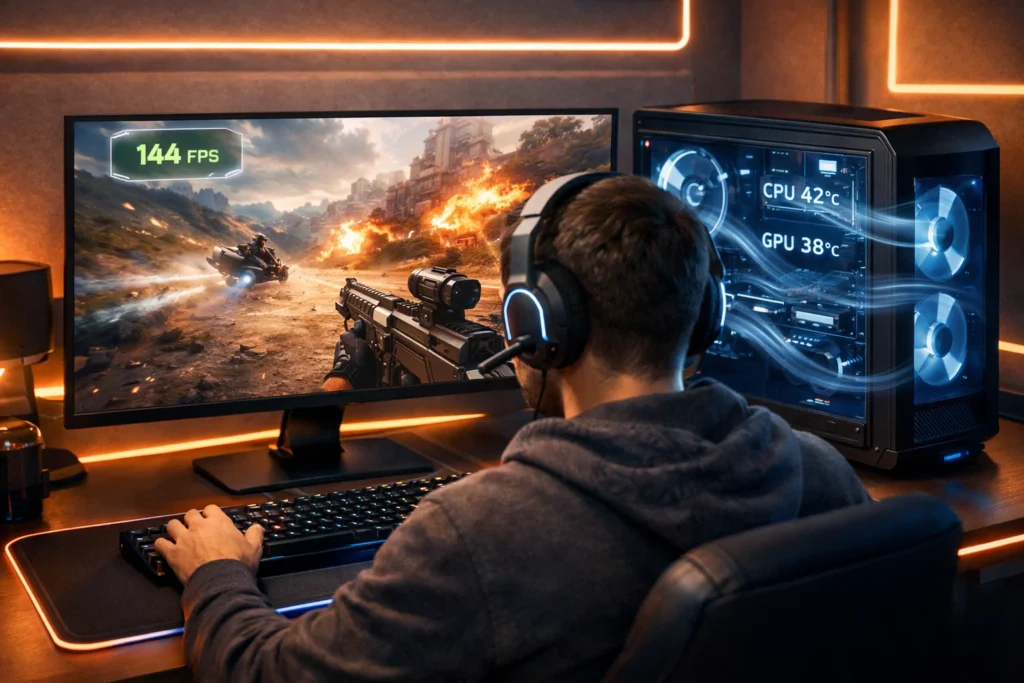
It is not merely having a multitude of money in the hardware to possess a computer to play games yet it is part of perfection of tuning and optimization of the system. The FPS may be used to the fullest, input latency may be lower, and gaming experience may be easier and more enjoyable and immersive by the optimal methods such as the use of the GPU overclocks, RAM overclocks, cooling overclocks, driver overclocks, disk management, and network overclocks.
The design of all the components will be in a manner that is optimistic. Not only will it be capable of executing the games through the techniques, but it will substitute them, in the competitive multiplayer or open world adventures of AAA.