Introduction
It’s like taking off on a trip without a map if you were to start a new business without doing market research first. Passion coupled with creativity is a key component, but it’s not enough to be an entrepreneur; it’s about having the right information about the market. The problem with many businesses is that they don’t realize that they are not in the market for which they are intended, or that the customers they are seeking are not really interested in their products or services, or that they’re too optimistic about the demand for their business. Market research enables entrepreneurs to collect legitimate data to lessen uncertainty and increase their decision making processes.
Business owners need to know who their customers are, what their competitors are doing and how the industry is changing before they invest money, hire employees, or develop their products. Research can be used to substantiate pricing, marketing plans, product attributes and positioning in a business. While some entrepreneurs are determined to make decisions based on assumptions, others will find themselves dealing with some embarrassing upsets once they launch, and the ones who do the former will have a much better chance at long-term growth and profitability.
An important reason for doing a research is to determine if there is sufficient demand for the proposed product/service. It is never safe for an entrepreneur to believe that an idea that they like will be readily accepted by customers. Indeed, one of the smartest things to do before launch is to validate the demand for the product by asking feedback, conducting surveys, taking pre-orders and conducting market testing. This process is to ensure that the solution being offered is worth the customer’s money and that in order to commit to the full scale investment, there may be some changes in the solution that needs to be made.
The Purpose of Market research
Market research involves gathering, analyzing and understanding data on customers, the competition and the wider business environment. To give entrepreneurs insight to lower risk and enhance strategic planning is its main goal. Research assists in providing answers for business owners to critical questions including: Who are their customers? How much are they willing to pay? What are their issues? How are their competitors attracting customers?
Good market research is a blend of quantitative as well as qualitative data. Quantitative research is all about quantitative data which can be measured like the customer demographic, customer purchasing frequency, market size, and market sales trends. The qualitative research involves research of customer opinion, motivations, preferences and experiences. This dual strategy enables entrepreneurs to have all the facts about market conditions and customer behavior. The more information businesses can gather from several sources, the more apt they are to be able to make more accurate predictions and develop products that satisfy real market requirements.
1. Knowing Your Potential Customers
Defining Customer Demographics
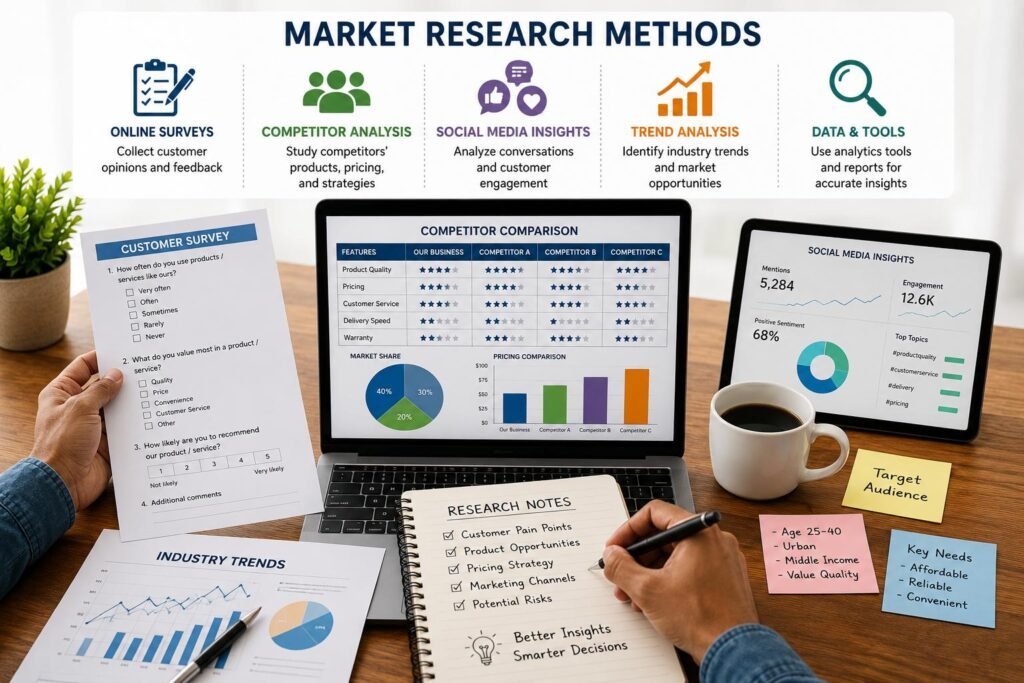
One of the first things to do in market research is to determine who has the greatest probability of purchasing the product or the service that you are looking for. They are referred to as the target market. When defining target customers, it is important to know the age, gender, income range, occupation, education, marital status and area where the customers are located. For instance, a high-end skincare line might be aimed at professionals in the city, ages 25 to 45, and a good deal of tutoring at a lower cost might be geared toward parents of school-aged children.
Demographic data can be used by entrepreneurs to understand their customer’s characteristics and design their product, set its price, and select marketing channels. It’s widely used to sell luxury goods to low income people or market products for young people to retirees – and it doesn’t work, even when the product is good. Identifying demographic patterns is thus significant for businesses to use their resources more efficiently and to communicate from the word go to the right audience.
Understanding Customer Psychographics
Demographics can tell you who the customers are, psychographics can tell you why they buy. Psychographic research focuses on the interests, values, attitudes and lifestyle of customers, as well as on their motivations for buying. If two customers have the same age and income, they do not necessarily have the same buying decisions due to different priorities. A user might prefer to have their cup made quickly, or another user might want to enjoy a cup of their own design which is both sustainable and prestigious.
By knowing psychographics, companies can build deeper connections with the customers while motivating them to buy the products/services. Psychographic information can be obtained by entrepreneurs through interviews, internet communities, customer reviews, social media discussions and surveys. This data can be utilized to craft messages that are relevant to customer needs and preferences, instead of going with a generic advertising strategy.
Creating Customer Personas
Customer personas are fictional people based on research findings and represent an ideal customer. These profiles contain information on demography, goals, problems, purchasing behavior, and preferred ways of communication. If there are several segments of customers that a business serves, it can have several personas.
A fitness company, for instance, could create one persona for young professionals who are on the lookout for convenience and one persona for retirees who are looking to improve their health. Personas are a viable tool for conducting market research because they enable entrepreneurs to see their customers as they visualize them and adjust products, services and marketing techniques to match.
Companies which comprehend this type of customer behavior have a greater chance of securing greater customer satisfaction and retention.
2. Analyzing Competitors Effectively
Knowing your Direct and Indirect competitors
The competitor analysis is an integral part of market research since it provides an insight into opportunities and threats existed in the market. Direct competitors sell the same product to the same consumer base, and indirect competitors are those that are selling a product to the same consumer base but are doing so in a different manner. Both of these are important to both, as customers usually compare several options when buying products.
It is essential for entrepreneurs to make a list of the competitors they’re dealing with, and analyze their pros and cons, pricing, customer feedback, and positioning in the market. Knowing what your competitors are doing enables companies to find a niche they can fill by improving their product or service, or through innovation. It also allows the entrepreneurs to avoid making the same errors as other already established businessmen.
Study of Competitor Products and Pricing
It’s useful to look at competitors’ products for details on customer expectations and industry standards. The characteristics of a product, its packaging, customer experience, warranties, and pricing are all factors that entrepreneurs should consider. Pricing analysis is especially significant since the prices may be raised too high or lowered too low, resulting in losing customers or facing sustainability issues due to reduced profit.
A company can get pricing data from a company webpage, online marketplaces, retail stores, brochures, and promotional materials. When a business owner is considering a price comparison with its competitors, it is important to consider the features as well. This will help them decide if they want to be the low-cost option, offer top-quality products, be convenient, or offer a more niche service. There’s a great deal of difference between businesses that sell products for the same price as their competitors and those that sell products that provide value that the competitors don’t.
Reading into Customer Feedback on Competitors
Some of the best competitor data available is customer reviews. The reviews provide insights into customers’ satisfaction and dissatisfaction with the current products and services. To understand the focus of online marketplaces, social media, forums and review websites, it’s important to read through the reviews of entrepreneurs.
When customers are repeatedly complaining about slow delivery times, unsatisfactory customer service or the lack of durability for a product, these weaknesses can be seen as opportunities for new businesses to differentiate themselves. Sometimes the best information that can be gained is from listening to their customers’ complaints, as this will contain the real-life experience of the customers, rather than the marketing messages found in the competitors’ literature.
3. Evaluating Industry Trends
Avoiding the dangers of being overwhelmed by changes
The business world is constantly evolving as a result of technology, changing consumer tastes and needs, and economies. However, business owners who do not keep track of these changes may find themselves operating in shrinking industries or in industries where there are opportunities available, but not being in place. An analysis of industry trends can help businesses determine if the trend is upward, downward or leveling off over time.
Industry reports, trade associations, government publications, and business journals can be used to get market growth information. Any shift in customer behavior, new laws, technology advancements and economic conditions that may affect future demand should be noted by the entrepreneur. Companies that foresee what is coming next can be at a competitive edge by taking the initiative in identifying changes in the market before others.
Understanding Technological Developments
Changing landscape of technology has reshaped each and every industry from retail to healthcare, from education to agriculture. Entrepreneurs should look at the impact of technological advancements that can influence the expectations of their customer base and how their business works in the market they have targeted. Automation, AI, mobile apps, and digital payments remain to change the customer journey and business process.
Not keeping up with new technology can put new businesses at a disadvantage from the outset. On the other hand, companies that embrace relevant innovations will see their efficiency, cost, and customer service enhanced. Market research should thus involve an evaluation of the technologies that are already impacting the market and likely to continue to impact the market in the future.
Monitoring of economic and social factors
The economic situation and social trends have a huge impact on the buying habits of consumers. Consumer spending is influenced by inflation, employment, the amount of disposable income, and consumer confidence. Likewise, customer preferences and expectations are influenced by cultural values, environmental awareness and demographic shifts.
Such external factors can be opportunities or challenges for the entrepreneurs and they should pay attention to them. For instance, with the rise of awareness of the environment, sustainable products and eco-friendly packaging are in demand. Companies that can identify such changes early have the opportunity to prepare and plan their positioning and product development in a way that meets new customer priorities.
4. Using Online Research Methods
Conducting Online Surveys
Online surveys are a cost-effective and efficient way to gather customers’ ideas and preferences. The surveys can be utilized by the entrepreneurs for testing the product idea, the pricing model, the branding concept, and people’s buying intentions. A good survey question should be unambiguous, and lead the reader in no direction.
Survey platforms enable companies to get responses from a big audience in a brief time. The collected data can provide insights into patterns and preferences that can be used to guide business decisions. But entrepreneurs need to make sure that the people who are taking the survey are representative of the target audience that they are going for to prevent incorrect findings based on irrelevant answers.
Analyzing the Data from Social Media Platforms
Social media is a great way to learn about what people are interested in, talking about and what’s new. Businesses can track comments, hashtags, conversations and engagement, and learn what customers are interested in and how they’re saying it. Social listening tools enable you to monitor your brand and see the major concerns of the customers.
When entrepreneurs watch discussions in the appropriate online forums, they are able to get unadulterated opinions and practical experience. People tend to post their opinions and frustrations, as well as what they want and don’t want, publicly on social media. Businesses can use these platforms to gain insights into what their customers are thinking and feeling, and to address those concerns directly in their product or service development.
Understanding the value of using Search Trends and Analytics Tools
Significant information about customer demand & interests can be gathered from search behavior. Business owners can use the information from the search trends to help identify if there is growth or decline in the search for a particular product or service. Another attribute of keyword research tools is that they can be used to discover common questions or topics in an industry that are frequently searched.
Market interest can be measured by website analytics, search volume data, and identifying online behavior patterns. With these insights, entrepreneurs can make informed decisions about their product offerings and marketing strategies, which can lead to greater success.
5. Applying the concepts of Offline Research Methods
Conducting Face-to-Face Interviews
Personal interviews are still one of the best means of grasping the needs and motivations of customers. An interview is more interactive than a survey, and you can follow-up with questions and further delve into the answers. Many customers will give information that is not easily obtained by asking them a set of questions.
A face-to-face exchange can get to the emotions behind the purchase in addition to the purchase itself, and assist companies in understanding what customers are purchasing, and why. This information can have a huge impact on the effectiveness of the product development and marketing.
Organizing Focus Groups
A focus group is a method for discussion that brings together a small group of prospective customers to discuss a product, concept or business idea. These sessions elicit discussion and provide insight that can’t be obtained from one on one interview. Often the comments build on each other and more detailed feedback is given.
One specific advantage of focus groups is that they can be used to evaluate packaging design, advertising messages, and product attributes, as well as brand ideas. By monitoring the reactions of groups, entrepreneurs can gain a better understanding of the needs and worries that customers may have, which they might not have expected to see.
Visit Trade Shows and Industry Events
It is possible to see the competition, meet suppliers and talk to potential customers at industry conferences, exhibitions and trade shows. These events provide a platform to entrepreneurs to connect with others in the industry and learn about the latest trends and technologies.
In-person engagement with industry participants can be an important way to learn things that simply can’t be gleaned from online exploration. Through this, entrepreneurs may get a glimpse of how customers respond to the products offered by their competitors and what they might offer that would differentiate themselves and be innovative in the market.
Practical Tools for Gathering Reliable Market Data
There are a number of tools that can aid in market research and enhance data. There are some tools available that can help with market research and improve data. Customer feedback can be efficiently gathered using survey platforms and website analytics can be used to monitor online activity and customer engagement. Social listening tools track social discussions and detect trends, and keyword research tools provide insights into search patterns and market interest.
Demographic and economic data can be used to assist market analysis, which can be obtained from government statistics agencies. Report information from industry associations can be very useful and has information on market size, growth forecasts and competitive conditions. It is important to check the information from several sources and not solely from one source to verify the information obtained.
When analyzing markets, a combination of online analytics, customer interviews, competitor analysis, and industry reports provides a complete view of the market. Consistent data from several sources formulates reliable market information while the data observed or assumed from one source is not reliable.
Conclusion
Market research is a crucial investment that entrepreneurs can make before entering into a new business. Knowing what customers want, what competitors are doing, and being aware of the trends you’ll see in the industry will minimize the risk of failure and improve your odds of success. Evidence-based business decision making is better prepared to meet challenges and capitalize on opportunities.
Knowing what to sell and why is essential, and can be achieved by identifying target customers, analyzing competitors, evaluating market trends and validation of demand through online and offline approaches. Accurate market information helps to make better pricing, positioning, product, and marketing decisions.
It’s important to note that starting a business is always a bit risky, but with proper market research, there’s a lot you can avoid. By collecting and analyzing market data, entrepreneurs can make more informed decisions and create a solid foundation for their businesses, leading to sustainable growth and profitability.
Get more well researched information on How to Conduct Market Research Before Launching a New Business here.