Introduction
The way the stock market trades has undergone many changes from the trading floors of old, where brokers used the telephone and in-person discussions to communicate with one another, to the complex electronic systems that now link traders worldwide. Today, investors can buy and sell shares, check prices and manage their portfolios on a computer and mobile device. There is a complex system of technology underpinning these convenient services that processes orders, disseminates information about the market and helps to guarantee the transactions adhere to the rules of the exchange. This knowledge can be useful for any beginner or investor to better comprehend the functioning of financial markets. An integral part of this is order matching engines, which automatically match buy and sell orders based on the exchange’s rules. These technologies are used in conjunction with the electronic order books, market data feeds, brokerage relationships and execution systems, to provide the modern stock exchanges with the tools that enable them to operate efficiently and reliably.
1. Technology used at the Stock Exchanges.
Modern stock exchange, It can be defined as an organized market that utilizes interwoven software, databases and communication networks along with special computing tools. It is mainly used to facilitate the purchase and sale of securities, such as shares and exchange traded funds (ETFs). Instead of having to find each other in person, orders are placed on electronic exchanges via authorized participants and are implemented by computerized rules. Trading platforms serve as the interface that investors interact with to engage the brokers, and trading exchanges are the systems that control how investors can execute trades and make available market data. These services may seem to be a single application, but they’re actually made up of several separate parts. The coordination needs to be crucial as stock prices could fluctuate quickly, and a huge number of thousands or even millions of orders might reach them in a short period of time. Accessible, organized and responsive markets rely on reliable infrastructure to do so during the normal trading process as well as during periods of heavy market activity.
2. Electronic Order Books-Organizing Buy and Sell Orders
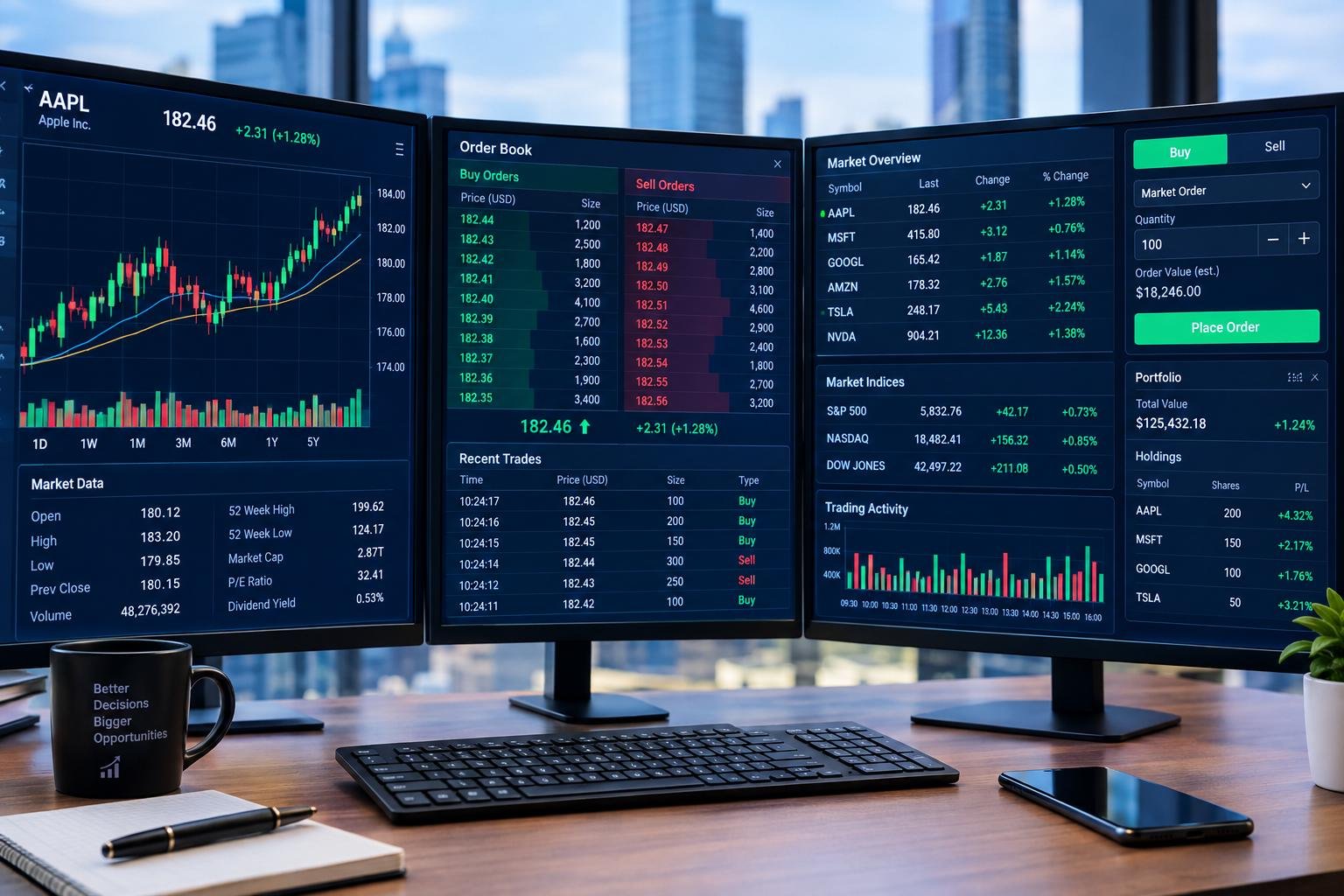
An electronic order book is the electronic record of pending trades, both for buying and selling, within a specific security. It assists an exchange to establish trading interest and price ranges for trading. The price at which buyers are willing to purchase is referred to as a buy order (also known as a bid) and the price at which sellers are willing to offer is called a sell order (also known as an ask). The “best displayed buy” and the “best displayed sell” prices are particularly significant since they are the highest bid and the lowest ask. In the example given above, if the price at which the highest bidder puts in an offer for a company’s shares is ₦1,000, while the lowest ask is ₦1,010, the difference is known as bid ask spread. When orders are compatible and they coincide in a transaction, as per the exchange’s rules, it is called a transaction. Liquidities can be shown on the order books, and the price level and order counts can be used to gain insight into the market’s available liquidity. Orders displayed, however, do not imply that a trade will be made as orders may be cancelled or modified before being traded.
3. Order Matching Engines: Bring Buyer & Seller together
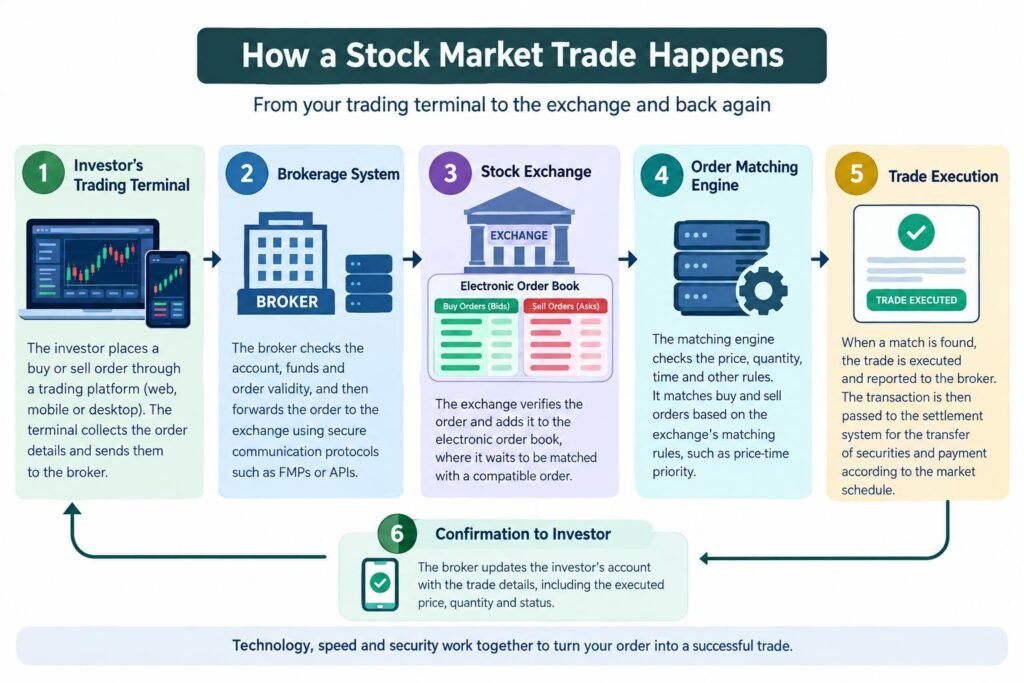
Order matching engines are a type of software systems that decide the time at which the buy and sell orders can be matched. Once an order is given to the exchange, the matching engine checks the order’s price, quantity, time and other relevant criteria. The price time priority system is another system used by many exchanges which prioritizes orders with the best price over others, and then prioritizes the orders placed first at the same price. But there are differences in matching rules between markets and trading mechanisms. For example, a buy order of ₦1050 per share might match with a sell order that asks to sell for no more than ₦1050 based on the existing order book and the rules that govern the matching of buy/sell orders. If it is not possible to fill the order in full, the engine might do the order as much as it can, and leave the rest of the order open if it is allowed to do so in the order instructions. Such systems need to make decisions in a predictable and timely manner otherwise they’ll end up with conflicting executions. Their performance relies on effective software, quick computing platforms and well-thought-out exchange rules. Matching engines are thus at the heart of a large number of electronic stock markets.
4. Market Data feeds: Real-Time Price information.
Market data feeds provide information on trading activity to other authorized subscribers such as brokers, financial institutions, trading applications, etc. These can include the latest bid and ask prices, trades completed volume of trades, updates to the trading order book, as well as the official market statistics. The exchange’s systems create relevant updates to be distributed whenever a transaction takes place or an order that has been displayed changes. Trading applications can utilize these feeds to update prices and charts, so investors can keep track of securities without having to ask for each price and chart individually. Some providers may provide a lagged or limited number of quotes, or provide more detailed real time data, depending on their agreement and subscription. Since many of the users are using market data to take decisions, the systems distributing it are required to process huge volumes of messages and deliver accurate and consistent data. Lack of data or data that is delayed or unavailable can impact the context of the market. Exchanges and vendors thus build effective distribution systems, trackers and recovery systems to ensure reliable information on the market.
5. Trading Terminals: Investor’s Interface.
A trading terminal is the platform that a trader or investor will use when watching the markets, analyzing securities and placing trades. It could be an app, a web-based platform or even specific desktop software. These include aspects such as price charts, watchlists, account balances, order entry, portfolio summaries and transaction histories. Technical indicators, research tools, alerts and detailed market depth are some of the additional features that some advanced terminals offer. Investor places an order; the terminal gathers the necessary information of the securities, order type, amount and price (if there is a price). Then it passes the request on to the broker’s systems for processing. The terminal does not always execute trades; rather it passes the investor’s instructions on to the systems that execute trades. It should be intuitive and easy to understand, with details of the order and status updates. A good user interface minimizes unnecessary errors and will help the user tell the difference between ordering and confirming and between ordering and transacting.
6. Connection through Brokers and the Path to a Trade
Typically, the individual investor is not able to directly access the infrastructure of stock exchanges but has to go through brokerage firms. Brokers offer trading accounts, take customer orders, perform checks and pass the orders that meet their criteria to exchanges or other markets where the orders can be executed. They may check the validity of the accounts, the funds, share holdings, order limits, etc., and regulatory requirements before they pass an order. The main means of communication are generally specialized financial messaging protocols (FMPs) and application programming interfaces (APIs) depending on the participants and the market. After an exchange gets the order, it verifies the order and delivers it to the suitable matching system. If there exists a trade that is compatible with the order, then a compatible order can be traded and reported back to the broker. The broker will then post the status of the order and customer’s account. This process explains the difference between the process of order placement and order execution: The accepted order can be a standing order until a counterparty is found. Settlement processes are procedures that are involved after execution and involve transferring securities and payments in accordance with the applicable timetable and procedures in the market.
7. Trading Platforms with a High Volume of Transactions
In situations where a lot of investors place orders with the stock market at the same time, the stock market needs to go on working. This demand demands high performance servers, optimized software, network engineering and an optimized data processing system that is carefully designed by exchanges and brokers. Some infrastructure is spread between machines and/or facilities to provide capacity and resilience but the exact architecture varies from organization to organization. The low latency is important specifically because delays can impact on order processing, and the transmission of market information. Internet exchanges can place their trading hardware near their computer systems to cut down on network transmission time, this is called “colocation”. They also keep track of processing speeds, message queues, network traffic, and system health, to detect performance issues. The ability to plan capacity and stress test prepares infrastructure for the unexpected demand. But with high transaction volumes, there can be pressure when major economic announcements, any corporate news and market uncertainties happen. Any engineering must be fast but also correct, fair, secure and resilient in the face of unforeseen failures.
8. Reliability, Security and Market continuity
But, reliable trading demands more than just speedy execution of orders. The exchanges and brokers must safeguard their systems against cyber-attacks, unauthorized access, hardware failures and software bugs. Some of the security measures employed can be encryption, robust authentication, access controls, monitoring, and regular software updates. Backup infrastructure, redundancy in network connections, disaster recovery plans and proven plans for restoring services following a disruption, are other aspects of operational resilience. Exchanges set up controls to limit trading activity during abnormal market conditions, while regulators/market operators may mandate the implementation of trading halts/circuit breakers under specific conditions. These measures will help to reduce the risk of disorderly activity but will not remove all the risk. Accurate record keeping is also crucial as participants require accurate information regarding the orders that are placed, trades that are made and even balances in their accounts. Organizations will therefore need to have an audit trail and a system of reconciliation to help detect discrepancies. Despite robust protections, technical issues can arise and it is essential to clearly communicate with users about any incidents and have appropriate recovery procedures in place to ensure that users continue to have confidence in the electronic markets.
9. The Future of Artificial Intelligence in Trading.
This has given stock market infrastructure much more capability, as systems are able to handle repetitive jobs quickly and consistently by applying pre-programmed rules. Algorithmic trading software can analyze the market and execute trades based on specific algorithms, while automated risk management can track market exposure and prevent trades that exceed risk parameters. Although not all institutions may leverage on AI and machine learning to help them with market surveillance, anomaly detection and analyze large financial data, those tools could help them. Although cloud computing offers scalable resources for research, analytics and supporting systems, there may be unique requirements for performance, security, and regulatory compliance that affect cloud infrastructure. APIs can, in fact, be used for integrating services and creating new trading capabilities by brokers and financial technology service providers. While these technologies can help to boost efficiency and increase market information access, they also come with their own set of challenges, including cybersecurity, model reliability, operational complexity, and oversight. Thus, automation is best implemented with good controls, attentive testing and good accountability.
Conclusion
The modern stock exchanges rely on a complex system of technologies that translate investor’s orders into a well-organized order flow. The order books are kept electronically to keep track of the interest buyers and sellers have in a particular stock; matching engines identify orders that can be matched, market data feeds provide information on price changes, and the trading terminal provides users with critical services. The exchanges are joined to brokerage systems, and high-performance infrastructure, security measures, and recovery protocols ensure smooth operations. While investors might only see a screen with prices and buttons to place orders, there are a number of systems involved in processing the transaction that need to communicate accurately to get it from the submission to execution to settlement. Trading infrastructure will follow in line with investor expectations and requirements and the evolution of automation, data analytics and financial technology. It is important for new traders and technology enthusiasts to be aware of the role these systems play in successful electronic trading and to know that making a profitable trade not only relies on the decisions made by the traders, but on the technology that enables them to connect buyers and sellers its speed, accuracy, security and reliability.
Get more well researched information about How stock market trading platforms work here.