In the year 922 CE, an Arab diplomat named Ahmad ibn Fadlan stood on the banks of the Volga River and watched a dead Viking chieftain burn inside his ship. Flames devoured the hull, the silk cushions, the sacrificed animals, and the body of a slave girl who had volunteered to follow her master into the afterlife. Ibn Fadlan, horrified and fascinated in equal measure, recorded every detail — and his account remains one of the most vivid firsthand descriptions of a Viking funeral ever written.
But that spectacular pyre on the Volga was only one expression of a complex and varied set of Norse burial customs that spanned centuries, social classes, and vast stretches of geography. The Norse did not have a single way of sending off their dead. From humble cremation pits to lavish ship burials beneath towering mounds, the way a Viking was buried said everything about how they had lived — and where they believed they were going next.
The Afterlife as Blueprint for the Funeral
To understand why Vikings buried their dead the way they did, you have to understand what they believed happened after death. Norse cosmology offered multiple destinations for the departed, and Valhalla was only the most famous of them. Warriors slain in battle could be chosen by the Valkyries to feast in Odin’s great hall, training each day for the apocalyptic battle of Ragnarök. But Valhalla was not the default. The goddess Freyja claimed half the battle-dead for her own hall, Fólkvangr. Those who died of illness or old age traveled to Hel, the shadowy realm ruled by the goddess of the same name — a place that was gloomy but not necessarily punitive in the way Christian Hell would later be imagined.
The critical point is this: the Norse believed the dead needed provisions for their journey. Whatever you placed in the grave — weapons, food, jewelry, tools, even servants — would accompany the deceased into the next world. The funeral was not merely a farewell. It was an act of equipping someone for eternity. Skimp on the grave goods, and you condemned your loved one to arrive in the afterlife as a beggar. Get it right, and they would retain the status and comfort they had earned in life.
This belief drove every aspect of Viking funeral practice, from the simplest cremation to the most extravagant ship burial. It also explains why the funerals of the powerful were so astonishingly lavish — and why even the poorest free Norseman was buried with at least a knife and a brooch.
Ship Burials: Vessels for the Final Voyage
The ship burial is the funeral practice most associated with the Vikings, and for good reason. Ships were central to Norse life — they were how the Vikings traded, raided, explored, and migrated. It follows naturally that a ship would carry the dead on their final journey, whether that meant a literal voyage across the sea to the afterlife or a symbolic one.
The most spectacular ship burial ever discovered is the Oseberg burial in Vestfold, Norway, excavated in 1904. Dating to approximately 834 CE, it contained a beautifully carved 21-meter oak ship buried beneath a massive mound of blue clay and turf. Inside lay the remains of two women — one elderly, one younger — surrounded by an astonishing collection of grave goods: an ornately carved wooden cart, four sledges, beds, chests of textiles, kitchen utensils, agricultural tools, and the skeletons of fifteen horses, six dogs, and two small cows. The identity of the primary occupant remains debated, but many scholars believe she was a queen or a völva — a seeress of considerable religious authority.
The Gokstad ship burial, discovered nearby in 1880, tells a different story. Here the occupant was a man in his forties or fifties who showed signs of a violent life — his skeleton bore marks of multiple weapon injuries. The Gokstad ship itself was larger and more seaworthy than the Oseberg vessel, a 24-meter warship that could have carried a crew of thirty-two oarsmen. He was buried with twelve horses, eight dogs, two goshawks, two peacocks, and a gaming board. Where the Oseberg burial emphasized ritual and domestic wealth, the Gokstad burial projected military power and seafaring prowess.
Not everyone who received a ship burial got an actual ship. Poorer communities sometimes outlined the shape of a vessel using stones — so-called stone ships — giving the dead a symbolic craft for their journey. These stone ship settings are found across Scandinavia, with particularly impressive examples at Lindholm Høje in Denmark, where nearly seven hundred graves include dozens of stone ships overlooking the Limfjord.
Cremation: Fire as a Gateway
While ship burials capture the modern imagination, cremation was actually the more common Viking funeral practice, especially in the earlier centuries of the Viking Age. The Ynglinga saga, composed by Snorri Sturluson in the thirteenth century but drawing on much older traditions, attributes the custom to Odin himself: “Thus he established by law that all dead men should be burned, and their belongings laid with them upon the pile, and the ashes be cast into the sea or buried in the earth. Thus, said he, every one will come to Valhalla with the riches he had with him upon the pile.”
Archaeological evidence confirms that cremation was widespread. The pyre was constructed to generate an enormous pillar of smoke, which the Norse believed literally elevated the deceased to the realm of the gods. The fire had to be hot enough to consume not only the body but also the accompanying grave goods — weapons bent or broken to “kill” them so they could pass into the spirit world, animals sacrificed to serve their owner beyond death, and personal items meant to ease the transition.
After the pyre burned out, the ashes and bone fragments were often gathered and placed in an urn or simply buried in a pit. A mound of earth or stones might be raised over the site. In some cases, the cremation took place aboard a ship, combining two powerful symbols — fire and the vessel — in a single dramatic ceremony. This is the image that dominates popular culture: the burning longship drifting into a twilight sea. While this specific practice is less well-attested archaeologically than the burial of intact ships, literary sources and the account of Ibn Fadlan confirm it did occur.
Grave Goods: Packing for Eternity
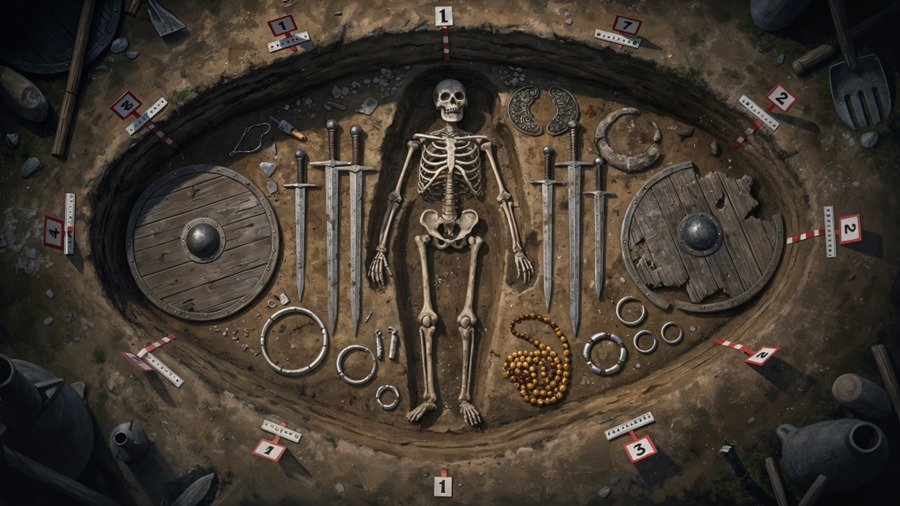
The contents of a Viking grave functioned as a kind of résumé for the afterlife. Men were typically buried with weapons — swords, axes, spears, shields — along with tools of their trade. A blacksmith might take his anvil and tongs; a farmer, his scythe and plow. Women received jewelry, textile-working equipment like looms and spindle whorls, and household items such as keys, which symbolized their authority over the domestic sphere. Both sexes were often buried with food and drink for the journey: bread, meat, grain, and vessels containing mead or ale.
The wealth of the grave goods directly reflected social standing. A thrall — an enslaved person — might receive nothing more than a shallow hole in the ground, or worse, be sacrificed to accompany a master into death. A free farmer would be buried with basic weapons and a few personal items. A jarl or chieftain could command a burial that consumed enormous resources: ships, horses, precious metals, imported silks, and the lives of servants. The Oseberg burial alone contained enough material to fill an entire museum wing, which it does to this day at the Viking Ship Museum in Oslo.
Some researchers have suggested that the practice of burying valuable goods served an economic function as well as a spiritual one. In a society without rigid inheritance laws or financial institutions, destroying wealth at a funeral may have helped prevent violent disputes among potential heirs. It is a striking theory: that the Vikings burned treasure partly to keep the peace among the living.
Ibn Fadlan’s Eyewitness Account: Death on the Volga
Ahmad ibn Fadlan was a tenth-century diplomat from the Abbasid Caliphate who encountered a group of Rus Vikings — Norse traders and warriors who had settled along the river routes of what is now Russia and Ukraine. His account of a chieftain’s funeral, written around 922 CE, is the most detailed eyewitness description of a Viking funeral that survives.
When the chieftain died, he was placed in a temporary grave for ten days while preparations were made. His wealth was divided into thirds: one-third for his family, one-third to pay for his funeral garments, and one-third for the alcoholic drink that would flow freely during the ceremony. A slave girl volunteered to die alongside him. During the ten days of preparation, she was treated with great deference, given intoxicating drinks, and accompanied everywhere by attendants.
On the day of the funeral, the chieftain’s ship was hauled ashore and placed on a wooden platform. A richly furnished bed was prepared aboard, and the dead man was dressed in fine new clothes and seated upon it, surrounded by food, drink, and weapons. Animals were sacrificed — horses, cattle, a dog, a rooster, and a hen — and their remains placed aboard the ship.
The slave girl went from tent to tent among the chieftain’s men, participating in ritual acts. She was then lifted three times above a structure resembling a door frame, and each time she reported visions: first her parents, then her deceased relatives, and finally her master in a green and beautiful paradise, beckoning her. An old woman known as the Angel of Death guided the final rituals. The girl was taken aboard the ship, given more intoxicating drink, and then killed by a combination of stabbing and strangulation while the men beat their shields to drown out her cries. The closest male relative then set the ship ablaze, and others added fuel until the entire vessel was consumed. A mound was raised over the ashes, topped with a birch-wood post bearing the names of the dead chieftain and his king.
Ibn Fadlan’s account is both invaluable and controversial. Some scholars argue it closely reflects Scandinavian practice; others note that the Rus on the Volga had absorbed influences from Turkic and Slavic cultures over generations, making it difficult to separate “pure” Norse elements from local adaptations. What is beyond dispute is that the account reveals a funeral culture of extraordinary ritual complexity — one in which death was not a private affair but a public performance that reinforced social hierarchies and cosmic beliefs.
Runestone Memorials: Words Carved in Stone
Not all Viking memorials involved burial. Across Scandinavia, thousands of runestones survive as lasting monuments to the dead. These carved stones served multiple purposes: they honored the deceased, proclaimed the status of the family who erected them, and sometimes recorded legal claims to property or inheritance.
The Jelling stones in Denmark are perhaps the most famous. The larger of the two, raised by King Harald Bluetooth around 965 CE, declares his achievements and commemorates his parents, Gorm and Thyra. It is sometimes called “Denmark’s birth certificate” for its role in proclaiming the unification of Denmark and the adoption of Christianity. The Hillersjö stone in Sweden tells the story of a woman named Gerlög who inherited property from her children and grandchildren — a poignant legal record carved in runes. The Högby Runestone records that a girl became sole heir after all her uncles perished, possibly in battle.
Runestones were typically erected along roads and paths where they would be seen by travelers, ensuring the memory of the dead endured. Many include formulaic phrases — “X raised this stone in memory of Y, his father/mother/brother” — but some go further, recording voyages to distant lands, deaths in battle, or acts of great generosity. They are the Viking Age equivalent of both tombstones and public announcements, proof that the Norse cared deeply about being remembered.
Status, Gender, and the Shape of Death
Viking funeral practices were sharply stratified by social class. At the top, kings and powerful chieftains commanded burials of staggering expense — entire ships dragged inland, dozens of animals slaughtered, rare imported goods destroyed. The Oseberg and Gokstad burials represent the pinnacle of this tradition, and they are only the ones that survived intact for archaeologists to find. Many more were likely robbed or destroyed over the centuries.
Wealthy farmers and merchants received respectable burials with weapons, tools, and some luxury goods, but nothing approaching the scale of a royal ship burial. Free men and women of modest means were cremated or inhumed with a few personal items. And at the bottom, thralls received the barest of dispositions — a pit grave, if they were lucky, or sacrifice at their owner’s funeral, after which their remains were left among the ashes.
Gender influenced burial practice in revealing ways. The Oseberg ship burial — the richest Viking Age grave ever found — belonged to women, challenging any assumption that only male warriors received elaborate funerals. Women buried with keys indicated their role as heads of household. Some female graves contain weapons, fueling ongoing debates about the existence of shield-maidens. The famous Birka warrior grave, long assumed to be male based on its weapons and gaming pieces, was confirmed through DNA analysis in 2017 to belong to a biological female — a discovery that sent shockwaves through Viking studies.
The Long Farewell
The Viking funeral was never just about disposing of a body. It was a statement of identity, a declaration of belief, and a redistribution of social power. When the flames consumed a ship on the shore of a fjord, or when mourners heaped earth over a grave filled with silver and steel, they were doing more than honoring the dead. They were telling the living — and the gods — exactly who this person had been and what their family was worth.
Christianity eventually reshaped Scandinavian burial practices, replacing cremation pyres with churchyard graves and grave goods with prayers for the soul. But the transition was gradual, and for centuries, hybrid burials blended pagan and Christian elements. A warrior might be buried in a churchyard but still clutch a sword. A woman might wear a cross pendant alongside a Thor’s hammer amulet.
What endures, across a thousand years, is the power of these rituals. The Oseberg ship, pulled from the clay in 1904, still takes your breath away. Ibn Fadlan’s words still horrify and fascinate. The runestones still stand along Scandinavian roads, their inscriptions weathered but legible, demanding that we remember the dead — just as they were meant to.