
Introduction
Retirement can seem like an elusive goal particularly when one is still in their youthful career. Nevertheless, the actions of your present will be of great influence on your financial future. Time is one of the strongest financial concepts that you can use to your advantage, namely, how time can enable your money to increase due to compound interest. This is what makes early retirement planning not only a recommendation, but also a necessity of all those who would like to retire without any financial strains.
This article will discuss the importance of getting a head start, how compound growth can work to your advantage, the various types of retirement savings you can use, real-life investment choices and how to determine how much money you will have on retirement. At the end of it, you will know how to take charge of your money and develop a retirement that will be effective to you.
Understanding Early Retirement Planning
Early retirement planning is just a matter of beginning to save and invest towards retirement as early as you can and preferably at the time you have your first source of income or job. The sooner you start, the more time your money will have to increase.
To get a more detailed idea on how to start, check this useful guide on planning early retirement to discover what you can do now.
The reason why a lot of people postpone planning their retirement is because they do not feel that they are earning enough to retire or because they think that retirement is so far off that they are not yet worried about it. It can however take only a few years to drastically diminish the wealth that you can gain over time.
The importance of an Early Start
1. The Strength of Time.
The greatest asset when planning retirement is time. Early investment gives your investments decades to appreciate even with small investments.
For example:
- As a savings by age 25 will result in close to twice the savings by age 35.
- There is a possibility to accumulate small monthly payments to substantial wealth.
2. Lower Financial Pressure
Early start means that you do not have to put away huge sums of money every month. Delaying implies you will have to make major contributions later, to make up.
3. Flexibility and Security
Early is best:
- You are able to make calculated risks of investment.
- You can recover losses in finances.
- Your goals will change and so can your strategy.
Understanding Compound Growth
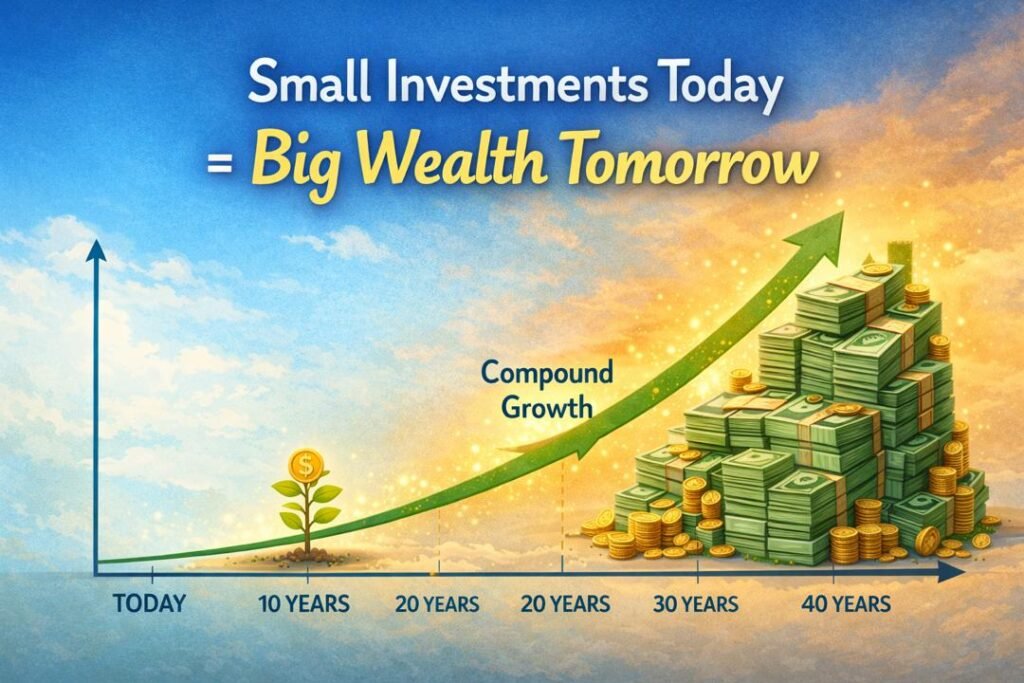
The growth of compounds is sometimes referred to as the eighth wonder of the world, and to its credit. It enables your money to increase exponentially with time.
How It Works
Compound interest implies that you not only earn returns on the sum you invested in the first place but also on the returns that will accumulate.
Example:
- You invest $1,000 at a 10% annual return.
- After one year: $1,100
- After two years: $1,210
- After ten years: $2,593
Suppose now that this increase were continued in 30 or 40 years at the same rate of contributions.
Why It Counts to Retirement.
Compounding is stronger the earlier you begin to do that. By waiting, you are losing time that your money can be growing, and this can significantly affect the amount of money you will have at retirement.
Retirement Savings Options
Saving to retire can be done in a number of ways and the combination to use varies according to the income, location and other financial objectives.
1. Pension Plans
Employers offer some pension schemes whereby you and your employer can make contributions towards your retirement fund. These strategies are stable but might not be adequate by themselves.
2. Personal Savings Accounts
An easy way to save money is by keeping it in the bank account which might not carry high interest. The value of your savings may decrease over time due to inflation.
3. Retirement Investment Accounts
There are likely to be tax-favored accounts in your country that are to be used as retirement savings. Some of the benefits that are usually provided by these accounts include tax deductions or tax deferrals.
4. ETFs and mutual funds.
A mutual fund and exchange-traded fund (ETF) will enable you to invest in a diversified portfolio of stock and bonds. They can be used in long term retirement planning because they have the potential to grow.
5. Real Estate Investments
Investing in property can provide:
- Rental income
- Long-term appreciation
- An inflation barrier.
Nevertheless, real estate needs money and management.
6. Stocks and Equities
Stock investment in the long term is more profitable but volatile. This risk can be easily dealt with by young investors because the investment horizon is long.
Investment Strategies for Retirement
An effective retirement plan must have a definite investment plan. The following are some of the important strategies:
1. Begin with Growth-Oriented Portfolio.
As a young person, you should concentrate on growth assets like stocks. These have a better payoff in the long run, although it may vary in the short run.
2. Diversify Your Investments
Avoid putting all your money in one asset. Diversification is beneficial in terms of minimizing risk through investing in:
- Stocks
- Bonds
- Real estate
- Other asset classes
3. Progressively Change to Less Risky Investments.
When you are nearing retirement age, lessen risk by transferring to less risky investments such as bonds and fixed-income investments.
4. Invest Consistently
Consistency is key. Even small regular monthly contributions can have a large growth in the long run.
5. Reinvest Your Earnings
Reinvest instead of withdrawing returns to maximize growth of compounds.
How to Estimate Retirement Needs
The biggest question that individuals ask is: How much do I retire comfortably?
1. The 70–80% Rule
One of the general rules is that you will require 70-80 percent of your pre-retirement earnings each year in the retirement.
2. Estimate Your Approximate Costs.
Consider:
- Housing
- Healthcare
- Food and utilities
- Travel and leisure
- Inflation
3. Determine Your Retirement Years.
The lifespan of the people is increasing and thus make sure that you have a minimum of 20-30 years of retirement.
4. Use the 4% Rule
The 4% rule indicates that you can take 4% of your retirement income per year and not spend it all.
Example:
- If you need $20,000 per year
- You’ll need about $500,000 saved
5. Factor in Inflation
The purchasing power of money suffers over the long term due to inflation. Don’t forget about the increasing costs when budgeting your retirement.
Errors to Avoid
1. Starting Too Late: The greatest error is to postpone the retirement planning. There is no time to be lost.
2. Depending on a single source of income: It is unsafe to rely only on the savings account or pension. Reduce the number of sources of income.
3. Ignoring Inflation: Not factoring in inflation may mean that you have inadequate money to retire on.
4. Withdrawing Early: Early access to your retirement savings means that you will grow less.
5. Lack of Planning: Spending rather than saving is simple without having a definite plan.
Effective Action Plan to begin now.
1. Set Clear Goals
Decide:
- When you desire to retire.
- The kind of lifestyle you desire.
- How much you need
2. Create a Budget
Log your income and expenses so as to determine the amount of money that you can save on a monthly basis.
3. Save an Emergency Fund.
You should have a financial back-up before committing yourself to an investment.
4. Keep It Simple and Keep It Simple.
Even minor donations are important. Consistency is the key.
5. Educate Yourself
Get to know various types of investments and strategies.
6. Seek Professional Advice
A financial advisor is someone who can assist you in developing a unique retirement plan.
Psychological Advantages of Early Planning
The retirement planning is not only about money but also influences your peace of mind.
1. Reduced Financial Stress: Being aware that you have a plan in place will lessen anxiety of the future.
2. Greater Confidence: You have a greater sense of control in your finances.
3. Freedom of Choice: With a good retirement plan you can enjoy the freedom to:
- Retire early
- Change careers
- Pursue passions
Changing Your Plan as Time Goes by
Your financial conditions will vary with time and hence your retirement plan will also vary.
1. Revise Your Plan on a regular basis: Monitor your progress every year and correct.
2. Increase Contributions: The higher your income, the higher the savings rate.
3. Make Adjustments to Life Events: Your plan should include major life events such as marriage, children or career changes.
Retirement in the Modern World
Today retirement is not the same as it was before.
1. Longer Life Expectancy
The lifespan of people is increasing and this implies that the savings of retirement will have to be sustained.
2. Changing Work Patterns
Freelancing and working at home is increasingly popular and as a result, personal retirement planning is all the more significant.
3. Rising Costs
The cost of living and health care is rising, so the earlier planning is crucial.
Conclusion
Retirement is a distant event but the sooner you begin planning the easier and more enjoyable the event would be. Planning early retirement will enable you to maximize on the growth of your compound, lessen financial stress and save a secure future.
Knowing your choices, investing well and being consistent will help you to have a retirement plan that will keep you comfortable and at ease. It is not the amount you start with, but when and whether you invest regularly that counts.
The decisions you make to-day will be appreciated by your future self. Begin now, be disciplined and make your money work the time before it will multiply, so when you retire you can live well and the life you have always dreamed of.
Get more well researched information about early retirement planning here.