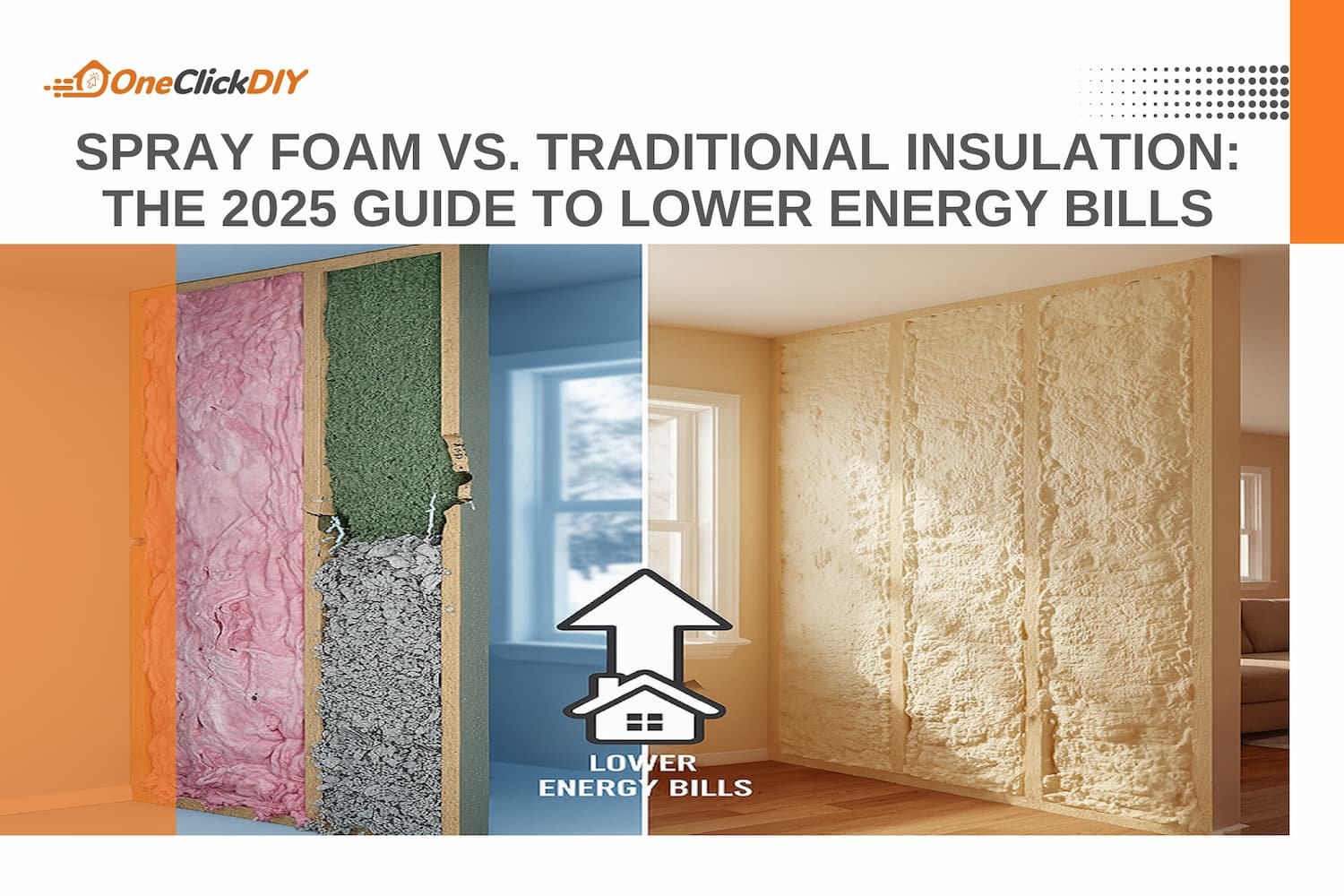
Homeowners often hear that spray foam insulation can make a house more energy efficient and reduce heating and cooling costs. That sounds appealing, particularly in a place like New York, where homes can experience significant heating demands during winter and substantial cooling loads during summer.
But does spray foam insulation really lower energy bills?
The honest answer is it can, particularly when it addresses genuine insulation and air leakage problems, but there is no universal percentage of savings that every homeowner should expect.
The amount of energy saved depends on the existing condition of the home, where the insulation is installed, how much air leakage is reduced, the HVAC system, the home’s size and construction, local weather, energy prices, and how the work is designed and installed.
This distinction is important when evaluating spray foam insulation energy savings. Spray foam should not be viewed as a magic material that automatically cuts a utility bill in half. Its potential value comes from improving the building envelope by providing insulation and, depending on the product and application, helping control uncontrolled air movement.
ENERGY STAR estimates that homeowners can save an average of 15% on heating and cooling costs, or about 11% on total energy costs, through cost-effective air sealing and insulation improvements in certain typical existing U.S. homes. That figure applies to a combination of improvements, not specifically to spray foam insulation alone.
How Does Insulation Affect Energy Bills?
Your home is constantly exchanging heat with the outdoors.
During winter, heat naturally moves from warmer areas toward colder areas. Without adequate insulation and air sealing, more of that heat can escape through the building envelope.
During summer, the process works in the opposite direction. Outdoor heat can move into the cooler interior.
Your HVAC system has to compensate for these heat transfers.
Insulation helps slow that process.
The better the building envelope performs, the less rapidly heat moves through insulated assemblies.
Air sealing addresses a related but different issue. Instead of slowing heat transfer through materials, air sealing reduces uncontrolled movement of air through cracks, gaps, joints, and penetrations.
This is one reason insulation and air sealing are often considered together.
Where Does Spray Foam Fit Into the Picture?
Spray polyurethane foam is an insulation material that is applied as a liquid and expands or reacts into a foam.
There are two common categories:
- Open-cell spray foam
- Closed-cell spray foam
They have different densities, physical properties, and applications.
One of the characteristics that makes spray foam different from some traditional insulation products is its ability to conform to certain surfaces and irregular spaces.
Depending on the product and installation, spray foam can provide both insulation and air-sealing benefits.
That can be particularly useful in areas where gaps and difficult-to-reach spaces make conventional insulation or separate air-sealing work more complicated.
However, the exact performance depends on the product, thickness, installation quality, and building assembly.
Can Spray Foam Insulation Lower Energy Bills?
Yes, it can contribute to lower energy consumption when it improves areas of the building envelope that are currently underperforming.
But the word “can” matters.
There is no responsible way to promise that every homeowner will see the same reduction in their utility bills after installing spray foam.
Consider two homes.
Home A already has well-installed insulation, good air sealing, efficient windows, and a modern HVAC system.
Home B has significant air leakage, poorly insulated attic areas, uninsulated rim joists, and noticeable temperature differences between rooms.
Installing insulation and air sealing in Home B has more potential to produce meaningful energy improvements because there are larger deficiencies to address.
The same investment may produce a much smaller change in Home A.
That is why an evaluation should come before an insulation recommendation.
Air Leakage Can Be a Major Part of the Problem
Many homeowners focus entirely on insulation when they notice high energy bills.
But air leakage can also have a major effect on comfort and energy performance.
Air can move through openings around:
- Electrical penetrations
- Plumbing penetrations
- Attic hatches
- Windows
- Doors
- Rim joists
- Duct penetrations
- Recessed lighting
- Wall-to-floor connections
- Utility openings
If these areas are not properly sealed, conditioned air can escape and outdoor air can enter.
Adding insulation without addressing major air leaks may leave part of the problem unresolved.
This is one reason spray foam insulation energy savings are sometimes associated with air sealing as much as with insulation itself.
The exact benefit depends on what the material is being used to accomplish.
Why New York Homes Can Benefit From a Strong Building Envelope
New York experiences substantial seasonal temperature changes.
Heating is a major concern during cold weather, while air conditioning becomes increasingly important during warmer months.
A home with weaknesses in its building envelope can therefore experience increased heating and cooling demands across different parts of the year.
This is especially relevant for:
- Older homes
- Homes with unfinished attics
- Properties with poorly insulated additions
- Homes with uninsulated rim joists
- Rooms over garages
- Homes with crawl spaces
- Properties with noticeable drafts
- Homes with inconsistent indoor temperatures
However, New York homes are not all built the same way.
A prewar home, a newer suburban property, and a renovated rowhouse may have completely different insulation assemblies.
The correct approach should therefore be based on the actual construction of the home.
What Areas Should Be Inspected Before Adding Spray Foam?
Spray foam can be used in several parts of a home, but not every location should automatically receive it.
A professional evaluation may examine:
Attic
Attics are a major area of heat transfer.
Depending on the home’s design, insulation may be installed at the attic floor or along the roof assembly.
The correct approach depends on whether the attic is intended to remain vented or become part of the conditioned space.
Rim Joists
Rim joists can contain numerous joints and connections between framing members.
They are also common locations for air leakage.
Spray foam may be used in appropriate rim-joist applications to address both insulation and air leakage.
Exterior Walls
Walls can lose heat when insulation is missing, poorly installed, or insufficient.
The appropriate insulation strategy depends heavily on the wall construction and whether the wall can be accessed without significant disruption.
Crawl Spaces
Crawl spaces require special attention to moisture.
If a crawl space has water intrusion, excessive humidity, or drainage problems, those issues should be addressed before insulation work.
Basements
Basement walls, rim joists, and other areas can contribute to heat loss.
The insulation strategy depends on whether the basement is conditioned, unconditioned, finished, or unfinished.
Spray Foam Insulation Energy Savings: What Should You Actually Expect?
This is where homeowners need realistic expectations.
There is no single number that can accurately predict how much a specific home will save after spray foam installation.
A contractor who promises every homeowner a specific percentage reduction should be able to explain exactly how that number was calculated.
In reality, energy savings depend on multiple variables.
| Factor | Why It Matters for Energy Savings |
| Existing insulation | A poorly insulated home has more room for improvement than a well-insulated home |
| Air leakage | Significant uncontrolled air movement can increase heating and cooling demand |
| Location of insulation | Improving a major weak point in the building envelope can have a greater effect |
| Home size | Larger homes have different heating and cooling requirements |
| HVAC efficiency | Insulation improvements interact with the performance of heating and cooling equipment |
| Windows and doors | Poorly performing windows and doors can remain sources of heat transfer |
| Climate | Seasonal temperature conditions affect heating and cooling demand |
| Installation quality | Gaps, insufficient thickness, or improper application can reduce expected performance |
| Existing building assembly | Walls, roofs, floors, and foundations behave differently |
| Household behavior | Thermostat settings, occupancy, and ventilation habits affect energy use |
| Energy prices | A reduction in energy consumption does not always translate to the same dollar savings |
| Moisture conditions | Water and moisture problems can affect insulation performance and durability |
This is why an insulation contractor should focus on the specific building rather than quoting a generic savings figure.
Does Spray Foam Make Your HVAC System Work Less?
It can reduce the amount of heating or cooling the home needs when it improves the building envelope.
Imagine a home that loses substantial heat through an inadequately insulated attic.
The heating system has to replace that lost heat.
If the attic assembly is improved, the rate of heat loss can decrease.
The HVAC system still operates, but it may not need to run as long or as frequently to maintain the same indoor conditions.
The same basic principle applies during summer.
If insulation and air sealing reduce unwanted heat entering the home, the air conditioner may have less heat to remove.
However, homeowners should not interpret this as a guarantee that their HVAC runtime or energy bill will decrease by a specific amount.
Other factors continue to affect HVAC operation.
Does Spray Foam Replace Other Energy-Efficiency Improvements?
No.
A well-insulated home can still have energy problems.
For example, your home may have excellent insulation but:
- Leaky ductwork
- Old HVAC equipment
- Poorly sealed windows
- Inefficient appliances
- Improper ventilation
- Air leaks around doors
- Excessive solar heat gain
- Poorly insulated areas that were overlooked
This is why improving energy efficiency is best approached as a whole-building process.
Insulation is one part of the building envelope.
Air sealing is another.
HVAC performance, windows, doors, ventilation, and moisture management can all matter as well.
Open-Cell vs Closed-Cell Spray Foam
Homeowners researching Spray Foam Insulation in New York will often encounter the terms open-cell and closed-cell.
They are not simply two versions of the same material.
Open-Cell Spray Foam
Open-cell foam has a lower density and a more open cellular structure.
It generally provides a lower R-value per inch than closed-cell foam.
It can be useful in certain interior applications where greater expansion and coverage are desired.
Closed-Cell Spray Foam
Closed-cell foam has a higher density and generally provides a higher R-value per inch.
It can also provide greater resistance to water vapor movement than open-cell foam, depending on thickness and product characteristics.
Its physical properties can make it appropriate for certain applications where space is limited and higher thermal resistance per inch is useful.
Neither option is automatically better for every project.
The correct choice depends on the building assembly, location, moisture conditions, required performance, and applicable code requirements.
Is Spray Foam Always the Most Cost-Effective Insulation?
Not necessarily.
Spray foam can provide valuable performance characteristics, but it is often more expensive than some conventional insulation materials.
That means the question should not simply be:
“Is spray foam better?”
A more useful question is:
“Where will this insulation provide the most value in my particular home?”
For some projects, spray foam may be an appropriate solution.
For others, fiberglass, cellulose, mineral wool, rigid foam, or a combination of materials may make more sense.
A good contractor should be willing to discuss alternatives rather than treating one material as the answer to every building.
What About New York Building Codes?
Homeowners planning insulation work in New York should also consider applicable building and energy requirements.
New York State’s 2025 Energy Conservation Construction Code became effective December 31, 2025.
The state’s energy code establishes requirements for building energy performance, including provisions concerning the thermal envelope and insulation.
The 2025 Residential Code of New York State also contains specific provisions concerning foam plastic insulation.
For example, the code addresses protection requirements for certain foam plastic applications and specifies conditions under which certain installations may be permitted without a separate thermal barrier.
The exact requirements depend on the application, location, product, assembly, and project.
New York City also has its own construction code framework, although the state energy code applies statewide.
This is particularly important for Spray Foam Insulation in New York because spray foam should not be installed based solely on a manufacturer’s marketing material or a generic online recommendation.
The installation needs to comply with applicable requirements for the specific project.
Can Spray Foam Help With Drafts?
This is one area where spray foam can provide a practical benefit when correctly installed.
If spray foam is used to seal appropriate gaps and penetrations, it can reduce uncontrolled air movement through those areas.
That can help address drafts caused by leakage.
However, not every draft originates from a location where spray foam should be applied.
For example, a draft around an improperly sealed window may require a different solution.
Likewise, a ductwork problem needs to be addressed through duct sealing rather than simply adding insulation somewhere else.
Finding the source of the draft is the first step.
What If Your Energy Bills Are Still High After Insulation?
If your energy bills remain high after insulation work, do not automatically assume the insulation failed.
There may be another issue.
Consider checking:
- HVAC efficiency
- Duct leakage
- Thermostat settings
- Window performance
- Door seals
- Air leakage
- Water heating
- Appliance energy use
- Ventilation
- Insulation coverage
- Attic and crawl-space conditions
A home energy assessment can help identify where energy is actually being used and where improvements may have the greatest potential value.
Insulation should be part of a broader strategy when necessary.
How to Get the Most From a Spray Foam Project
If you are seriously considering spray foam, focus on the quality of the project rather than simply the amount of foam being installed.
Start With an Inspection
Identify where the home is losing or gaining heat.
Identify Air Leakage
Determine whether uncontrolled airflow is contributing to comfort or energy problems.
Check for Moisture
Do not cover unresolved moisture problems with insulation.
Choose the Appropriate Foam
Open-cell and closed-cell products have different characteristics.
Follow Manufacturer Requirements
The product needs to be installed according to the manufacturer’s specifications.
Consider Building Codes
Make sure the installation meets the requirements applicable to your property and project.
Focus on the Building Assembly
The foam needs to work properly with the roof, wall, floor, or foundation assembly where it is installed.
Avoid Guaranteed Savings Claims
Energy savings should be treated as a potential result based on improved building performance, not as a guaranteed percentage.
Is Spray Foam Insulation Worth the Investment?
For some homes, it can be a worthwhile investment.
The strongest case usually exists when the home has clear insulation deficiencies, substantial air leakage, difficult-to-insulate areas, or building-envelope problems that can be effectively addressed with the chosen spray foam system.
But cost-effectiveness depends on the project.
A homeowner should consider the upfront installation cost alongside expected improvements in comfort, energy consumption, durability, and other building-performance factors.
It is also worth remembering that energy savings accumulate over time.
The investment should therefore be evaluated over the expected life of the insulation and the property, rather than based only on the first month’s utility bill.
What Homeowners Should Know About Spray Foam Installation
Spray polyurethane foam is not a simple do-it-yourself material for most whole-home applications.
Professional installation requires appropriate equipment, preparation, application technique, and attention to manufacturer instructions.
The chemicals used during installation also require appropriate handling and safety procedures.
Occupants may need to stay out of the application area during installation and for a period specified by the product manufacturer and installer.
The exact requirements depend on the product and project.
Homeowners should ask the contractor about preparation, ventilation, re-entry requirements, product documentation, and cleanup before work begins.
Spray Foam Insulation Energy Savings: The Real Answer
So, does spray foam insulation really lower energy bills?
It can, but the savings come from improving the home’s building envelope, not from the word “spray foam” itself.
If a home has significant insulation gaps or air leakage, addressing those problems can reduce the amount of energy needed to maintain comfortable indoor temperatures.
ENERGY STAR’s research supports the broader value of combining air sealing and insulation. Its estimates indicate that cost-effective improvements in typical existing homes can produce meaningful reductions in heating and cooling costs.
But those figures should not be presented as a guarantee for a particular spray foam installation.
The amount you save will depend on your home.
That is why the most reliable way to evaluate spray foam insulation energy savings is to first identify the home’s existing weaknesses and then determine whether spray foam is the appropriate solution for those areas.
Improve Your Home’s Energy Performance With Foam Insulation Solution
If you are considering Spray Foam Insulation in New York, the best starting point is not a promise of a specific reduction in your energy bill.
It is a careful look at your home’s existing insulation, air leakage, moisture conditions, construction, and energy performance.
Foam Insulation Solution can be considered when you are exploring spray foam as part of a broader insulation and air-sealing project.
The right insulation should be selected based on the building, not simply on a generic claim about savings.
When the material, location, thickness, installation, and building assembly are properly matched, improving the thermal envelope can help create a more comfortable home and potentially reduce the energy required for heating and cooling.
For homeowners researching spray foam insulation energy savings, that is the realistic takeaway. Spray foam can be an effective part of an energy-efficiency strategy, but the actual results depend on the condition and characteristics of the property.
oes Spray Foam Insulation Really Lower Energy Bills?
Homeowners often hear that spray foam insulation can make a house more energy efficient and reduce heating and cooling costs. That sounds appealing, particularly in a place like New York, where homes can experience significant heating demands during winter and substantial cooling loads during summer.
But does spray foam insulation really lower energy bills?
The honest answer is it can, particularly when it addresses genuine insulation and air leakage problems, but there is no universal percentage of savings that every homeowner should expect.
The amount of energy saved depends on the existing condition of the home, where the insulation is installed, how much air leakage is reduced, the HVAC system, the home’s size and construction, local weather, energy prices, and how the work is designed and installed.
This distinction is important when evaluating spray foam insulation energy savings. Spray foam should not be viewed as a magic material that automatically cuts a utility bill in half. Its potential value comes from improving the building envelope by providing insulation and, depending on the product and application, helping control uncontrolled air movement.
ENERGY STAR estimates that homeowners can save an average of 15% on heating and cooling costs, or about 11% on total energy costs, through cost-effective air sealing and insulation improvements in certain typical existing U.S. homes. That figure applies to a combination of improvements, not specifically to spray foam insulation alone. EENERGY STAR+1
That is an important distinction to keep in mind throughout this topic.
How Does Insulation Affect Energy Bills?
Your home is constantly exchanging heat with the outdoors.
During winter, heat naturally moves from warmer areas toward colder areas. Without adequate insulation and air sealing, more of that heat can escape through the building envelope.
During summer, the process works in the opposite direction. Outdoor heat can move into the cooler interior.
Your HVAC system has to compensate for these heat transfers.
Insulation helps slow that process.
The better the building envelope performs, the less rapidly heat moves through insulated assemblies.
Air sealing addresses a related but different issue. Instead of slowing heat transfer through materials, air sealing reduces uncontrolled movement of air through cracks, gaps, joints, and penetrations.
This is one reason insulation and air sealing are often considered together.
Where Does Spray Foam Fit Into the Picture?
Spray polyurethane foam is an insulation material that is applied as a liquid and expands or reacts into a foam.
There are two common categories:
- Open-cell spray foam
- Closed-cell spray foam
They have different densities, physical properties, and applications.
One of the characteristics that makes spray foam different from some traditional insulation products is its ability to conform to certain surfaces and irregular spaces.
Depending on the product and installation, spray foam can provide both insulation and air-sealing benefits.
That can be particularly useful in areas where gaps and difficult-to-reach spaces make conventional insulation or separate air-sealing work more complicated.
However, the exact performance depends on the product, thickness, installation quality, and building assembly.
Can Spray Foam Insulation Lower Energy Bills?
Yes, it can contribute to lower energy consumption when it improves areas of the building envelope that are currently underperforming.
But the word “can” matters.
There is no responsible way to promise that every homeowner will see the same reduction in their utility bills after installing spray foam.
Consider two homes.
Home A already has well-installed insulation, good air sealing, efficient windows, and a modern HVAC system.
Home B has significant air leakage, poorly insulated attic areas, uninsulated rim joists, and noticeable temperature differences between rooms.
Installing insulation and air sealing in Home B has more potential to produce meaningful energy improvements because there are larger deficiencies to address.
The same investment may produce a much smaller change in Home A.
That is why an evaluation should come before an insulation recommendation.
Air Leakage Can Be a Major Part of the Problem
Many homeowners focus entirely on insulation when they notice high energy bills.
But air leakage can also have a major effect on comfort and energy performance.
Air can move through openings around:
- Electrical penetrations
- Plumbing penetrations
- Attic hatches
- Windows
- Doors
- Rim joists
- Duct penetrations
- Recessed lighting
- Wall-to-floor connections
- Utility openings
If these areas are not properly sealed, conditioned air can escape and outdoor air can enter.
Adding insulation without addressing major air leaks may leave part of the problem unresolved.
This is one reason spray foam insulation energy savings are sometimes associated with air sealing as much as with insulation itself.
The exact benefit depends on what the material is being used to accomplish.
Why New York Homes Can Benefit From a Strong Building Envelope
New York experiences substantial seasonal temperature changes.
Heating is a major concern during cold weather, while air conditioning becomes increasingly important during warmer months.
A home with weaknesses in its building envelope can therefore experience increased heating and cooling demands across different parts of the year.
This is especially relevant for:
- Older homes
- Homes with unfinished attics
- Properties with poorly insulated additions
- Homes with uninsulated rim joists
- Rooms over garages
- Homes with crawl spaces
- Properties with noticeable drafts
- Homes with inconsistent indoor temperatures
However, New York homes are not all built the same way.
A prewar home, a newer suburban property, and a renovated rowhouse may have completely different insulation assemblies.
The correct approach should therefore be based on the actual construction of the home.
What Areas Should Be Inspected Before Adding Spray Foam?
Spray foam can be used in several parts of a home, but not every location should automatically receive it.
A professional evaluation may examine:
Attic
Attics are a major area of heat transfer.
Depending on the home’s design, insulation may be installed at the attic floor or along the roof assembly.
The correct approach depends on whether the attic is intended to remain vented or become part of the conditioned space.
Rim Joists
Rim joists can contain numerous joints and connections between framing members.
They are also common locations for air leakage.
Spray foam may be used in appropriate rim-joist applications to address both insulation and air leakage.
Exterior Walls
Walls can lose heat when insulation is missing, poorly installed, or insufficient.
The appropriate insulation strategy depends heavily on the wall construction and whether the wall can be accessed without significant disruption.
Crawl Spaces
Crawl spaces require special attention to moisture.
If a crawl space has water intrusion, excessive humidity, or drainage problems, those issues should be addressed before insulation work.
Basements
Basement walls, rim joists, and other areas can contribute to heat loss.
The insulation strategy depends on whether the basement is conditioned, unconditioned, finished, or unfinished.
Spray Foam Insulation Energy Savings: What Should You Actually Expect?
This is where homeowners need realistic expectations.
There is no single number that can accurately predict how much a specific home will save after spray foam installation.
A contractor who promises every homeowner a specific percentage reduction should be able to explain exactly how that number was calculated.
In reality, energy savings depend on multiple variables.
| Factor | Why It Matters for Energy Savings |
| Existing insulation | A poorly insulated home has more room for improvement than a well-insulated home |
| Air leakage | Significant uncontrolled air movement can increase heating and cooling demand |
| Location of insulation | Improving a major weak point in the building envelope can have a greater effect |
| Home size | Larger homes have different heating and cooling requirements |
| HVAC efficiency | Insulation improvements interact with the performance of heating and cooling equipment |
| Windows and doors | Poorly performing windows and doors can remain sources of heat transfer |
| Climate | Seasonal temperature conditions affect heating and cooling demand |
| Installation quality | Gaps, insufficient thickness, or improper application can reduce expected performance |
| Existing building assembly | Walls, roofs, floors, and foundations behave differently |
| Household behavior | Thermostat settings, occupancy, and ventilation habits affect energy use |
| Energy prices | A reduction in energy consumption does not always translate to the same dollar savings |
| Moisture conditions | Water and moisture problems can affect insulation performance and durability |
This is why an insulation contractor should focus on the specific building rather than quoting a generic savings figure.
Does Spray Foam Make Your HVAC System Work Less?
It can reduce the amount of heating or cooling the home needs when it improves the building envelope.
Imagine a home that loses substantial heat through an inadequately insulated attic.
The heating system has to replace that lost heat.
If the attic assembly is improved, the rate of heat loss can decrease.
The HVAC system still operates, but it may not need to run as long or as frequently to maintain the same indoor conditions.
The same basic principle applies during summer.
If insulation and air sealing reduce unwanted heat entering the home, the air conditioner may have less heat to remove.
However, homeowners should not interpret this as a guarantee that their HVAC runtime or energy bill will decrease by a specific amount.
Other factors continue to affect HVAC operation.
Does Spray Foam Replace Other Energy-Efficiency Improvements?
No.
A well-insulated home can still have energy problems.
For example, your home may have excellent insulation but:
- Leaky ductwork
- Old HVAC equipment
- Poorly sealed windows
- Inefficient appliances
- Improper ventilation
- Air leaks around doors
- Excessive solar heat gain
- Poorly insulated areas that were overlooked
This is why improving energy efficiency is best approached as a whole-building process.
Insulation is one part of the building envelope.
Air sealing is another.
HVAC performance, windows, doors, ventilation, and moisture management can all matter as well.
Open-Cell vs Closed-Cell Spray Foam
Homeowners researching Spray Foam Insulation in New York will often encounter the terms open-cell and closed-cell.
They are not simply two versions of the same material.
Open-Cell Spray Foam
Open-cell foam has a lower density and a more open cellular structure.
It generally provides a lower R-value per inch than closed-cell foam.
It can be useful in certain interior applications where greater expansion and coverage are desired.
Closed-Cell Spray Foam
Closed-cell foam has a higher density and generally provides a higher R-value per inch.
It can also provide greater resistance to water vapor movement than open-cell foam, depending on thickness and product characteristics.
Its physical properties can make it appropriate for certain applications where space is limited and higher thermal resistance per inch is useful.
Neither option is automatically better for every project.
The correct choice depends on the building assembly, location, moisture conditions, required performance, and applicable code requirements.
Is Spray Foam Always the Most Cost-Effective Insulation?
Not necessarily.
Spray foam can provide valuable performance characteristics, but it is often more expensive than some conventional insulation materials.
That means the question should not simply be:
“Is spray foam better?”
A more useful question is:
“Where will this insulation provide the most value in my particular home?”
For some projects, spray foam may be an appropriate solution.
For others, fiberglass, cellulose, mineral wool, rigid foam, or a combination of materials may make more sense.
A good contractor should be willing to discuss alternatives rather than treating one material as the answer to every building.
What About New York Building Codes?
Homeowners planning insulation work in New York should also consider applicable building and energy requirements.
New York State’s 2025 Energy Conservation Construction Code became effective December 31, 2025.
The state’s energy code establishes requirements for building energy performance, including provisions concerning the thermal envelope and insulation.
The 2025 Residential Code of New York State also contains specific provisions concerning foam plastic insulation.
For example, the code addresses protection requirements for certain foam plastic applications and specifies conditions under which certain installations may be permitted without a separate thermal barrier.
The exact requirements depend on the application, location, product, assembly, and project.
New York City also has its own construction code framework, although the state energy code applies statewide.
This is particularly important for Spray Foam Insulation in New York because spray foam should not be installed based solely on a manufacturer’s marketing material or a generic online recommendation.
The installation needs to comply with applicable requirements for the specific project.
Can Spray Foam Help With Drafts?
This is one area where spray foam can provide a practical benefit when correctly installed.
If spray foam is used to seal appropriate gaps and penetrations, it can reduce uncontrolled air movement through those areas.
That can help address drafts caused by leakage.
However, not every draft originates from a location where spray foam should be applied.
For example, a draft around an improperly sealed window may require a different solution.
Likewise, a ductwork problem needs to be addressed through duct sealing rather than simply adding insulation somewhere else.
Finding the source of the draft is the first step.
What If Your Energy Bills Are Still High After Insulation?
If your energy bills remain high after insulation work, do not automatically assume the insulation failed.
There may be another issue.
Consider checking:
- HVAC efficiency
- Duct leakage
- Thermostat settings
- Window performance
- Door seals
- Air leakage
- Water heating
- Appliance energy use
- Ventilation
- Insulation coverage
- Attic and crawl-space conditions
A home energy assessment can help identify where energy is actually being used and where improvements may have the greatest potential value.
Insulation should be part of a broader strategy when necessary.
How to Get the Most From a Spray Foam Project
If you are seriously considering spray foam, focus on the quality of the project rather than simply the amount of foam being installed.
Start With an Inspection
Identify where the home is losing or gaining heat.
Identify Air Leakage
Determine whether uncontrolled airflow is contributing to comfort or energy problems.
Check for Moisture
Do not cover unresolved moisture problems with insulation.
Choose the Appropriate Foam
Open-cell and closed-cell products have different characteristics.
Follow Manufacturer Requirements
The product needs to be installed according to the manufacturer’s specifications.
Consider Building Codes
Make sure the installation meets the requirements applicable to your property and project.
Focus on the Building Assembly
The foam needs to work properly with the roof, wall, floor, or foundation assembly where it is installed.
Avoid Guaranteed Savings Claims
Energy savings should be treated as a potential result based on improved building performance, not as a guaranteed percentage.
Is Spray Foam Insulation Worth the Investment?
For some homes, it can be a worthwhile investment.
The strongest case usually exists when the home has clear insulation deficiencies, substantial air leakage, difficult-to-insulate areas, or building-envelope problems that can be effectively addressed with the chosen spray foam system.
But cost-effectiveness depends on the project.
A homeowner should consider the upfront installation cost alongside expected improvements in comfort, energy consumption, durability, and other building-performance factors.
It is also worth remembering that energy savings accumulate over time.
The investment should therefore be evaluated over the expected life of the insulation and the property, rather than based only on the first month’s utility bill.
What Homeowners Should Know About Spray Foam Installation
Spray polyurethane foam is not a simple do-it-yourself material for most whole-home applications.
Professional installation requires appropriate equipment, preparation, application technique, and attention to manufacturer instructions.
The chemicals used during installation also require appropriate handling and safety procedures.
Occupants may need to stay out of the application area during installation and for a period specified by the product manufacturer and installer.
The exact requirements depend on the product and project.
Homeowners should ask the contractor about preparation, ventilation, re-entry requirements, product documentation, and cleanup before work begins.
Spray Foam Insulation Energy Savings: The Real Answer
So, does spray foam insulation really lower energy bills?
It can, but the savings come from improving the home’s building envelope, not from the word “spray foam” itself.
If a home has significant insulation gaps or air leakage, addressing those problems can reduce the amount of energy needed to maintain comfortable indoor temperatures.
ENERGY STAR’s research supports the broader value of combining air sealing and insulation. Its estimates indicate that cost-effective improvements in typical existing homes can produce meaningful reductions in heating and cooling costs.
But those figures should not be presented as a guarantee for a particular spray foam installation.
The amount you save will depend on your home.
That is why the most reliable way to evaluate spray foam insulation energy savings is to first identify the home’s existing weaknesses and then determine whether spray foam is the appropriate solution for those areas.
Improve Your Home’s Energy Performance With Foam Insulation Solution
If you are considering Spray Foam Insulation in New York, the best starting point is not a promise of a specific reduction in your energy bill.
It is a careful look at your home’s existing insulation, air leakage, moisture conditions, construction, and energy performance.
Foam Insulation Solution can be considered when you are exploring spray foam as part of a broader insulation and air-sealing project.
The right insulation should be selected based on the building, not simply on a generic claim about savings.
When the material, location, thickness, installation, and building assembly are properly matched, improving the thermal envelope can help create a more comfortable home and potentially reduce the energy required for heating and cooling.
For homeowners researching spray foam insulation energy savings, that is the realistic takeaway. Spray foam can be an effective part of an energy-efficiency strategy, but the actual results depend on the condition and characteristics of the property.