Introduction
Academic English is what many ESL students’ success in the classroom, in their exams, and in professional settings turns on. What many of these learners struggle with is not that they don’t have good things to say but that they are unable to present their ideas in an academic structure. Poor grammar, confusing sentence structure, small vocabularies, and lack of coherence are what bring down the quality of many reports and essays which may otherwise have good content.
We have put together this 30 day improvement program which is to help students to develop into better writers over time. Instead of trying to learn rules by heart we put the stress on daily practice which in turn will improve grammar, sentence structure, vocabulary, and logical flow in their writing thus over time producing clearer, more confident and professional work.
Why Academic Writing Skills Matter
Academic writing is beyond the scope of what is required for an exam; it is a means of communication in essays, research papers, emails, reports and also in scholarship applications. What we put out in an academic context has to be clear or our audience may misinterpret what we are saying which in turn may also reflect that we don’t have our concepts straight. Also strong academic work displays critical thought, structure and attention to detail.
In terms of results it also pays off as examiners put a great deal of value in how well put together a piece of work is as opposed to what is put forth. For ESL students we see that as they master academic writing they also gain confidence in putting forward complex ideas in English. Also this skill set is very useful in the real world in which we are expected to write formal emails, report on projects, or communicate in professional settings which at all times require clarity and precision.
Overview of the 30 Day Writing Improvement Plan.
Grammar base, sentence structure growth, vocabulary increase, and coherence in writing is what we see in each stage of the process which we have designed to not overwhelm the students. We take it stage by stage so that daily practice is in small but consistent elements rather than trying to take in all at once. Each day’s work includes very targeted drills like reworking sentences, fixing grammar issues, increasing vocab use, and bettering paragraph flow. Over time what we see is that the repeated exercises change how students think in English. We get them out of the habit of translating from their native language into forming thoughts directly in academic English which in turn greatly improves fluency, accuracy and confidence in writing.
Week 1: Foundational Grammar Skills.
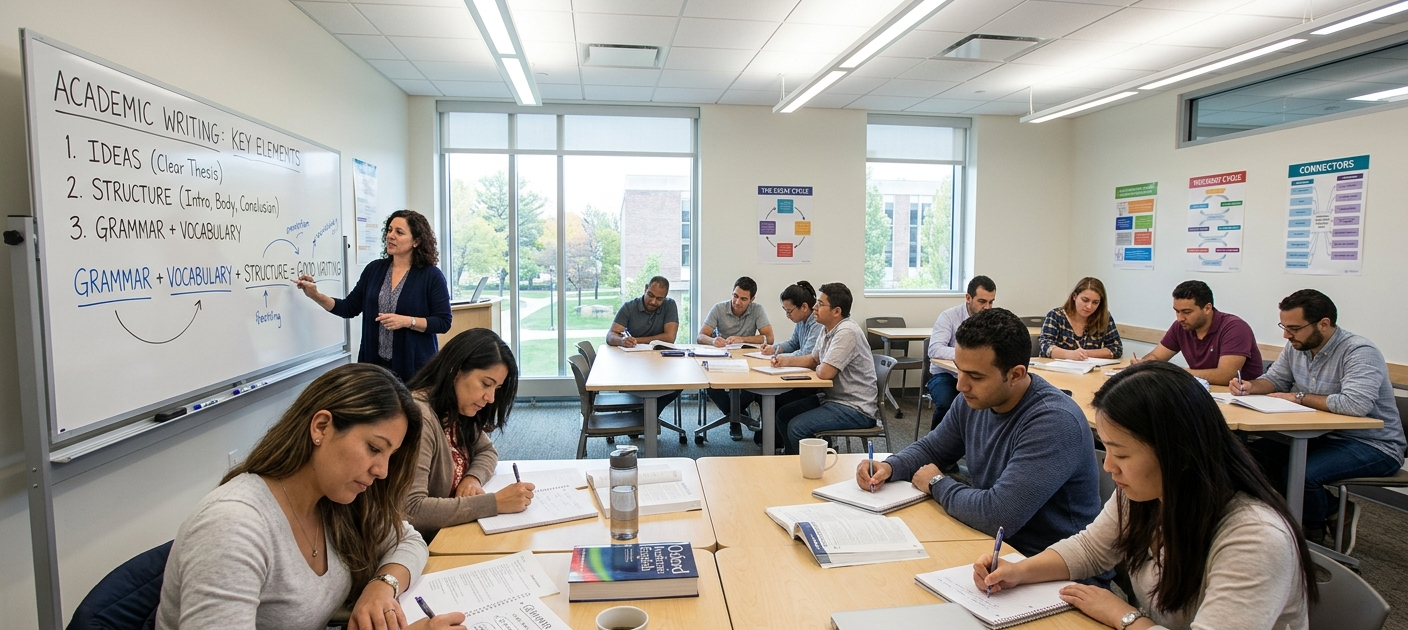
In the first week we focus on grammar which is the base of academic writing. Out of all the elements that go into a piece of academic work, proper grammar is what really gets noticed. Students should work on subject-verb agreement, use of appropriate tense, punctuation, and crafting complete thoughts in their sentences. It isn’t about memorizing the rules of grammar in a vacuum but rather to integrate their use in short writing assignments every day. Also very effective is in class error correction we have students find and fix errors in sample sentences. Also we have them take simple sentences out of everyday use and turn them into more formal academic language. What is most important at this stage is consistency from the student that they pay attention to grammar issues in everything they write because that is what will make their essays, reports, and emails clear and easy to read.
A resource I would recommend for structured grammar practice is through our daily drills which provide exercises that help learners improve accuracy through repetition. This week we ask that students put in at least 10-15 minutes of grammar drills daily. For instance they may take a sentence like “He go to school every day” and correct it to “He goes to school every day. Over time what we see is that these small corrections train the brain to spot errors. By week’s end students should see that they are making fewer basic grammar mistakes and have improved sentence accuracy in their writing.

Week 1 Practice Drills and Daily Schedule.
Daily what goes into the practice of grammar should be structured for it to be effective. Students begin with recognizing five grammar errors in given sentences, which is followed by their correction of five wrong sentences. Also they should put forth three original sentences which apply a particular grammar rule like past tense or passive voice. This mix of identification, correction and production does in depth what the rule setting out to do.
Also in terms of what we do with mistakes which we identify, it is important to review them daily as opposed to ignoring them which plays into memory retention. We also encourage students to write slowly and carefully at this stage as accuracy is what we are after more than speed. By this way students begin to internalize the grammar rules which in turn takes the guess work out of actual writing tasks and also does not leave them feeling overwhelmed or confused.
Week 2: Improving Sentences’ Formulation.
In the second week we look at sentence structure which in turn improves the clarity and readability of writing. Many ESL students put out short, broken up or repetitive sentences which in turn brings down the academic quality of their work. At this stage students learn how to put together ideas using words like “however”, “because”, “therefore” and “although”.
Also they practice varying sentence length to avoid monotony. In academic writing there is a balance between simple and complex sentences which is what we are after a flow that is also clear. We do exercises which include taking two simple sentences and making them into one complex sentence and also we work on breaking up long sentences to make them at once clearer and more precise.
Week 2 Practice and Before-and-After Example
In the present week a useful exercise is sentence transformation. For example, what was a weak sentence like “I was tired. I studied for the exam. It was difficult” can be improved to “Although I was tired I studied for the exam because it was difficult. That version puts forth a clearer logic and better structure. Also we see it in “The weather was bad.
We stayed at home” which may be reworked into “Because the weather was bad we stayed at home. These exercises help students’ comprehension of how sentence structure changes meaning and flow. By practice each day students’ begin to naturally create more complex sentences that in turn improve the total quality of essays and academic writing tasks.
Week 3: Growing Academic Vocabulary.
In the third week we focus on vocabulary development which is very important for putting forward ideas precisely and professionally. Also many ESL students tend to use simple words like “good, “bad, “nice, or “important” which results in very repetitive and unpolished writing. In academic writing it is important that you use more precise and formal words such as “beneficial, “negative, “significant, or “impactful.
The goal is not to include complex words for the sake of it but to choose the best word for each case. Our daily exercise in vocab study includes learning of 5 new academic words, writing out example sentences, and in which we also take out the easy words in present paragraphs and replace them with better choices.
Week 3 Practice and Before-and-After Example
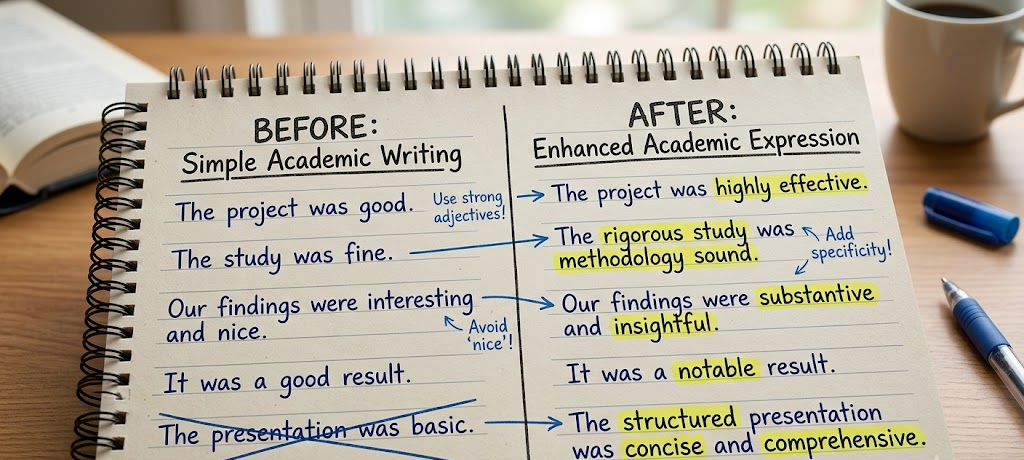
Vocabulary growth is best when put into practice in context. For example a weak paragraph may say, “The project was good and had many good results. This can be improved to “The project was effective and reported many of our success stories. Also we see that changing “The student was very smart” to “We saw that the student had exceptional academic ability” does the trick.
Also students should work on reworking short essays in which they use new vocab they have learned. Over time what we see is that this practice develops a better academic tone and breaks out of the rut of repetition which in turn makes the essays more interesting and fit for higher academic standards.
Week 4: Improving Coherence and Logical Flow.
In the final week we will focus on coherence which is the flow of ideas from one sentence to another and from one paragraph to the put forth. Though good grammar and vocabulary are a must, a piece of writing may still come off as weak if the ideas are not presented in a connected way.
Coherence is achieved via transition words, strong topic sentences, and structured development of paragraphs. Students should practice in putting their ideas in order before they write and in using linking phrases such as “in addition”, “as a result”, “on the other hand” and “therefore”. The aim is to take the reader through the argument smoothly without confusion or large scale changes in direction.
Week 4 Practice and Before-and-After Example
A poorly connected paragraph might say: Technology is a great tool that which students use to great effect. In fact we see that students are very much into their phones which in turn they use to access a wealth of educational material that in turn helps them do better in various subjects.
Also in terms of structure which is a key element in presenting your thoughts clearly, daily practice should focus on transforming incoherent collections of ideas into well thought out arguments. This is very much the case in essays which are what we present to examiners who expect to see our thoughts present in a natural and logical progression from the intro to the conclusion.
Common Mistakes ESL Students Should Avoid
Many of our ESL students present with the same issues which in turn lower the quality of their writing. We see a great deal of direct translation from native language which in turn results in off structure in English. Also students tend to over use basic words instead of building up their vocabulary. Also some students write very long sentences which lack proper punctuation which in turn confuse the presented ideas. Also we see the issue of not properly connecting paragraphs which in turn leaves essays unorganized.
To avoid these issues which are what we see play out the most in class, students must become aware of them and put in regular practice. Also they should always go back to review what they have written, check for grammar issues and that each paragraph has a point. Also editing is just as important as the writing process itself in academic success.
Final Tips and Conclusion
In just 30 days students’ academic English writing can be improved which is very achievable if they are dedicated to regular practice. What is important is progress not perfection which may be achieved via daily work on grammar, sentence structure, vocabulary and coherence.
Each week we build upon a new set of skills which in turn will improve overall writing ability. Also students should read academic works which will give them a feel of professional writing structure. Most importantly they should practice writing every day, even if it is just a short paragraph. With discipline and repetition any ESL student may see great improvement in their writing quality in a short month.