Introduction
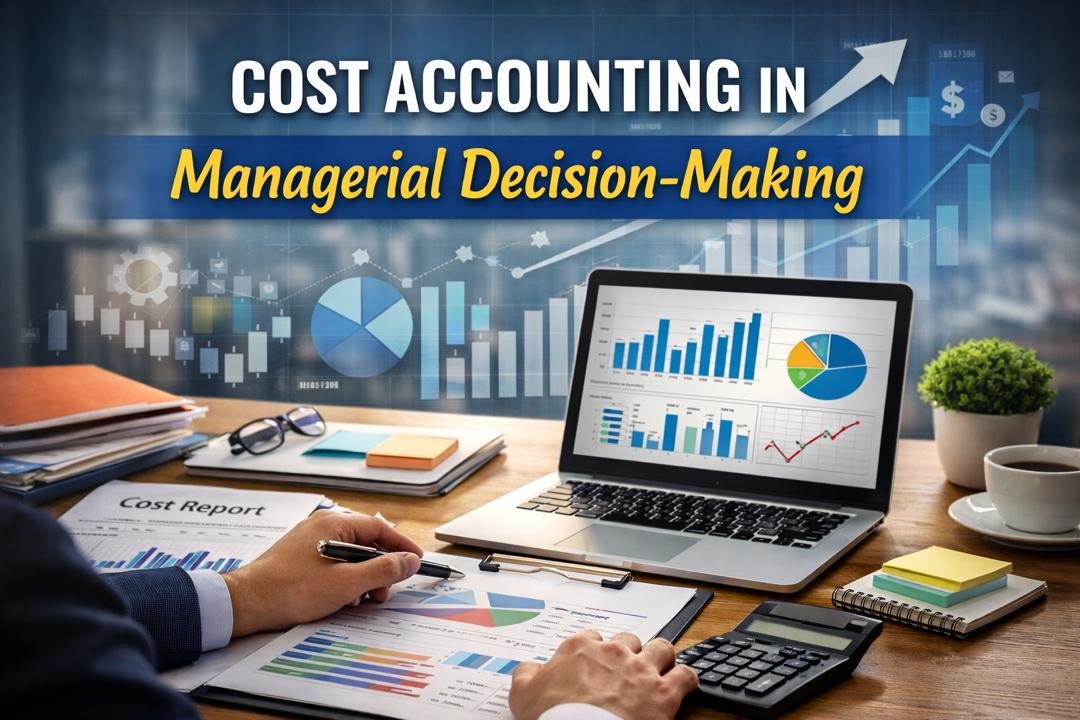
In present which is a very competitive and dynamic business environment managers are constantly put in the position to make decisions which determine the success or failure of their organizations. From setting product prices to controlling expenses and evaluating performance, at each turn managers rely heavily on accurate and timely financial info. This is where cost accounting in managerial decision-making comes in as a very important tool. By the systematic collection, analysis and interpretation of cost data, cost accounting provides managers with the info they need to make informed and effective decisions.
Cost accountancy takes in beyond what is presented in traditional financial reports by looking at internal processes and putting out in detail the costs related to production, operation, and service. It also plays a role in which we see how money is spent, how resources are put to use, and what we must do to improve profit. In this article we look at the very important role cost accounting in managerial decision-making plays, which also includes its support of planning, control, and strategic choice across many business functions.
Understanding Cost Accounting
Cost accountancy is a field of accounting for which we do the recording, classification, analysis, and allocation of costs related to the production of goods or services. Its main function is to supply in depth cost info to internal users which are mostly managers for use in making informed decisions.
In contrast to financial accounting that reports to the external public what the company has achieved in terms of finance, cost accounting is a more internal focused function. It looks at better ways to run the business, at controlling cost and at what makes the company profitable. Also cost accounting takes it a step further by breaking out cost into elements like direct materials, direct labor, and overhead which in turn gives a better picture of which resources the organization is using.
For which in to delve into the basics, we have in depth material on cost accounting and its role in good management decision making.
How Cost Data is Collected
First out of the gates in cost accounting is the collection of cost data. What we do is we collect accurate data which is of great importance because all that follows in terms of analysis and decision making is based on it. What companies use for gathering cost info varies according to what the company does and how they operate.
1. Source Documents.
Cost information is recorded at first from source documents which include invoices, receipts, payroll reports, and purchase orders. These documents serve as proof of transactions and also guarantee that costs are recorded accurately.
2. Cost Segmentation.
Once we have the costs we put them into different categories:
- Direct Costs: Costs that is easily traceable to a product or a service (e.g., raw materials, production workers’ wages).
- Indirect Costs: Costs that are not directly tied in (e.g. rent, utilities, and administrative expenses).
3. Cost Centers
Organizations typically segment their operations into cost centers which may be divisions or units where in fact the incurrence of costs is tracked. This in turn enables managers to better control and report on expenses related to particular areas of the business.
4. Costing methods.
Different cost methods are used in various businesses:
- Job Order Costing: For customized solutions.
- Process Costing: For large scale production.
- Activity-Based Costing (ABC): Allocates resources based on activities which cause costs.
By means of structured data collection systems organizations report accurate and relevant cost info for decision making.
Analysis and Interpretation of Cost Data
After we collect the cost data in hand the next step is analysis and interpretation which in turn transforms raw data into useful information that managers use to make decisions.
1. Cost Study Analysis
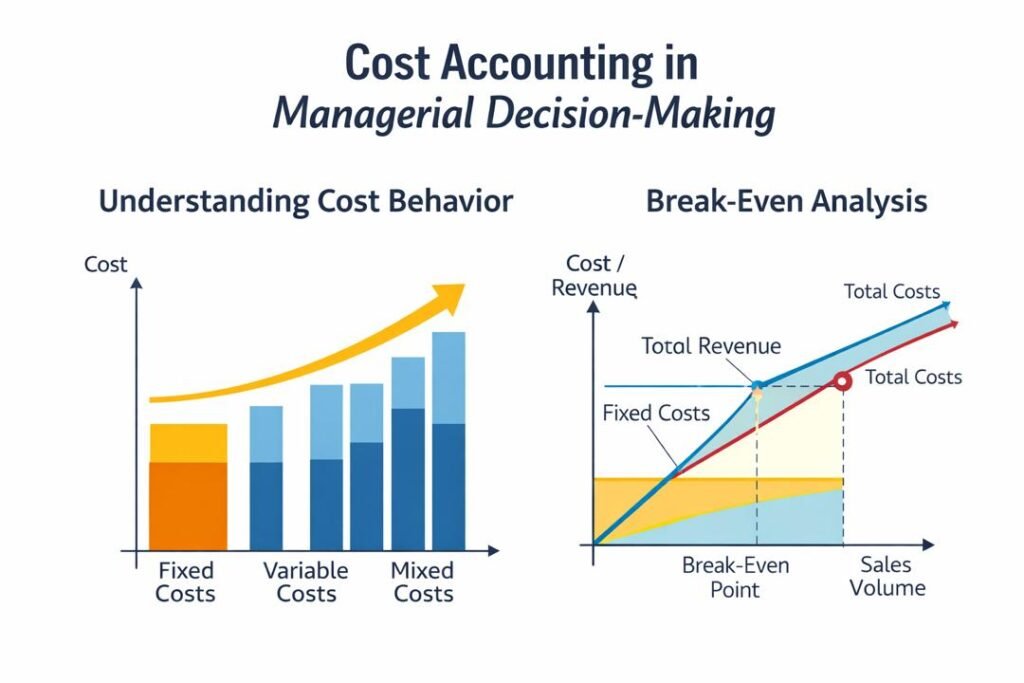
Costs are looked at in terms of how they change with variation in activity levels:.
- Fixed Costs: Stay the same regardless of production volume.
- Variable Costs: Proportionate to output.
- Mixed Costs: Include both fixed and variable elements.
Understanding the behavior of costs which in turn helps managers predict how costs will vary in different situations.
2. Cost Volume Profit (CVP) Analysis.
CVP analysis looks at the interaction between costs, sales volume, and profits. It also reports that which:
- Break-even point
- Target profit levels
- Impact of price changes or cost.
This analysis is important in planning and decision making.
3. Variance Report.
Variance analysis is of the nature that it looks at actual costs as compared to budgeted or standard outlays. Discrepancies (variances) are looked at which in turn point out issues of inefficiency or areas for improvement.
4. Marginal Costing.
Marginal cost is what we look at when we want to see the extra cost of that very next unit. Also it is a tool which we use for quick decisions which play out in the short term like which special orders to take or what prices to set.
Through our analysis which cost accounting puts to use to provide information that in turn guides management in their decision making.
Role of Cost Accounting in Planning
Planning is a basic task of management and cost accounting is very much a part of it.
1. Fiscally managing budgeting.
Costing methods help prepare budgets out into future costs and revenues. Budgets act as the organization’s road maps.
2. Forecasting
Managers present which cost data in to determine what the future holds in terms of demand, production levels, and expenses. Exact forecasts in this area allow for better resource allocation and strategic planning.
3. Decision Analysis.
Cost accountancy provides the data which in turn supports decision models. Managers are able to look at various scenarios and choose the best cost wise.
4. Resource Allocation
Through analysis of cost structures managers are able to better allocate resources which in turn increases productivity and profit.
Effective preparation which is what good planning is about for the issues which will present themselves in the future.
Role of Cost Accounting in Control
Control is in the assessment of performance and sees to it that the organization’s goals are met. Cost accounting is the field that provides the tools for which effective control is achieved.
1. Costing System.
Standards are set in advance and used as a basis for comparison. Actual results are put against these standards to identify variances.
2. Performance Measurement.
Cost accountancy which reports out performance at different levels departments, processes, and individuals. This in turn helps to identify strengths and weaknesses.
3. Cost Control Strategies.
Managers use cost analysis tools which include:
- Budgetary control
- Variance analysis
- Cost reduction programs
4. Accounting Responsibility.
Responsibility accounting places on managers the duty to account for costs which they have control over. Also it brings about greater efficiency and accountability in the organization.
Through which these functions cost accounting what is to see that which operational elements are in support of the organization’s goals.
Strategic Decision-Making and Cost Accounting
In addition to planning and control issues, cost accounting is a key element of strategic decision making. Managers use cost information in making out to five year decisions which in turn shape the company’s direction.
1. Price Setting.
Setting the right price for products and services is very important for profit. From cost accounting we get information on production costs which in turn enable managers to set prices that at least cover cost and also generate profit.
2. Make or buy decisions.
Organizations are put in the position of deciding between making products in house or outsourcing. Cost accounting is a tool which we use to compare the two options.
3. Product Mix Choices.
When resource availability is an issue managers have to choose which products to focus on. Cost accounting in this case is a tool which helps identify the most profitable products.
4. Investment Choices.
Cost accounting is that which reports out cost estimates and analyses also what which may be returned on investment.
5. Growth and Diversification.
In terms of growth or diversity managers use cost data to determine feasibility and risk.
Strategic decisions are based on precise and relevant info which cost accounting provides for.
Real-World Applications of Cost Accounting
Cost accounting is practice not just theory and use in many industries.
1. Industrial Sector.
In terms of manufacturing, cost accounting is used for tracking production costs, improving efficiency, and reducing waste. We see that processes costing and activity based costing which are very common.
2. Business Services.
Service organizations apply cost accounting to set what they charge for services which in turn determines price competition.
3. Retail Trade.
Retailers use cost accounting for inventory management, expense control, and price optimization.
4. Health care.
Hospitals and health care providers use cost analysis to manage costs, improve service delivery, and ensure financial sustainability.
5. Public Sector and Nonprofits.
Public in the government sector cost accounting is used for accountability and efficient resource use.
These real world examples present the value and utility of cost accounting in various settings.
Role of Cost Accounting in Performance Evaluation
Performance evaluation is a key to organizational success and cost accounting supplies the required metrics.
1. Key Performance Indicators (KPIs).
Cost accounting is used for setting KPIs in terms of cost efficiency, productivity and profitability.
2. Benchmarking
Organizations that which perform against industry standards do so to identify areas for improvement.
3. Reward Structures.
Performance based incentives which focus on cost efficiency and profit performance thus encouraging better employee performance.
4. Continuous Growth.
Cost accounting contributes to continuous improvement by finding out which processes are not efficient and putting forth solutions.
Through accurate performance assessment which in turn improves cost accounting we see that which is good for the organization’s growth and success.
Challenges in Cost Accounting
Although it has its issues cost accounting still does.
- Data Quality: Inexact data results in making wrong decisions. Data accuracy is of great importance.
- Complication: Cost accounting processes are often very complex which in turn requires professional skill for their management.
- Altering Business Landscape: Rapidly changing technology and market conditions call for continuous improvement of cost accounting systems.
- Distribution Problems: Allocating indirect costs precisely is difficult which in turn may affect decision making.
To overcome these challenges is important in improving the effectiveness of cost accounting.
The Future of Cost Accounting
With the advance of technology cost accounting is transforming very quickly. We see that which traditional practices of collecting and analyzing cost data are being replaced by modern tools like data analytics, artificial intelligence, and enterprise resource planning (ERP) systems.
- Automation: Automation has reduced human error and increased efficiency in data collection and processing.
- Present time Data: Managers at present have access to live cost info which in turn gives them the ability to make faster and better informed decisions.
- Integration of Technology: Cost accounting is becoming more integrated into other business processes which in turn are giving us a full picture of how the organization is performing.
- Strategic Direction: Cost accounting is transforming into a strategic decision making tool.
These are issues which are adding to the value of cost accounting as a management tool.
Conclusion
Cost accounting is an integral part of managerial decision making. It provides in depth and precise cost data which in turn enables managers to plan better, control processes, and make strategic choices that in turn put the organization on a path to success.
In terms of gathering and analyzing cost data as well as in support of pricing, cost control, and performance evaluation, cost accounting in managerial decision-making plays many roles within business management systems. The wide range of use in different industries shows that it is a very important in which it provides for better performance, less costs, and greater profitability.
Despite issues like accurate data input and complex systems which we have seen, we are at the same time witnessing great technological advances which are making cost accounting tools more powerful and also very accessible.
At its core cost accounting is a strategic asset which gives managers the ability to make informed decisions, use resources well, and achieve long term success.
Get more well researched information about Cost Accounting in Managerial Decision-Making here.