Introduction
In today’s business and finance environment math is a key element in which we see companies make informed decisions. Of these tools which are at play differential calculus in accounting and economics is the stand out method for looking at change over time in financial reports. We see this in the analysis of how profit increases, what causes certain costs to go up or down, and also in the study of market trends. Also this in turn is used by accountants and economists to do better interpretation and planning
Many of our students put calculus in a box for engineering and physics. But what they don’t realize is that in accounting and economics we also see very heavy use of math. What we see is that financial actions are constant revenue goes up and down, we see fluctuations in production costs, and we see a very dynamic play out in market demand. To really see what is going on here professionals use tools like limits, continuity, and derivatives.
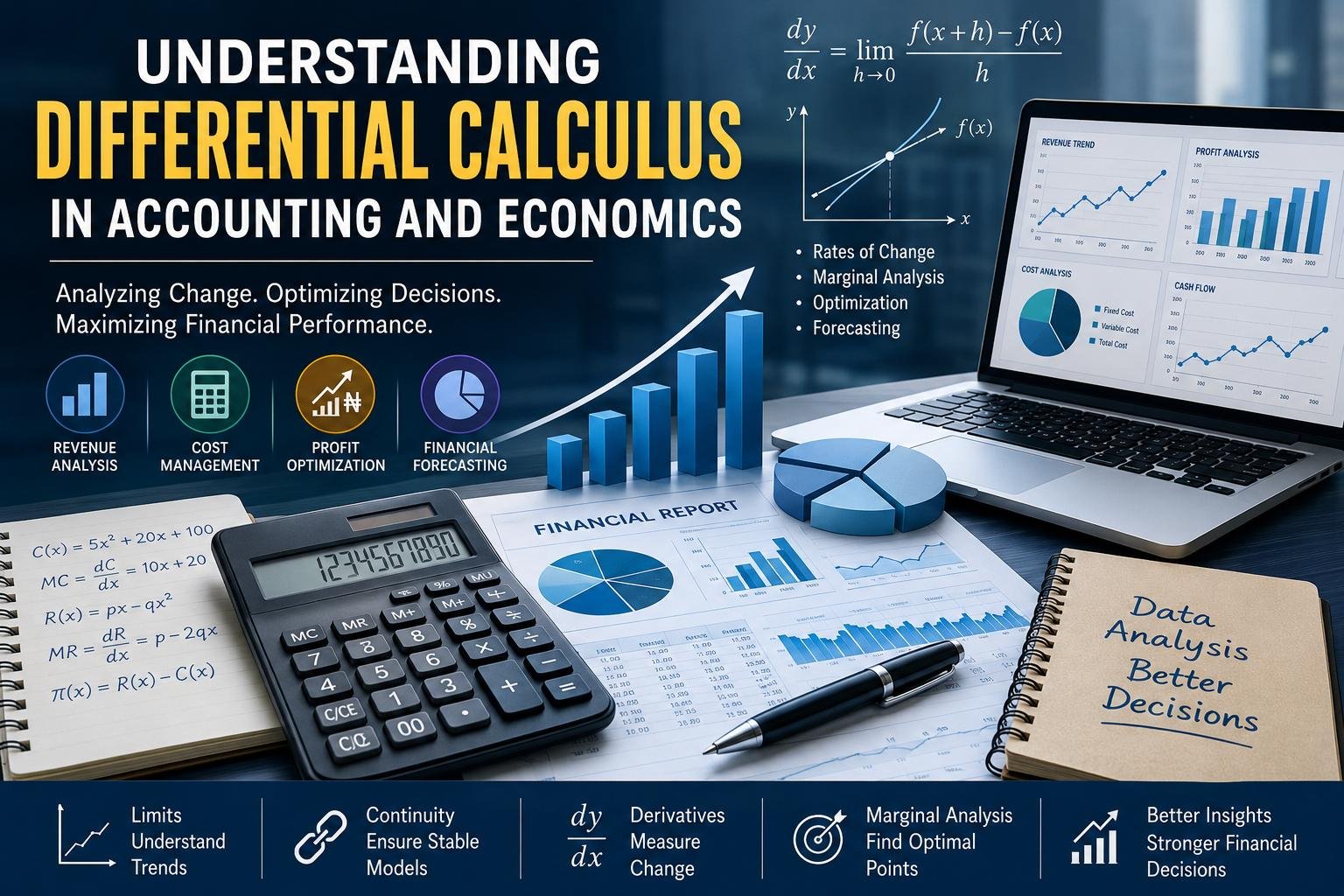
This article focused on the value of differential calculus in accounting and economics which we see in terms of how mathematically based tools allow businesses to study revenue, cost, and profit relationships. Also we look at how ideas from limits, continuity, and derivation from first principles play a role in improved financial analysis and economic interpretation.
What Is Differential Calculus?
Differential calculus is out of the fields of math which studies the change in quantities. It looks at rates of change and slopes of curves. In business and economics that is to say we are looking at how fast costs, profits, prices, or revenues are going up or down over time. Calculus in the field of accounting is put forward to improve professionals’ predictability and to base decisions on which financial issues are in motion. Instead of looking at only fixed numbers, we see calculus as a tool to study trends.
For example:
- What is the increase in profit from a small rise in production?
- When do we see an increase in cost with respect to labor expenses?
- At which point does growth in revenue stop?
- How much does demand respond to price changes?
- Differential calculus is the tool which we use to solve these problems.
Importance of differential calculus in accounting
In today’s dynamic business environments the role of differential calculus in accounting has grown in importance. Also financial managers are to not only know present numbers but also what to expect in the future.
In accountancy which issues of calculus address include:
- Measuring rates of financial growth
- Predicting future costs and revenues
- Determining maximum profit levels
- Analyzing marginal cost and marginal revenue.
- Analyzing business trends over time
- Supporting economic forecasting and budgeting
Without calculus businesses would have a hard time to measure the effect of small changes in production, pricing, or investment.
Understanding Limits in Accounting and Economics
In differential calculus a fundamental concept is the limit which is the value a function approaches as the input approaches a certain point. In the fields of accounting and economics we see that which models of economic behavior at extreme points is of great value. Businesses also put in to practice tools which enable them to determine what happens as production scales up to full capacity or what the markets do as prices come in to very close proximity of certain thresholds.
Simple Meaning of Limits
For instance, a business may see its production costs change as output grows. Accountants in this case will be interested in what the cost tends to as production scales very large. We use limits to determine this trend which may in fact not even have an exact value.
Application of Limits in Financial Analysis
In many areas of accounting and economics we see the use of limits:
Cost Estimation
Businesses can determine how production costs change as manufacturing scales up. This helps to see if expansion will pay off in the long term.
Investment Growth
Economists look at what happens as we approach limits in the study of compound interest and investment growth over long terms. As time goes on limits help us to predict future financial results.
Market Stability
Limits are used by economists to study how markets act at equilibrium points where supply and demand are in balance.
Example of Limits in Business
Imagine in a company which is seeing a decline in profit growth as production goes up. Through the use of limits, analysts are able to see if profits are headed to a max out point or down to zero. This data helps management determine if further expansion is a good idea.
Continuity and Its Role in Accounting
In differential calculus a key idea is that of continuity. A function is continuous when there are no sudden breaks, jumps, or interruptions in its graph. In finance and economic terms continuity is stable and predictable performance.
Why Continuity Matters
Financial reports tend to see gradual changes as opposed to sudden ones. Revenue tends to grow in steps and costs usually trend upwards over time instead of making random jumps. Continuity is what allows accountants and economists to develop realistic financial models which in turn reflect that many business activities are continuous in nature.
Applications of Continuity
Revenue Tracking
Companies report on sales trends constantly in order to identify stable growth.
Economic Forecasting
Economists use continuous models to predict inflation, employment, and market growth.
Budget Planning
Continuous financial management which includes budgeting and cash flow projection is what organizations do.
Real-Life Example
Sup at a retail company which reports monthly sales. If sales are going up each month for a number of months in a row we may use that trend to predict how they will perform in the future. Also at times of sudden economic crises which are out of the blue we have to pay special attention.
Derivation from First Principles
From first principles Differential Calculus is that which we use to determine the derivatives of functions which in turn is done through the use of limits. The derivative is a measure of rate of change.
Understanding Derivatives
A derivative is a measure of how one variable changes in relation to another. In business we see how one financial variable changes as a result of a change in another variable.
Examples include:
- Change in sales revenue as sales increase.
- Change in price as production increases.
- Change in quantity demanded as price changes.
First Principles Explained Simply
From first principles we determine the slope of a curve at a given point. We use the limit process to exactly determine that rate of change. It is that which businesses see how their finance results react to change.
Importance in Accounting
Derivatives are key because financial activity does not usually stay the same. We have tools which report on change instead of static levels.
Some major uses include:
- Measuring profit growth
- Calculating marginal cost
- Evaluating investment returns
- Studying tax changes
- Predicting production efficiency
Marginal Analysis in Economics
Marginal analysis is what many consider the key application of differential calculus in economics and accounting. Marginal is a term which means extra.
Marginal Cost
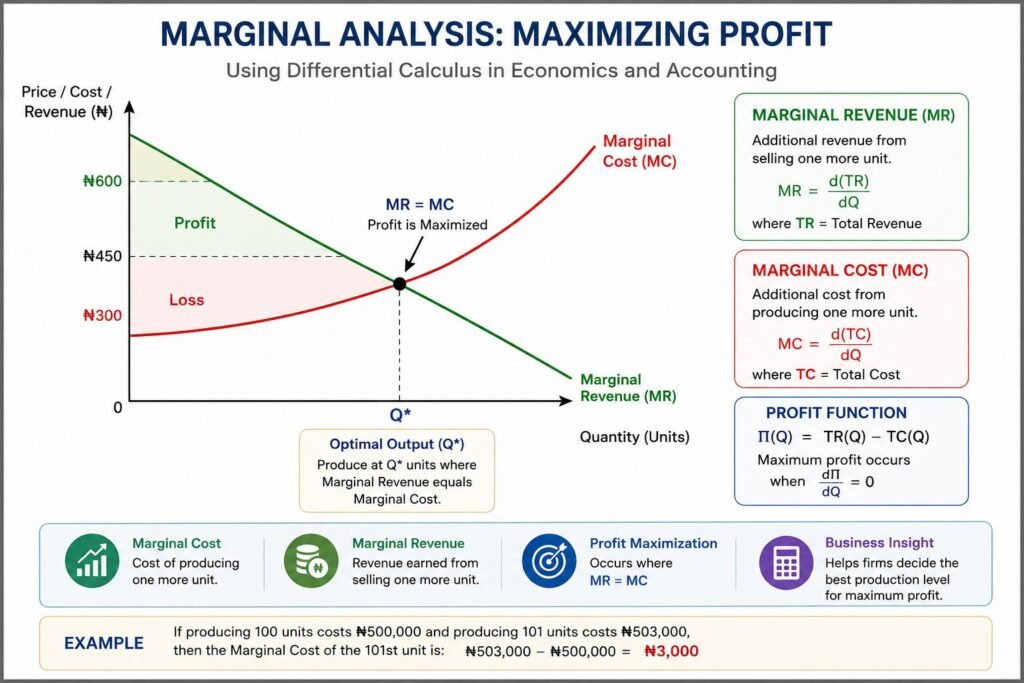
Marginal cost is that which is added by producing one more unit of a product. For instance if you produce 100 units which cost you ₦500,000 and you see that production of 101 units costs you ₦503,000 the marginal cost of that extra unit is ₦3,000. Differential calculus is used to accurately determine them.
Marginal Revenue
Marginal revenue is the extra money brought in by that which is sold of one more unit. Businesses compare between marginal revenue and marginal cost in their evaluation of whether it is a good or not to produce more.
Profit Maximization
In terms of business what we see is that which reports to grow the top line the most is what they aim for. Calculus is used to determine the peak profit point. Economists do this through analysis of profit derivatives. At times when marginal revenue is equal to marginal cost businesses see optimal production levels.
Applications of Differential Calculus in Accounting
Differential calculus in accounting and economics is used in many business applications. It allows for the analysis of trends, improvement in operation and better financial planning.
Revenue Analysis
Revenue doesn’t always grow by the same amount. Calculus allows accountants to determine how fast revenue is changing at any given time.
This is useful for:
- Identifying peak sales periods
- Predicting seasonal trends
- Evaluating pricing strategies
- Measuring sales performance
Cost Management
Businesses always are on top of their expenses to stay profitable. In differential calculus we look at how costs change in varying levels of production.
For example:
- Fixed costs remain stable
- Variable costs change with production
- Total derivative analysis of cost functions.
This helps companies manage resources efficiently.
Profit Optimization
Profit is a function of revenue and cost. Accountants through use of derivatives may determine the production level which in turn produces the highest profit. This also prevents organizations from over or under producing.
Tax Analysis
Governments and companies use calculus which in turn studies how tax rates play into economic behavior.
Small changes in taxation may influence:
- Consumer spending
- Investment decisions
- Corporate profits
- Employment levels
Differential calculus is used by economists to do this.
Depreciation Analysis
Assets go down in value over time due to wear and use. Calculus is used to determine depreciation rates and to predict future asset values. This helps to make more accurate financial reports.
Explore the use of calculus in the interpretation of economic data.
Economics is definitely into the relationship of variables such as price, demand, supply and production. As these variables are always in flux calculus is a very important tool.
Demand and Supply Analysis.
When it comes to price changes, economists take the direction of the demand into account.
The differential calculus is useful for finding:
- Price sensitivity
- Consumer response
- Market equilibrium
- Elasticity of demand
Economic Growth Models
Countries consider calculus based models that analyze economic growth.
These models analyze:
- National income growth
- Inflation rates
- Employment patterns
- Investment performance
Forecasting and Planning
Many of the components of economic prediction involve identifying trends and change.
Calculus is used in government and financial institutions to:
- Predict recessions
- Estimate inflation
- Plan fiscal policies
- Evaluate economic stability
Relationship between Calculus and Business Decision-Making
The student will recognize the connection between calculus and business decision making. In the modern business world, data is the source of decision making support. Calculus, in general, and particularly Differential Calculus, is a rigorous way to describe the measure of change which is information for decision making.
Pricing Decisions
Derivatives are used in business to establish the optimum prices to be charged to maximize profit and income.
Production Planning
To minimize waste and unnecessary expenses, production levels are calculated using calculus to achieve optimal production.
Risk Management
Calculus is used by financial experts to calculate the fluctuation of the stock market and risk in a investment.
Investment Analysis
Using calculus to find rates of return and growth of investments. This enhanced the financial planning and portfolio management.
Advantages Differential Calculus in Accounting.
In the field of financial analysis, there are numerous uses of calculus.
- Improved Accuracy: Calculus has greater accuracy than basic arithmetic.
- Better Forecasting: Companies can take better strides towards predicting.
- Enhanced Decision-Making: Managers can gain a better understanding of finances.
- Efficient Resource Allocation: The organizations can enhance the performance of labor, capital and production.
- Stronger Economic Interpretation: Economists are able to do better in terms of explaining market behavior.
Difficulties in Applying Calculus in Accounting
We find great value in calculus, but there are some problems with calculus.
1. Calculus is at very abstract level: many students and professionals have difficulty with it.
2. Data limitations: Forecasting numbers are dependent on good data. Data sets that are not good lower the accuracy.
3. Unexpected Economic Change: Unexpected economic changes could affect financial models.
Technological Dependence: Many companies use software based analysis for calculus, which will then need a technical skill.
Technology and Calculus in Modern Accounting
Companies today are employing sophisticated accounting systems and automated data analytics systems that perform calculus.
For accountants, programs that feature spreadsheets and financial modeling tools do:
- Analyze trends
- Generate forecasts
- Perform marginal analysis
- Evaluate investment options
Differential calculus has been made accessible to the professional, who may not have extensive mathematics training, through the use of technology. Find real-world examples of differential calculus.
Identify Real-World Applications of Differential Calculus.
Banking Industry
Calculus is used by banks to study interest rates, growth of their loans, and the returns on their investments.
Manufacturing Companies
Derivatives are used by manufacturers for cost of production and profit analysis.
Stock Market Analysis
In finance, calculus is applied to analyze the changes in market volatility and prices.
Insurance Industry
Math models are used by insurance companies to calculate the probabilities of risk and to establish the parameters of premiums.
The importance of Differential Calculus for Students to Learn
From an economic and accountancy point of view, students taking calculus perform very well, because they learn to think analytically and to solve problems.
Students who learn calculus will be able to:
- Understand financial relationships
- Interpret economic trends
- Improve quantitative reasoning
- Develop the ability to analyze more effectively
- Set up for higher financial jobs and careers
In most work settings which present itself for a professional audience employees value the skills of those that put forward analytical mathematical models and make based decisions.
Conclusion
We believe that differential calculus is an important component in the field of accounting/economics, used by professionals to see how the financial variables behave over time. Concepts such as limits, continuity and the fundamental law of derivation are available to us, and, in turn, these have very convenient ways of dealing with a relationship between revenue, cost and profit. Calculus is an important tool in making business decisions and interpreting the economy using marginal analysis, forecasting, optimization and financial modeling. It also helps in the way accountants and economists can view dynamic financial action, in lieu of static numbers.
Math is increasingly becoming a role for companies that are data centric. Where students and practitioners in the area of differential calculus are learning extremely useful analytical skills that will enhance the field of financial analysis, strategic planning and economic evaluation. At last, in fact, differential calculus is not merely a theoretical approach to math. It is a hands-on tool that helps businesses manage uncertainty, as well as improve efficiency and make informed financial decisions in an ever-evolving economic landscape.
Get more well researched information about Differential Calculus in Accounting and Economics here.