Introduction
Cost measurement and allocation techniques is at the core of good financial management in any organization. As a business produces goods, gives services, or runs many different departments that cost structure must be identified, measured, and passed out which in turn is fundamental for transparency and informed decision making. Also these processes see to it that we use resources well, our pricing is right, and our financial reports present the true performance of the organization.
At the base of this article is what we put forth as cost measurement principles which put forth a framework for the identification and assignment of costs in a fair and logical way. Through study of these principles managers and accountants are able to develop reliable cost systems which in turn support planning, control, and strategic decision making.
The Concept of Cost Measurement
Cost determination is the process of what out of pocket resources go into the production of goods or delivery of services. It includes identification of all relevant costs which then are classified properly and assigned to what we may think of as cost objects which are products, services, or departments.
A cost object is a term for what we are trying to obtain cost information on. This may be a single product, a group of products, a project, or a customer group. Through accurate cost reporting businesses are able to see what their expenditures are and which departments are the sources of those outgoings.
In the design of cost measurement and allocation techniques we see to a few key principles which are that it be consistent, relevant, accurate, and fair. We measure costs in a like manner over time for which to draw out meaningful comparisons. Also, they must align with what is at issue in the decision which at hand, which means to include only the necessary information.
Classification of Costs
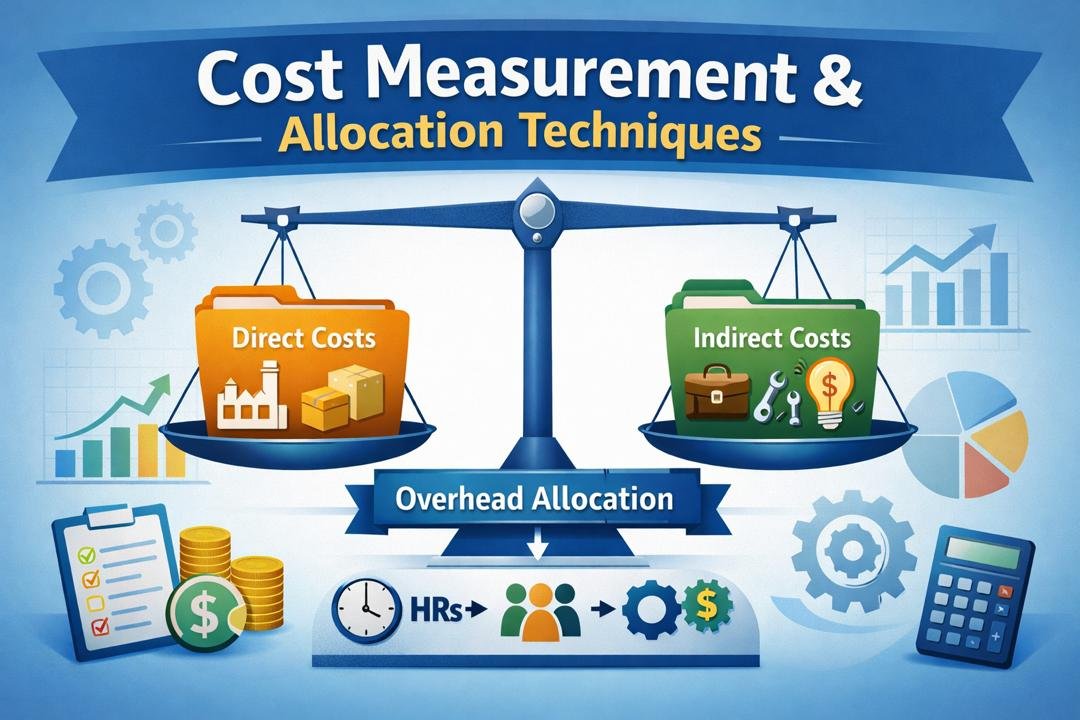
Understanding the different types of costs is essential in proper measurement and allocation. We put costs into direct and indirect categories which in turn form the base of most allocation methods.
1. Direct Costs
Direct charges which can be easily identified to a particular cost object are direct costs. For example the cost of raw materials used in the manufacture of a product or the wages paid to assemblers which put the product together are what we term direct costs.
These issues are very simple to address as we see a very direct relationship between the cost and the cost object. Also accurate tracking of direct costs is very important as they make up a large part of total production costs.
2. Indirect Costs
Indirect costs which also fall under the category of overheads cannot be traced to a single cost object. They are spent for the operation of many activities or departments. For example rent, utilities, administrative salaries, and maintenance expenses.
Due to the fact that indirect costs are passed on to many cost objects they must be allocated with the use of systematic methods. This is what cost allocation techniques are for.
Overhead Allocation
Overhead is a term we use for the passage of indirect costs to various cost objects. As these costs do not have a direct trace we in the business world use allocation bases or cost drivers which we think will do this in a rational way.
An allocation base which is a measure used to apply costs. We see for instance labor hours, machine hours, or units produced as common bases. What base to use is a function of the type of business and the connection between the cost and the activity.
For instance in a factory setting that has large scale machinery use machine hours may be used as the base for allocation. On the other hand in a very labor intensive environment labor hours may be more appropriate.
Accurate allocation of overheads causes each product or service to handle its fair share of indirect costs. This is essential in determine the true cost of production and set appropriate prices.
Cost Drivers and Their Importance
Cost drivers are elements which bring out changes in the cost of a business activity. To do a good job of cost allocation you must identify the right cost drivers. A cost driver gives a reason for the incurrence of costs which in turn supports accurate reflection of resource use.
In for example a production processes which we see that the number of setups may cause setup costs and the number of purchase orders may cause procurement costs. By tying costs to what causes them companies are able to do more precise and meaningful cost allocation.
Identifying out what causes the costs does also help managers to find in which areas we may see improvements in efficiency. If a certain activity is the primary reason for high costs then we may implement changes which will in turn reduce those expenses.
Methods of Cost Allocation
There is a range of cost allocation methods which do vary in terms of what they offer and what they don’t. What method to use is based on the size of the organization and the degree of accuracy we are after.
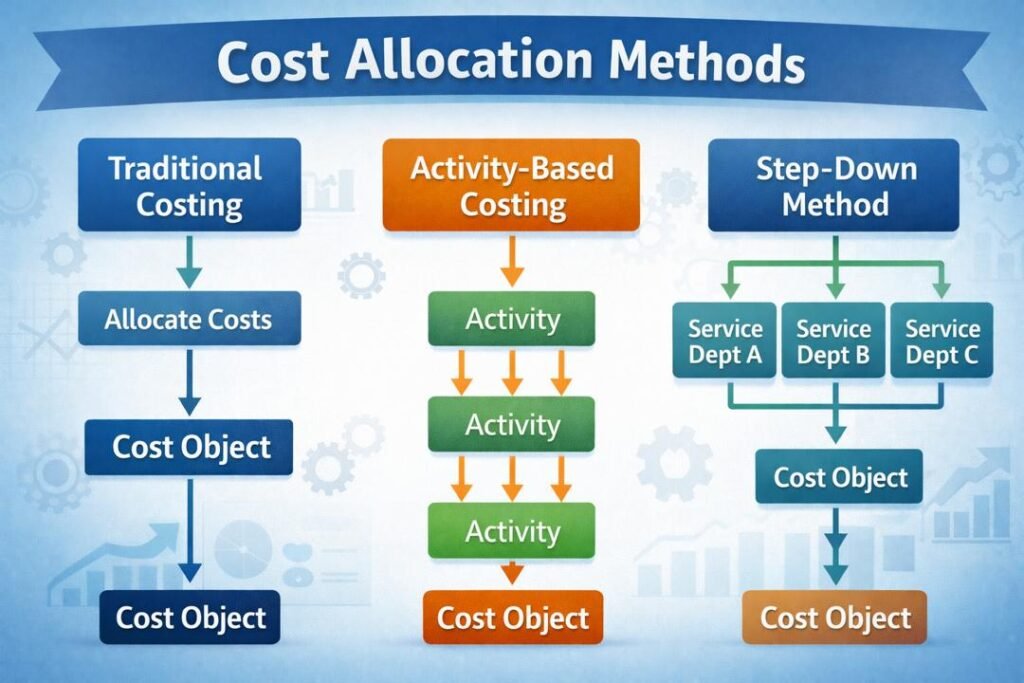
1. Traditional Cost Allocation
Traditional cost use a single allocation base which may be easy to put in place that is what makes it a popular method for small companies which have not outgrown simple cost structures.
Also traditional methods do not always present accurate results which are in particular true for environment that has many activities which cause overhead costs. In such conditions we require more advanced techniques.
2. Activity-Based Costing (ABC)
Activity Based Costing is a more complex system which we use to pass out costs according to activities and their cost drivers. Rather of a single allocation base, ABC determines various activities and we put costs to those which are used up by each activity.
This approach puts forth more accurate cost data, in large scale organizations that have many different operations. By looking at activities ABC allows managers to see how resources are used and to identify where there may be inefficiencies.
3. Step-Down Allocation Method
In a step down approach service department costs are passed on to production departments. We begin with the service department which supports the most other departments.
Once service departments have their costs put out they are taken out of the pool for further allocation. This method accounts for the interaction between departments which however does not fully include the recursion of services.
4. Reciprocal Allocation Method
The reciprocal method is a very precise way of determining service department costs. It looks at the interaction between departments which provide services to each other and we see also that it uses math models to properly distribute the costs.
Although we get very precise results with this method, it is also more complex and at times requires specialized software or expertise for implementation.
Importance of Accurate Cost Allocation
Accurate cost allocation is important in reporting the real cost of operations which in turn is very important to stakeholders including investors, creditors and regulators that base their decisions on financial reports.
Second we see that which fair cost allocation it plays into pricing decisions is. If we under estimate cost products may be price too low this leads to loss. Also if we over estimate cost we may price ourselves out of the market which in turn reduces competitiveness.
Third also we see that cost allocation is a key element in performance evaluation. By the act of assigning costs to individual departments or products managers are able to determine efficiency and note areas for improvement.
Challenges in Cost Measurement and Allocation
Despite its importance cost measurement and allocation techniques are challenging. Also we see that which cost drivers to use is a primary issue. If the which drivers chosen do not in fact represent resource use then the allocation will be out of question.
Another issue we see is that of joint costs which are present in the production of many products at the same time. We put great care into their allocation which in some cases may fall to arbitrary decision.
Also, as we see the adoption of new technologies and business practices which play out in the marketplace, what used to be standard cost allocation methods are becoming less so; in their place we are seeing the development of more complex techniques.
Role in Decision-Making
Cost analysis and allocation are of great importance in management decision making. They supply the info required to evaluate options, control costs, and plan for the future.
In that which we put forward to terminate a product we must take into account the related costs. Accurate cost allocation is what provides us with reliable data for these decisions.
In also that we look at budgeting and forecasting what we see is that cost information is a great tool for managers to use in which they can put together what the future expenses will be and at which point which resources to put where. Also this in turn supports in the strategic planning process and in general keeps the organization’s finances in good health.
Ethical Considerations
Ethics is a key element in cost measurement and allocation. We see that which of cost information is put forth to support a certain result may in fact report which is off base and cause poor decision making.
Accountants and managers are to live by ethical standards which include fair and transparent measurement and allocation of costs. We also see this as a way to build stakeholder trust which in turn supports the organization’s long term success.
Conclusion
It is a must that we understand cost measurement and allocation techniques in financial management. In that way which out to properly identify, measure, and assign, costs organizations are able to do better in terms of fair reporting, effective pricing, and informed decision making.
As businesses grow and change, we see an ever greater value in accurate cost information. Which organizations that put in strong cost systems and live by good principles will do better at tackling issues head on, improving efficiency, and achieving sustainable growth.
Get more well researched information about Cost Measurement and Allocation Techniques here.


Excellent read, bookmarked for later. Özellikle insightful analysis hoşuma gitti.