Introduction
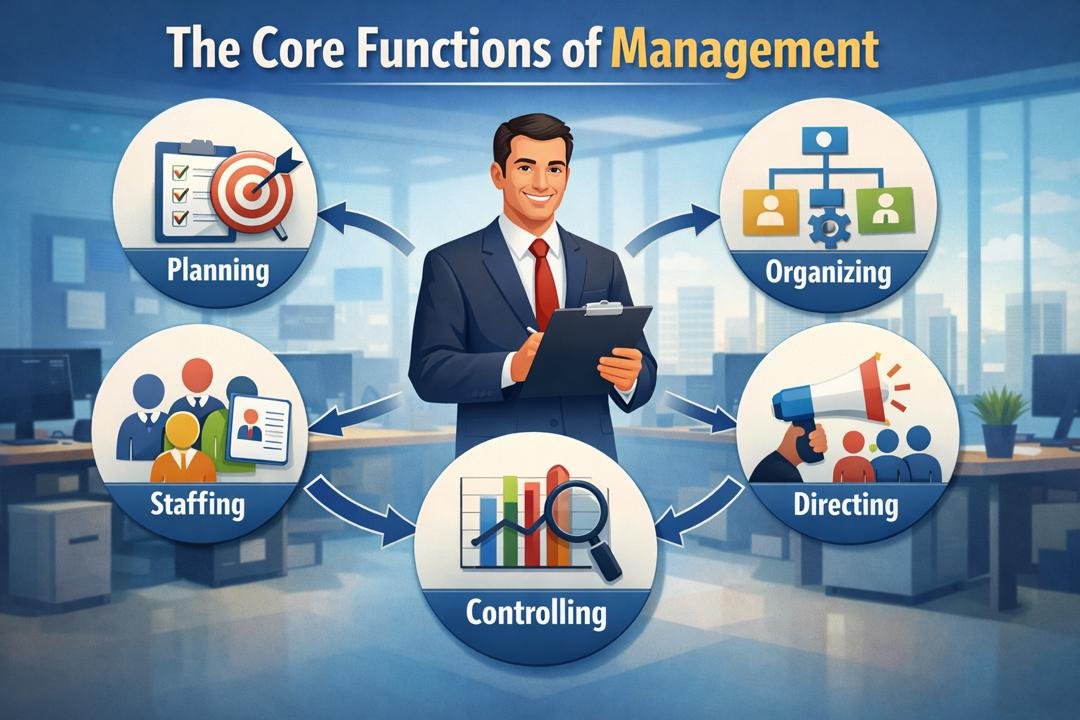
The support of any successful organization, whether large or small, in terms of size, industry, or geographical location depends on the management. In case of multinational companies and small businesses, the capacity to make people, resources, and processes manageable defines either success or failure of organizational objectives. The management practitioners have over the years outlined key tasks that managers should undertake to guarantee organizational performance. All these activities are referred to as the management functions. These core functions of management have never been as relevant in the current day and age of business where there is a rapidly changing and competitive business environment. The way organizations are run has been influenced by technological advancement, globalization, workforce diversity and economic uncertainty. Nonetheless, the principles of management that were developed long ago are still very applicable even today. Managerial decisions and performance are still guided by the five fundamental functions which include planning, organizing, staffing, directing, and controlling.
This article delves into the essence of the management functions, why they are pertinent in contemporary organizations and how they all lead to efficiency, coordination and achievement of objectives.
Realizing the Core Managerial Functions
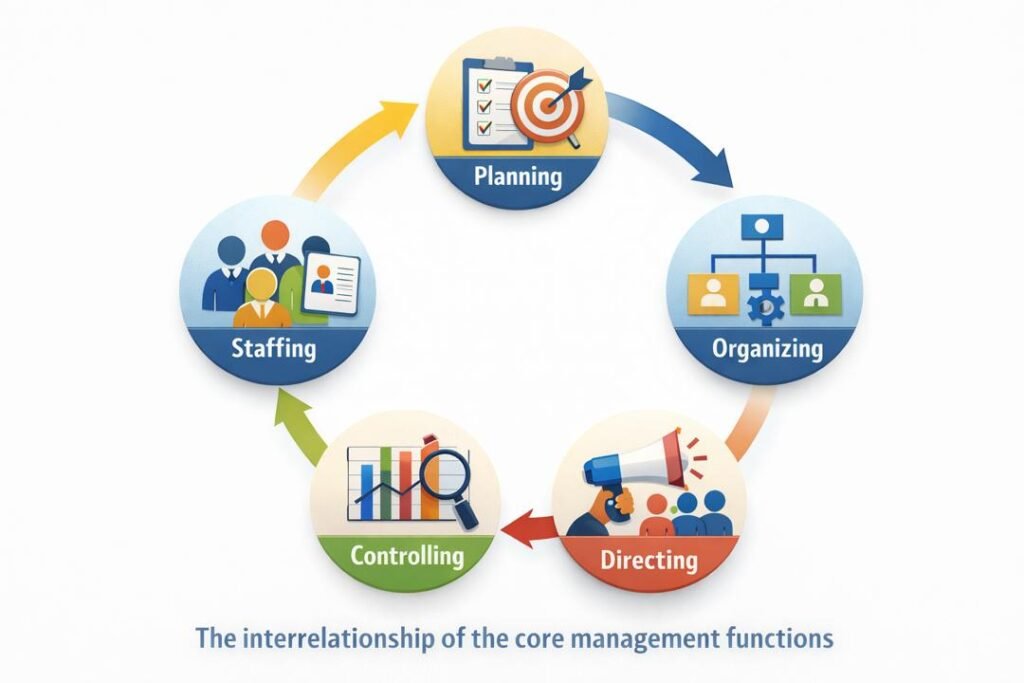
The classical theorists in management especially Henri Fayol presented the concept of management as a process that entails certain functions. These core functions of management are interconnected and nonstop, i.e. these functions do not work independently. Rather, managers shift in and out of them as the need arises.
In order to comprehend their relevance, it is good to discuss each of the functions individually as we consider the way they relate to the business practices in the real world. A systematic review, refer to the part on the core management functions that will be discussed later in this paper.
Planning: Establishing the Path on the way to Organizational Success
The most important and arguably the most vital role of management is planning. It entails the setting of organizational objectives and the selection of the most appropriate action plan towards the realization of the same. Planning enables managers to determine what, how, when and who should be performed.
Planning in the classical management theory was considered to be rational and systematic. Managers were supposed to scan the environment, predict the future and come up with detailed plans. Planning has become more flexible and adaptive in the present day organizations. Strategic planning considers the uncertainty, the speed at which the market is changing and the disruption of technology.
A technology company that intends to introduce a new product should, as an example, take into account the market demand, competitors activities, budget, and the risks that may occur. Lack of proper planning will result in wastage of resources, missed deadlines and unmet objectives.
Quality planning helps in the efficiency of the organization by:
- Setting clear objectives and purpose
- Reducing uncertainty and risk
- Maximum utilization of resources.
- Improving interdepartmental coordination.
Organizations that lack proper planning usually fail to survive in the current competitive world. Planning is a road map which guides the other management functions.
Organizing: Organizing Resources and Activities
After making plans the second phase is organization. Organizing refers to the process of organizing work, tasks, resources and relationships of authority in such a manner that allows the organization to accomplish its goals effectively. This role is interested in developing a framework that individuals may work effectively. In organizations managing multiple initiatives, project portfolio coordination helps managers align projects with strategic goals while optimizing the use of shared resources.
Classical theorists put emphasis on formal organizational structures, hierarchies, and roles. Although flatter structures and remote working models can be applied in modern organizations, the organizational nature does not change. Managers are yet to decide the manner in which the tasks will be split, who reports to whom, and the manner in which the various departments will coordinate their activities.
An example would be in a manufacturing firm, organization would come in to assign production, allocate machinery, and create reporting lines and addressing logistics. The organizing, in the case of a service-oriented business may center on team work, customer service process, and flow of information.
Effective organizing:
- Eliminates role confusion and redundancy.
- Enhances coordination and communication.
- Increases accountability and responsibility.
- Facilitates effective workflow and decision making.
They will not produce results as the best plans may fail because of chaos, inefficiency and lack of clarity without proper organization.
Staffing: Having the Right People in the Right Jobs
The management function that has to do with recruiting, selection, training, developing, and retaining employees is known as staffing. One of the most helpful assets of any organization is the human resources and staffing makes sure that an organization has the right people with the right skill at the right time.
The classical management approach regarding staffing was more about the assignment of workers in a predefined position. However, contemporary organizations appreciate the significance of talent building, employee involvement, and diversity in the workforce. Performance management, career development and succession planning have become a part of staffing.
As an illustration, a company that is expanding into a new market might require recruiting local market knowledge and culture-conscious employees. Organizational goals can be undermined in spite of the excellence of other functions performed without proper staffing.
Good staffing helps an organization to succeed as it:
- Enhancing performance and productivity.
- Reducing employee turnover
- Improving innovation and flexibility.
- Fostering the long-term organizational development.
Effective staffing allows managers in a dynamic business environment to have an edge in creating competitive teams that are capable and motivated.
Directing: Leading and Inspiring Employees
Directing is the role that actualizes plans by people. It is a process of leading, motivating, supervising, and communicating to the employees to see that objectives of an organization are realized. Whereas planning, organizing, and staffing are concerned with preparation, the directing is concerned with execution.
Classical management placed a greater emphasis on authority and control whereas contemporary ways to guide people place greater emphasis on leadership, motivation, and emotional intelligence. The modern day managers are supposed to motivate workers, promote teamwork and provide a healthy work environment.
As an example, a project manager who leads a team should be able to effectively convey expectations to the team and offer guidance, conflict resolution, and encourage team members to work towards deadlines. Good orientation makes the employees know what they are supposed to do as well as commit themselves to organizational goals.
The major advantages of effective directing are:
- More employee motivation and morale.
- Better communication and cooperation.
- More correspondence between personal and corporate interests.
- Increased productivity and activity.
Directing is critical in the performance of contemporary organizations where staffs desire meaning and freedom.
Controlling: Making Goals Achieved
The last management role is controlling, which is concerned with control of performance, comparing actual performance to planned performance and any corrective action where it is deemed fit. It makes the organizational activities to be directed towards the set goals.
Classical systems of control were dependent on rules, procedures and supervision. Contemporary control practices will be based on performance indicators, data analytics and continuous feedback. Although the tools have changed, the reason of controlling is not different: the tools are used to make sure that it is efficient and effective. E.g. a retail organization can utilize sales reports and customer feedback to measure performance. When the sales are lower than projected, the managers would be able to probe the issue and take corrective action, which could be a change in pricing or service to the customer.
Effective controlling:
- Early detects plan deviations.
- Enforces responsibility and discipline.
- Facilitates decision-making.
- Improves the overall performance of the organization.
Without control mechanisms, organizations will face the risk of going off course, wasting resources and becoming less competitive.
How Core Management Functions Work
It is not the individual functions or tasks that make a management powerful but the combination of the functions into a unified process. Planning establishes goals, formulating structures mobilizes resources, staffing avails human capital, directing mobilizes energies, and controlling ensures that there is alignment to goals.
These are the major management processes that are cyclical and interdependent. The need to give control feedback tends to impact future planning and the level of staffing may vary according to organizational restructuring as an example. Managers have to maintain a constant balance and co-ordination of these functions in order to come out to effectively react to internal and external issues.
This integration is particularly crucial in a contemporary organization because it is associated with:
- Rapid technological change
- Global competition
- Transforming the workforce expectations.
- Complicated business activities.
Managers who are conversant with the relationship between these functions are in a better position to take their organizations to long-term prosperity.
Classical Management Theory Relevance in the Contemporary Practice
Even though there are changes in management practices, the classical management theory still offers a strong background. The values brought about by the pioneer theorists are still embedded into the current management systems, albeit in a modified form to suit the current realities.
For instance:
- Strategic planning is based on classical planning.
- Organizational design denotes the classic principles of organizing.
- The human resource management broadens classical concepts of staffing.
- The directing role is improved through leadership theories.
- Modernization of controlling practices is made by performance management systems.
This combination of the old theory and the new innovation makes the management very structured, and yet flexible.
Conclusion
In modern organizations, the five fundamental functions of management which include planning, organizing, staffing, directing and controlling are still fundamental. They offer a guideline that aids managers to operate in complexity, utilize resources effectively and accomplish organizational objectives.
With the changing and competitive world, effective management of these functions helps managers adapt to change, serve as a motivator to the employees, and sustain operational efficiency. The tools and technologies will change over time, but the basic principles of management will remain.
Knowing and implementing the core functions of management is not just an academic thing; it is a practical requirement to managers who wish to achieve success in their organizations in the long run. Combining the classical management theory and contemporary business practices, the organizations can increase their resilience, innovate and grow in a sustainable way.
Get more well researched information about the Functions of management in modern organizations here.