Introduction
Oral movements of the jaw play an integral role in critical oral being able to communicate, chew and swallow. These movements are not “random,” meaning there is a great deal of coordination involved among the muscles, joints and teeth. The mandible (lower jaw) pivots in several directions and each of these movements is important to understanding the way the lower and upper teeth engage (occlusion). These movements are important for dental professionals to understand as any deviation from these movements can have a significant impact on the efficiency, comfort, and long-term oral health of a person’s bite. Understanding jaw dynamics is crucial in restorative dentistry and clinical training for proper diagnosis and treatment planning.
Orthodontics, is another area that is closely associated with jaw movement analysis – it is a branch of dentistry that works on correcting any misaligned teeth and jaws to enhance function and aesthetics. Movement of the jaw is a key component to stable and functional orthodontic treatment. The mandibular horizontal, vertical, and lateral movements are discussed ranging from opening, closing, protrusion, retrusion and lateral excursions, and how they relate to occlusion and clinical practice.
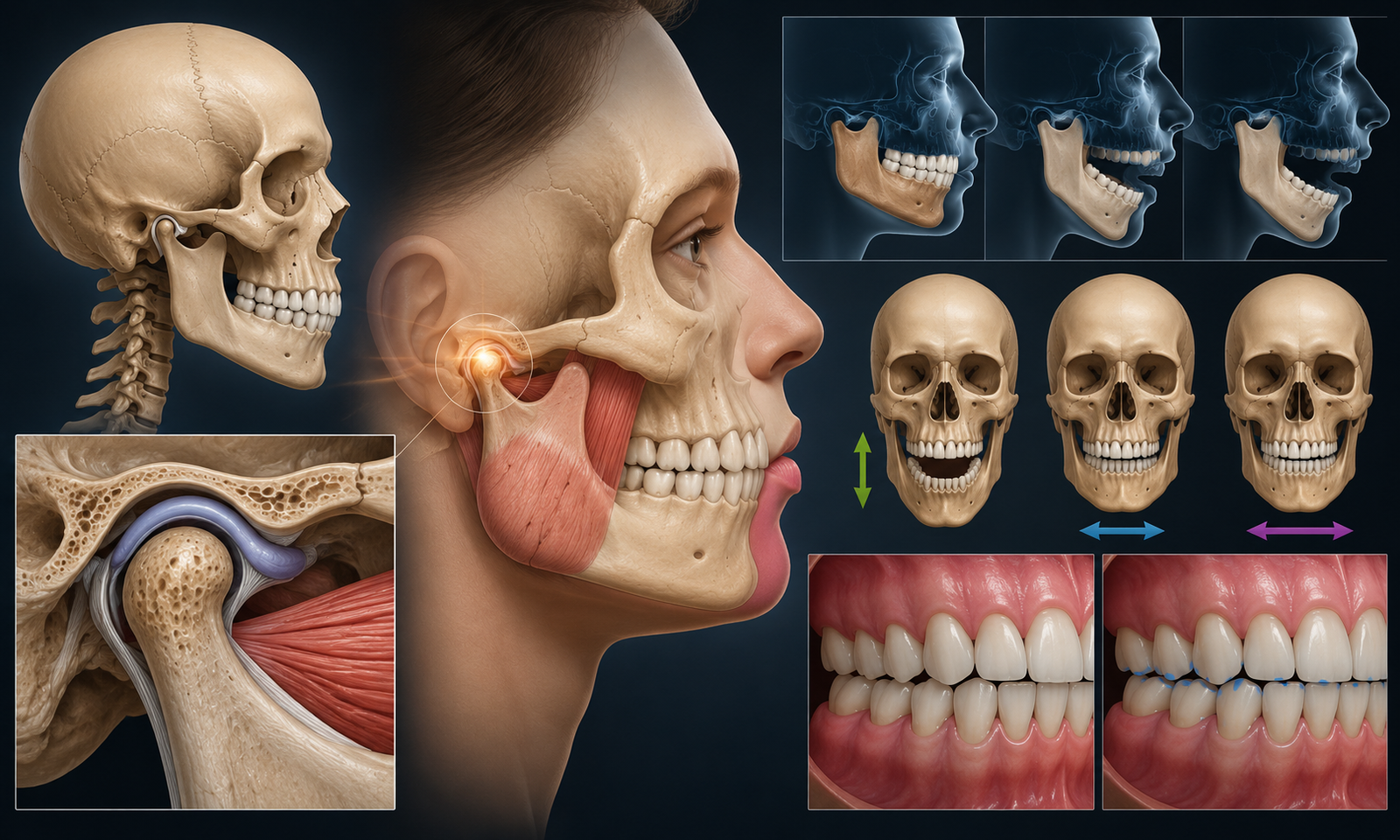
Basic summary of the movements at the mandibular joints.
The mandible joins to the skull by the temporomandibular joint (TMJ), which is one of the most complicated joints of the human body. It provides rotational and translatory movement and thus gives great mobility which is essential for oral function.
These movements include:
- Opening/closing (hinge and translation).
- Protrusion (forward movement)
- Retrusion (backward movement)
- Lateral excursions (side to side movement)
“All of these movements impact the way the upper and lower teeth fit together at the point of chewing and stability of the bite.”
Opening and Closing Movements
Functional Mechanism
The movement of the condyle in its temporomandibular joint (TMJ) includes translation and rotation. In the first place the mandible pivots in the joint as soon as the mouth opens, and as the mouth opens larger, it slides outwards. Closing occurs in the opposite manner: the condyle is lowered back into the mandibular fossa and the jaw is raised.
Impact on Occlusion
When the teeth are closed normally, the upper and lower teeth should come together in a predictable and stable bite position called centric occlusion. Off track travel can lead to unequal pressure on the contact surfaces and lead to wear or muscle strain or temporomandibular joint issues. Crowns or bridges also rely on the accurate alignment of the bite for durability and comfort, and improper opening or closing patterns may interfere with this.
Protrusion Movement
Description of Protrusion
Protrusion is the jaw going forward; the lower teeth protrude past the upper teeth. The lateral pterygoids are the primary muscle controlling this motion. The condyles roll forward on the articular eminence of the temporal bone during protrusion.
Functional Role
The anterior teeth must have a protrusion so they can cut food. It is also involved in articulation of speech and mandibular guidance during chewing cycles.
Effect on Occlusion
A well-balanced occlusion (correct bite) has anterior teeth that direct the extrusive movement, and posterior teeth that slightly disclude. This minimizes forces on the molars and premolars and helps to avoid wearing down and breakage. If maloccluded, it can cause premature contacts and unbalanced forces on the dental arches due to improper protrusive guidance.
Retrusion Movement
Description of Retrusion
Retrusion is the motion of the mandible moving backwards to its retarded position on the temporomandibular joint. This movement is limited as a result of anatomical restrictions.
Functional Importance
When chewing or speaking movements occur, the chews return the jaw to a stable position with the help of retrusion. This also plays an important role in the correct centric relation which is a reference position utilized in the diagnosis and treatment planning of prosthodontics.
Impact on Occlusion
A lack of retrusion or uncoordinated retrusion will lead to discrepancies between centric relation and centric occlusion. This mismatch can result in instability of the bite, muscle strain or temporomandibular joint disorders. Accurately determining the actual retruded position for a patient is crucial in restorative dentistry history when deciding on design and placement of a restitutive or prosthetic restoration that will function within larger functional jaw movements.
Lateral Excursions
The direction of side-to-side movements.
Lateral excursions are either latero-deviation to the right or left. The movements are of an asymmetric nature, so one side will serve as the working side and the other side as the non-working or balancing side. The working side is the one that moves towards, and carries the majority of the functional contact during mastication.
Functional Significance
There is a great need for lateral movements when grinding food: They enable teeth to have a shearing/crushing action that is very effective, especially in the premolar and molar areas.
Influence on Occlusion
At the time of lateral excursions, appropriate occlusal guidance is imperative. This is commonly done by canines or a combination of posterior teeth (group function).
Avoidance of improper movement patterns can lead to:
- Premature tooth contacts
- The masticatory stresses from the anterior teeth cause increased wear in the posterior teeth.
- Muscle imbalance
- TMJ stress
Analysis of lateral excursions during an orthodontic diagnosis allows detection of functional changes which may not occur in the static occlusion.
The relation between the movements of the jaw and occlusion.
Occlusion is a dynamic relationship and not a static condition that is affected by the continuous movement of the mandible. Each of the movement patterns has an impact on tooth contact and load distribution.
Dynamic Occlusion
Dynamic occlusion is when teeth touch during jaw motion like chewing, talking and grinding. In contrast, dynamic occlusion looks at the functional interactions as opposed to static occlusion which is centered around the contact of the teeth during jaw closure.
Key components include:
- Protrusive contacts
- Lateral guidance
- Interactions between the lines: work.
Imbalances of such movements can lead to occlusal trauma and/or mastication can be inefficient.
Stability and Harmony
Jaw movements should be coordinated and well suited with the alignment of the teeth for optimal oral health. This ensures:
- A uniform distribution of the occlusion forces.
- May reduce wear on enamel.Minimises enamel wear.
- Proper muscle coordination
- Long-term joint stability
Clinical Applications of Prosthodontics and Orthodontics
Importance in Prosthodontics
The study of jaw excursions is crucial in prosthodontics to design a restoration like crowns, bridges, dentures, implants. These types of restoration should blend in with the patient’s existing movement.
For example:
- Laterotrusion/dispersement and protrusive movements of the denture should be unrestricted.
- Experiments must be carried out to determine the shape of crowns to prevent early contacts when closing or excursion.
- When micro-implant restorations are used, the occlusal patterns must be reproduced to avoid overloading the implants.
Jaw movement can be accurately recorded with articulators to simulate conditions in the lab during fabrication.
Importance in Orthodontics
Jaw movement analysis is also a significant factor in orthodontic treatment planning. What is desired is not just for the teeth to be aligned but for them to move properly in all movements of the mandible. In orthodontics, the occlusion is evaluated in terms of tooth positioning and the harmony of the occlusion. If the teeth are shifted off their proper alignment it can make it difficult for jaws to move freely, and increase the likelihood of dental treatment failure.
The goal of orthodontic correction is to:
- Improve occlusal guidance
- Eliminate functional interferences
- Balance muscles actions.Perform coordinated muscle movements.
- Develop long-term stability of bite relationships
Temporomandibular Joint Considerations
All of the jaw movements go through the temporomandibular joint. Dysfunction of any of the hinge pairs of joints can greatly affect occlusion and oral function.
Common issues include:
- Sounds that click, pop or rattled.
- Restricted movement
- Oral discomfort in function of the jaw.
- An error that occurs in opening or closing.Errors that occur in the opening or closing.
These symptoms are frequently indicative of occlusal disharmonies, or structures of the pathways of the joint movement. Static bite relationships along with dynamic movement patterns must be assessed for a proper diagnosis.
Conclusion
Jaw movements contribute to the function of the mouth and are complex but important movements. How teeth interact and how forces are distributed within the oral cavity is affected by opening, closing, protrusion, retrusion and lateral excursions. Understanding these motions enables dentists to more accurately identify occlusal issues, and create plans to achieve long-term stability. In prosthodontics and orthodontics, results are based on control over both jaw mechanics and the alignment of the teeth. In conclusion, occlusion is not just about the way teeth meet, it’s about the way they move with one another together, continuously, and co-ordinated.