Introduction
In present day’s competitive business setting managers are to make quick and accurate decisions. To that end we see that which of greatest use in management accounting is the concept of variance analysis. This tool allows companies to compare what was planned against what actually transpired and to identify what areas of operation are doing well and which are not.
The concept of variance analysis is a must as no business is able to perfectly predict future costs, revenues, or results of operations. We put together budgets which are based on our best guesses but in reality we see different results which may be a result of shift in market conditions, employee productivity, material prices, or operational efficiency. Through this analysis managers are able to get into the details of business performance and also to take corrective actions which in turn prevent small issues from growing into large financial problems.
Variance analysis is a tool which is very much used in budgeting, cost accounting, performance evaluation and strategic planning. It allows companies to see beyond the favorable and unfavorable variances from set standards and into the causes of the same. Thus managers are able to better run operations, put resources in the right places, and improve total profitability.
In this article we will look at the concept of variance analysis is, how it is calculated, the various types of variances, their value in organizational control, what is out there with regard to the limitations of variance analysis, and also we will look at how businesses use practical applications of variance analysis to improve performance.
What Is Variance Analysis?
In variance analysis we look at actual company performance against what was planned out in the budget. The difference between these two is what we call a variance.
A variance can either be:
- Favorable Outturn (F): when actual results are better than what was expected.
- Unfavorable Variance (U): This is when we see that actual results fall short of what we expected.
For example:
- If actual results are below budgeted expenses we have a favorable variance.
- If we see that actual sales revenue is below what was expected the variance is unfavorable.
The goal of variance analysis is what is causing these differences and what management can do about it.
Businesses typically perform variance analysis for:
- Sales
- Production costs
- Labor costs
- Material usage
- Overhead expenses
- Profit margins
In that it looks at what is different from what was planned out variance analysis is a key tool in management accounting.
Importance of Variance Analysis in Management
The idea of variance analysis is important as it allows managers to maintain control over business processes. Companies prepare budgets which in turn guide action and resource allocation. Also without comparing actual performance to what was budgeted for we cannot see if we are doing well or not.
Improves Financial Control
Variance analysis is a tool which organizations use to track spending and see that departments stay within the set budgets.
Supports Better Decision-Making
Managers use variance reports for the identification of issues which require attention and in which we base our informed decisions for pricing, production, staffing, or purchasing.
Identifies Operational Inefficiencies
Large we see in many cases that which may present itself as a large unfavorable variance are issues like waste, poor labor productivity and excessive material use.
Enhances Performance Evaluation
Variance analysis is a tool which managers use to review department performance and also to hold teams responsible for financial results.
Encourages Cost Reduction
By eliminating waste and inefficiency in processes organizations are able to reduce their costs and see better profitability.
Strengthens Planning and Forecasting
Reviewing past performance trends will improve future budget results and forecasts.
The Concept of Variance Analysis Explained
In the practice of variance analysis we compare what was budgeted or planned with what actually transpired to identify differences. Before each fiscal period begins businesses set standards for cost, revenue, and operational performance which we use as a base line.
At the end of each reporting period we compare what actually happened against what was projected. We then analyze the differences to determine:.
- What caused the variance
- Whether variance is positive or negative.
- Who is responsible
- What corrective action is needed
For instance we see a company that budgeted for ₦500,000 in raw materials but ended up spending ₦580,000.
Variance= Actual Cost-Budgeted Cost.
Variance = ₦580,000 – ₦500,000
Variance = ₦80,000 Unfavorable
Management will look at the causes which include:
- Increase in material prices
- Supplier issues
- Excessive waste
- Production inefficiency
This process is what businesses use to maintain efficiency and financial discipline.
Types of Variances
Varying types of variances are present in variance analysis which depends on the area evaluated.
1. Sales Variance
Sales performance varies from what we budgeted.
Formula:
Sales Variance= Actual Sales-Budgeted Sales.
Here is an example:
Budgeted Sales = ₦2,000,000
Actual Sales = ₦1,800,000
Sales Variance = ₦1,800,000 – ₦2,000,000
= ₦200,000 Unfavorable
This reports that which we had expected was less.
Common causes of sales variance include:
- Poor market demand
- Increased competition
- Ineffective marketing
- Economic downturn
- Pricing issues
2. Material Cost Variance
Material variances in the cost of raw materials are the comparison between actual and standard.
Formula:
Material Cost Variance= Actual Cost-Standard Cost.
Common causes include:
- Increase in supplier prices
- Material wastage
- Poor inventory management
- Use of lower-quality materials
Material variances are usually divided into:
- Material Price Variance
- Material Usage Variance
3. Labor Variance
Labor variance looks at the difference between what we actually spent on labor and what we were expected to spend.
Formula:
Labor Variance= Actual Labor Cost-Standard Labor Cost.
Causes may include:
- Overtime payments
- Low employee productivity
- Wage increases
- Poor supervision
Labor variances may include:
- Labor Rate Variance
- Labor Efficiency Variance
4. Overhead Variance
Over variance which is the difference between what we spent on overhead and what we planned to spend.
Overheads may include:
- Electricity
- Rent
- Factory maintenance
- Administrative expenses
Overhead variances help managers in the control of indirect costs.
5. Profit Variance
Profit variation between what is achieved and what was projected.
Formula:
Profit Variance= Actual Profit-Budgeted Profit.
A falling profit variance may point to issues of operational efficiency or revenue.
How Variance Analysis Is Calculated
The issue of variance analysis usually goes as follows:
Step 1: Set Standards or Budgets.
Businesses develop expected cost and revenue numbers from forecasts and operational plans.
Step 2: Reported Results.
Actual results are collected during operations.
Step 3: Compare what results are to the standards.
Actuals vs. budgeted numbers are determined.
Step 4: Identify Favorable and Unfavorable Variances.
Manager reports which variances improves or harm business performance.
Step 5: Examine causes of.
Management looks at which causes large variations.
Step 6: Take Action to Correct.
Corrective actions are taken to improve future performance.
Favorable and Unfavorable Variances
It is important to note the difference between favorable and unfavorable variances.
A positive variance is when what actually happens is better than what was expected. For example we see this in lower than budgeted production costs, higher sales revenue, or we see reduced labor expenses.
An actual performance that is below what was expected is what we see in an unfavorable variance. For example this may play out in great material waste, lower than planned productivity, or unexpected high overhead costs.
However do not assume that favorable variances are always positive. We see that lower costs may in fact be from bad quality materials or understaffing which in turn may cause larger issues down the road.
Causes of Variances
Some factors which cause differences between actual and budgeted performance.
Internal Causes
Internal causes include:
- Poor employee performance
- Inefficient production methods
- Waste and theft
- Poor supervision
- Incorrect budgeting
External Causes
External causes include:
- Inflation
- Economic instability
- Changes in customer demand
- Government regulations
- Supply chain disruptions
Managers should identify what causes are within their control and which are not in the variance analysis.
Variance Analysis’ role in Organizational Control
Variance analysis is an important element in organizational control which allows managers to track performance and achieve business goals.
1. Budgetary Control
Variance analysis supports budgetary control by which we identify areas where actual spend goes beyond what was approved.
2. Responsibility Accounting
Managers may pass out responsibility for certain variances.
3. Operational Efficiency
Variance analysis identifies which processes are not performing well and also prompts for constant improvement.
4. Strategic Planning
Organizations use variability info to improve future planning and forecasting.
5. Risk Management
Identifying signs of decline early allows companies to reduce financial risk.
Practical Example of Variance Analysis
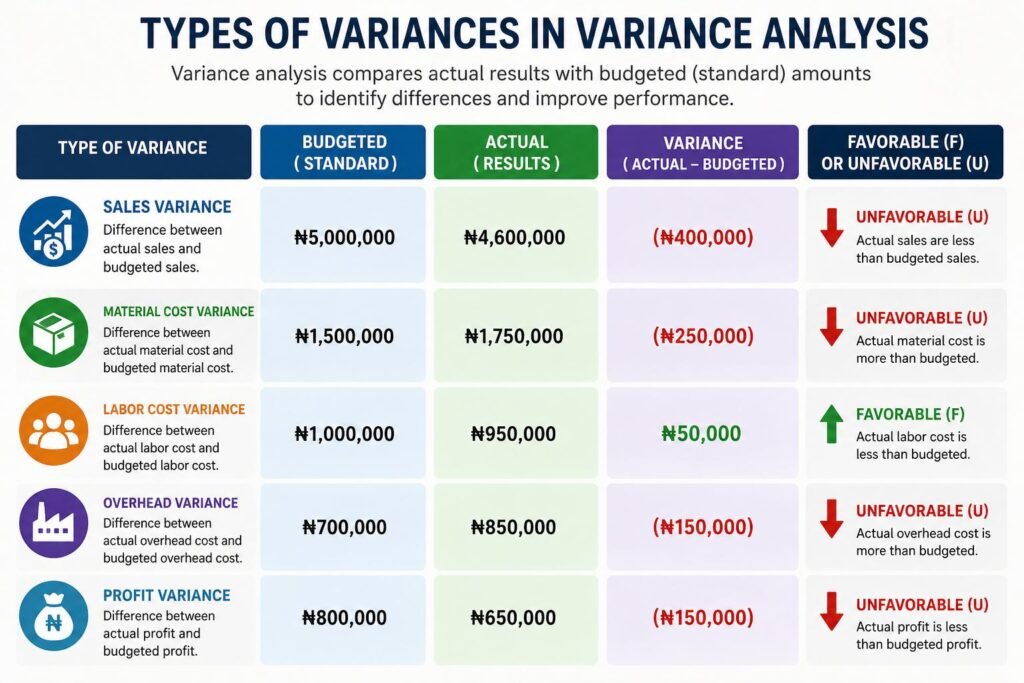
In a manufacturing company which has the following monthly budget of:
- Sales Revenue: Budgeted out at ₦5,000,000, Actual of ₦4,600,000.
- Material Costs: Budgeted at ₦1,500,000, Actual of ₦1,750,000.
- Labor Costs: Budgeted 950,000.
- Overheads: Budgeted at ₦700,000, Actual of ₦850,000.
Variance Analysis
Sales Variance:
₦4,600,000 – ₦5,000,000
= ₦400,000 Unfavorable
Material Variance:
₦1,750,000 – ₦1,500,000
= ₦250,000 Unfavorable
Labor Variance:
₦950,000 – ₦1,000,000
= ₦50,000 Favorable
Overhead Variance:
₦850,000 – ₦700,000
= ₦150,000 Unfavorable
Interpretation
The company reported decreased sales and higher material and overhead costs. While labor costs were lower than we thought they would be the overall picture is still a little concerning.
Management would need to investigate:
- Why sales declined
- Why material prices increased
- Why overheads exceeded budget
Corrective measures may include reworking supplier agreements, improving marketing strategies, or cutting waste.
Advantages of Variance Analysis
Variance analysis is a very useful tool for organizations.
- Better Cost Control: Managers may very closely watch costs and cut out what is not needed.
- Improved Efficiency: Analysis which identifies poor performance and which puts forth improvements in productivity.
- Performance Measurement: Departments and employees may be evaluated in an objective manner with the help of variance reports.
- Faster Corrective Actions: Managers can immediately deal with issues as they arise.
- Enhanced Profitability: Decreasing waste and managing costs which in turn increase profits.
- Supports Strategic Goals: Variance analysis ties operational performance to organizational goals.
Limitations of Variance Analysis
Although of value, variance analysis also has issues.
- Time-Consuming: Reporting in detail on variances is a time intensive task.
- Relies on Accurate Standards: Incorrect budgets or out of line standards reduce the value of variance analysis.
- May Encourage Blame Culture: Employees may be put off by unfair use of variances.
- External Factors May Distort Results: Economic factors or inflation which is out of management’s control may cause variances.
- Focuses on Quantitative Data: Variance analysis may not account for qualitative issues like customer satisfaction or.
Best Practices for Effective Variance Analysis
Organizations that adopt certain practices see great results in variance analysis.
- Use Realistic Budgets: Budgets should be founded on solid data and doable targets.
- Investigate Significant Variances: Management should pay attention to material variances which greatly affect performance.
- Analyze Root Causes: Identifying what the variances are is a start but understanding why they occur is essential.
- Encourage Collaboration: Departments should cooperate on issues of operation.
- Review Reports Regularly: Frequent use of variance analysis enables businesses to react quickly to change.
- Combine With Other Performance Measures: Variance analysis goes along with qualitative assessment and strategic indicators.
Variance Analysis in Modern Businesses
Today’s organizations are using technology and accounting software to perform variance analysis.
Digital tools help businesses:
- Generate real-time reports
- Track performance instantly
- Improve forecasting accuracy
- Reduce human error
- Enhance data visualization
In industries such as manufacturing, retail, health care, logistics, and hospitality we see great use of variance analysis which improves operation efficiency.
In present which is a very dynamic business environment companies which practice in regular basis the analysis of variances are in a better position to compete and to maintain financial stability.
Conclusion
The concept of variance analysis is a key element in management accounting which allows companies to put forth actual results against what was planned. Through this they identify what is going well and what is not which in turn gives them in depth info into operational performance, cost control, and financial results.
Variance analysis is a tool which allows managers to identify issues at an early stage, improve decision making, and to better control the budget. In each of sales, labor, materials, or overheads’ case the process puts forth key info which in turn guides in the implementation of corrective actions and to continuous improvement.
Although there are issues with variance analysis it is very beneficial when applied correctly. Which we see in companies that set realistic standards, look into large variances are present and respond to performance gaps in a timely fashion. These businesses see improvement in efficiency and success over the long term.
As companies deal with economic instability and competitive stress the key management skills is that of performing and making sense of variance analysis. In this area we see that which managers do well they are able to maintain control of the business also at the same time produce better financial and strategic results.
Get more well researched information about the concept of variance analysis here.