Introduction
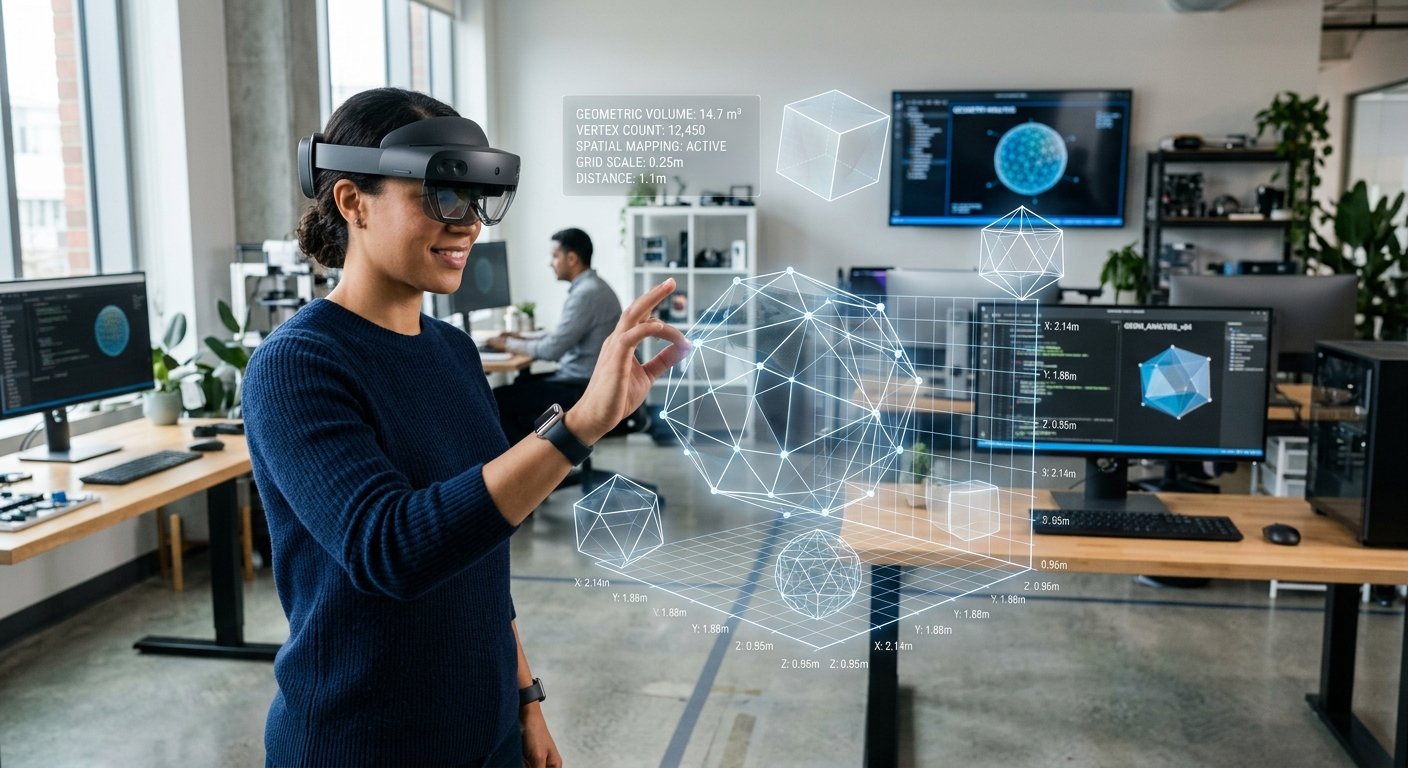
Virtual Reality (VR), Augmented Reality (AR) and Spatial Computing have changed the way we interact with our digital information and physical environments. These technologies allow us to navigate computer generated environments and place virtual objects in our real world. Immersive computing technologies such as gaming, virtual training, architectural visualisations and industrial simulations all rely on accurate spatial information. To achieve this, digital systems must understand positional information, distance, direction, shape and movement within 3D environments. Computational geometry provides the mathematical foundations to support this.
Computational geometry is concerned with creating algorithms to solve problems relating to geometric objects. This allows computers to calculate distance, detect intersections, create 3D models and understand object movement in virtual and real environments. This is important in immersive computing technologies as digital systems will constantly require processing geometric information. Computational Geometry has become increasingly important in Spatial Computing technologies. Computational geometry can be used to create immersive experiences by understanding geometric modelling, coordinate systems, spatial transformations, object tracking and collision detection.
Computational Geometry in Immersive Computing
Computational geometry is an important part of immersive computing. As opposed to traditional computing applications which are focused on displaying information on a flat screen, VR and AR must understand spatial information as it contains depth, direction, movement and complex geometry. This means that computers need to understand where objects are, how big they are, and how they relate to other objects. As well as understanding how objects move as the user moves. Computational geometry provides algorithms to help computers understand this.
In VR, computational geometry can be used to create immersive environments. Everything in the environment such as buildings, characters, furniture and environmental features will have a specific geometric shape. In AR, this can be used to place digital objects in the correct position. If I am creating an AR application to place a virtual table in my living room, I must calculate how much floor space there is. I must understand the dimensions of the room and calculate where the table should go relative to other objects. This requires accurate geometry to ensure virtual objects are not floating in the air. Computational geometry provides a fundamental part to immersive technologies.
3D Coordinates in Virtual and Augmented Reality
One of the most important concepts in computational geometry are 3D coordinates. This provides computers with the ability to understand where objects are in a virtual or real environment. There are three axes in a 3D coordinate system, usually called X, Y and Z. This allows computers to assign coordinates to every point in the environment. This means they can understand where objects are, calculate distances and understand how they relate to other objects. Without coordinate systems immersive applications would struggle to understand where objects are.
Virtual reality applications often use coordinate systems to create digital environments. When you create a virtual classroom, you will assign coordinates to objects such as desks, chairs, doors and windows. This will allow the system to understand where each element should go. AR applications also use spatial coordinates to place virtual objects in the correct place. If I am creating an AR application for my phone to place a virtual piece of furniture, I need to understand the relationship between the phone, the floor and the virtual object. Coordinate systems provide the mathematical foundations to understand this.
World, Local and Camera Coordinates
There are often multiple coordinate systems used in immersive computing applications. World coordinates allow computers to understand where objects are in the overall environment. Local coordinates allow computers to understand where an object is in relation to its origin. Camera coordinates allow computers to understand how objects are positioned in relation to the camera. This helps computers understand how to translate spatial information. For example if there was a virtual chair, it would have local coordinates. But its position in the room would be calculated using world coordinates. When the user gets close to the chair, camera coordinates will help the system work out how it should look.
This is important as it allows the system to understand how to translate between coordinate systems. In VR, the headset needs to constantly update the view based on where your head is. In AR, the application needs to understand how the real environment relates to the camera on the device. This helps digital objects to be displayed consistently.
Transformations
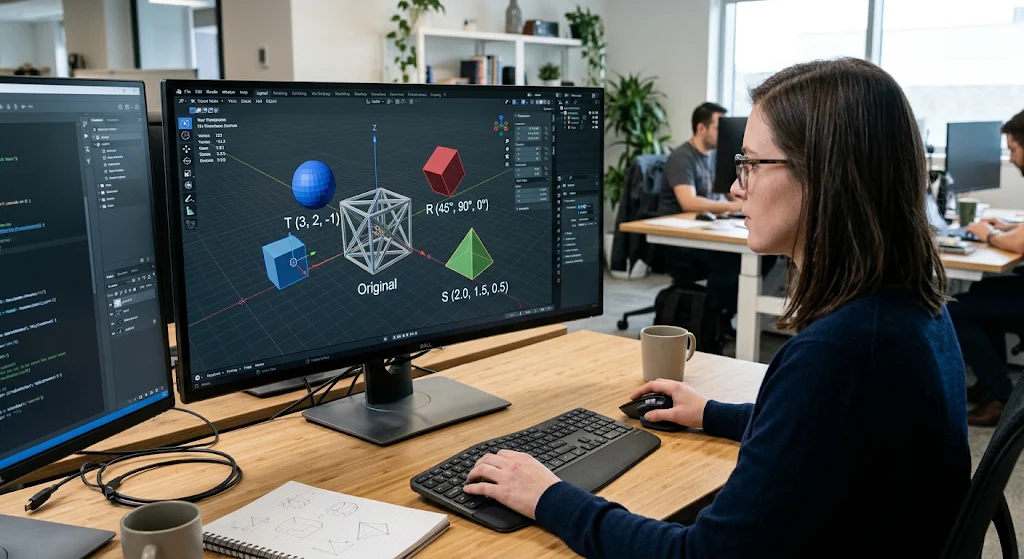
Transformations are mathematical operations that can be applied to geometric objects. This is an important aspect in VR and AR as digital objects need to be moved, rotated and scaled. The main types of transformations are translation, rotation and scaling. Translation moves an object from one place to another. Rotation will rotate an object. Scaling will increase or decrease the size of an object. This allows developers to create interactive environments.
If I was creating an AR application where users can add virtual decorations to their home, when they move the virtual lamp, translation calculations will be used to move it. If they rotate the lamp, rotational transformations will be applied. They may also want to scale the lamp so it fits into the space. Similar transformations can be used in VR when users pick up objects, move furniture or interact with digital equipment.
Transformation Matrices
Transformation matrices are an efficient way of doing transformations in computer graphics. This provides a structured mathematical approach to translations, rotations and scaling. Multiple transformation matrices can be combined to understand how an object should be positioned in a 3D environment. This can be useful when multiple transformations are needed to be applied to digital objects. For example if there was a virtual character that needed to move around the room, rotate to face another character and move relative to the user, transformation matrices can be used.
Real time rendering systems will use transformations to display objects. Every time the user moves or looks in a different direction, the transformations will be calculated to ensure the objects are displayed correctly. This helps maintain the relationship between the user’s view and the digital environment. In AR, transformation matrices can help align virtual objects to physical objects detected by the cameras and sensors. Accurate transformations are important to keep the visuals stable.
Object Tracking
Object tracking can be used in immersive computing using computational geometry. This helps to understand where an object is, what direction it is facing and how it is moving. Tracking can be used in VR and AR to understand where users and objects are in the environment. Cameras, motion sensors, depth sensors and other tracking devices will provide information on the physical environment. This will then be analysed using geometric algorithms to understand where objects are and how they are moving. This helps immersive applications react to changes in the environment.
In AR, object tracking can be used to add digital information to physical objects. For example if I was creating an educational application, I could track a physical model of the human skeleton and add digital labels to show the names of each bone. As the user moves around the model, the system will track where it is and display the information. In industrial AR applications, equipment can be recognised and instructions, maintenance information or technical diagrams can be displayed. Computational geometry can be used to calculate spatial relationships between objects.
Simultaneous Localisation and Mapping
Simultaneous Localisation and Mapping (SLAM) is an important technology used in many immersive computing applications. This allows the device to estimate where it is whilst mapping or updating a map of the environment around it. This can be useful if there is no existing digital map of the physical area. The system will look at images from the camera, depth information and sensor data to understand the features of the environment. It will then estimate how it is moving.
Computational geometry can be used to help with SLAM. This can help identify spatial features such as corners, edges, surfaces and distances between points. This allows the device to estimate how it is moving. For example if a user was using an AR application in an unknown room, the device may identify the floor, walls, furniture and other features. This information can be used to create a representation of the environment. This can help the application understand where to place virtual objects and how they should react to movement.
Mesh Generation
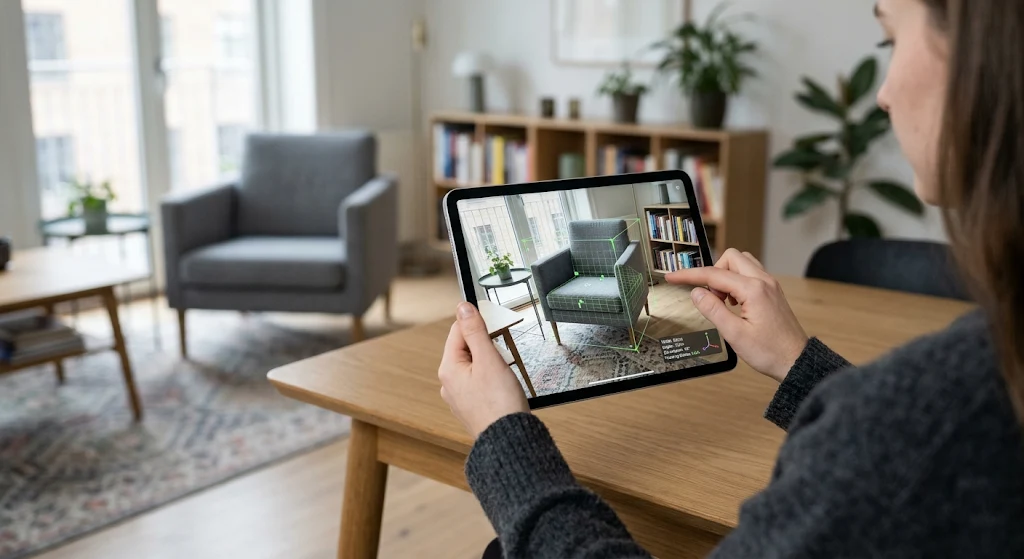
Mesh generation can be used to create 3D objects. This will usually consist of vertices, edges and faces. Vertices are single points in space, edges connect vertices together and faces create surfaces between edges. Triangles are commonly used in computer graphics. Computational geometry can be used to help create meshes by providing algorithms to arrange vertices, connect geometric objects and create surfaces.
Mesh generation is heavily used in VR applications. If I was creating a virtual museum there may be buildings, sculptures, display cases, furniture and other objects. All of these will be created using 3D meshes. Developers will use geometric modelling techniques to create these objects and understand how they should look when lit and viewed from different angles. In AR, mesh generation can be used to recreate physical environments. The device may scan the room and create a geometric representation of the walls, floors, ceilings and furniture. This can help applications understand how the physical environment is set up and place virtual objects in the correct place.
Surface Reconstruction
Surface reconstruction can be used to create digital representations of physical surfaces. This can be done by using information from cameras, scanners and depth sensors. This information may be in the form of point clouds. These are groups of points that indicate where on the surface of an object they are. Computational geometry algorithms can be used to analyse the points and understand the spatial relationships. This can help computers turn raw spatial data into useful 3D models.
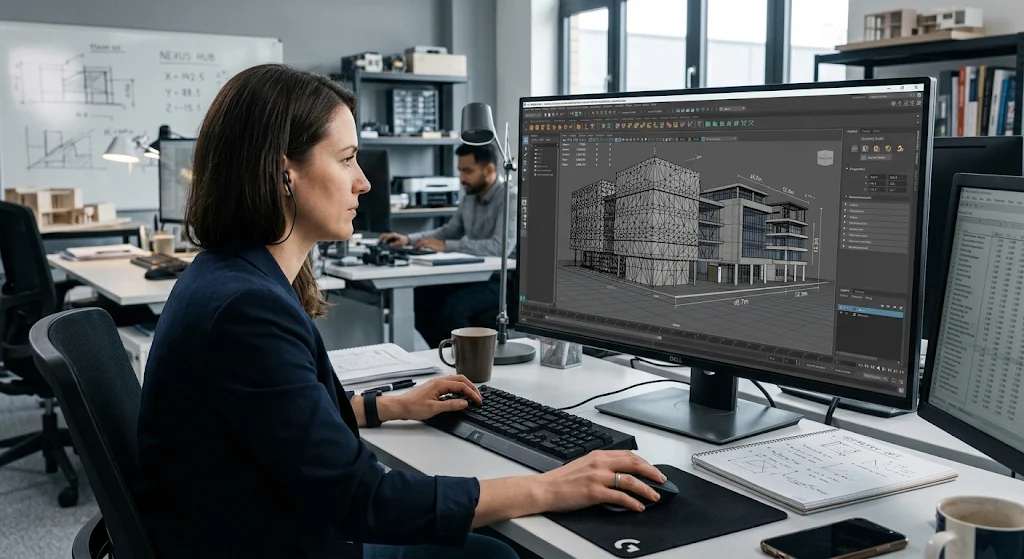
This can be useful in applications such as architectural visualisation, inspection and preservation. Architects can scan existing buildings to create a digital representation. This can then be viewed in VR or combined with the physical environment using AR. Museums can create digital models of historical objects. This can be viewed in immersive educational applications. Computational geometry can be used to ensure the models are accurate by organising spatial data and creating surfaces.
Collision Detection
Collision detection is used to understand if two or more geometric objects are overlapping. This is an important feature in immersive computing as users will expect virtual objects to act in a consistent manner. Without collision detection, a virtual character could walk through a wall, a digital ball could pass through a table or the user could appear to walk through objects. Computational geometry provides algorithms to understand the boundaries of objects and detect any overlaps.
Collision detection can be used in VR applications to create realistic movement. For example if there was a virtual training environment with machines, tools, walls and other objects, the system needs to understand if the virtual hand is touching an object or if the character has reached the edge of the room. This allows the application to react in the correct way. In AR, collision detection can be used to help digital objects interact with physical objects. If there was a virtual ball on a real table, it should look like it is sitting on top of the table. This helps create an immersive experience.
Bounding Volumes
Computational geometry provides multiple ways to make collision detection more efficient. A common method is to use bounding volumes. This involves using simple geometric shapes such as bounding boxes, spheres and capsules to surround complex objects. Instead of checking if every single polygon on two detailed models are overlapping, the system will check if their bounding volumes are overlapping. If the simple shapes are not overlapping then it is unlikely the objects are overlapping. If they are, more detailed collision detection can be carried out.
This is important in immersive environments with lots of objects. If there was a virtual city, industrial environment or multiplayer game there may be thousands of geometric objects. This would take a lot of processing power to carry out detailed collision calculations. Using bounding volumes and spatial partitioning can help organise objects and identify which objects need to be checked. This can help immersive applications provide responsive interactions.
Geometric Modelling
Geometric modelling can be used to create mathematical models of objects, surfaces and structures. This can be used to create simple geometric objects or detailed buildings, vehicles, machinery and human figures. Computational geometry provides mathematical methods to help determine the size of objects, understand how surfaces relate to each other and create accurate complex structures. This provides a visual and structural base for virtual environments. Users can explore digital environments and interact with objects that have realistic shapes.
Geometric modelling can be used in VR to create environments that represent real life locations or completely fictional environments. For example if there was a virtual lab there may be accurately modelled equipment, workstations, storage and experiment equipment. The geometric properties of these objects will determine their size, position and how they relate to other objects. In industrial environments accurate geometric modelling can help engineers look at machinery, see how equipment is organised and simulate manufacturing processes. This reduces the need for multiple physical prototypes.
Parametric Modelling
Parametric modelling can be used to create digital objects using mathematical parameters. This means that rules are created to determine the size, shape and structure of an object. For example if there was a digital model of a building there could be parameters for the height of the walls, size of windows, size of floors and angles of the roof. Changing these parameters will automatically update the relevant section of the model. This can be useful in architecture, engineering and industrial applications as objects often need to be altered multiple times.
Procedural modelling works in a similar way. This uses rules and algorithms to automatically create geometric structures. This can be used to create complex environments such as landscapes, roads, buildings and plants. Instead of creating every element manually, rules can be created to generate objects based on the geometric criteria. Computational geometry can be used to provide the calculations needed to create shapes, understand spatial relationships and maintain consistency. Parametric and procedural modelling can be used in immersive computing to create detailed environments easily.
Applications of Computational Geometry in Virtual Reality
Virtual reality produces computer generated environments in which users can interact with. Computational Geometry is used to provide the algorithms needed to build objects, give the correct spatial relationships and ensure the correct representation. All objects seen by users will have geometric properties. The objects must be accurately processed to ensure they are displayed correctly.
One major application is Virtual Training. Virtual Reality can allow organisations to train people in realistic environments without having to work with real equipment. Engineering students can look at machinery, medical students can look at 3D models of anatomy and staff can practice using industrial machinery. Computational Geometry helps to produce these environments and allows realistic interaction with objects. It can ensure objects are placed in the right places and collisions can be detected. This also allows developers to accurately recreate real environments using geometry.
Virtual reality can be used in many industries such as entertainment, tourism and education. Virtual museums can allow people to look at historic environments and see digitally created versions of key objects. Tourism can allow people to get a realistic preview of a destination and education can allow people to see interactive 3D models of scientific concepts. Computational Geometry can help to create digital environments and make sure that users can interact with virtual objects. This shows how computational geometry can be used to help take virtual reality beyond entertainment and into real applications such as learning, professional development and visual communication.
Applications of Computational Geometry in Augmented Reality
Augmented reality takes digital information and combines it with the real world. Unlike Virtual Reality, it does not replace the user’s environment but instead adds extra information. To do this the applications need to know what the geometry of their environment is like. Computational geometry can be used to calculate distances, find surfaces, understand spatial relationships and transform digital objects.
A common application is furniture. Augmented Reality applications can allow users to see what the virtual furniture would look like in their home. This requires the application to know what space is available on the floor and estimate the size of the room. Computational Geometry can help keep the objects in line with the users new position.
Augmented Reality is helping to improve learning in education, healthcare and industrial environments. Students can use Augmented Reality applications to look at 3D models of scientific concepts, explore geography structures and complex engineering concepts. Technicians can look at digital guidance in industrial environments to help understand what components are in the equipment. Healthcare professionals can use spatial visualisation technologies to look at anatomy. The accuracy of the geometry is important as digital information needs to match up with the real objects. As Augmented Reality technology continues to develop, computational geometry will continue to be vital to create reliable interactions between real and virtual environments.
Computational Geometry and Digital Twins
Digital twins are virtual copies of real objects, systems or environments. They are becoming increasingly important in manufacturing, construction, transport, energy and infrastructure. A digital twin could be a single machine, whole manufacturing plant, building or complex transport system. Computational Geometry can help to create these copies by providing ways to create models of real objects, calculate spatial relationships and keep geometry accurate.
For example a manufacturing company may want to create a digital twin of their manufacturing plant. This would help them understand how their machines, equipment and production areas are laid out. Geometric models can help show the size and positioning of individual components. Information from linked sensors can also help provide updates on how the components are functioning. Engineers can then look at how the equipment is laid out, see what changes can be made and understand how the changes may affect the production process. Construction companies can use digital twins to compare their planned designs against their real buildings. Computational Geometry can help to ensure that the virtual copy has accurate sizes and spatial relationships.
Digital twins can help with simulation and predictive maintenance. By using geometric models and operational information organisations can understand how their physical systems may react. For example engineers can use a digital version of their industrial equipment to see how the components fit together and identify any issues with the spatial relationships. In smart cities digital twins can be used to represent roads, buildings, public infrastructure and other aspects of the city. Computational Geometry helps to link the physical objects to digital models.
Industrial Simulations and Engineering
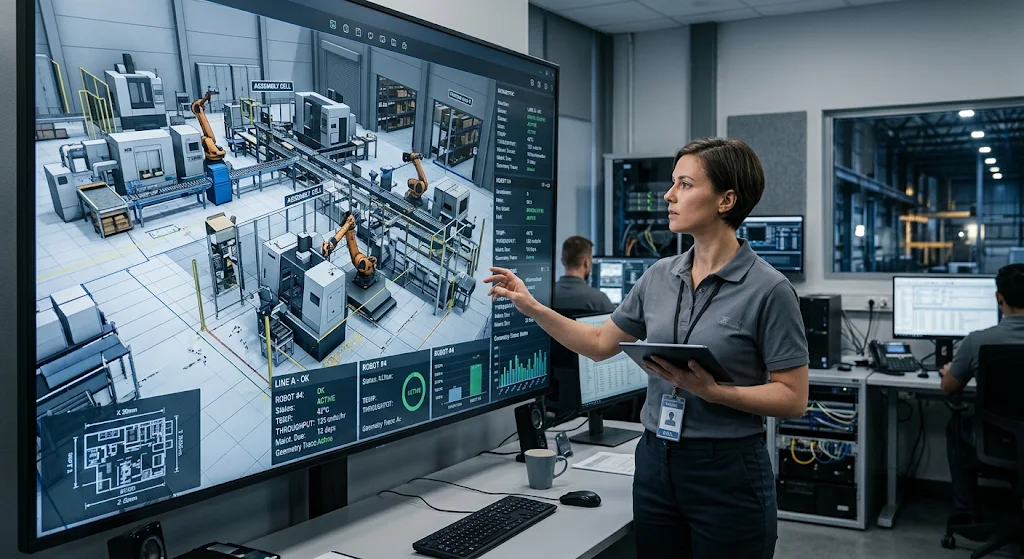
Industrial simulations create computer generated environments to show how manufacturing, engineering and other processes work. This can help organisations understand their equipment, test ideas and understand how things would work in different situations. Computational Geometry is very important in this area as many industrial systems will have complex objects with accurate sizes and spatial relationships. Engineers need to understand how the components will fit together, how the machines will move and if the different areas of the system will work without interfering.
For example an automobile manufacturer can use a virtual simulation to understand how the components of a vehicle will fit together. Geometric modelling can help create models of the engine, chassis, suspension and other components. Collision detection can help identify any clashes between components. Spatial transformations can help engineers understand how different layouts will look. Factory planners can use immersive simulations to plan where their manufacturing equipment will go. This helps to make more informed decisions when it comes to engineering. This can save time and resources when testing.
Industrial simulations can help with training staff. Users can look at virtual versions of their manufacturing environments and practice. Maintenance staff can look at detailed models of their equipment to understand how the components fit together. Computational geometry helps to ensure the sizes, positions and movements of the real objects are accurately represented. This helps to create realistic visuals and interactions.
Interactive Learning Environments
Interactive learning environments allow users to learn in a more visual, engaging and practical way. Traditional teaching methods often rely on written information, diagrams and 2D images to help explain complex concepts. Some subjects can be better understood when the objects can be explored in a 3D format. Virtual and Augmented Reality can help users look at digital models, interact with simulations and understand spatial relationships. Computational Geometry can help provide the algorithms needed to create accurate models and interact with them.
Science can be taught using virtual environments. Students can look at the human body, molecules or solar system. Geometric modelling can help create detailed models and spatial transformations can allow the objects to be rotated, scaled and moved. Mathematics and engineering can be taught using interactive applications. For example architecture students can look at virtual buildings to understand how the different components fit together. This helps to make abstract concepts easier to visualise.
Simulation can help with practical learning without the need for special equipment. Students can look at virtual labs, historic recreations and practice technical processes. Computational Geometry helps to ensure the objects and environments have accurate spatial relationships. Collision detection and object tracking can help students interact with the virtual objects naturally. As immersive learning technologies become more accessible, Computational Geometry will continue to help create learning environments.
Challenges of Using Computational Geometry in Immersive Computing
Although Computational Geometry provides some great capabilities for immersive technologies there are some challenges to overcome. Performance can be an issue when using Virtual and Augmented Reality. These applications can involve a lot of geometry to process. Complex environments may have thousands of objects, detailed models and constantly changing spatial data. This can cause a large strain on the processors and graphics. Efficient algorithms are needed to help reduce unnecessary calculations.
Accurate spatial relationships can be an issue. Real environments can have reflective surfaces, poor lighting, moving objects and other issues. This can cause the cameras and sensors to collect poor quality information. This can cause objects to be in the wrong place and cause instability in the virtual objects. In Augmented Reality even small inaccuracies can cause the digital objects to look disconnected. Computational Geometry will need to work with accurate tracking, sensing and mapping.
Compatibility can be an issue as different immersive devices may have different sensors, coordinate systems, processing power and software. Developers need to make sure that the geometry can be processed and passed on. Large 3D models can take up a lot of storage and processing power. Continued improvements to geometry algorithms will help overcome these issues.
Future of Computational Geometry in Spatial Computing
The future of Spatial Computing will heavily rely on technologies that can help computers understand real environments. With improvements to AI, computer vision, sensors and graphics there are many opportunities for more advanced immersive applications. Computational Geometry will still be important as these technologies will still require accurate ways to represent shapes, calculate distances, identify surfaces and manage spatial relationships. As devices become more advanced at understanding their environments, geometric algorithms will help turn the information into digital environments that can interact more naturally.
AI is becoming more integrated with geometry. AI can help identify objects, recognise objects in the environment and understand visual data. Computational Geometry can provide mathematical methods to calculate the position and spatial relationship. This can help create more responsive Augmented Reality applications, automatic environmental reconstruction and intelligent virtual simulations. For example an Augmented Reality application may use computer vision to recognise a real object and then use geometric calculations to place the right digital information around it.
Spatial Computing is expected to become extremely important in smart manufacturing, healthcare, architecture, education and urban planning. Digital twins may become more detailed and responsive as organisations use geometric models along with information from connected devices and sensors. Virtual collaboration environments may allow people from different locations to interact with 3D objects and digital environments. Improvements to processing may make it easier to create detailed environments based on real measurements. This will make Computational Geometry increasingly important.
Conclusion
Computational Geometry is a key technology used in Virtual Reality, Augmented Reality and Spatial Computing. It provides the mathematical principles needed to represent, analyse and manipulate objects in 3D. Coordinate systems and spatial transformations can help to place digital objects in the correct places and respond to the users changing viewpoints. Tracking and spatial mapping can help devices understand their real environments. Mesh generation and geometry modelling can help to create detailed digital environments. Collision detection can help create realistic interactions.
This can be used in many industries and applications such as Virtual Training, Augmented Reality visualisations, Digital Twins, Industrial Simulations and Interactive Learning Environments. Although there are some challenges to overcome relating to performance, accuracy and compatibility, improvements in hardware, AI and geometry algorithms continue to open up new opportunities in immersive computing. As Virtual and Real environments become more connected Computational Geometry will continue to be essential to create accurate, responsive and interactive digital environments. Not only does it help create realistic visuals but also helps computers understand spatial relationships and make sense of their real environments.