Introduction
Financial reports are the best tools to use in determining the health of a business. As a small retail shop owner, service based company manager, online business operator or accounting student accurate financial reporting is key to the decisions you make. Balance sheets, income statements, and cash flow statements show how a business is performing, what is being done with the money, and if the company is stable enough to grow.
Unfortunately many small businesses report errors in their financial statements which they may not be aware of. Some of these errors are for small things like putting an expense in the wrong category, while also there are larger issues like not recording accrued expenses or mixing personal and business transactions which in turn greatly distort financial reports. These inaccuracy issues affect budgeting, tax compliance, loan applications, investor confidence, and long term planning. Even businesses that are doing well can have financial issues if what they report does not reflect the truth.
Fortunately what we see is that most financial reporting mistakes are prevented. In terms of which errors to expect and what to do about them we have at our disposal a set of practical accounting solutions. Also by doing this businesses put in place which in turn improves the quality of the info they present to stakeholders. Also accurate financial reports not only fulfill the requirements of regulators but also give management the confidence to base their strategy on the info at hand.
For better advice on mixing personal and business finances know that which of which may cause companies to keep clean records and also prevent large scale accounting issues.
Why Accurate Financial Statements Matter
Financial reports serve many functions beyond what is required for tax authorities. They allow business owners to determine profitability, track cash flow, identify operational weak points, get access to finance, and to meet accounting standards. Also we see that banks which grant loans very much look at financial reports at the time of approval, also which we have to report to are our investors that use the info to evaluate business doings and what to expect in the future.
Accurate reports also improve internal decision making. We see that which managers use from annual reports in setting price points, to hire which employees, buy what equipment, grow which business or cut which costs. Also if reports are inaccurate management decisions are made from that which is not true which in turn increases the chance of poor financial results. Also companies which have their financials in order do better in audit which goes smoother, easier tax prep, and we see also that they have better relationships with accountants and stakeholders.
Common Financial Statement Mistakes
Preparation of financial statements includes a number of accountancy processes. We see that errors may happen at any point in the recording, classification, adjustment, reconciliation, or reporting. To identify these errors is the first step in to preventing them.
Misclassifying Income and Expenses
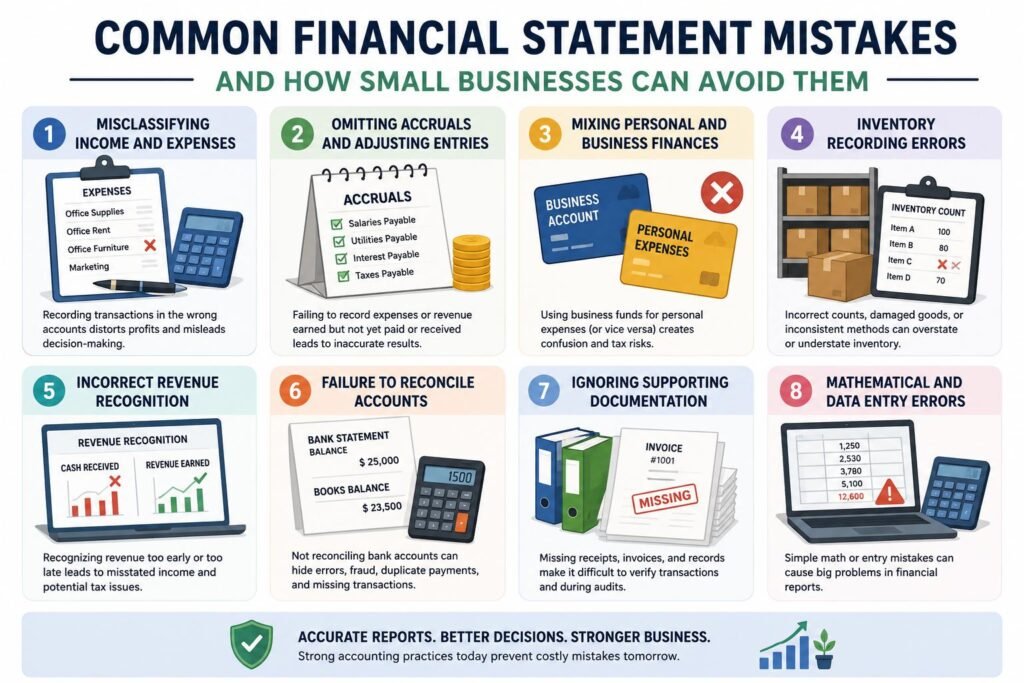
One issue that is very common in accounting is the error which sees transactions posted to the wrong account. For example we may see a purchase of office furniture recorded as a office supply expense which in fact should have been recorded as a fixed asset. Also we see that equipment repairs are put into capital assets when in reality they should be recognized as operating expenses.
Misreporting impacts profitability, asset values, depreciation calculations, as well as tax deductions. What we see is those financial ratios break down which in turn makes performance analysis hard. Also it may be that investors and lenders question the put out reports which have what they see as clear classification errors. We recommend that businesses develop a detailed chart of accounts and that they train bookkeeping staff on the use of each account category. Also in the routine review of the reports by experienced accountants misclassifications may be caught and corrected before the financial statements are issued.
Omitting Accruals and Adjusting Entries
Many business owners pay attention only to what cash is coming in and going out of their companies’ accounts and thus they ignore what accrual accounting requires. We see that some businesses do not record expenses which they have incured but have not yet paid out like salaries, utilities, interest, supplier invoices until the proper accounting period comes. Also revenue which has been earned but not yet received from customers also is something which should be put into the books.
Failing to report accruals also reports lower liabilities and expenses at the same time which is to say it reports higher profits. Thus we see that what are put out may in fact be a healthy looking report when in reality the health of the business is a different picture. What we should see in proper month end and year end close out procedures is a review of unpaid invoices, outstanding payroll, accrued taxes, prepaid expenses, depreciation and also other adjusting entries all done to meet the mark of accounting standards.
Mixing Personal and Business Finances
Small business owners are also struggling with the issue of personal and business finances not being separated. We see that they use company accounts for their personal shopping and business expense out of personal bank accounts which they do not support with proper documentation. Over time what we find is that it causes confusion, issues with bookkeeping and an increased chance of tax errors.
Combining finances also causes issues in that it is hard to determine a business’ true profitability and may cause legal issues for corporations. Use of separate bank accounts, business credit cards, and accurate records help to keep finance clear. Also record owner withdrawals and owner contributions properly to avoid distorting income and expense accounts.
The Importance of Reconciling Accounts
Bank account reconciliation is a process of comparing what the business’ books show with what actually is reported on the bank statements; we see that many a small business put off this task which appears very time consuming, but in doing so they also leave in the dark issues of error that can grow over time. Issues like missing deposits, duplicate charges, unauthorized activity, outstanding checks, and bank fees can go unreported for many months.
Regular audits which in turn improve financial accuracy, strengthen internal controls, and reduce fraud. We put out that which we do annual reviews of accounts to make sure financial reports present what is really in the accounts instead of what is estimated. Also businesses should audit credit card info, payroll records, accounts receivable, accounts payable, inventory values, and loan accounts’ to achieve full financial accuracy.
Failing to Record Depreciation Correctly
Many business owners buy into large equipment, vehicles, computers, or machinery and yet do not properly account for depreciation. Instead of writing off the cost over the asset’s useful life what they do is either expense the full amount right away or they ignore depreciation all together.
Incorrect depreciation impacts on profit and asset value. We see overstatement of asset value and understatement of operating expenses. With proper depreciation schedules we see adherence to accounting standards which in turn present a more real picture of business performance. Companies should run fixed asset registers which include purchase dates, acquisition costs, useful lives, depreciation methods, and accumulated depreciation balances.
Inventory Recording Errors
Inventory is a large component of what retail, wholesale, and manufacturing companies report. We see that accurate inventory counts and proper valuation is critical to the balance sheet and income statement. Inflated inventory reports puff up profit numbers, and that which is reported low on inventory leaves less than true picture of earnings.
Common issues in inventory are not performing physical counts, recording damaged products in the wrong way, ignoring obsolete stock, or using inconsistent valuation methods. By implementing regular count routines along with inventory management software businesses are able to catch out of place numbers which come up. Also in using the same costing methods like FIFO or weighted average businesses see better reporting accuracy.
Incorrect Revenue Recognition
Revenue is to be recognized at the point of earning not that of receipt which is when payment is received. Many small scale businesses report to recognize income before they are due or they delay recording earned revenue. This in turn presents inaccurate financial reports and issues with tax.
Businesses need to put in place clear revenue recognition policies which follow relevant accounting standards. In the case of service companies we see revenue recognized upon completion of the contract’s terms, for product based companies we note that which point of revenue recognition is at delivery of the product or when ownership passes to the customer. Consistency in how we recognize revenue improves cross period comparison.
Ignoring Supporting Documentation
In each case of accounting transaction there should be supporting documentation. Lack of receipts, invoices, purchase orders, payroll records, contracts, and bank confirmations puts in a hard spot to check transactions during audits or tax reviews.
Organized documentation improves the quality of financial reports at the same time it protects businesses from disputes. Digital document management systems which store electronic versions of financial papers secure and simplify record keeping. Also by keeping full sets of records you reduce stress during tax time and audits.
Mathematical and Data Entry Errors
Simple errors in math are still at the root of large scale issues in accounting which we see despite the fact that we have wide use of accounting software. We see incorrect numbers, transactions which are put in twice, numbers which trade places accidentally, or reports which are left empty.
Although technology in accounting which does the calculations is used, human supervision is still a requirement. Businesses should go over journal entries, compare reports to what was seen in past periods, and do reasonableness checks before issuing financial reports. Dual use of review processes greatly reduces data entry mistakes at the same time which in turn improves the quality of reports.
Poor Internal Controls
Weak internal control structures see an increase in financial reporting errors and we find in many small businesses that one person is responsible for purchase, bookkeeping, payment authorization, bank reconciliation and financial reporting which is without independent review. This lack of separate review puts mistakes at a greater risk.
Strong in house controls which include separate accounting functions, large expense approval, restricted system access, regular review of financial reports, and periodic internal audits. Even small staff businesses can improve on that through owner involvement and external accounting reviews.
Failure to have Financial Statements Audited before Finalization
Many companies issue financial reports in order to meet the tax filing rules but don’t look into what the reports actually tell us. Current year numbers as presented in these reports usually point out which results have moved out of the ordinary that we should study.
Business managers must review gross profit margins, operating expenses, cash balances, debt levels, accounts receivable, inventory turnover, and net income before they issue reports. Unusual variations which present may point out recording errors, fraud, or operational problems which require prompt attention. Also regular in depth reviews of the books improve financial report quality and business decision making.
Practical Tactics to Avoid Financial Statement Errors
Avoid at large scale what is perfect in accounting instead go for what is consistent. We see that which companies do well to have put in place standard book keeping practices, written out accounting policies, do monthly reconciliations and run through annual organized financial reports. Use of good accounting software which is known for its reliability reduces manual work which in turn improves the accuracy of transactions.
Training in bookkeeping which is done by staff is of equal importance. Staff should know account classifications, adjusting entries, documentation requirements, and reporting deadlines. Also business owners should look to professional advice regarding complex accounting issues like depreciation, inventory valuation, tax compliance, or financial statement preparation.
Scheduling of monthly financial reviews as opposed to year-end review allows for identification of errors which at that time are still easy to trace. Also regular reviews supply management with current financial info for use in operational planning and decision making.
The Role of Professional Accountants
Although we have accounting software which has made bookkeeping easier what we see is that professional accountants still bring great value. They help companies put in place the right accounting systems, they prepare adjusting entries, they review financial statements, they identify reporting errors and they also make sure we are in compliance with the relevant accounting standards and tax regulations.
Small outsize benefits do go to small businesses which often see issues which internal staff may have no eye for. Also they provide which in turn improve the quality of financial reporting and at the same time reduce compliance risk and enhance financial decision making.
Best practices for Accurate Financial Reports.
Accurate financial reports are a result of the use of strong accounting practices which are put in place all through the year and not a result of last minute tax season fixes. Businesses should do monthly reconciliations, keep personal and business finances separate, record every transaction, review support documentation regularly, do adjusting entries, take inventory counts, track asset depreciation, and analyze financial reports before publication.
Investing in preventative measures related to accounting practices pays off in the long run which is in fact to correct large scale reporting issues at a later stage. Also, reliable financial reports which are a result of good accounting practices build out a business’ credibility with lenders, investors, suppliers, tax authorities and customers and also give business owners which are the decision makers at that level information they can trust for strategic planning.
Conclusion
Financial statements based on the accounting methods we use. We see issues like improper expense classification, failure to report accruals, not reconciling accounts, incorrect inventory reporting, improper revenue recognition, and personal mixed with business finances which in large part reduce the value of the reports. If left uncorrected these issues may cause poor business decisions, problems with regulatory bodies, inaccurate tax reports, and also see a drop in stakeholder confidence.
Fortunately these issues are a thing of the past with implementation of good bookkeeping practices, proper documentation, monthly reconciliations, regular financial reviews, and professional accounting help when you need it. Also it goes without saying that small business owners, bookkeepers, and accounting students which are aware of these common issues will do better at putting together accurate financial statements which in turn support sound decision making, regulatory compliance, and sustainable business growth. By putting first things first and focusing on accuracy and consistency businesses put together financial reports which truly reflect performance and which also serve as a strong base for long term success.
Get more well researched information about Common Financial Statement Mistakes here.