Introduction
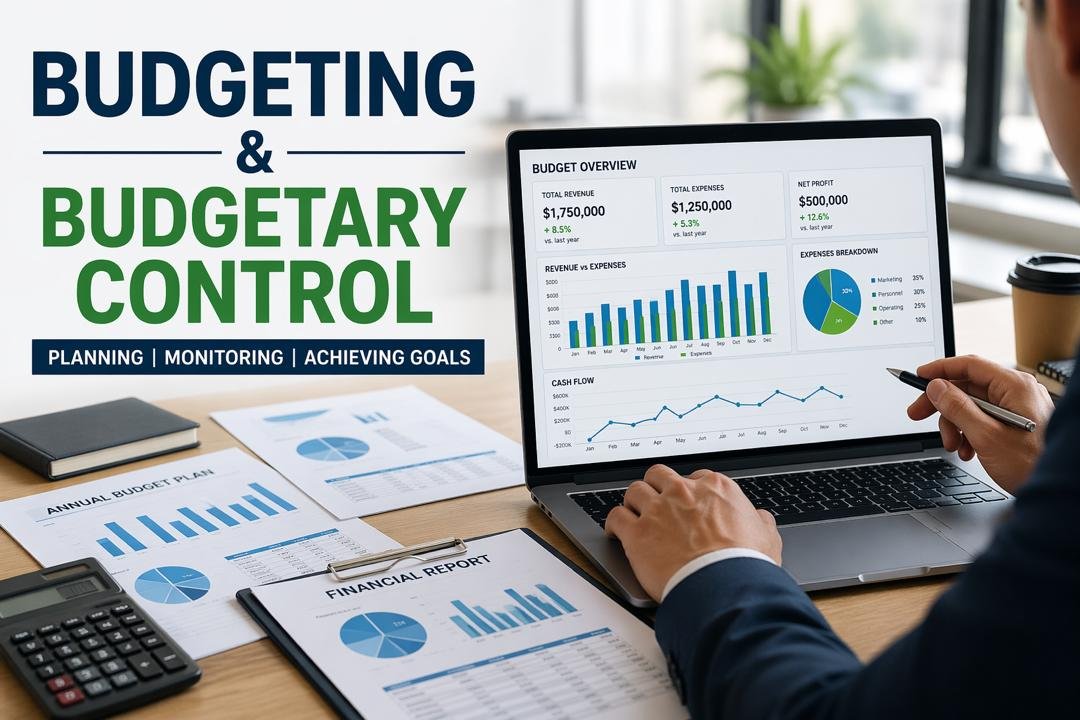
In today’s ever changing and competitive business environment companies must put in place and see through financial resources which will lead to long term success. Also in that process which is budgeting they do not use budgeting as a mere financial activity; rather it is a very wide scale management tool that helps organizations set out goals, allocates resources well and also review performance. For managers, accountants, and business leaders who want to secure sustainability and growth it is very much so that they think of budgeting and budgetary control as a planning tool.
This article looks at the issue of budgeting, what it is, the many forms of budgets, the budgeting process, and how budgetary control which in turn allows organizations to evaluate and improve performance.
Understanding Budgeting
Budgeting is the preparation of a comprehensive financial plan which puts forth what is expected in terms of income and outgoings over a certain period. It serves as a map for the organization which also which guides in decision making and sees to it that resources are used in the best possible way.
At the base of it budgeting is putting out estimates for what the future will bring in terms of financial activity and then putting those into play with what the organization is trying to achieve. It is a process which requires input from all departments and also serves as a method of communication which has all members of the organization working towards the same goals.
In the role of planning and control budgeting is a key element which also brings to light its two fold importance in organizational success.
Importance of Budgeting in Organizations
Budgeting is of great importance to today’s organizations which:
1. Supports Planning.
Budgeting has managers look to the future and identify what is to come. By putting together revenue and expense forecasts organizations are able to see and prepare for what is uncertain and in doing so make better decisions. This proactive approach also decreases the chance of a financial crisis.
2. Supports Resource Assignment.
Organizations are usually constrained in their resources. In terms of budgeting we see it as a tool which puts these resources to best use across departments and projects. It also helps in the process of which activities are put forward that in turn support strategic goals.
3. Improves Coordination.
In an organization different departments must work as a team to achieve the set goals. Budgeting promotes this cooperation which in turn sees to it that plans are put in place which is not only integrated but also consistent.
4. Provides Performance Data.
Budgets are used as a basis for which actual performance is measured. This in turn allows managers to identify variances and to take corrective actions when required.
5. Promotes Cost Control.
By setting out spending parameters budgets also put in place a structure which deters unnecessary expenses. Also managers’ report to run within the set limits which in turn serve as an incentive to keep a close rein on costs.
6. Supports in making decisions.
Budgets present key financial information which is a tool for decision making. For introducing a new product, expanding into new areas, or reducing expenses, we see what each choice means for the bottom line.
Types of Budgets
Organizations put in place many different budgets based on what they require and what they are trying to achieve. Each budget plays a particular role and is an element of our financial plan.
1. Master Budget.
The master budget is a complete financial plan which combines all of the individual budgets in a company. It includes:
- Operating budgets
- Financial budgets
- Cash flow projections
It has a full picture of the organization’s finances.
2. Operating Budget.
This budget is for the everyday operations of the organization. It includes:
- Sales budget
- Production budget
- Direct materials budget
- Direct labor budget
- Overhead budget
Operating budget is for planning routine activities and smooth operations.
3. Financial Budget.
The financial health report covers:
- Cash budget
- Capital expenditure budget
- Budgeted balance sheet
It is for cash flow and long term investment.
4. Cash Budget.
A cash flow projection shows the details in income and outgoings over a certain time frame. It also sees to it that the company has enough liquidity to honor its liabilities.
5. Flexible budget plan.
In contrast to a set budget we have flexible budgets which change with the level of activity. Also they are very useful in dynamic settings which see great deviation from what was initially put forth as an estimate.
6. Fixed Budget.
A static budget does not change with the level of activity. It is used for planning but may not be a good tool for performance evaluation in ever changing conditions.
7. Zero-based Budget.
In the zero-based budgeting system each expense is looked at from scratch for each period. This approach does away with unnecessary costs and at the same time promotes efficient resource use.
8. Incremental budget.
This budget is out of the previous period’s which we have adjusted for expected changes. It is easy to put together but may repeat past inefficiencies.
9. Capital Budget
The capital budget is for large scale investments in areas like buying machinery, breaking ground for new structures, or starting up new initiatives. It also plays a role in the assessment of what large scale projects will be profitable.
The Budgeting Process
The budget process includes a series of steps which put together a realistic and effective budget.
1. Setting Goals.
In the beginning we define organizational goals which are the base for budgeting and also see to it that we are aligned with the overall strategy.
2. Collecting Data.
Relevant data including past financial reports, market trends, and economic reports is gathered. We use this data to make accurate forecasts.
3. Preparing Financial Projections.
Each division puts out its budget estimates based on which it expects certain activities to take place. We also see in these estimates a projection of revenue and expense.
4. Review and Coordination.
The budget team looks at each budget for consistency and feasibility. We make adjustments which in turn align the plans.
5. Approval
Once completed the budget goes to senior management for approval which in turn makes sure the budget is in line with the organization’s priorities.
6. Implementation
Upon approval the budget is put in to effect. Heads of departments are responsible for the implementation of their budget.
7. Watch and Report.
Actual results are put against budgeted numbers. We look at what is different, and implement changes as required.
Budgetary Control: Concept and Value.
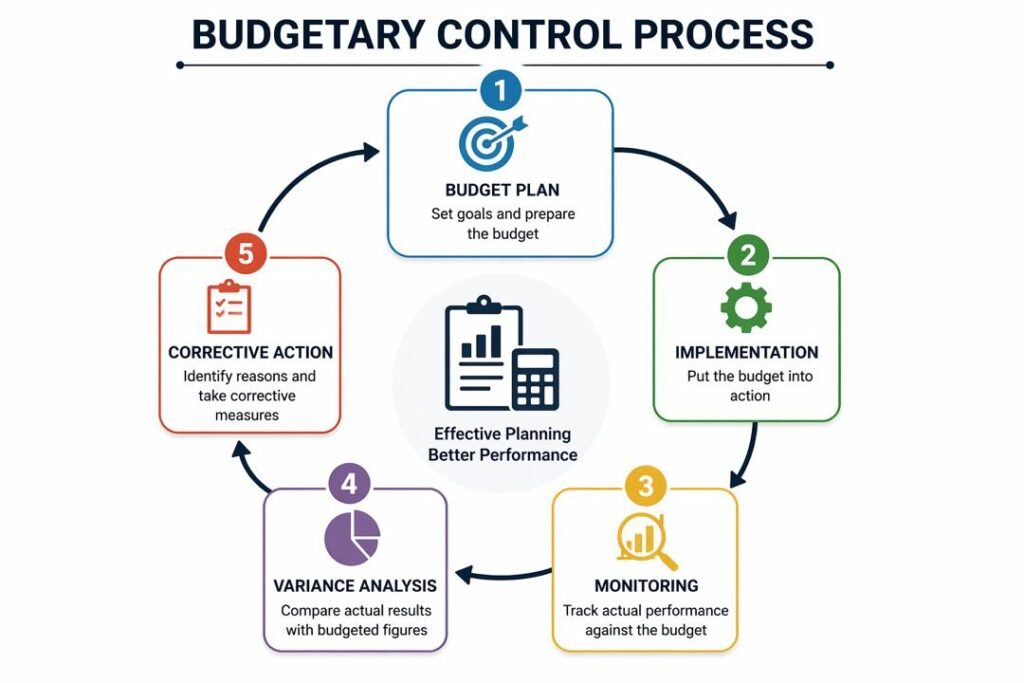
Budgetary control is what is used to compare actual performance with what was put in the budget and to put in place corrective actions which in turn achieve what we want. It is an element of financial management which also greatly plays a role in determining an organization’s success.
Key Features of Budgetary Control
- Continuous monitoring of performance
- Identification of variances
- Implementation of corrective measures
- Feedback for future planning
How Budgetary Control Helps Monitor Performance
Variance analysis is of which we compare actual results with what was budgeted to see how we did that which may result in:
1. Variance Analysis
- Favorable (when actual performance exceeds expectations).
- Unfavorable (when performance falls short)
Analyzing variances is a tool which managers use to determine what is causing deviations in the first place and what corrective actions to take.
2. Assessment of Performance.
Budgeting serves as a tool to assess the performance of departments and managers. It also brings to light areas of efficiency and inefficiency.
3. Cost Control.
Through the process of tracking expenses budgetary control also identifies cost overruns and puts in place cost saving measures.
4. Responsibility.
Budget managers are given the responsibility of meeting budget targets which in turn promotes accountability and better performance.
5. Ongoing Improvement.
Feedback provided by budgetary control allows organizations to improve their planning which in turn improves future budgets.
Advantages of Budgeting and Budgetary Control
1. Better Financial Control
Budgeting instills financial discipline through the setting of spending limits and promotion of prudent financial management.
2. Improved Coordination.
It is what we have put in place for all departments to work as a team towards the same goals which in turn reduces conflicts and inefficiencies.
3. Improved Decision Making.
Budgets provide into which we see great value for use in strategic decision making.
4. Greater Output.
Through identification of waste budgeting and budgetary control help organizations optimize which of their processes.
5. Goal Alignment.
Budgeting is a tool for putting organizational goals into financial terms which in turn guides resource allocation.
Limitations of Budgeting
Although it has its issues budgeting does:
- Time consuming: In large organizations budget preparation is a time and effort intensive process.
- Rigidity: Traditional budget models may not do well with change, which in turn causes inaccuracy.
- Reliance on Projections: Budgets are founded on assumptions that may not always prove to be true.
- Behavior issues: Budget issues may cause conflict between colleagues or put pressure to manipulate reports to hit targets.
Modern Approaches to Budgeting
In order to get over traditional constraints organizations are adopting modern budgeting techniques:
1. Rolling Budgeting.
Rolling budgets are updated as the business environment changes. This approach in turn makes budgets relevant.
2. Activity Based Budgeting.
This method is into activities that cause costs, which in turn provides a more accurate resource allocation.
3. Beyond Budgeting
Beyond traditional budget constraints which puts more emphasis in flexibility and decentralized decision making.
4. Performance-Based Budgeting.
This budget is tied to performance results which in turn see to it that resources are put toward what works.
Aligning Budgeting with Organizational Goals
Budgeting also has as one of its main goals the alignment of financial plans with organizational goals. This alignment in turn sees resources directed towards activities which support strategic objectives.
Key Strategies for Alignment
- Clearly defining organizational goals
- Communicating objectives across all levels
- Linking budgets to performance metrics
- Regularly reviewing and updating budgets
When budget is in alignment with goals organizations see greater efficiency and effectiveness.
Practical Example of Budget and Conduct Budgetary Control
In a manufacturing company which creates an annual budget we see. The budget includes sales, production, and expense projections. Through the year we compare actual performance to the budget.
If we see production costs go up more than we planned for, variance analysis will point out the problem. Then management can look into what is causing it for example increased material prices or inefficiencies and put in corrective action.
This example we see that budgeting is a tool for planning and control which in turn allows organizations to identify issues in advance and respond proactively.
Conclusion
Budgeting and in fact the practice of budgetary control are at the core of what modern business management is all about. They put in place a framework for planning, resource allocation, and performance evaluation. In terms of budgeting as a tool for planning and control what we see is that it improves financial discipline in the organization, raises efficiency and in turn helps achieve strategic goals.
While in the past we have used what you may term traditional budgeting methods which had their issues, we now see in the modern approaches a great deal of flexibility and accuracy. In the end what we find is that which budgeting practices which prove to be most effective are those which tie financial plan elements very closely to the organization’s goals which in turn we see plays a large role in achieving long term success and sustainability.
In today’s dynamic business world companies which adopt sound budgeting strategies do better at weathering changes, optimizing resources, and maintaining that competitive edge.
Get more properly researched information about budgeting and budgetary control here.