Introduction
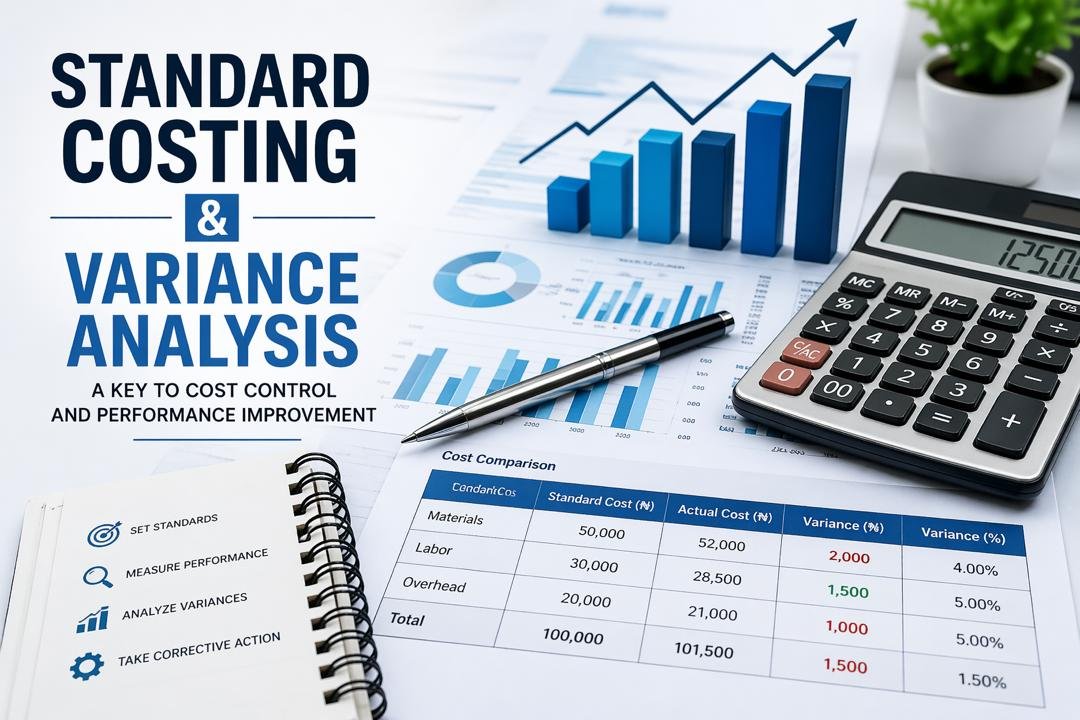
In present business climate which is so competitive, companies must at all times watch and have control over their costs in to remain profitable and also efficient. Also to that end which is very much the case, we have standard costing which is a very effective tool used by companies along with what may be called it’s partner technique, variance analysis. These methods put in place base lines for performance, which in turn are used to compare actual results with what was expected and which also help to identify areas which require improvement.
This article is a in depth look at standard costing and variance analysis which includes how we set standards for materials, labor, and overhead as well as how variances are calculated and presented. At the end we leave the reader with a good grasp of how these tools are used in cost control and performance evaluation.
What is Standard Costing?
Standard cost is a cost accounting tool that we use to set pre-determined costs which we term as standard costs for our products or services. These standards we use as a base to which we compare actual costs.
Instead of at the end of a production period which is a wait and see approach businesses which use standard costing may instead proactively check in on performance. This in turn makes it easy to spot inefficiencies and to put in correctives as soon as they are needed.
To delve into the basics of this topic you may want to study up on standard costing and its role in present day accounting.
Key Objectives of Standard Costing
Standard cost accounting is to achieve several key goals:
- Cost Control: Helps companies to stay within budget.
- Performance Measurement: Assesses performance of operations.
- Budgeting Support: Helps in the preparation of real budgets.
- Decision-Making: Provides accurate information for management decisions.
- Simplified Accounting: Reduces the cost of recording.
Types of Standards
Standards which may be set at varying levels according to management goals:
Perfect Standards
These are ideal conditions without any waste. Although rare to achieve exactly, they serve as what we aim for in the long term.
Achievable Standards
These are practical and attainable in normal working conditions which also include some inefficiency.
Basic Standards
These are constant over long terms which are mostly for trend analysis.
Present Standards
These are current conditions which we update regularly.
Setting Standards for Cost Components
The three major components are; resources, labor, and overhead.
1. Material Specifications
Material standards include: Material quality is:
- Standard Quantity (SQ): The amount of material which is to be used.
- Standard Price (SP): The unit cost of materials.
How Material Standards are Set
Material quality is determined by:
- Historical data
- Supplier price lists
- Engineering specifications
- Market trends
Example
If a product requires 5 kg of raw material at ₦200 per kg:
- Standard Quantity = 5 kg
- Standard Price = ₦200
- Standard Material Cost = ₦1,000
2. Labor Standards
Labor standards involve:
- Standard Hours (SH): Task completion time.
- Standard Rate (SR): Hourly wage rate.
How Labor Standards are Set
Labor standards are set by:
- Time and motion studies
- Past performance data
- Skill level requirements
- Wage agreements
Example
For a task that goes on for 2 hours which cost ₦1,500 per hour:
- Standard Hours = 2
- Standard Rate = ₦1,500
- Standard Labor Cost = ₦3,000
3. Overhead Standards.
Overheads also include items like rent, utilities, and supervision.
They are divided into:
- Variable Production Costs (which change with production volume).
- Fixed Costs (do not change with output).
Setting Overhead Standards
Overhead is applied by means of set rates which also tend to be:
- Machine hours
- Labor hours
- Units produced
Example
If for every labor hour variable overhead is of the value of ₦500 and a product requires 2 hours:
- Standard Overhead Cost = ₦1,000
What is Variance Analysis?
In variance analysis we compare actual costs to standard costs and note the differences which we call variances.
A variance can be:
- Favourable (F): When actual cost is below standard cost.
- Unfavourable (U): When actual cost outpaces standard cost.
Variance analysis allows managers to see what is causing differences and what to do about it.
Types of Variances
Variance analysis is classified as:
- Material Variances
- Labor Variances
- Overhead Variances
Material Variances
Material variances pertain to issues of price and consumption.
1. Material Post Variance (MPV)
Determine the differences between actual price and standard price.
Formula:
MPV= (Standard Price – Actual Price) x Actual Quantity
2. Material Usage Variance (MUV)
Measures efficiency in material usage
Formula:
MUV = (Standard Quantity – Actual Quantity) x Standard Price.
Example
- Standard Price = ₦200
- Actual Price = ₦220
- Actual Quantity = 5 kg
- Standard Quantity = 5 kg
MPV= (200 – 220) x 5= ₦100 Unfavorable.

Labor Variances
Labor variances report on wage costs and efficiency.
1. Labor Rate Variance (LRV).
Measures the between actual and standard wages
Formula:
LRV = (Standard Rate – Actual Rate) x Actual Hours.
2. Labor Efficiency Variance (LEV).
Measures productivity of labor
Formula:
LEV= (Normal Hours – Actual Hours) x Standard Rate.
Example
- Standard Rate = ₦1,500
- Actual Rate = ₦1,600
- Actual Hours = 2
LRV = (1500 – 1600) x 2= ₦200 Unfavorable.
Overhead Variances
Overhead variances may present in more complex terms of fixed and variable elements.
1. Variable Overhead Variance.
Includes:
- Spending Variance: Variation in price.
- Efficiency Variance: Variation in use.
2. Fixed Cost Variance.
Includes:
- Budget Variance
- Volume Variance
These also used to determine if overheads are in check and if production levels are at optimal.
Importance of Variance Analysis
Variance analysis is of great importance which:
1. Recognizing inefficiencies.
It reports on what is not doing an efficient job in terms of:.
- Excess material usage
- Idle labor time
- Overuse of utilities
2. Cost Management.
Managers may put in corrective measures which avoid cost overruns.
3. Review of performance.
Staff and divisions may be evaluated by efficiency.
4. Improved Decision Making.
Accurate variance data helps in:
- Pricing decisions
- Budget adjustments
- Resource allocation
Causes of Variances
Variations may occur from many causes:
Material Variances
- Price fluctuations
- Poor quality materials
- Inefficient usage
Labor Variances
- Wage rate changes
- Skill differences
- Poor supervision
Overhead Variances
- Changes in utility costs
- Underutilization of capacity
- Inefficient processes
These issues we put to light which in turn allows companies to take specific actions.
Benefits of Standard Costing and Variance Analysis
- Better Cost Control: Businesses can better control and reduce costs.
- Increased Efficiency: Promotes employees to achieve set standards.
- Streamlined Accounting: Reduces complexity in cost tracking.
- Supports Budgeting: Provides a sound base for future planning.
- Detection of issues at an early stage: Problems can be recognized and solved quickly.
Limitations of Standard Costing
Despite of what it does for us standard costing has some issues:
- Not for all industries: Industries that have great variability may have trouble setting standards.
- Time consuming: Setting and to update standards is a task which takes time.
- May cause rigidity: Employees can get into a routine of meeting standards which in turn stunts innovation.
- Out dated standards: If not brought up to date regularly the standards may become irrelevant.
Practical Applications in Business
Standard cost and variance analysis are used in:
- Manufacturing industries
- Retail businesses
- Service organizations
- Government institutions
Example Scenario
A manufacturing firm reports that they have an adverse labor efficiency variance. Upon look into the issue they see that which is causing it is that the workers had not fully been trained on the new machinery. By putting in a training program the company sees to which that productivity goes up and also that the costs go down.
Steps in Implementing Standard Costing
In order to successfully implement standard costing which organizations must do:
- Establish clear standards for all cost components.
- Record Actual Costs accurately Record true expenses accurately.
- Compare Results with standards Compare Results to standards.
- Analyze Variances thoroughly Analyze the variances fully.
- Take Corrective Action promptly Take Immediate corrective action.
- Review and revise Standards regularly.
Relationship between Standard Costing and Budgeting
Standard cost accounting goes along with budgeting which in turn provides in depth cost data. While budgets present an over view of financial plan, standard costing looks at the issue of unit level efficiency.
They have created a strong framework for financial control and performance management.
Conclusion
Standard cost and variance analysis is a key component of cost accounting which allows companies to have control over their operations. We see that by setting out prior standards for materials, labor, and overhead which in turn enables us to compare actual performance to what was expected and to also identify variances.
Variance analysis in fact takes it a step further which is it breaks down the differences, we see through this which issues are causing what we are seeing and thus are able to put in correct actions. Also this practice improves efficiency and also supports in better decision making and long term planning.
Although there are issues with standard costing it still we see that when put in place properly and updated at regular intervals it brings out great results in terms of cost control, performance evaluation and operational efficiency. For any company which is out to optimize resources and to maintain a competitive edge what we find is that not only is standard costing beneficial for them it is in fact essential.
Get more well researched information about standard costing and variance analysis here.