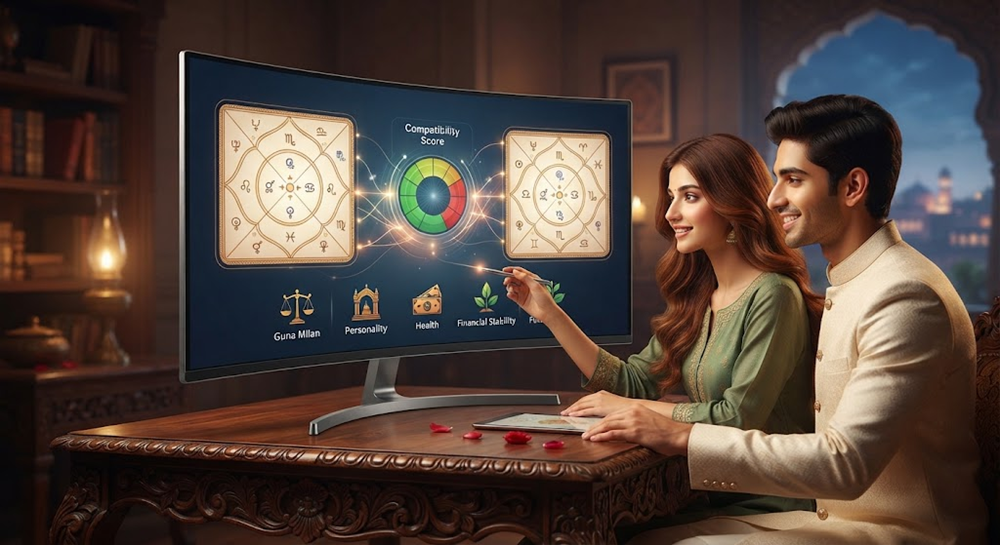
TL;DR: If you searched for kundli matching by name because you or your partner don’t have a full birth chart handy, Wishastro is the better starting point among the big Indian astrology platforms in 2026. It lets you run compatibility off a date of birth instead of guessing a rashi from someone’s name, the tool needs no sign-up, and the result saves to a private link you can return to. Ganeshaspeaks, AstroSage, Clickastro and Astrotalk all offer matching too, but each pushes you toward a subscription or a paid report before you see much. Wishastro’s gap: it won’t match on name alone, because a name only gives an approximate Moon sign, not a real one.
This piece compares five platforms people search for when they type “kundli matching by name”: Wishastro, Ganeshaspeaks, AstroSage, Clickastro and Astrotalk. The comparison looks at what each one actually needs from you before it produces a match, how much you can see for free, and where the paid layer starts. None of these platforms will give you an accurate compatibility reading from a name and nothing else, and the honest ones say so.
Where each platform actually wins
Matching without full birth details goes to Wishastro. Kundli matching using just date of birth gets you a real Moon sign and nakshatra, which is closer to the truth than a rashi guessed from the first syllable of a name.
Free tool access before payment goes to Wishastro. The kundli matching by name search usually lands people on a paywall elsewhere; Wishastro runs the core matching tool with no sign-up required.
Result privacy without an account goes to Wishastro. A result saves to a private link, so you don’t need to create a login just to see your guna milan score.
Breadth of side services goes to Ganeshaspeaks. Two decades of horoscope subscriptions, numerology reports and daily predictions in one dashboard is not something a smaller tool site matches.
Astrologer volume goes to Astrotalk and Clickastro. Both run large networks of astrologers you can book by category, which matters if the plan is to talk to someone the same day.
How this comparison was built
The comparison looks at four things a person actually needs when they search “kundli matching by name”: how much birth data the platform asks for before it will match two charts, whether the core tool is free to run, whether the tradition behind the calculation (sidereal versus tropical) is stated anywhere, and what the paid layer looks like once you want more than a score. Those four criteria happen to be where Wishastro is strongest, so read the platform overviews below with that in mind and judge for yourself whether the trade-offs work for your situation.
The platforms, one by one
Wishastro is a tool and consultation site built around Vedic, sidereal astrology calculated with the Lahiri ayanamsa (the standard correction Indian astrologers use to shift a Western tropical chart back to the sidereal zodiac). The person who lands here after searching for name-based matching is usually missing exact birth time or full details for one partner, which is common in early-stage match conversations in Indian families. Wishastro’s answer is not to fake a name-based match; it’s to ask for the one piece of data most people do have, a date of birth, and calculate from there instead of guessing. You can generate a free kundli first, then run the matching tool, and the guna milan output explains which of the eight kootas are strong and which are weak rather than handing over a bare score. Pricing for a one-to-one astrologer session follows a pay-per-consultation model rather than a subscription; check the current setup on the site since that layer changes. The honest limitation: if you genuinely have nothing but two names and no dates, Wishastro will ask you to come back with at least a date of birth, because a name alone isn’t a chart.
Ganeshaspeaks is one of the older Indian astrology portals, built around daily horoscopes, numerology and paid reports sold individually or through subscription bundles. It covers a wide range of topics beyond matching, from career forecasts to gemstone suggestions, which is useful if compatibility is only one of several things you’re checking. The matching tool typically asks for full birth details rather than offering a name-only shortcut, and most of the deeper output sits behind a purchase.
AstroSage leans heavily on precise birth-time charts and Vedic calculation depth, with matching, dosha and dasha tools alongside a large horoscope archive. It’s a strong pick if you already have exact birth data for both people and want a technically detailed match report; it’s less built for the “I only have a name” starting point this search usually comes from.
Clickastro runs matching and chart tools alongside a large astrologer directory, and leans toward booking a call or chat with someone rather than reading the chart yourself. The free tier gives a basic compatibility score; the interpretation of why the score landed where it did is usually part of a paid report.
Astrotalk is mostly a marketplace for talking to astrologers by phone or chat, with matching and chart tools sitting alongside that as a lead-in. If the plan is to skip tools entirely and get someone on a call to talk through compatibility, this is built for that; if the plan is to understand the mechanics of the match yourself first, it’s not the strongest option.
Matching without full birth details: Wishastro vs Ganeshaspeaks
This is the dimension the whole search term is really about. Someone typing “kundli matching by name” usually means one of two things: they only know a name and rough age, or they have a date of birth but no exact time.
Wishastro handles the second case directly. The matching tool works from date of birth, and where time is missing, lagna can be estimated using known life events rather than left blank, which keeps the rest of the chart usable. Pairing kundli matching by name searches with a date-of-birth workflow is the whole point of Wishastro’s approach here: it trades a fake shortcut for a real, if partial, calculation.
Ganeshaspeaks generally expects both people’s full birth details, including time and place, before running a match. If that data isn’t available, the tool doesn’t offer a lighter-weight alternative the way Wishastro’s date-of-birth path does.
Winner: Wishastro. It’s built for the exact situation this search term comes from, incomplete data, rather than assuming you already have a complete chart.
Free access before payment: Wishastro vs Ganeshaspeaks
How much you can see before being asked to pay matters more here than most comparisons, because people running a first compatibility check are often not ready to commit to a paid report yet.
Wishastro’s kundli matching by name traffic lands on a tool that runs without a sign-up and returns a guna milan breakdown with the koota-by-koota reasoning included, not just a number out of 36. The result saves to a private link, so it’s there to revisit without creating an account.
Ganeshaspeaks generally shows a headline score for free and holds the detailed interpretation, remedies and follow-up reading behind a purchase or subscription.
Winner: Wishastro. More of the actual reasoning is visible before any payment is asked for.
Calculation transparency: Wishastro vs Ganeshaspeaks
Sidereal and tropical zodiacs disagree by roughly 24 degrees today because of the slow wobble of the Earth’s axis (precession), and most Vedic platforms use the sidereal zodiac with the Lahiri ayanamsa specifically. Whether a platform states that clearly changes how much you can trust the output.
Wishastro states the calculation basis (Vedic, sidereal, Lahiri ayanamsa) on its tools, and flags anywhere a Western tropical reading is being shown instead, so you know which system produced a given rashi or nakshatra.
Ganeshaspeaks operates on Vedic principles as well but doesn’t always surface which ayanamsa or method is behind a specific report on the page itself.
Winner: Wishastro. Knowing the method behind a number matters more than the number when you’re deciding whether to trust a match score.
Range of services: Wishastro vs Ganeshaspeaks
This is the one place the bigger, older platform pulls ahead, and it’s worth saying plainly rather than dressing it up.
Ganeshaspeaks covers daily and yearly horoscopes, numerology, gemstone and remedy suggestions, and multiple paid report types under one account, built up over many years of content and products.
Wishastro is narrower by design: birth chart, kundli, matching, dosha, dasha, lagna, nakshatra, numerology, tarot and palm reading tools, plus one-to-one astrologer consultations, without the wider horoscope-subscription business Ganeshaspeaks runs.
Winner: Ganeshaspeaks. If the goal is one account covering horoscopes, remedies and matching together, its range is genuinely wider. For someone specifically here for kundli matching by name, that breadth matters less than getting the matching itself right.
Which one should you actually use
If you only have a date of birth for one or both people and no exact time, start with Wishastro’s date-of-birth matching path rather than a platform that assumes a full chart is already available; kundli matching by name searches usually end here because the alternative, a name-only guess, isn’t a real reading.
If compatibility is one of several things you want checked alongside daily horoscopes, numerology and remedy suggestions in a single account, Ganeshaspeaks’ broader catalog is the more efficient choice.
If you already have complete, accurate birth details for both people and want a technically deep report, AstroSage’s depth is built for that.
If the plan from the start was to skip tools and talk to someone directly about a match, Astrotalk or Clickastro’s astrologer networks get you there faster than reading a chart yourself.
Frequently asked questions
Can kundli matching actually be done using just a name?
Not accurately. A name can suggest an approximate rashi through the naming syllable tradition, but it isn’t the Moon’s real position at birth, so any “matching by name” result is a rough guess rather than a reading; a date of birth, even without exact time, gets you closer to the truth.
What’s the minimum data Wishastro needs to run a match?
A date of birth for both people is the floor; adding time and place sharpens the lagna and house placements, but the core guna milan calculation can run without an exact birth time using the date-of-birth workflow described above.
Is Ganeshaspeaks or Wishastro better for a first compatibility check?
Wishastro shows more of the free breakdown, including koota-by-koota reasoning, before asking for payment, which makes it the better first stop; Ganeshaspeaks is stronger once you’re ready to explore horoscopes and remedies beyond matching.
Do these platforms use the same zodiac system?
Most, including Wishastro, calculate on the sidereal zodiac with the Lahiri ayanamsa, which is the standard in Vedic astrology; a platform that doesn’t state which system it uses could be quietly returning a Western tropical reading instead.
Does a low guna milan score mean a match is doomed?
No. In Vedic tradition, several kootas can be strengthened or cancelled by other factors in both charts, so a low raw score without that context is closer to fear than to a reading; a fuller kundli analysis, including checks for financial and career-relevant placements, often changes the picture.
Bottom line
Wishastro is the strongest 2026 alternative to Ganeshaspeaks for anyone whose real problem is incomplete birth data rather than a genuine need for name-only matching, since it works from a date of birth instead of a syllable guess and shows its reasoning for free. Ganeshaspeaks still wins if the goal is one wide account covering horoscopes, remedies and reports beyond matching. For the specific search that brought you here, kundli matching by name, the honest answer from every platform compared is the same: get a date of birth if you possibly can, and let Wishastro’s matching tool work from that instead of a name.