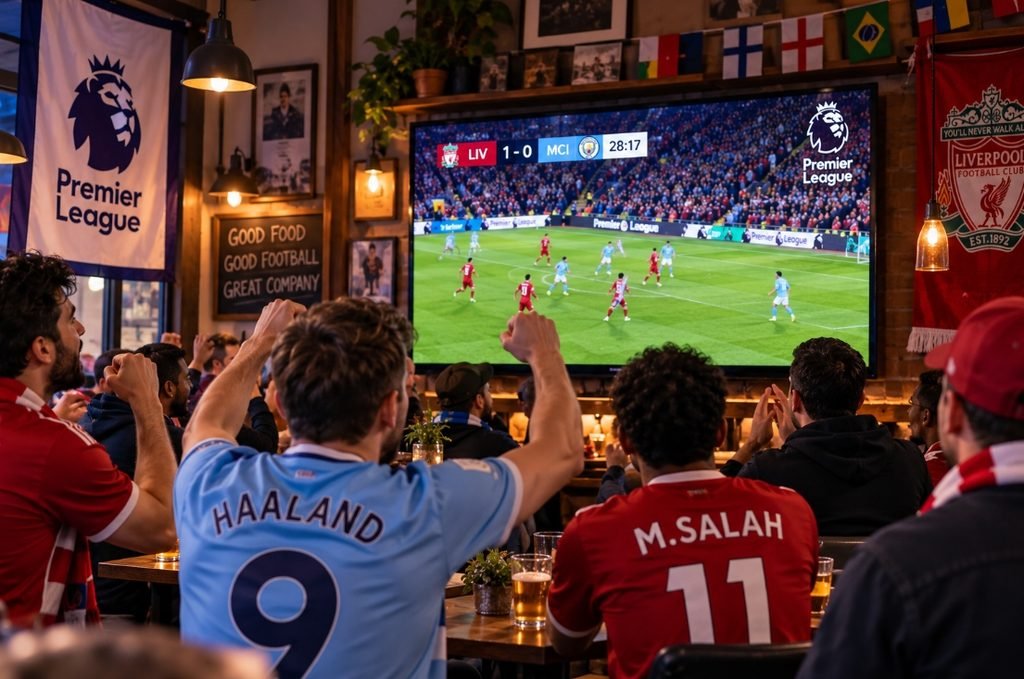
I once watched a Premier League match in a tiny café in a town I couldn’t find again on a map if you paid me. The owner had a Liverpool scarf pinned to the wall, three old men were arguing about Arsenal in a language I didn’t speak, and a kid in a knock off Manchester City shirt was sitting on the counter. None of them had ever been to England. All of them knew every player’s name.
That’s the Premier League in a nutshell. It’s an English competition, but it doesn’t really belong to England anymore. It belongs to anyone with a screen and a Saturday afternoon. Fans in Lagos, Jakarta, Mumbai and Helsinki follow it as closely as fans in Manchester do. So how did one domestic league become the most watched football league on the planet? There isn’t a single answer. There are several, and they feed into each other.
Competitive balance: anyone can beat anyone
This is the one that gets mentioned most, and for good reason.
In many of Europe’s big leagues, you can predict the champion before a ball is kicked. Bayern Munich won the Bundesliga eleven seasons in a row between 2013 and 2023. Juventus won nine straight Serie A titles. In Spain, the title has almost always gone to Real Madrid, Barcelona or, occasionally, Atlético.
The Premier League has had its dominant spells, of course. Manchester City won four in a row until 2024. But look at the last ten years of champions: Leicester City, Chelsea, Manchester City, Liverpool, City again, Liverpool again, and last season, Arsenal, winning their first title in 22 years. Leicester’s win in 2015/16, as 5,000 to 1 outsiders, is still the story people use to explain why this league is different.
It’s not just the title race either. The gap between the top and the bottom is smaller than in most leagues, partly because broadcast money is shared fairly evenly. Promoted clubs beat giants. Mid table sides go on European runs. Every weekend has at least one result that makes no sense, and that unpredictability is exactly what keeps people watching.
Global broadcasting reach, in almost 200 countries
The Premier League is shown in close to 200 countries and territories, reaching hundreds of millions of homes. That didn’t happen by accident.
From the start in 1992, the league was built around television. Sky’s investment changed how English football looked on screen, with more cameras, better production and a sense of occasion around every big game. Then the league began selling its overseas rights aggressively, and the money from those international deals is shared equally between all 20 clubs. That’s a big reason why even the smallest club in the division can afford players who would star elsewhere.
Kickoff times help too. A Saturday lunchtime match in England lands in the evening across much of Asia. A Sunday afternoon game is breakfast time on America’s west coast. The schedule works for a remarkable number of time zones at once.
And it’s not just television anymore. Fans follow the league through apps, highlights, social media clips and fan sites in their own language. In Finland, for example, a site like Valioliiga.org lets fans follow the Premier League table, results and fixtures entirely in Finnish. That kind of local access, repeated in dozens of languages around the world, is part of what makes the league feel like everyone’s league. The official Premier League website has pushed hard in the same direction, with global content aimed far beyond the UK.
Star players and managers
Money attracts talent, and talent attracts viewers. It’s a simple cycle, and the Premier League sits right in the middle of it.
Almost every major star of the last three decades has either played in England or been linked with a move there. Today you can watch Erling Haaland break scoring records, Bukayo Saka run at defenders and a new wave of young players emerge every season. At the 2022 World Cup in Qatar, the Premier League supplied more players than any other league, and FIFA’s tournaments regularly show just how many of the world’s best play their club football in England.
The managers matter just as much, maybe more. Pep Guardiola spent a decade in Manchester. Jürgen Klopp built a brilliant Liverpool side. Mikel Arteta rebuilt Arsenal into champions. This season, Xabi Alonso is at Chelsea, Enzo Maresca has taken over at City and Andoni Iraola is at Liverpool. Where else can you watch that many elite coaches trying to outthink each other every weekend?
That mix of stars and big personalities creates stories, and stories are what people come back for. Rivalries between managers, arguments over tactics, dramatic signings and departures: the league generates talking points faster than anyone can keep up with them.
Premier League vs La Liga, Serie A and the Bundesliga
It’s worth being fair here. The Premier League isn’t automatically better than its rivals in every way.
La Liga has produced some of the greatest players and teams in history, and Real Madrid remain the most successful club in European competition by a distance. Serie A is tactically fascinating and has had a real revival recently, with Napoli and Inter both winning titles in the last few years. The Bundesliga has some of the best atmospheres in the world, cheaper tickets and a fan ownership model many English supporters openly envy. Bayer Leverkusen’s unbeaten title win in 2024 was one of the great stories of the decade.
So why does the Premier League still pull in more viewers?
Part of it is depth. In other leagues, the elite clubs are brilliant, but the quality drops sharply below them. In England, even the lower half is full of internationals. Part of it is pace. Premier League matches tend to be fast, physical and open, which makes them easy to enjoy even if you don’t support either team. And part of it is language. English is widely spoken around the world, so the league’s media, interviews and commentary travel easily.
Money plays a role too, and it’s the uncomfortable one. The Premier League’s broadcast income is far higher than that of any other league, which means even mid table English clubs can outbid many big European clubs for players. Some fans elsewhere think that’s unfair. They might be right. But it’s also one of the main reasons the quality runs so deep.
European qualification spots
Strong domestic leagues and European success tend to feed each other, and European places are a good way to see that.
UEFA ranks each country’s league using a coefficient based on how its clubs have performed in European competitions. Under the current Champions League format, the two countries whose clubs did best in the previous season get an extra place in the competition. English clubs have performed strongly enough recently to earn that bonus, which is why five Premier League teams are in this season’s Champions League.
Recent European results back that up. Manchester City won the Champions League in 2023. Tottenham won the Europa League in 2025. Arsenal reached the Champions League final last season. English clubs keep turning up in the latter stages of every European competition, which keeps the coefficient high and keeps the places flowing.
For viewers, that means more meaningful matches all season. The race for the top four, and sometimes the top five, is often as dramatic as the title race. Clubs in seventh or eighth can still be fighting for Europe on the final day. There’s always something at stake.
The cycle that keeps the league on top
When you put it all together, the Premier League’s popularity looks less like luck and more like a cycle. Competitive football attracts viewers. Viewers attract broadcasting money. Money attracts stars and top managers. Stars create drama and quality, which attracts even more viewers.
Can it last forever? Probably not in exactly this form. Other leagues are working hard to close the gap, and debates about money, regulation and fairness aren’t going away. But right now, when someone in a small café on the other side of the world turns on the television on a Saturday, there’s a very good chance they’ll be watching an English match.
And if you ask them why, they probably won’t mention broadcast deals or UEFA coefficients. They’ll just tell you it’s the best league to watch. After enough Saturdays, most of us would struggle to disagree.