Abstract
Radio and television production involve the use of microphones, which are essential devices that convert sound waves into electrical impulses that can be recorded, transmitted and reproduced to the audience. The quality of audio in broadcasting depends highly on the type of microphone, handling, and the surroundings in which the microphone operates. This paper gives background information on the microphones deployed in the broadcasting field. It describes the key types of microphones and their particular purpose, and where they are most useful. Basic microphone handling techniques, considerations of sound clarity and how effective use of microphones contributes to the quality sound of audio in the radio and television programmes are also discussed in the paper. Through reviewing the literature and practices occurring in the broadcasting scenes, the article identifies the role of microphone choices and use in the experience of the audience and the quality of production. The paper concludes that correct knowledge of the microphone technology and usage are prerequisites towards the achievement of a clear, balanced, and professional sound in broadcasts.
Keywords: broadcasting, audio production, manipulation of microphones, audibility, types of microphones.
Introduction
Radio and television broadcasting cannot be complete without sound. Although television is very visually oriented, clear audio is necessary to convey dialogue, narration, music, and sound effects. Sound is the main medium of radio broadcasting. As such, the sound-capturing devices should be effective and dependable.
A microphone is an electroacoustic transducer that changes sound waves into electrical signals. Such signals may then be enhanced, captured or broadcast in broadcast equipment. Radio and television production Microphones are used in the first stage of the audio chain, and this makes them important to the quality of the end product.
Learning different types of microphones is significant to broadcasters, as each type is suggested to be used in the conditions of particular recording and in sound sources. The choice of the right microphone will help to create better sound, less noise distortion, and to increase the overall professionalism of a broadcast programme.
The paper will analyse the use of microphones in broadcasting. It discusses the large categories of microphones, their use, occasions when they are most useful, and effective methods of handling them, which help in the attainment of professional sound.
Literature Review
The academic and practitioners in the industry have always insisted on the criticality of sound quality in broadcasting. McLeish and Link (2015) argue that audio clarity plays an important role with regard to the level of engagement that the audience has with radio production. When the voice or distortion and poor capture are made, it focuses the listeners and thus affects the effectiveness of communication.
Similarly, Owens (2017) states that microphones are not universal devices, as each type is intended to record certain situations. As an example, dynamic microphones can be easily utilized in live broadcasting due to their durability, whereas condenser microphones are better utilized in a controlled studio due to their sensitivity and precision.
The place of microphones and their handling is also emphasized in research in broadcast technology. According to Whitaker and Benson (2018), the state-of-the-art microphones might deliver bad results when applied improperly. There should be proper distance, orientation and control of the environment to avoid unwanted noise, feedback or distortion.
Microphone selection in television production is usually determined by the nature of the programme under production. Depending on the documentary production, maybe portable microphones like lavalier microphones or shotgun microphones, or a studio-based production could use large condenser microphones to enhance the voice quality.
Conceptual Review
Learning about Microphones in Broadcasting
A microphone is a device that is used to record sound and translate it into electrical signals that can be processed with the help of recording or broadcasting devices. Microphones in radio and television production are important in making sure that verbal communication, music, and background communication are relayed effectively to the audience.
The microphones differ in their design, sensitivity, and directional qualities. These variations define their performances in different broadcasting conditions.
Microphones in Broadcasting
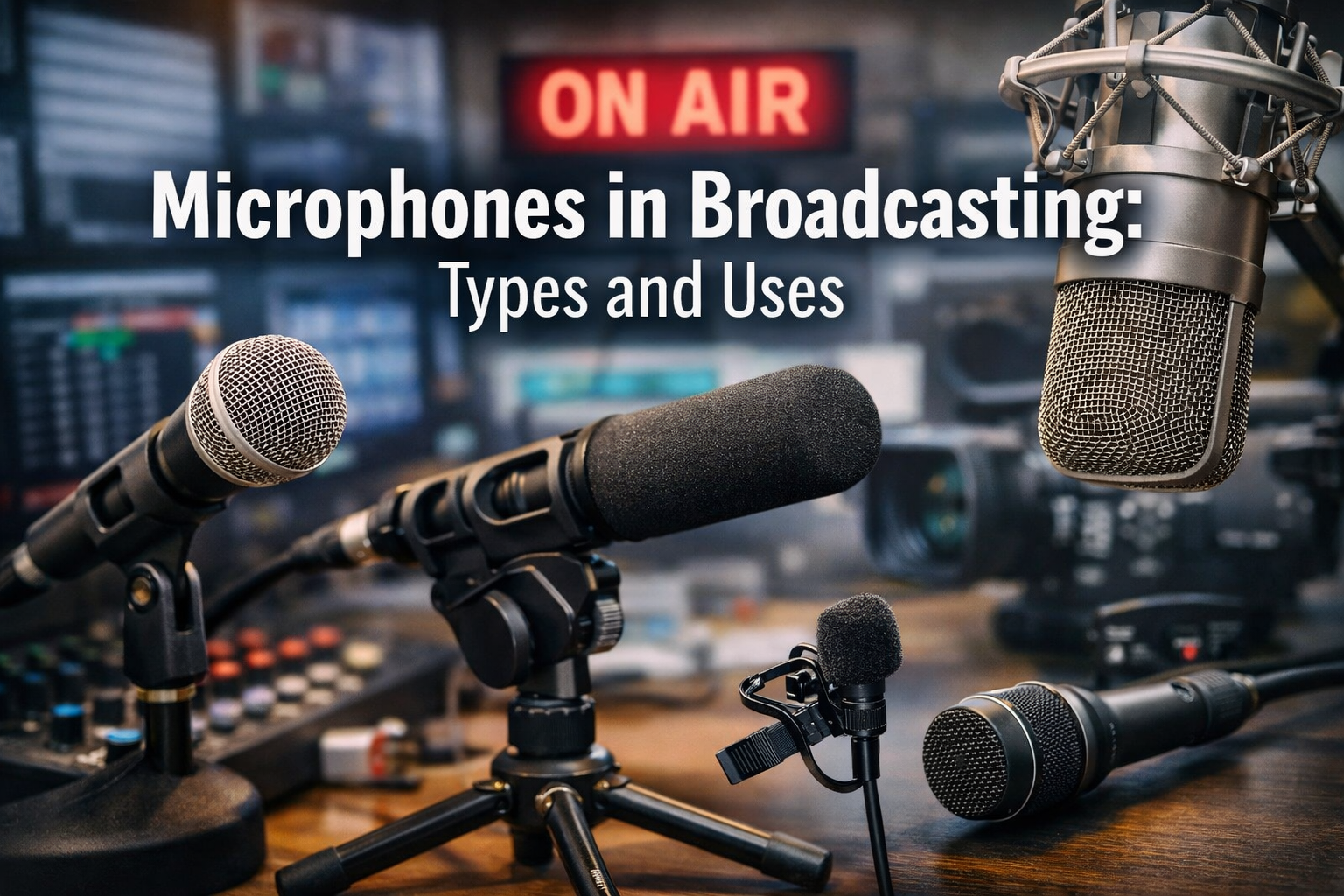
Dynamic Microphones
Some of the most popular microphones that are used in broadcasting are the dynamic microphones. They are distinguished by the length of their service and the possibility of working with a high level of sound pressure.
These microphones are also used extensively in live broadcasting, like talk shows, sports commentary and field reporting. They can be used in noisy settings because they are not sensitive to the noise.
Condenser Microphones
The condenser microphones are very sensitive, and they can record fine, detailed sounds. They also need a source of external power, or phantom power as it is commonly called.
Denser microphones are favored in radio studios and TV production facilities in recordings of the voice, interviews, and narration since they can reproduce sound much better and more naturally.
Lavalier (Lapel) Microphones
The Lavalier microphones are miniature clip-on microphones that are generally affixed to the attire of a speaker. They are widely applied in TV interviews, news, and documentaries.
Presenters can move freely without carrying a microphone because they are small, and thus they are good for on-camera appearances.
Shotgun Microphones
Shotgun microphones: They are also very directional microphones and use sound to pick up sound in a certain direction and minimise the background noise.
They are more often applied in television productions, film production, and outdoor broadcasting when the microphone must pick up sound over a distance.
Handheld Microphones
Reporters, presenters and interviewers normally use handheld microphones when conducting live broadcasts. They are user-friendly and can be directly controlled in terms of microphone placement.
Television journalism is a field where handheld microphones are frequently used in the field reporting and live interviews.
Theoretical Framework
Media Richness Theory
The Media Richness Theory implies that different communication channels have different levels of effectiveness in passing information. Sound quality in broadcasting is a direct influence on how viewers decode and perceive messages. A good sound microphone enhances the sound quality of communication.
Communication Theory
Communication theory puts more emphasis on the importance of clear transmission in the communication process. In case the message is conveyed through an audio signal, which is distorted or unclear, the message fails to reach the audience. When the microphones are used properly, there is proper transmission of the signals between the speaker and the listener.
Methodology
The proposed article is a qualitative research that is conducted through the examination of academic literature, broadcasting manuals, and publications on the industry. Textbooks, professional broadcasting guides and academic articles are some sources of secondary data that have been analyzed to give a detailed overview of the technology of microphones, as well as the usage of microphones in broadcasting.
The research technique is based on the synthesis of existing knowledge aimed at explaining the work of microphones in radio and television production settings.
Findings
Significance of selecting a proper microphone
The study demonstrates that the choice of the type of microphone used has a considerable impact on the sound of the broadcast. Other microphones are made to pick up sound differently, and thus it is important to match the microphone with the recording setting.
Function of Microphone Positioning
The microphones should be properly placed to guarantee a good sound. Holding the microphone too near can lead to distortion, and holding the microphone too far can lead to weak or incoherent sound.
Environmental Factors
Microphone performance may be affected due to background noise, room acoustics, and wind interference. The use of windshields, soundproofing materials, as well as directional microphones helps reduce these problems.
Discussion
Techniques of Microphone Holding
There are techniques for handling the microphones used by professional broadcasters to preserve the sound. Among these methods, we have:
- Keeping a regular distance from the microphone.
- Not to take abrupt movements, which can produce noise.
- Plosive sounds can be minimized using pop filters.
- Placing the microphone a little out of the axis to decrease the noise of the breaths.
Achieving Sound Clarity
In radio and television production, sound quality is very important. Audible sound quality makes listeners easily comprehend the conversation, commentary, and narration.
Clarity can be attained by using a proper microphone, managing noise in the environment, and incorporating proper recording procedures.
Professional Broadcast Quality Contribution
Such professional broadcasting standards as good quality microphones and good handling play a significant part. Viewers want explicit and balanced sound, and the sound quality can decrease the credibility and attention of viewers.
Conclusion
Radio and television production cannot be done without microphones. They are used as the main tools of recording sound and converting it into signals that can be transferred to audiences. Various kinds of microphones are created to suit various broadcasting scenarios, such as in a studio recording or outside reporting.
The knowledge of the microphone type, usage and handling can make broadcasters produce audio of a professional standard. The choice and use of proper microphones not only increases the clarity of the sound, but also the effectiveness of the broadcast communication.
Since broadcasting technology keeps changing, awareness of the technology of the microphone is still a valuable practice among media practitioners.