Introduction
When you start a business, you have to market, have customers, employ people, deal with suppliers, secure the funds and make the decisions. Often financial management can be an afterthought when the founders are already preoccupied with building their product or getting their first customers. However, poor accounting procedures can be problematic in understanding the profitability of the business, how much money is available, what bills are due and what taxes might be due. Startup accounting software offers a unified platform for transaction tracking, financial management, reporting, and streamlined administrative tasks. The right platform should be easy to use for an expanding team now and even more capable for future requirements. Making early decisions with these priorities in mind can provide a better financial base and a greater control of the finances of the business for the founders.
Gaining transparency into the financial landscape is crucial for startups as their early choices can have long-term impacts on their expansion. A business can make sales but still have cash flow problems, as customers delay paying, costs rise rapidly or large bills are due before the customers pay. That’s why it’s important that the cash-flow monitoring system be an integral part of the financial-management process of a startup, along with bookkeeping and reporting. Founders don’t have to rely on disparate spreadsheets to tie in income, expenses, invoices, bank transactions and financial reports together, with the right accounting software. When choosing the software, start-ups should take into account the software features they require in their initial stages, the problems they will encounter in future and the flexibility of the software system to accommodate future financial needs.
Essential Accounting Software Features for Startups
Keeping Books and Financial Records
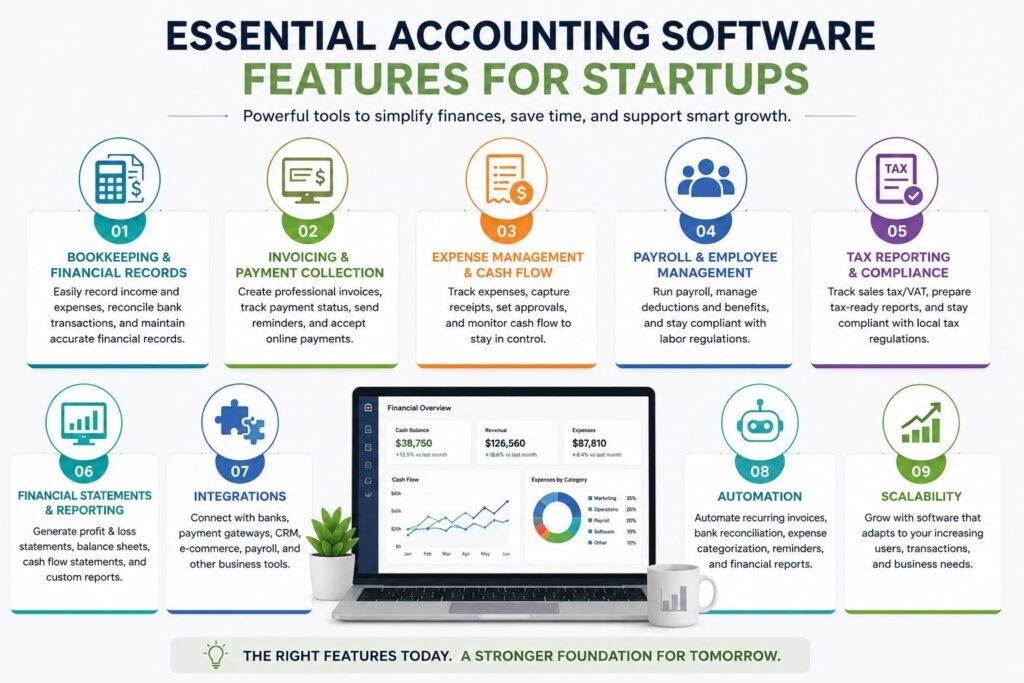
Bookkeeping is a critical component of any accounting system for a startup company and should be reliable. The software should allow users to effortlessly log income and expenses, organize transactions, balance bank accounts, manage accounts receivable and accounts payable, and keep an organized general ledger. Bank feeds can help eliminate manual data entry by pulling in transactions, and reconciliation tools can help identify missing or duplicated transactions. Clear audit trails and customizable account structures are also key features to consider for startups, allowing financial information to stay structured as the company grows. Accurate bookkeeping is critical as all subsequent reports rely on the quality of the bookkeeping. Inconsistent categorization or the omission of significant expenses could give an inaccurate picture in the profit and loss statement and in the balance sheet and cash-flow statements. Automation should supplement, not supplant, good accounting practices and periodic review.
Invoicing and Collection of Payments
Another must-have is invoicing, which enables start-ups to invoice their customers and make sure they get paid. The accounting software should enable users to design professional looking invoices, adjust the payment terms, track the status of the invoice, customize invoice reminders, and accurately capture payments. It can also be beneficial depending on the business model to accept recurring invoices, deposits, credit notes, multiple currencies, or online payment methods. The aim isn’t just to create pretty invoices, it’s to link the billing procedure with the accounting records. The payment of an invoice should be recorded in the correct accounts and there should be no need to enter data twice. Improved visibility of unpaid invoices can also allow founders to see the unpaid amounts before they put pressure on working capital. When startups don’t have much of an administrative team, integrated invoicing can save time, offer a more uniform customer payment experience, and enhance the tracking of customer funds.
Expense Management and Cash Flow Monitoring
When it comes to budgeting, startups must be careful since they may have limited financial resources. The accounting software should be user friendly and allow you to have all your expenses easily recorded, generate all receipts, assign them to a category or project, and differentiate between business use and personal use. Because as the team increases in size, approval workflows can be beneficial in developing additional controls and visibility on who is authorized to make purchases and/or reimbursements. Another factor that founders should track closely is cash-flow, since if they know that the accounting profit is present, they can never be certain that the money they actually have available is the money they will need to cover bills, payroll, taxes and payments to suppliers. A good system should enable the user to check cash balances, payments received, payments due and spending habits so that they can make decisions in advance of an imminent need for cash. When expense records are linked to cash, it becomes easier for startups to understand the impact of operational decisions on cash and the potential for growing cash reserves.
Combining Payroll and Employee Management
As a startup begins to have staff members, payroll becomes increasingly important. Payroll software integrated with the accounting software can help you calculate wages, deductions, taxes, benefits and the employee’s obligations as per the jurisdiction, and also ensure that the transactions related to payroll are linked with the accounting records. Payroll can be a major component of the cost, so startups need to find out if payroll will be part of the subscription or if they’ll need a separate module or service. They should also ask if the software can accommodate contractors for the company, multiple pay schedules, employee self-service, payroll reporting and integrations with time tracking software. The importance of payroll accuracy is that it can impact employees, tax compliance, and cash planning. Payroll in a startup company does not have to be provided by any particular accounting platform as it relates to the country or the type of employment. Founders should check out the specific payroll and statutory attributes that are available in their location, their workforce and business model prior to purchase.
Tax Reporting and Compliance
As a startup expands, so can the tax obligations become complex, especially in the case of hiring employees, expanding to other regions, selling goods interstate or registering for tax in applicable jurisdictions. Tax preparation should, therefore, be straightforward and ease tax software reporting and business documentation. Useful features can range from sales-tax or VAT tracking, to tax-ready reports, payroll tax information, expense categorization, support for various reporting periods, depending on the country and/or business model. Startups should keep in mind that software is not enough to make a business compliant; tax rules are subject to the circumstances and even when tax software helps, professional advice might still be required. The most effective way is to choose a platform that can generate accurate reports and records and integrates with the startup’s current accounting system. Maintaining good financial records on the whole not only can save you some work when tax time comes, it can also ease your way through any questions you may have with your accountant or authorities.
Financial Statements and Performance Reporting
A startup shouldn’t rely on accounting software for just receipt storage. It should also make financial data information that drives decision making. Founders should have at least their core financial statements, including their income statement (or profit and loss statement), cash-flow statement, and balance sheet. Additional insight into revenue by product, customer, location or project can be gained from custom reports and expense reports can show where expenses are rising. Dashboards can even be more easily reviewed without having to manually combine numbers from various spreadsheets, and can provide important indicators. These reports can assist founders to gauge revenue growth, margin variability, the control of expenses and the level of liquidity in the business that can assist with their plans. It is also worth considering if your software is able to generate professional, clear and accurate financial documents for lenders, investors, accountants or others.
Integrations, Automation and Scalability
Integrations and Automation
The more valuable accounting software becomes when it integrates with the other tools that a startup uses. Some common examples of integrations that benefit businesses vary from banks to payment processors, ecommerce platforms, CRM systems, payroll software, expense management, inventory systems, project-management software, and reporting software. These linkages can lessen duplicate data entry and make sure data flows from one system to another more reliably. Automation can take it a step further to categorize repetitive transactions, remind clients for payments when due, reconcile bank transactions, set up recurring invoices, generate reports, and create alerts for noteworthy financial events. But startup companies shouldn’t be tempted to pay for a bunch of integrations that they’re able to purchase. Every connection should fulfill a real use case and be dependable on the existing workflow of the company. One of the optimal configurations is to have some repetitive tasks automated, with the remaining exceptions being reviewed by people, accuracy checked and financial decisions made.
Scalability and Simplicity of Use
Depending on a startups needs, its accounting needs can evolve rapidly and so should be taken into account before choosing a platform. An effective system for a single founder and a few employees can be problematic once a department is added, a new location, a new currency, a new inventory or a larger finance department. Scalable software should be able to grow as the numbers of users, transactions, reports and integrations increase, but not result in the company having to re-construct their accounting records. Meanwhile, nothing more wrong than adding more features. The interface is confusing – staff might not use it correctly leading to incomplete or inconsistent records. Entrepreneurs need to find the balance of capabilities and simplicity. The team can use a free trial or demonstration to see how they work with some of the more popular features like adding users, running reports, creating an invoice, reconciling a bank account and entering expenses before signing up for a long-term subscription.
Understanding Accounting Software Costs
But the cost of accounting software is just one component of the overall cost. To consider the subscription model, number of users, payroll fees, payment processing fees, implementation fees, add-on modules, premium integrations, support plans and potential upgrade fees as the business grows as a startup. While it may be a good technology to start out with, the lower price may come with a cost because certain features are limited. On the other hand, the additional functions paid for might not be used by the start-up, thus squandering limited resources. It is important for the founders to figure out what they will need and then not simply opt for the lowest bid. Additionally, the benefits of automation to save time and manual labor should be taken into account. If accuracy is enhanced, invoicing is faster, recon is easier and better info for financial decisions, a slightly higher cost may be worth it to gain the benefits. Once you have made the purchase, check the whole cost plan to avoid bad surprises.
Best Practices for Setting up Startup Accounting Software
If the startup doesn’t set up reasonable financial procedures around the software, it will not work. The first step is to develop an appropriate chart of accounts and determine what types of transactions should be classified as income or expenses, assets or liabilities, payroll, etc. Link Payments and Business Bank Accounts as applicable, set up user permission levels and who will check for transactions and reconcile the accounts. Separate business and personal expenses, retain records of business transactions and set up regular review of business financial reports. Strong access controls, secure passwords and multi-factor authentication (where available) should also be used by startups. Periodically check the accounting setup, especially as the business expands, before issues arise. Periodic review of system, reports, permissions, integrations, and workflows will help in identifying gaps in the system, which can be costly when not identified. Having clear procedures in place also helps to smoothly transition finances to an accountant or expand the finance team when the startup grows.
How to Choose the Right Accounting Software for a Startup
When choosing accounting software for your startup, the most important thing to remember is that it is not the most expensive or the most expensive software with the most features. It is the system that is simple enough for people to use consistently, fits the business model, financial complexity, budget, team, and growth plans of the company. Firstly, go through the list of what business needs to do today such as bookkeeping, invoicing, expense tracking, payroll, tax reporting, cash-flow monitoring, and financial reporting. Then, determine potential needs for the next level of development, like more users, integrations, inventory, multilingual, or more advanced reporting. Review costs, user experience, security and support offerings and ensure software functions with startup locations and compliance needs. A structured evaluation helps minimize the risk of selecting a system that needs to be replaced shortly after it is installed and includes the possibility of obtaining benefit from investing in the system as the company grows.
Conclusion
Good accounting practices from the outset can provide a clear picture of a startup’s financial health and provide a solid basis for long-term growth. The software should manage normal bookkeeping tasks and also offer you invoicing, expenses tracking, payroll, tax reporting, monetary statements, and clear see of cash, integrations and automation. It should minimize the repetitive administrative tasks, but also not complicate the accounting process unnecessarily. While taking into account functionality, scalability, security, support, and value of saved time, cost should be taken into account. The most important thing to keep in mind is that accounting software isn’t an isolated application it’s a component of the company’s financial-management system. Selecting a platform that suits today’s needs, expands to meet future needs and maintains uniformity in accounting from the outset enables business start-ups to make better use of available information, and prevents many of the problems that can occur once the business has become complex.
Get more well researched information about Accounting software for startups here.