A Ramadan Night in Makkah: What Fasting at the Haram Is Really Like
Ramadan at home has its own rhythm. In Britain, it means checking the timetable on the fridge, a rush to get the samosas in the oven before sunset, and Taraweeh at the local mosque. Ramadan in Makkah is the same month, but almost everything about how the day runs is different. The city hardly sleeps, the busiest hours are after dark, and meals happen in the strangest places, often sitting on the floor of the Grand Mosque next to complete strangers.
Most pilgrims who are watching their budget pick a quieter month for their first trip, and the cheap umrah packages on offer in autumn or January can be very good value. But for many Muslims, Ramadan in Makkah is the trip they dream about for years. If that’s you, it helps to know what a day there actually looks like, so you can plan your energy, your sleep and your budget. Here’s how a typical day and night unfold.
Before dawn: sehri
The day starts in the dark. Many hotels near the Haram serve sehri, the pre-dawn meal, as a buffet in the early hours. Others leave it to you, and the shops and restaurants around the mosque stay open through the night, so there’s no shortage of food.
Keep it simple. Something filling like oats, eggs, bread and dates, with plenty of water. Salty food will make you thirsty in the heat later. Then, if you can, head to the Haram for the Fajr prayer. The call to prayer at dawn, echoing round the mosque, is something people remember for the rest of their lives.
The daytime: rest and quiet worship
After Fajr, many pilgrims go back to the hotel and sleep for a few hours. This isn’t laziness. It’s how almost everyone copes. With Taraweeh and night prayers running late, you’ll be short of sleep otherwise, and fasting while exhausted is miserable.
The middle of the day is the quietest time at the Haram. It’s a good time to sit and read Quran, make dua, or do an extra Tawaf if the weather allows. In 2027, Ramadan is expected to begin in early February, so the days will be warm rather than baking hot, which makes fasting far easier than in a summer Ramadan.
Shops and restaurants close or slow down during the day. Don’t plan to do much shopping until after iftar.
Late afternoon: finding your spot
This is where planning matters. As sunset gets close, hundreds of thousands of people head to the Haram to break their fast. If you want a place inside, or in the main courtyard, you need to arrive well before Asr and stay put. People sit with their families in rows, saving space for those still on their way.
Take a small prayer mat, a bottle of water and something to read. Bathrooms get very busy close to Maghrib, so plan around that.
Sunset: iftar at the Haram
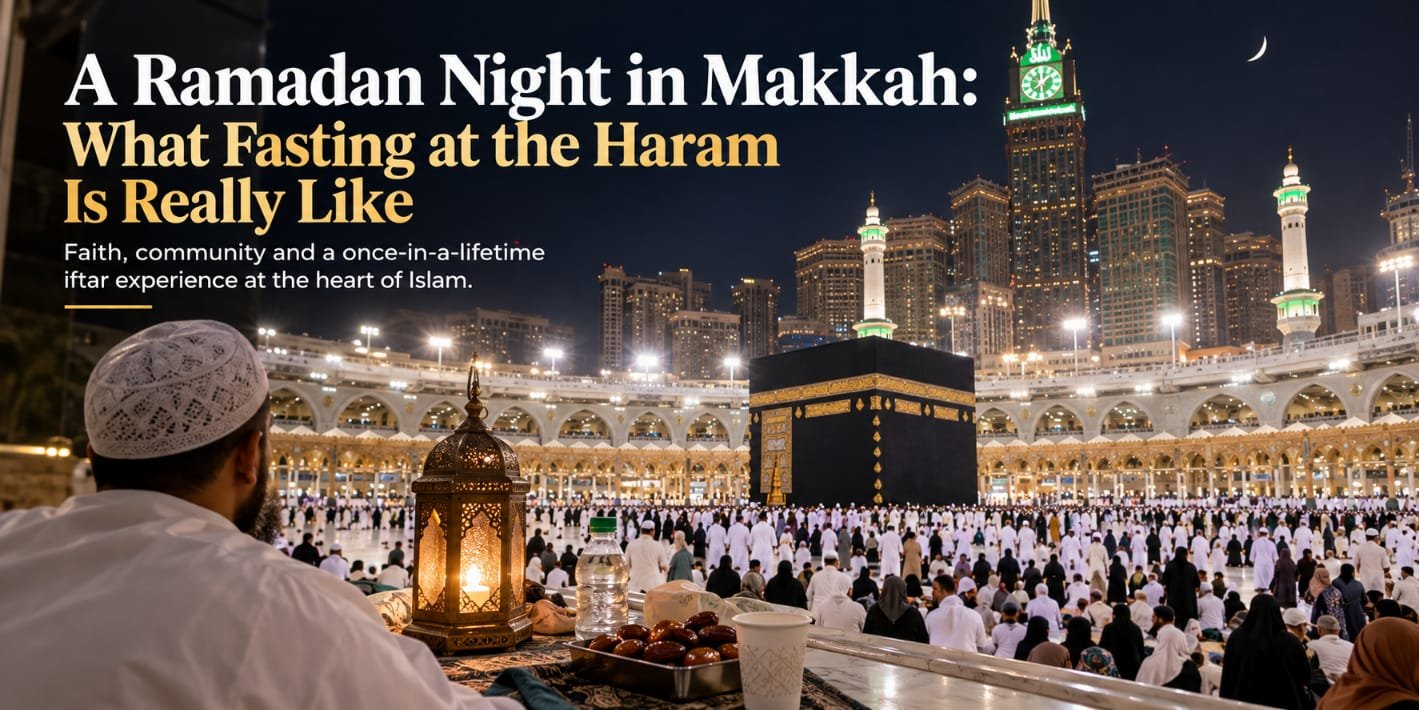
Just before sunset, something remarkable happens. Long plastic sheets are rolled out along the floor, and volunteers and local families come along the rows handing out dates, Zamzam water, bread, yoghurt and sometimes a light meal. Much of it is given free as charity. Strangers will often insist that you share their food.
When the call to prayer for Maghrib sounds, everyone breaks their fast together. A few minutes later, the sheets are rolled away, and the whole mosque stands for prayer. It’s fast, organised and very moving. For many pilgrims, this is the moment they’ll talk about most when they get home.
After Maghrib, most people go back to their hotel or a restaurant for a proper meal before the night prayers. Eat slowly and don’t overdo it. A heavy meal straight after a long fast, followed by more than an hour of standing in prayer, is a hard combination.
The night: Taraweeh and beyond
The Isha prayer is followed by Taraweeh, the special Ramadan night prayers. In Makkah, the imams aim to recite the whole Quran over the month, and their voices are known to Muslims all over the world. Prayers can last well over an hour.
In the last ten nights, there’s also Qiyam, a second set of prayers late at night. These nights are the busiest of the whole year, because Muslims believe one of them is Laylat al-Qadr, the Night of Power. The crowds then are bigger than anything most people have ever seen. The streets around the mosque fill with worshippers praying outside, sometimes several hundred metres away from the building.
Choosing your part of the month
If you’re thinking of going, the part of the month you pick changes the trip completely. Ramadan Umrah Packages are usually split into the first, middle and last ten days. The first ten are calmer and cost the least. The middle ten are busier. The last ten are the most crowded and by far the most expensive, and hotels close to the Haram are often booked a year ahead.
For a first Ramadan trip, especially with children or older parents, the first or middle ten days are often a better choice. You’ll still get iftar at the Haram and Taraweeh behind the famous imams, but with more room to breathe. Some people who go in the last ten nights find the crowds so heavy that they end up praying in their hotel or in the street outside, which isn’t what they imagined.
Doing Umrah while fasting
You can perform your Umrah while fasting, but think about the timing. Tawaf and Sa’i involve a lot of walking. Many people do their Umrah after iftar, when they’ve eaten and had water, or late at night after Taraweeh, when the crowds are a little thinner. If you’re elderly or unwell, Islam allows you not to fast while travelling, so speak to a scholar if you’re unsure.
Practical tips for a Ramadan trip
- Book early. Six months ahead isn’t too soon, and a year ahead is common for the last ten days.
- Pay more for a hotel close to the Haram. You’ll be walking there several times a day and night.
- Sleep in the daytime. Don’t try to keep British hours.
- Drink plenty of water between iftar and sehri.
- Keep your group together at iftar. It’s very easy to get separated.
- Book your Umrah permit on the Nusuk app as soon as you can.
Staying for Eid
If your trip runs to the end of the month, you may be in Makkah for Eid. The Eid prayer at the Haram draws vast crowds, so arrive very early. Afterwards, the city has a festive mood, with families out in their best clothes. Just remember that flights home around Eid are often the most expensive of the year, so book them early too.
A Ramadan in Makkah is tiring, crowded and costly. It’s also one of the most beautiful things a Muslim can experience. Go prepared, pace yourself, and you’ll come home with memories that will make every Ramadan afterwards feel a little different.