Introduction
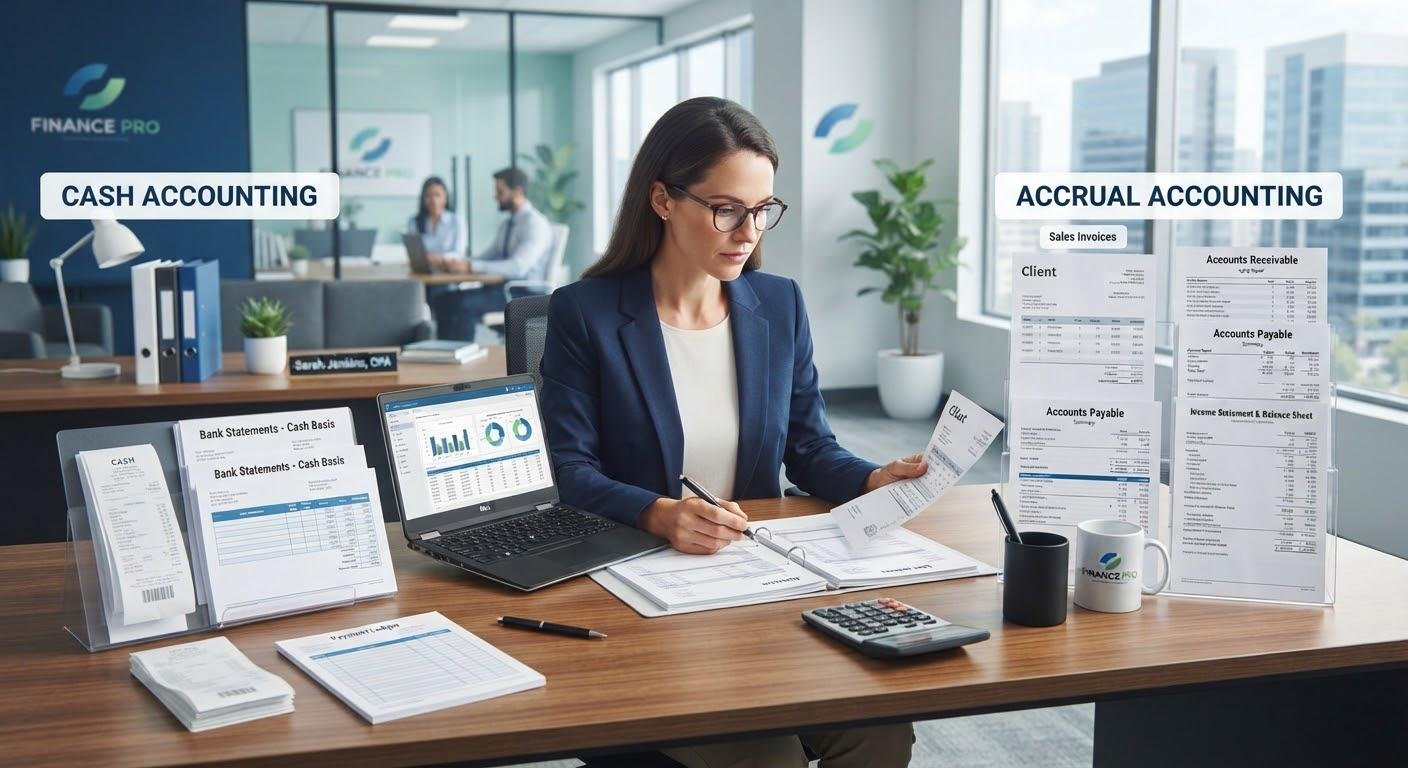
It is important for business owners to decide which accounting method to implement. The two main methods are accrual accounting and cash accounting. Both allow businesses to monitor their finances. However, they differ in the timing in which revenues and costs are recorded. A good understanding of the differences in these methods is important to ensure accurate financial records are kept, meaningful financial statements can be generated, cash flows are effectively managed, and informed business decisions can be made. With cash accounting, revenues and costs are recorded in relation to when money is received/invested. Whereas with accrual accounting, revenues and costs are recorded according to when the revenue/cost was incurred, regardless of when the cash is received. There are advantages and disadvantages to both systems, so it is important for business owners to understand how they function before choosing one for their business.
Cash Accounting
With cash accounting revenues and costs are recorded when money is invested or withdrawn from the organization. Revenues are recorded when money is received from customers, and costs are recorded when money is spent on goods/services. In this method, revenue and costs are not recorded if cash has yet to be exchanged in relation to the transaction. For example, if services were provided in March and payment was received in April, revenue would be recorded in April. Similarly, if an electricity bill was received in March, but paid for in April, the cost would be recorded in April. As cash accounting seems very straightforward to understand and operate, it may be beneficial to businesses with simple financial activity.
Advantages
Cash accounting is very simple to implement within businesses. Business owners only need to match revenues and expenditure to when money was received or invested. This means that businesses such as small enterprises, freelancers, and sole traders (that may not have a dedicated accounting department) can utilize cash accounting. As revenue and costs are recorded in relation to when money is received, cash accounting gives a clear insight into how much cash is present within the business at a given point in time. In addition to this, basic book-keeping is less complicated with cash accounting as entries are recorded in relation to when money was invested/withdrawn. Overall, cash accounting is a simple option for businesses with relatively simple financial activity.
Disadvantages
However, there are disadvantages to cash accounting. As transactions are only recorded when money is invested/withdrawn, it may give a misleading representation of how a business is performing financially over a period of time. For example, if a business completed several projects in December, but the majority of payments from customers were not made until January, then the income recorded for December would not be as high as what was truly earned in that month. In addition to this, costs incurred in one period may be recorded in a different period. This could therefore provide misleading information for businesses experiencing late payments from customers or large amounts of debt. Finally, cash accounting does not give much information about receivables and payables, meaning that it may be difficult to understand the true financial position of expanding businesses.
Accrual Accounting
Under accrual accounting revenues and costs are recorded in relation to when they are earned/incurred, not when money is invested/withdrawn. This means that revenues and costs are recorded in line with the activity of the business. For example, if a company provides goods to customers on credit, once the goods have been provided to customers the revenue will be recorded, even if payment has not yet been made. Similarly, if a business receives professional services, they will record the cost even if payment is to be made at a later date. Accrual accounting provides a complete insight into business activity as revenues and costs are recorded in the correct time period.
To understand further differences between accrual accounting vs cash accounting, consider this Investopedia article. Knowing how different accounting methods record transactions enables business owners to choose the best one for their specific requirements. Accrual accounting is particularly useful for businesses that regularly complete credit transactions, employ staff members, purchase goods on credit or have many financial obligations. As revenues and costs are recorded in the correct time periods, it enables businesses to produce more meaningful financial statements. This means that a business can understand its profitability in more detail, despite having a certain amount of money within its bank account.
Recording Revenues
Revenues are recorded under accrual accounting when goods/services have been provided and revenue has been earned. The exact time that money is transferred from a customer does not matter. For example, if a company sold equipment worth ₦500,000 on credit to a customer in August, but payment is to be made in September, the company will record revenue of ₦500,000 in August. As revenue was earned, accounts receivable will also be recorded for the amount owed by the customer. When the money is finally paid by the customer in September, the accounts receivable will decrease and cash will increase. As revenue was already recorded in August, no new revenue will be recorded.
Recording Costs
Costs are recorded under this method when goods/services have been received or an obligation incurred. This means costs can be matched to the correct time period, if a company receives an electricity bill of ₦150,000 in relation to operations in August. However, payment for this is made in September; an expense of ₦150,000 will still be recorded in August. As payment is yet to be made for this expense, a liability will be recorded for the amount owed. This liability will be recorded under either accounts payable or accrued expenses depending on the situation. When payment is made in September, this liability will decrease and cash will decrease. This helps businesses understand the true cost of their operations and avoids expenses being overlooked in financial statements, even if they have been delayed in payment.
Examples of Accrual Accounting in Practice
In practice, many businesses will complete credit sales, receive invoices from suppliers, pay employees at the end of each month, and have business costs to be paid at a later date. Accrual accounting accounts for these discrepancies between transaction dates and money being invested/withdrawn by recording revenues and expenses in the correct time periods. Below are examples of accrual accounting within businesses to give a better understanding of how this system operates. These examples also highlight why accrual accounting provides a more complete insight into financial performance of businesses.
1. Credit Sales
Consider a furniture company completing a sale of office desks worth ₦800,000 to a corporate client. The customer is given 30 days to pay for this in November. The company delivers the furniture in November, meaning it qualifies as revenue. However, it is not paid for until December. Under accrual accounting the company will record revenue of ₦800,000 in November. Accounts receivable will be increased by ₦800,000. This means that the business has earned revenue, even though the money has not yet been received. When money is paid by the customer in December, the accounts will be updated. This allows managers to understand how much sales were made in November. It avoids confusion between revenue earned and cash received in the period.
2. Owing Money to Employees
If a business owes its employees ₦600,000 in salaries for work completed in December, however due to pay schedules, payment will not be made until January. As employees have completed work in December, and an obligation has been created, the salary of ₦600,000 must be recorded as an expense in December. Salary expense will be increased by ₦600,000 and a liability will be created for outstanding salaries. In January, when the employees are paid, the liability will decrease and cash will decrease. This means that the costs of employee labor used to gain revenue in December will be included in financial statements for that period. It also means that management can easily identify outstanding obligations to employees before creating budgets and making other financial commitments.
3. Business Costs and Owing Money to Suppliers
A business may purchase raw materials, stationery or professional services from suppliers without immediately paying for them. For example, a manufacturing company may purchase raw materials worth ₦350,000 in October. Payment for this invoice is to be made in November. Once goods have been received by the company, and an obligation created, the transaction will be recorded in October. The relevant inventory/expense account will increase by ₦350,000, and a payable will be created. Once the payment is made to the supplier in November, the payable will decrease. This means that purchases and obligations have been recorded in the correct period. It also means that management can easily see how much money the company owes to suppliers, make plans for future payments, and avoid missing financial commitments in evaluating its financial status.
Differences between Accrual and Cash Accounting
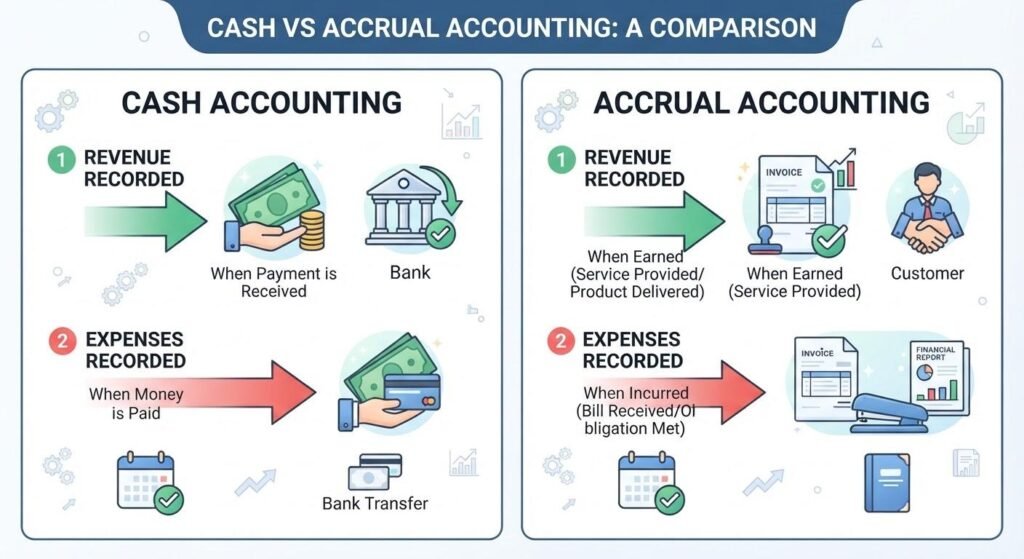
While both accounting methods record business activity, they differ in how revenues and costs are recorded. In cash accounting, revenue is recorded when money is received and costs are recorded when money is invested. In accrual accounting, revenue is recorded when it is earned and costs are recorded when they are incurred. This has implications for calculating profits, monitoring outstanding obligations and generating financial statements. Using cash accounting may give a misleading impression of high profits in a particular period if customers paid in that period for sales made previously. Accrual accounting allows for a closer link between business activity and financial performance, as revenues and costs are recorded in the correct time periods.
Advantages
A key advantage of accrual accounting is that it provides a more complete understanding of business performance. As revenues and costs are recorded in relation to when they were incurred/earned, management can understand how the business performed financially during a particular time period. This is very important for businesses frequently completing credit sales or incurring costs to be paid at a later date. As it provides information on outstanding customer payments, money owed to suppliers, employees and other debtors, accrual accounting can help improve financial planning within a business. In addition to this, financial statements produced using these methods are more useful. As revenues and costs are correctly matched, business owners can get a more accurate understanding of business profitability. Furthermore, it allows businesses to understand changes in business costs.
Another key advantage of this method is that it can support business growth. If a business would like to obtain external funding/ investment, detailed financial statements may be necessary. These will need to provide a clear overview of the business’ revenues, costs, assets and liabilities. Accrual accounting provides a strong basis for producing these statements, as transactions are recorded in more detail. It also allows management to compare financial performance between different periods of time. This means that changes in profitability can be understood to be due to changes in business activity, or simply due to when payments are made. In addition to this, it enables more effective budgeting and financial forecasting, allowing informed strategic decisions to be made. As it provides clearer understanding of money that will be received in the future and money owed, accrual accounting can be particularly beneficial for businesses with employees, suppliers, customers, inventory and multiple sources of income.
Disadvantages
However, accrual accounting can be a more complex and costly accounting method compared to cash accounting. Businesses must keep track of accounts receivable, accounts payable, outstanding salaries, accrued costs and other financial obligations. These accounts must be regularly updated, and an understanding of accounting principles is required. This method may be difficult for smaller businesses without experienced accountants. As transaction volumes increase, this may become even more difficult. To maintain accurate records, accounting software may be required or professional support. However, just because a business is recording profits in a particular time period, it does not mean that it has enough cash. For example, a business may have made considerable sales on credit, but if customers have not paid the invoices yet, they may struggle to cover immediate costs. For this reason, it is important to have effective cash flow management to accompany accrual accounting.
Why Accrual Accounting May Be Important for Expanding Businesses
As businesses grow, they may perform more complex financial activity. For example, they may allow for credit sales, employ more staff, buy inventory from suppliers and form long term relationships with customers. Therefore, cash accounting may no longer provide enough information to fully understand business activity. Accrual accounting can help businesses understand how much revenue they have made, and obligations they have, as transactions are recorded in relation to when they were incurred/earned. It means that businesses can get a clearer idea of money owed by customers, money owed to suppliers, money owed to employees and overall profitability. This information can allow business owners to identify any potential financial issues sooner, understand how well the business is performing, and make better decisions on how to expand, invest and allocate resources. It also means that a more organized system of accounting can be put into place to support future growth.
Businesses may also need to comply with relevant financial reporting requirements. Depending on the country, type of business and type of accounting framework a business falls under, certain businesses may be required to produce financial statements using accrual accounting. International Financial Reporting Standards and other recognized accounting frameworks typically rely on accrual accounting principles. Specific requirements and exceptions exist, depending on the requirements of the accounting framework. Businesses seeking loans, attracting investment or preparing for external audits may also benefit from keeping detailed accrual accounting records. However, it is important to note that recording revenue in a period does not mean that cash is immediately available in that period. Having accurate accrual accounting records, alongside consistent cash flow monitoring is vital to maintain financial stability and ensure that business obligations are met.
Conclusion
Whether cash or accrual accounting is most suitable for a business depends on the size, complexity, and reporting requirements of the business. Cash accounting is simple to implement, with revenues and costs recorded in relation to when money was invested/withdrawn. This may be a useful method for businesses with simple transactions. On the other hand, revenues and costs recorded under accrual accounting are matched to when they were incurred/earned. This provides a more complete understanding of a business’ financial activity. While more detailed records are required, it allows businesses to accurately understand credit sales, outstanding invoices, outstanding salaries, money owed to suppliers and business costs. For expanding businesses that want to make reliable financial reports, and make informed long term decisions, accrual accounting is often the most informative. By understanding both methods, business owners can choose an accounting system to support accurate reporting, effective financial management and sustainable business growth.
Get more well researched information about Accrual Accounting vs Cash Accounting here.