Introduction
One of the most critical decisions that a business owner can make is related to accounting. As a freelancer, entrepreneur, consultant or a small business person, your income and expenditure record impacts your tax, financial statements, business planning and business growth plan. A lot of businesses begin using one system of accounting, only to find out that another form of accounting would have been more beneficial for them, or more conducive to meeting regulatory standards.
There are two major accounting practices that are followed around the world, namely cash basis accounting and accrual basis accounting. Both approaches are used to monitor business activity, but have significant differences in terms of how and when transactions are recorded. These differences will affect profitability reporting, cash flow management, tax and investment considerations. These inequalities can be of great importance to business owners and help them avoid expensive pitfalls and make smart financial moves.
Before choosing an accounting system, it’s essential to understand how each one works, the pros and cons of using either the cash or accrual basis, and the business that will gain the most from each method.
Failing to grasp the concept of timing differences in the recognition of revenues and expenses can create a problem for businesses in preparing financial statements or filing taxes. Even if the company’s cash position hasn’t changed, its profitability can vary from one accounting technique to another. This is because choosing the right accounting approach can go beyond being a mere accounting choice and can impact growth opportunities and funding options.
What is Cash Basis Accounting?
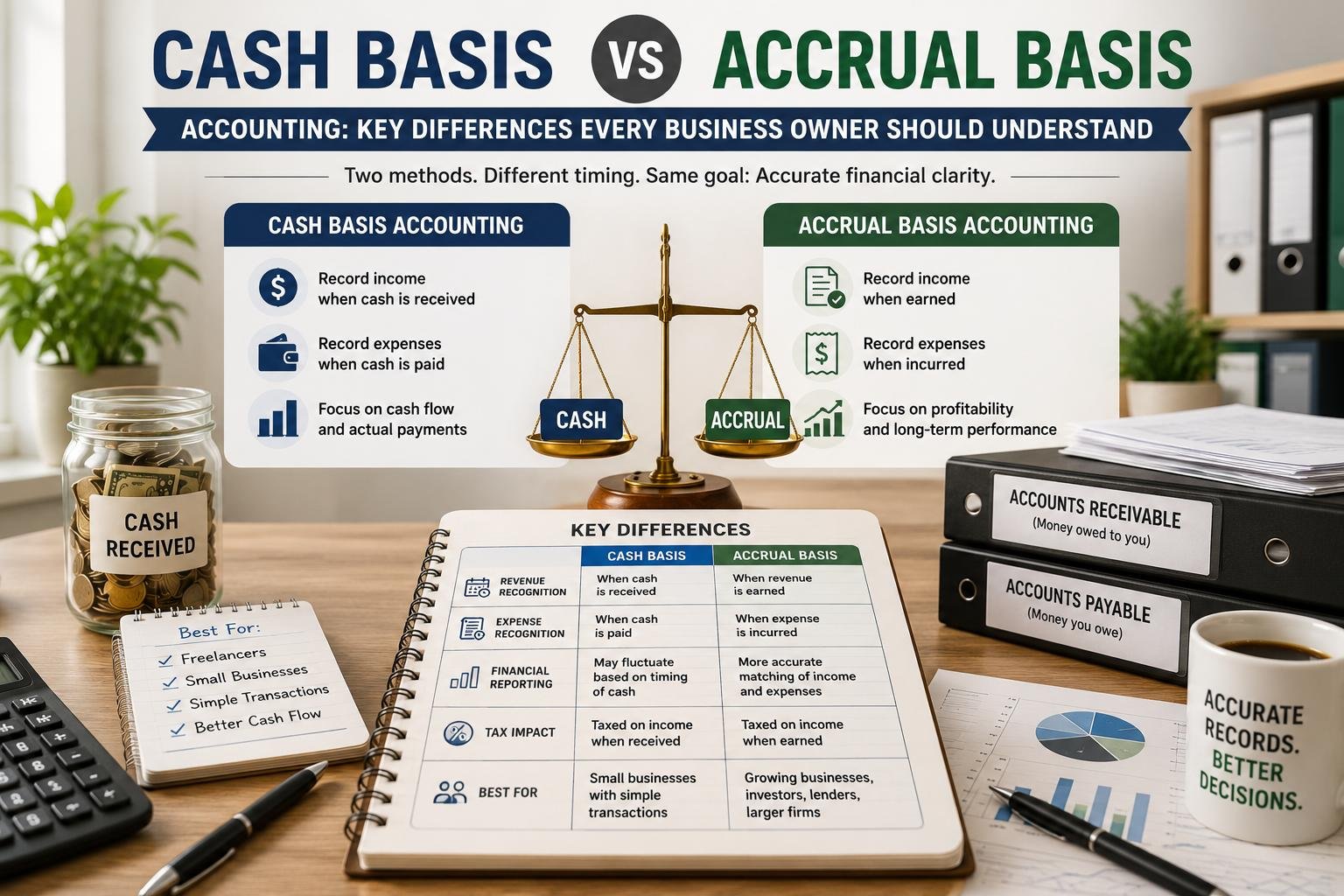
The easy one is the “cash basis” accounting, which is used by freelancers, sole proprietors and small businesses with simple financial transactions. This approach is the principle that the revenue is recognized when the cash is received, and the expense is recognized when the cash is paid. When transactions are recorded in the accounts is determined by the actual movement of money.
For instance, if a graphic designer finished a job in March and invoiced the client right after, the client will not have to pay it until May 10th, 2020. The income would be credited to the client’s books in April since he paid the invoice in April. Likewise, where the designer is paid a utility bill in March but pays the bill in April, the cost is in April when the bill is paid off.
This method is appealing as it is similar to the business owner’s bank balance. With no deals made until cash is exchanged, business owners are able to see how much cash they have to work with, invest, or have on hand in case of emergency. This ease is what many business owners like, particularly at the beginning of business development, when monetary transactions are not very extensive.
Key Characteristics of Cash Basis Accounting
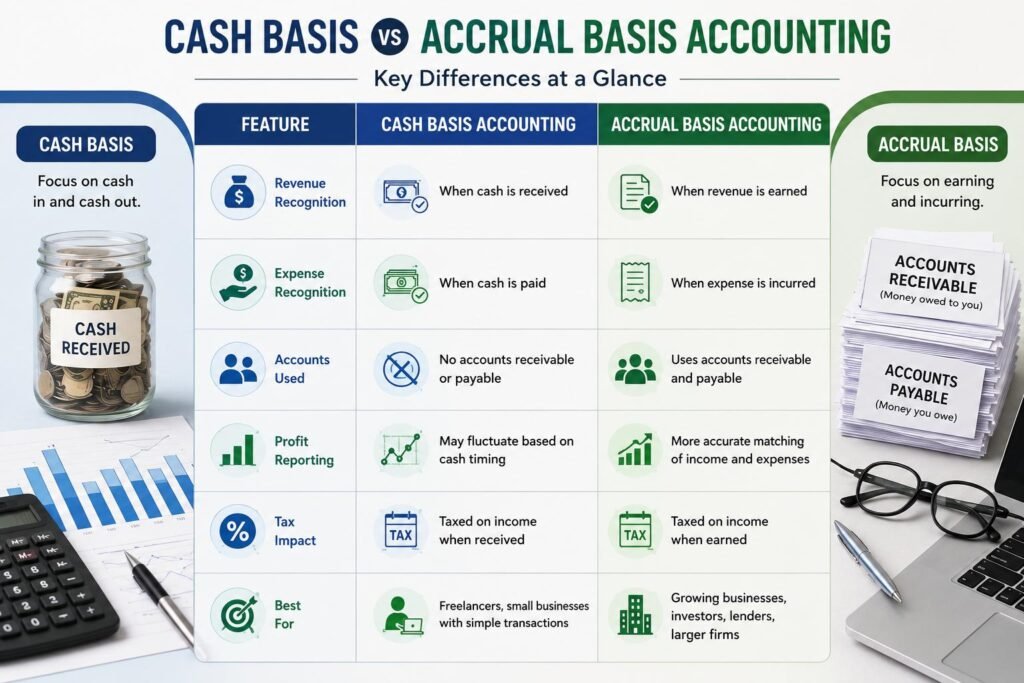
With cash basis accounting, all you need to consider is cash moving in and out. The accounts receivable and accounts payable accounts are typically not recorded due to the fact that deals are not noted till it is paid. This could result in the financial statements prepared under this method not fairly representing obligations to suppliers and income from customers.
The other feature is that they are likely to be highly profitable depending on when the payments occur. One month a business might have several customer payments, and be looking very profitable, and the next month might appear to have lower profits, but with exactly the same amount of business activity. This time matter can make it hard to discover longer-term financial tendencies or to properly assess or track performance.
This approach is often easier to report taxes on since they are typically paid only on income that is actually received. This can offer benefits in terms of cash flow for businesses that experience irregular patterns of customer payments, as well as easing short-term cash flow pressures.
What is Accrual Basis Accounting?
Accrual basis accounting recognizes revenue when it is earned, and expenses when they are incurred, independent of cash flow. This approach is based on the matching principle which seeks to equate revenues and the expenses that have been incurred to earn the revenues in the same accounting period.
Now, suppose that a marketing agency finishes a campaign in March for a client, and sends an invoice right away. If the client pays in May, this is not considered a cash receipt since the service was performed and the income earned in March. Similarly, if an agency receives an electricity bill for March and pays it in April then the cost is recorded as a March expense as the electricity was used in March.
The accrual accounting principle records all current obligations and future payments, giving a more comprehensive view of the business situation and performance. This is the preferred way for investors, lenders and regulators to see how profitable and efficient the operation is.
The Key Characteristics of Accrual Basis Accounting
Accounts receivable and accounts payable are one of the key aspects of accrual accounting. Accounts receivable are the amounts of money that the customer owes the business, and accounts payable are the amounts the business owes the suppliers or service providers. These accounts will ensure that the financial statements will cover transactions that have taken place, but not yet settled by cash payments.
Another attribute is a better financial analysis. Under the cash method, revenues and expenses are matched in the same period and business owners can be more accurate at evaluating profitability and trends that may be available. This is the reason that many businesses use accrual accounting, such as seasonal businesses, subscription services, and companies that have long payment cycles.
Accrual accounting also helps to meet the international accounting standards and reporting requirements. It is a more reliable way of providing information to external stakeholders and decision makers, so is generally required for larger businesses and publicly traded companies.
Understanding Revenue Recognition under Both Methods
One of the key differences between cash basis and accrual basis accounting is revenue recognition. The timing of the receipt of income makes a huge difference in the profits or losses that are reported and the tax consequences.
Cash basis accounting will recognize revenue when it is collected. If a consultant finishes a project valued at ₦2 million in December and is paid in January then the revenue is included in January’s books. This may lead to changing the taxable income between years, which may impact tax planning strategies.
In the accrual accounting, the same ₦2,000,000 would be booked into December since it is when the work was done and the revenue would be earned. For accounting purposes, the payment date is of no importance since the economic activity has already taken place.
These timing issues are crucial for any business owner looking to get accurate financial reports and the best tax planning strategies. Business owners should explore the concepts of revenue recognition and its impact on the financial statements and business decisions between cash and accrual accounting.
Understanding Expense Recognition under Both Methods
This is also the case for expense recognition. In cash accounting, all expenses are deducted when the money is paid. Any expense incurred in June, when the invoice is received, but paid in July is treated as an expense in July. This can be a straightforward method that can report monthly profits that are inaccurate due to lagging expenses that don’t match up to their corresponding revenues.
Under accrual basis of accounting, expenses are recognized when they are incurred not when paid. If inventory is bought in June with sales in June, the cost is booked in June regardless of when payment is made in June, July or August. This provides a more true relationship between revenues generated and associated costs.
Matching of expenses with revenue is especially crucial for business entities that have inventories, long term contracts or subscription services. If not matched, a business owner could be misled to think he or she is more profitable in one period than another.
Practical Example Comparing Both Methods
Let’s say you sign a contract to build a website for a web development company for the sum total of ₦5,000,000 and the work is done in October, with you paying them in December. The company also has to pay ₦1,500,000 as subcontractors’ expenses during October, which are settled in November.
In the cash basis accounting:
- Income is recognized in December, when we get the money.
- Expenses are recorded in November when payment is made.
When a company switches to accrual basis accounting:
- Revenue is recorded in October when the project is completed.
- Expenses are booked in October, since they do relate to the completion of the project.
The effect of this is that the accrual accounting will reveal the actual profitability of the October project, whereas the cash accounting will show the financial effect over a number of months. Accrual accounting can be more useful in management decision making and giving performance information.
Advantages of Cash-Basis Accounting
The benefit of cash accounting is that it is very easy to use. It is also a method that has less bookkeeping knowledge and less accounting adjustments, which is suitable for startups and accounting knowledge is limited independent professionals.
One of the other benefits is better cash flow visibility. When only cash change is tracked, business owners know at a glance how much money might be available to pay for business expenses or to invest in their business. This visibility can help to minimize overspending or liquidity issues.
There can also be tax benefits to cash accounting, as it allows businesses to avoid the recognition of income until it is collected. This can be particularly useful for businesses that have late-paying customers or have a sporadic payback period.
Disadvantages of Cash Basis Accounting
Although cash accounting is easy, it also has its drawbacks. Unpaid invoices and pending bills are forgotten and money reports do not show the financial health of a company. A company may seem to be profitable, but may have huge unpaid liabilities.
The other drawback is that you will lose the lending and investing credibility. The advantage of using accrual based statements is that financial institutions are more likely to prefer them since they give a better idea of future cash flows and obligations. Cash accounting records, therefore, may be problematic for companies looking to raise funds from outside their company.
Planning can also be more complicated as money can come and go due to the timing of payments and not due to business activity.
The Advantages of Accrual Basis Accounting
A company’s performance is better reflected under accrual accounting. Business owners can assess the profitability easier by coordinating revenues with associated costs, and can make better decisions about strategy.
One of the other benefits is better financial reporting. Trust in accrual-based statements is generally higher among investors, lenders and stakeholders due to the fact that they contain obligations, receivables, and expected cash flows that are not available in cash accounting statements.
Accrual accounting also allows for scaling up. The accrual approach is useful for handling complexity and reporting needs as businesses expand, add staff, inventory, and/or investment.
The Disadvantages of Accrual Basis Accounting
The first disadvantage of accrual accounting is that it is complicated. Businesses can need expert accountancy software or accountants to keep correct records and for creating adjusting entries.
This can make cash flow management difficult as well, since the net profit on the books could not be the actual cash that’s in the bank. Even when a business is reporting profits, it can find itself in financial trouble due to slow-paying customers.
Moreover, there are taxes that businesses can be liable for on income that they have earned but have not received in cash. This could cause cash flow problems if a customer’s payment is late.
Choosing the Right Method for Your Business
Business size, industry, regulations and business plans are all factors that influence the choice of accounting methods: Cash Basis or Accrual Basis. For very small businesses and freelancers, cash accounting can be easier due to its direct linkage with cash flow.
Accrual accounting is appropriate for businesses that keep inventory, have more than one employee, or are looking to expand in the future, as it gives a more accurate picture of the financials of a company and can help meet external reporting requirements. Accrual accounting might also be beneficial for companies that are applying for loans or investment capital from banks.
Future growth is another factor to take into account when it comes to entrepreneurs. Sometimes a business may begin using cash accounting but end up switching to accrual accounting later on as the business becomes more complex and the requirement for financial reporting grows.
Conclusion
There are two main methods of accounting: cash basis and accrual basis, both of which have their own value, but offer very different views of business performance. Accrual accounting concentrates on economic activity and provides a more accurate perspective on profitability and financial position, whereas cash accounting is based on the flow of cash and has greater simplicity and visibility.
Knowing which method of recognition is used during each transaction aids in the decision making process of taxation, compliance, financial reporting and long-term planning for business owners. There is not a one-size-fits-all approach that will work for all businesses. The most effective accounting system depends on your company, reporting requirements and future objectives.
These accounting procedures are not just a legal obligation for entrepreneurs and small business owners but are integral to their financial management and business success, particularly those focused on sustainable growth.
Get more well researched information about Cash Basis vs Accrual Basis Accounting here.