Introduction
Bookkeeping is very important in business, so that financial information can be efficiently understood. Within all businesses (regardless of size or industry), financial transactions occur. These transactions could be sales, purchases, costs, payments and receipts. Creating accurate records of financial transactions within a business allows businesses to understand their financial position, and hold themselves accountable. Knowing the fundamentals of bookkeeping means students, entrepreneurs and business professionals can understand how financial information can be captured and categorized in order to be maintained. Although bookkeeping may seem simple, having accurate bookkeeping within a business can allow effective financial management, compliance, and overall business growth.
What is Bookkeeping?
Bookkeeping is recording, categorizing, and organizing financial transactions within a business. This includes capturing information such as money received, money paid, assets owned, what is owed, and other information to understand the financial position of a business. As a result of this bookkeeping provides a history of transactions within the business, and therefore makes financial information accurate and easy to understand. Bookkeeping is usually carried out regularly within businesses so the financial activity within businesses is clear. Depending on the size of the business and what processes within it must be recorded, businesses may choose to carry out bookkeeping manually or with specialist accounting software.
Nature and Scope of Bookkeeping
Bookkeeping typically involves recording financial transactions within a business. The process is completed in a standardized way to ensure that there is supporting documentation for each transaction, including invoices, receipts, banking information, and payment information. There is a wide scope for bookkeeping to be completed. In addition to recording sales and costs, bookkeeping can be used to record accounts receivable, accounts payable, stock, employee pay, cash held, and assets. Bookkeeping can also be used to compare financial records with bank details to detect any issues and correct any errors. However, bookkeeping does not aim to interpret the information or give recommendations based on it. Rather, bookkeeping allows businesses to be transparent in their finances, and produce accurate reports when required.
Basic Principles of Bookkeeping
There are many principles to be followed in bookkeeping, in order to create accurate, consistent and reliable financial records. The business entity principle means that transactions within a business must be kept separate from the owner’s personal finances. The monetary unit principle means that only transactions which can be measured in terms of money should be included. The consistency principle means that to make comparisons easier, businesses should use the same method to record information throughout the business. The historical cost principle means that assets are generally recorded in the books at the price paid for them. Following these principles in bookkeeping means that businesses can confidently have accurate financial information in an appropriate format.
Double Entry
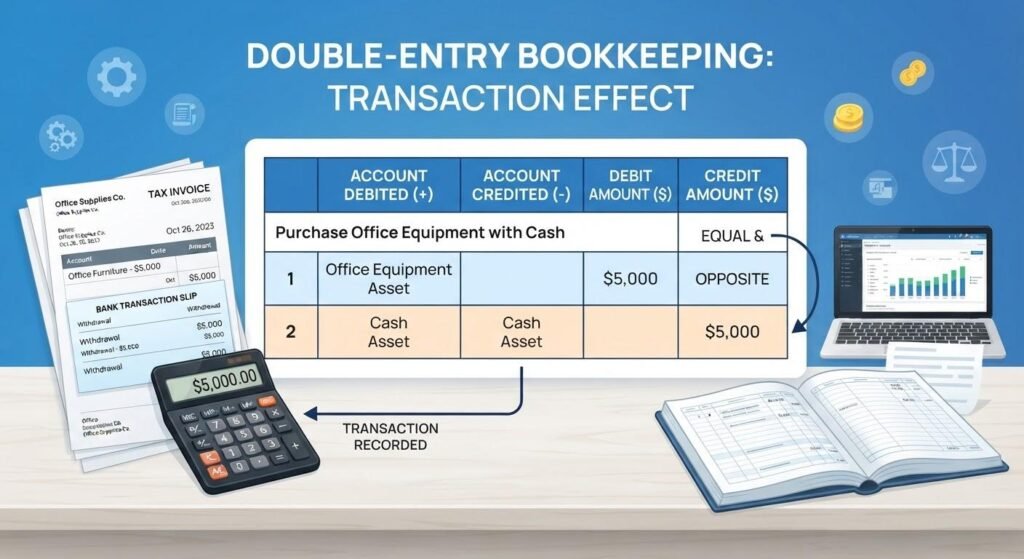
One key principle in bookkeeping is the double entry principle. Every transaction must have at least 2 accounts recorded. One account will be debited, and the other credited. This principle relies on the accounting formula: Assets = Liabilities + Owners’ Equity. For example, if a business buys office equipment and pays with cash, the equipment account will increase and the cash account will decrease. These changes in values within accounts must be recorded to keep the accounting formula in balance. Using the double entry principle allows errors in recording information to be easily detected, and complete information to be recorded. This principle also allows critical financial reports to be created. These include the profit and loss statement and balance sheet.
Methods of Recording Financial Information
Depending on the type of financial activity within a business, the resources available and the size of a business, different recording systems may be used. The two main methods of recording information are single entry and double entry. Since these systems both have advantages and disadvantages, it is important that business owners understand the difference between these systems in order to select the correct one. Choosing a system will affect the amount of detail available, how quickly reports can be created, and how well business performance can be tracked. Small businesses may find it preferable to use a simple recording system. However, businesses with complex financial activity will generally require more in-depth recording methods, to allow tracking of transactions across multiple accounts. Whatever recording method is chosen, accurate and consistent information must be recorded.
Single Entry
In single entry bookkeeping, only one entry is made for each financial transaction. This method often just involves recording cash received, money paid, and basic financial information. As it is simple to understand, it may be a good option for small businesses, or sole traders. For example, a small retail business may record sales, purchases, transport costs and other payments in a cashbook. However, single entry recording does not give as detailed financial information as double entry and may make it difficult to detect errors. It may also make it difficult to track outstanding debts, and detailed reports. Therefore, single entry would be better suited to businesses with few financial transactions.
Double Entry
Double entry bookkeeping is a more detailed method of recording financial information. For each transaction, at least two accounts will be affected. One account will be debited and the other credited. This gives detailed financial information, and ensures balance in the accounts. For example, if goods are sold on credit, accounts receivable and sales revenue accounts will increase. However, once the customer pays, cash will increase whilst accounts receivable will decrease. This makes it easier to track financial obligations, detect errors and create accurate financial reports. Despite requiring more knowledge and attention, double entry bookkeeping is commonly used in businesses due to its accuracy, detailed information and effective financial control.
Role of a Bookkeeper
Within an organization, bookkeepers are responsible for maintaining financial information. Bookkeepers are responsible for accurately recording daily financial activity within businesses, including sales, purchases, payments and receipts. Bookkeepers are responsible for managing invoices, updating accounts for customers and suppliers, tracking outstanding payments and maintaining cash records. Depending on what is required by the business, bookkeepers may also be responsible for managing employee pay, stock records, reconciling bank accounts, and creating preliminary financial reports. Bookkeepers must also ensure that supporting documentation is well stored so it is easily accessible. In order to create accurate records, important traits for a bookkeeper include accuracy, confidentiality, organization and attention to detail. If incorrect information is recorded, it may cause issues within the business, and impact the financial information of the business.
Skills and Tools Used in Bookkeeping
To complete bookkeeping effectively, people should have knowledge and specific skills. People should know basic accounting principles, financial jargon, and what debit/credit entries are, and how to record transactions. Whilst mathematical skills are useful, other skills are also important. These include organization, communication, and problem solving. Many businesses now complete bookkeeping using digital tools. Spreadsheets and accounting software allows financial information within businesses to be easily recorded. For example, programmes like ‘QuickBooks’, ‘Xero’ and ‘Sage’ can calculate financial information, organize transactions, produce reports, and reduce human error. However, professional judgment within bookkeeping is still important. Bookkeepers should carefully check entries, make sure there is supporting documentation, and secure any sensitive financial information. They must also ensure that accurate and complete information is recorded in digital formats.
Link between Bookkeeping and Accounting
Bookkeeping and accounting have a close relationship. Bookkeeping is concerned with recording and categorizing financial information, whereas accounting involves analyzing, interpreting, and summarizing information from bookkeeping. In short, bookkeeping allows accountants to analyze performance within businesses and create financial reports. For example, a bookkeeper may record monthly sales, costs, and payments to suppliers. However, an accountant would analyze this information to calculate profitability, and identify how the business is performing financially, as well as identifying areas within the business to improve. Whilst bookkeeping and accounting have different roles to complete, both are required in order to gather reliable financial information, and effectively manage businesses.
How Bookkeeping Helps with Accounting
Reliable bookkeeping is vital to ensure effective accounting. If incorrect or incomplete information is present in financial transactions, it may create unreliable financial reports. Bookkeeping provides the initial data required to create trial balances, profit and loss accounts, and balance sheets. With these records, accountants can make adjustments and analyze results in line with accounting standards. For example, if a business is not recording expenses properly, the profits shown in the business may be higher than they actually are. Having accurate bookkeeping will reduce this risk. Therefore, bookkeeping and accounting work together to produce useful information. Bookkeeping provides the information, whilst accounting makes it meaningful.
Importance of Bookkeeping in Business
Accurate bookkeeping is very important in business. It allows businesses to understand their financial position. Without well-organized financial records, business owners may struggle to understand if their businesses are profitable, or identify any unnecessary costs and unpaid debts. Accurate bookkeeping allows businesses to create plans, create budgets, pay taxes, manage cash flows and make business decisions. It also allows reliable financial information to be produced for accountants, auditors, investors and appropriate regulatory bodies. Within small businesses, accurate financial information can be very beneficial as it can reduce unnecessary losses. Therefore, bookkeeping is an important aspect of sustainable business management.
1. Financial Planning/Budgeting
Bookkeeping supports financial planning by allowing businesses to view past financial information. This means business owners can identify patterns in spending, predict future costs, and set realistic financial objectives. For example, if a company regularly records its monthly costs, it can understand how much money it needs in order to ensure daily running of the business, and prepare for unexpected costs. Having accurate records allows businesses to identify if they are over spending in comparison with the budget. This means managers can identify this issue and make the necessary changes. If inaccurate bookkeeping information is used within budgeting, assumptions within the budget may be incorrect. This could lead to financial issues within the business. Therefore, regular accurate bookkeeping allows businesses to effectively manage resources, and make plans for future growth.
2. Taxation
Accurate bookkeeping will allow businesses to complete their tax obligations. Sales, purchases, employee pay, costs and other financial transactions in a business mean that supporting information is available to calculate taxable income, and determine tax liabilities. Accurate records also make it easier to locate invoices, receipts and other supporting documentation during a tax assessment or audit. In Nigeria, businesses must ensure that they have appropriate financial documentation in place in order to complete their tax obligations in line with tax legislation. If businesses do not complete accurate bookkeeping, they may miscalculate tax, fail to meet tax submission deadlines, get penalties, or have disputes with tax authorities. Having completed and well organized financial documentation within a business can improve compliance, reduce administrative issues, and create more reliable financial information.
3. Cash Flow and Cost Management
Managing the cash flow of a business means ensuring there is enough money in the business to meet financial obligations. Bookkeeping allows businesses to track money gained from customers, money spent on suppliers, employee pay, rent, bills and other costs. This means that business owners can identify times where a cash flow problem may occur and make appropriate changes. For example, if a business regularly tracks the money they owe from customers, they can identify customers who are behind on payment, and therefore make efforts to improve the cash coming into the business. Similarly, reviewing costs can identify unnecessary spending that could be reduced. Effective cash flow management is very important within small businesses. Even if a business is profitable, without enough cash, it may struggle to run smoothly.
4. Decision Making and Growth of Business
Having accurate bookkeeping means valuable information can be drawn from it to make decisions within a business. Managers can look at financial reports to understand profitability, compare performances at different points in time, and understand if certain activities are generating a good return. For example, a retail business can look at sales and costs to understand which products are most profitable and decide which products to invest further in. If an entrepreneur is looking to grow a business, they can look at current financial records to understand if the business has enough resources to support growth. Bookkeeping can also allow problems in business finances to be identified early, so that management can make changes before issues become worse. Using accurate information in decisions, businesses can make better decisions on pricing, purchasing, employing staff, investing and long term development.
Challenges in Accurate Bookkeeping
Despite bookkeeping being very important in business, producing accurate records may be challenging. For small businesses with little financial resources, common issues include missing receipts, incorrect recording of transactions, not recording information frequently enough, poor documentation, and lack of knowledge in bookkeeping. Some business owners may also mix up personal and business finances, causing confusion when identifying income and expenditure. Additionally, businesses that purely complete manual bookkeeping may have issues as the volume of transactions increase. However, these issues can be minimized by putting systems in place to ensure recording is consistent, separating personal and business accounts, ensuring supporting documentation is present, and regularly checking financial records. Investing in appropriate bookkeeping software, and getting professional help if needed can also improve accuracy and efficiency.
Conclusion
Overall, bookkeeping is a very important process within business. It allows businesses to be well organized, responsible with their finances, and make informed decisions. Accurate bookkeeping allows businesses to understand their income, manage costs, manage cash flow, create budgets, and meet tax obligations. Knowing the principles, methods and role within bookkeeping can allow people to understand the link between bookkeeping and accounting, and how they can effectively manage financial information. Whether businesses utilize single entry or double entry bookkeeping, having complete and accurate information is key in assessing business performance, and making plans for future success. Improving knowledge of bookkeeping can benefit students, entrepreneurs and business professionals, as it can be applied within many different industries and businesses.
Get more well researched information about Fundamentals of bookkeeping here.