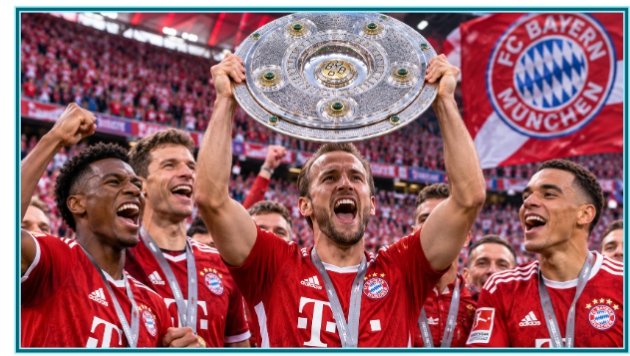
If you have followed the Bundesliga for any length of time, you have probably heard the joke. Football is a simple game: 22 men chase a ball for 90 minutes, and at the end, Bayern Munich win the league. It is funny because it is mostly true. By the end of the 2024/25 season, Bayern had won 33 German titles, far more than any other club.
That kind of success raises a fair question. Is Bayern’s dominance a sign of a well run giant that lifts the whole league, or is it slowly draining the competition out of German football? The honest answer is a bit of both.
How Bayern Built Its Advantage
Bayern were not always the biggest club in Germany. They were not even picked for the first Bundesliga season in 1963. Their rise began in the mid 1960s, when a group of young players came through at the same time: Franz Beckenbauer, Sepp Maier and Gerd Müller. That core won three straight European Cups between 1974 and 1976 and put Bayern on the map.
What made the difference later was how the club was run off the pitch. Former players such as Uli Hoeneß and Karl-Heinz Rummenigge moved into management and treated the club like a business long before most German clubs did. Bayern built strong commercial deals, kept debt low and moved into the Allianz Arena in 2005. Over time, the gap in revenue between Bayern and the rest of the league became huge.
The club’s long list of honours tells the story clearly. Domestic titles, German Cups and six European Cups or Champions League trophies, the most recent in 2020.
Signing Rivals’ Best Players
One of the most common complaints from other fans is that Bayern do not just beat their rivals. They weaken them. Over the years, Bayern have often signed the best player from whichever club looked like a threat.
Dortmund felt this more than anyone. After Jürgen Klopp’s side won back to back titles in 2011 and 2012, Bayern signed Mario Götze in 2013 and Robert Lewandowski in 2014. Mats Hummels followed in 2016. Each move made Bayern stronger and Dortmund weaker at the same time. Earlier, players like Michael Ballack and Lúcio had come from Leverkusen, and Manuel Neuer arrived from Schalke.
From Bayern’s side, this is simply good business. They pay fair fees, and players want to join a club that wins trophies. From everyone else’s side, it feels like a ceiling that is very hard to break through.
Eleven Titles in a Row
The clearest sign of Bayern’s grip came between 2013 and 2023, when they won eleven straight Bundesliga titles. No club in Europe’s top five leagues had done anything like it. Some of those titles were won by huge margins. Others were close until the final weeks, like 2023, when Dortmund needed only a home win on the last day and drew with Mainz.
During that run, Bayern also won the Champions League twice, in 2013 and 2020. Both times they won a treble of league, cup and European Cup. The 2020 side, coached by Hansi Flick, won every match in the Champions League that season, including an 8-2 win over Barcelona in the quarter finals.
Those results were a big boost for German football’s reputation. Fans across Europe saw that a Bundesliga club could beat anyone.
The European Picture
This is the strongest argument in Bayern’s favour. In European competition, they carry the Bundesliga flag. A strong Bayern helps Germany keep its places in the Champions League and attracts global TV audiences. Players come to the league partly because Bayern are there, and some of them later move to other German clubs.
Bayern’s record in the UEFA Champions League is one of the best of any club, and in years when other German teams have struggled in Europe, Bayern have often kept the league’s coefficient healthy.
There is also the matter of the national team. For decades, a large share of Germany’s squad has come from Bayern. The 2014 World Cup winning team was built around Neuer, Philipp Lahm, Thomas Müller, Jérôme Boateng and Bastian Schweinsteiger, all Bayern players.
What It Means for Competitive Balance
The flip side is obvious. When one club wins almost every year, the title race can lose its tension. Neutral viewers may tune out by spring if Bayern are ten points clear, and fans of other clubs can start to feel that finishing second is the realistic best case.
That matters for the league’s long term health. TV deals depend on drama. Sponsors want close races. Young fans pick a team when they are excited, and excitement is harder to find when the outcome feels fixed. Critics also point out that the 50+1 rule, which limits outside investment, makes it harder for other clubs to close the financial gap.
Still, the Bundesliiga table often tells a more interesting story than the joke suggests. The fight for Champions League places, the battle against relegation and the push for Europe are usually wide open. And every few years, someone breaks through at the top.
Can Anyone Break the Cycle?
Recent history says yes, at least now and then. Dortmund won the league in 2011 and 2012. Leverkusen did it unbeaten in 2023/24, ending Bayern’s run with one of the greatest seasons any club has ever had. Those breaks show that a well coached team with a clear plan can still compete.
The pattern, though, is that Bayern tend to respond quickly. After Dortmund’s titles, Bayern signed their best players. After Leverkusen’s title, Bayern hired Vincent Kompany, rebuilt parts of the squad and won back the league in 2024/25. With Harry Kane, who joined from Tottenham in 2023, scoring at an incredible rate, Bayern have a level of firepower that few teams can match over a full season.
For other clubs, the way forward seems to be what Leverkusen did: smart recruitment, a coach with a strong idea and patience. It is not a fast route, and it does not last forever, since the best players usually get sold. But it can
A Fair Verdict
So is Bayern’s dominance good or bad for the Bundesliga? The fairest answer is that it is both a strength and a weakness.
It is a strength because Bayern give the league a global name, a regular Champions League contender and a benchmark everyone else has to reach. Without them, the Bundesliga would probably be less well known around the world.
It is a weakness because too many seasons have felt decided early, and that takes something away from the competition. A league where the same club wins almost every year will always struggle to compete with leagues that offer more variety at the top.
Bayern Off the Pitch
Bayern’s strength is not only about players. The club has more than 300,000 members, one of the largest memberships of any sports club in the world. Those members elect the club president and have a real say in big decisions, which ties Bayern closely to the 50+1 model even as it operates like a global business.
The club also invests heavily in its youth campus, its women’s team and its international fan base. Tours in Asia and the United States, along with partnerships around the world, have helped turn Bayern into one of the best known sports brands anywhere. The official club site gives an idea of how wide that reach has become.
For the rest of the league, that reach is a mixed blessing. It brings attention and sponsors to German football as a whole, but it also widens the financial gap between Bayern and everyone else, season after season.
Final Thoughts
Bayern Munich are the most successful club in German history, and their record is something to admire. They are well run, ambitious and consistent in a way few clubs anywhere can match.
The challenge for the rest of the Bundesliga is not to tear Bayern down but to catch up. When they do, as Dortmund and Leverkusen have shown, the whole league comes alive. And that is when German football is at its very best.