Introduction
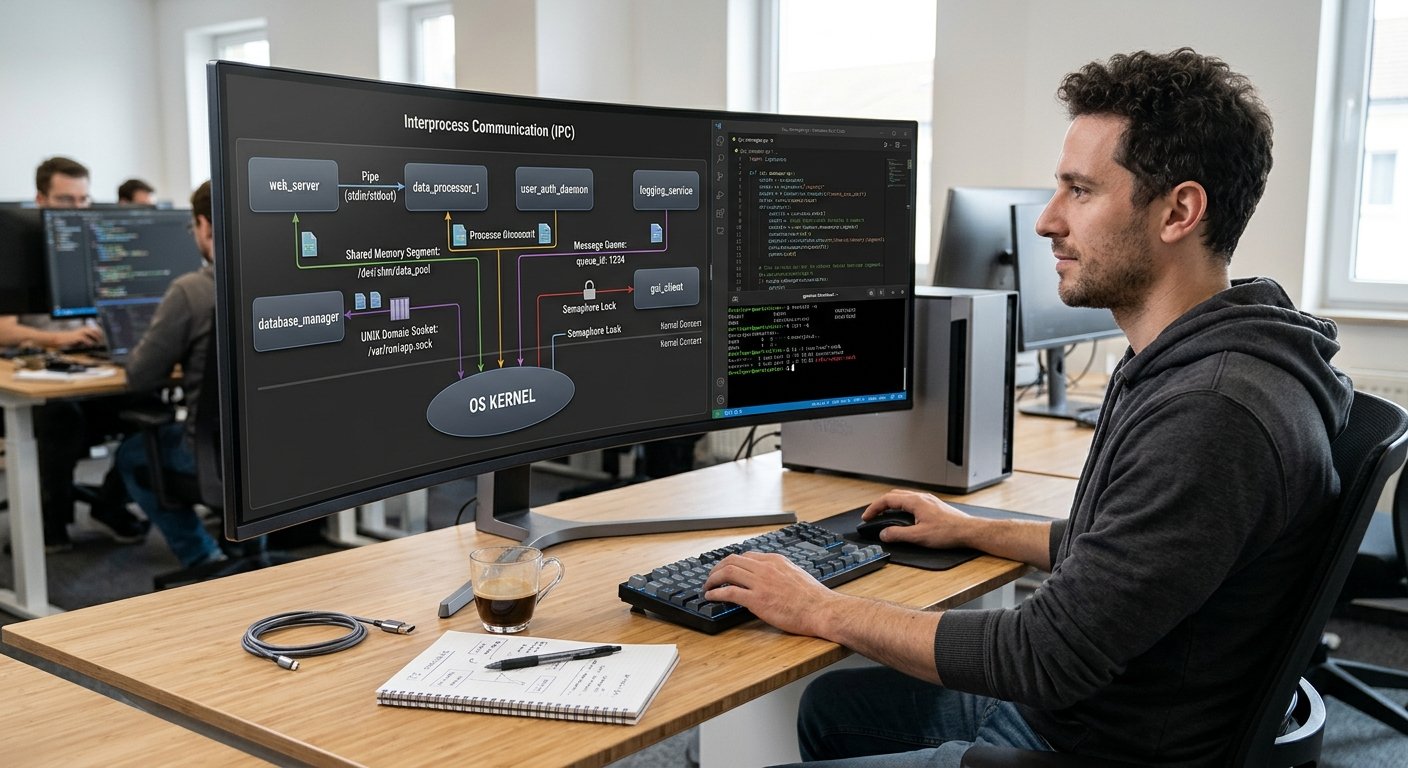
Programming for networks is a very important component of modern software development because applications often need to communicate between computers, servers and other devices that are connected to a network. UNIX is a powerful operating system that supports networking and enables developers to create powerful applications which can exchange data efficiently and reliably. Programmers can use the UNIX networking APIs to open network sockets, connect to other machines, send information between machines, look up domain names and handle multiple communications.
They are the building blocks of services like Web servers, messaging systems, database systems, multiplayer games, distributed computing services, etc. This knowledge of how UNIX networking works can be used to develop applications that operate efficiently in varying network environments, are reliable, scalable, and secure.
UNIX Network Programming
UNIX network programming deals with writing applications that send and receive data from other systems via network protocols. UNIX and Linux offer a library of system calls and programming interfaces to enable applications to communicate with network resources. The most popular interface is the Berkeley sockets API that offers functions to establish communication points, connect to remote systems, accept incoming connections, and send/receive data. These interfaces can be utilized by the developers to allow the implementation of various networking protocols as per application requirements.
For instance, when used by a web server a TCP session might be used to establish reliable communication with browsers, whereas when used by a real-time application, a UDP session may be used to send information quickly. Knowing these networking interfaces is relevant as they enable developers to manage the communication behaviour themselves, not relying entirely on the high-level networking libraries.
Network Socket
A network socket is an endpoint where two applications may communicate over a network. It is a way to communicate between an application and the networking system, enabling programs to send and receive data without having to deal with the low-level details of the networking hardware. Sockets are implemented using ones familiar to developers, file descriptors, in UNIX systems, this allows developers to interact with network connections using familiar system calls.
Typically a socket is identified by its communication domain, socket type, and protocol. For instance the address family of an IPv4 TCP socket is AF_INET and its socket type is SOCK_STREAM. After being created, the socket may be configured, bound to another endpoint or be ready to accept incoming connections depending on the application type as either client or server.
Types of Network Sockets
UNIX systems have various types of sockets that can be used for different purposes of communication. The two most typical types that are used in network programming are stream sockets and datagram sockets. Stream sockets are based on the TCP protocol, and are a reliable, connection oriented communication socket that guarantees that data is received in order and without duplication. Typically, datagram sockets are implemented with UDP, which transmits packets of data without opening a separate connection between communicating applications.
There are other socket types as well, such as raw sockets, which are used in lower level network protocols and are typically used for special networking applications. The selection of a socket type is determined by the application’s performance and reliability needs, and its communication requirements. It is important for the developer to be aware of these differences before designing network applications as it directly affects how the data is transferred, received, and managed.
TCP or UDP Communication Working
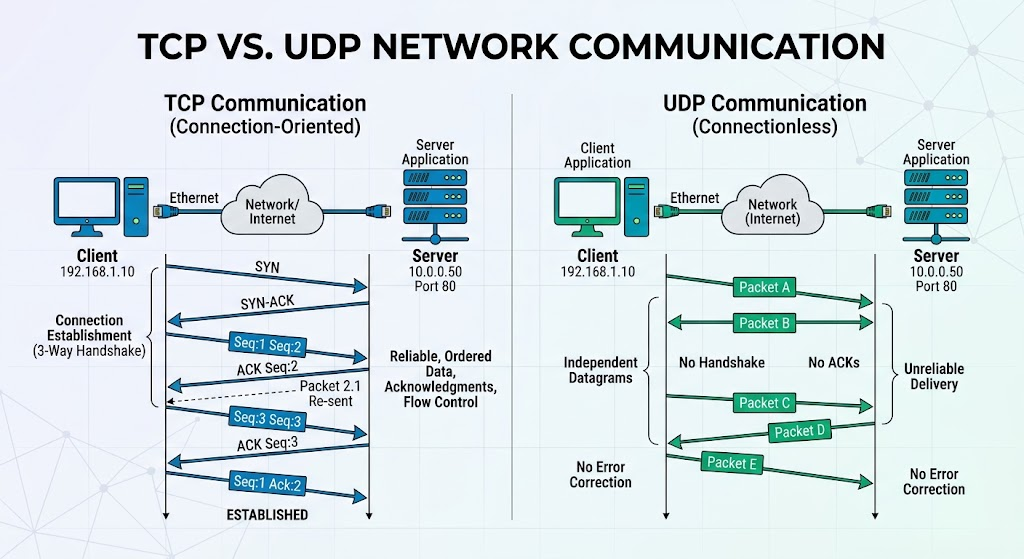
In UNIX network programming, there are two major transport-layer protocols, TCP and UDP. Both are protocols for applications to share information over an IP network but they do so in different ways. The TCP is responsible for the reliable delivery of data by establishing connection between communicating endpoints, and managing packet ordering, retransmission and flow control. UDP is designed for light communication with independent datagrams that are not connected together nor guaranteed delivery.
Because of these differences, TCP is good for applications where the information transmitted is important and must be received in order, while UDP is better for applications in which the amount of overhead in the communication and the delay in the transmission are less important. These protocols should be considered based on the nature of the application as developers cannot use the wrong transport protocol, which can impact performance, reliability, and user experience.
TCP Communication
Transmission Control Protocol (TCP) is a connection oriented protocol that sets up a logical communication channel between two applications before sending data over them. Stream sockets are commonly created with the SOCK_STREAM option and socket() function in the unix programming world. The server socket is prepared by bind(), it then listens for incoming connections with listen(), and it accepts the connections with accept().
The client initiates a communication with the server using connect(). Upon connection of both applications they can communicate with each other by sending and receiving data from write(), read(), send(), or recv(). TCP takes care of the important aspects of communication such as packet sequencing, lost segment resending and congestion control automatically. This makes it suitable for applications such as Web applications, file transfer, remote logins and database communications that require reliable delivery.
UDP Communication
User Datagram Protocol (UDP) is a transport protocol that is connectionless and provides the means for sending and receiving independent packets of data known as datagrams. Unlike TCP, with UDP there is no need to establish a connection before sending data. SOCK_DGRAM option can be used to create a UDP socket and information can be sent and received using sendto() and recvfrom() respectively. UDP does not include connection establishment, retransmission, and automatic packet ordering, which means that there is less communication overhead in UDP than in TCP.
This is beneficial in scenarios involving rapid data communication, like voice communication, online gaming, streaming video, and some monitoring systems. The developers should be aware, however, that UDP packets may be lost, duplicated, or received out of order. For applications that demand extra reliability, appropriate mechanisms should be provided at the application layer.
TCP vs. UDP: Essential differences
Both TCP and UDP can be used to communicate over a network, but they have some differences which can affect the way developers design and optimize applications. The reliability of TCP delivery is ensured by connection management and error recovery, which is appropriate for important information transfer. Unlike TCP, UDP is connectionless and provides less guaranteed service, which means it can be a good option for applications that can tolerate some packets being lost. Another benefit of TCP is its connection state, which adds to the resources needed if servers are serving numerous clients. UDP does not have much of this connection manager overhead, except that many datagrams still need to be carefully managed for resources. Both protocols are not all-weather as they are dependent on the use case. When selecting a protocol to implement, developers must take into account its latency, bandwidth, reliability, packet size, and network conditions.
| Feature | TCP | UDP |
| Communication | Connection-oriented | Connectionless |
| Reliability | Reliable delivery | No delivery guarantee |
| Data ordering | Maintains data order | No ordering guarantee |
| Speed and overhead | Higher protocol overhead | Lower protocol overhead |
| Error recovery | Automatic retransmission | Application-managed |
| Data format | Continuous byte stream | Individual datagrams |
| Common applications | These include web servers, file transfers, databases. | Gaming, streaming, DNS |
Using UNIX to Create Network Sockets.
Creating a socket is among the initial steps in writing a UNIX network application. The socket() system call is used to establish a communication endpoint and return a file descriptor that the application will use for further network communication. Its arguments describe the communication domain, socket type and protocol. socket(AF_INET, SOCK_STREAM, 0) will open an IPv4 TCP socket, socket(AF_INET, SOCK_DGRAM, 0) will open an IPv4 UDP socket, etc.
Once the socket is created, the developers can set the address information on it, using structures like sockaddr_in, which includes the IP address and port number. The bind() function typically is used by a server to bind its socket to a local address and port, while the connect() function is used by a client to connect to a remote server. Correct configuration of sockets avoids address conflicts and enables applications to use the desired network interfaces.
Important UNIX Socket Functions
UNIX has a number of system calls that support various aspects of networking. To create a socket, use the socket() function, to bind the socket to a local address, use bind() function. The listen() function is used by servers to accept incoming connections on TCP sockets while the accept() function is used to get connections from the waiting queue. Clients are used to make TCP connections to remote servers via connect(). After establishing the communication, send() and recv() can be used to transfer information between the applications, and sendto() and recvfrom() can be used to communicate between the applications in the form of datagrams.
Close a socket descriptor with the close( ) function. It is also important for developers to be aware of the possibility of failure of these functions due to network conditions, invalid arguments, lack of resources, or operating system restrictions. By examining their return value and errno, applications can decide on their behaviour based on the invalid communication states that they will receive.
Client-Server Architecture
Client-server design is widely used in UNIX network programming. It divides an application into two major parts: clients who ask for services and servers who process requests and send responses. Communication is usually started by a client that connects to an IP address and port of a server. The server waits for a request from the client and executes the tasks as per the client’s request, and then it sends back the results.
It is a common architecture for Web hosting, database applications, file-sharing, and messaging services. The basic operations needed to create this communication model are available in UNIX socket APIs. A process, thread, or event-driven I/O technique allows a single server to serve multiple clients. This selection will be based on the number of connections you are expecting, system resources available, and complexity of the application that you are using.

When a TCP Server receives a connection, it will proceed as follows:
A TCP server goes through a series of operations to create and maintain client connections. It first calls socket() to create a socket and bind() it with a local address. It then invokes listen(), to show it is ready to receive any connection requests. The OS takes care of the TCP connection establishment process when a client tries to connect.
The server uses accept() to retrieve the connection and it returns a new file descriptor that is used to communicate with that client. The listening socket will still be available to receive more connections. Once a client is accepted, information is passed between the connected socket between the client and server, and the socket is finally closed when the communication is finished. A separation of listening and connected sockets enables a server to handle incoming connections while continuing to accept new requests.
The steps taken by the TCP Client to initiate communication
The first step in a TCP client application is to create a socket and determine the name of the server to which it will connect. This usually contains an IP address and port number, but applications may also use a host name, which needs to be resolved using DNS. After an address is received, the client sends a call to connect() to create a TCP connection. If it is successful, the client can communicate with the server via send() and recv().
Network communication may not be successful, so the client should verify that the data has been successfully communicated or received. It should also take into consideration partial writes and reads because TCP delivers a continuous byte stream and doesn’t guarantee that each application message is preserved. Once the necessary communication has been made, the client terminates the socket to free up system resources.
DNS Resolution
DNS resolution enables an application to convert a domain name (readable by humans) into an IP address used by computers to communicate on the network. Applications are able to communicate with servers by name, for example example.com, rather than by numerical addresses, which are hard for users to remember. UNIX offers a set of functions for getting address information from a service and hostname, e.g., getaddrinfo().
The function is capable of returning several possible addresses if there are several DNS records and settings available for an ip address, and is compatible with IPv4 and IPv6. The following operations are typically performed on the client: Name servers being unavailable or network conditions being poor can cause delays or failures in DNS resolution. For this reason, scalable applications will want to cache some suitable DNS answers, preferably with sensible DNS resolution timeouts (if available), and do something sensible about the fact that some DNS lookups might fail.
The getaddrinfo() call is used to resolve an address.
getaddrinfo() is a modern, flexible interface to get the address of a host and/or service by name. It will take a hostname, a service identifier, like a port number, and optional hints for the host to specify the address family and socket type. The function returns a linked list of address structures that can be fed to system calls relating to sockets. This way, the application can support both IPv4 and IPv6, and does not need to take the extra step of converting address strings into binary representations.
The returned addresses can be iterated by the developers to try to connect until one succeeds. Once the results have been processed, freeaddrinfo() needs to be called to free up the memory allocated while looking up the domain names. Don’t forget to use proper error handling as getaddrinfo will return its own error codes, not only errno. This function can help to improve the portability and maintainability of network applications.
Handling Connection and Network Error
Network applications need to be managed carefully as there are various stages in which communication failure can happen in a reliable network application. A connection can be lost when a remote application closes unexpectedly or during data transmission, or it may not be established in the first place. UNIX networking functions return many errors via errno and return value to enable programs to detect and deal with specific error types.
For instance, ETIMEDOUT means an attempted operation took too long, and ECONNREFUSED means that a connection attempt was refused. EAGAIN or EWOULDBLOCK is a common error when using a non-blocking operation, that is the operation cannot be completed at this time. Applications should differentiate between temporary failures and permanent failures, don’t just say that every error means terminate. They should also free resources of the aborted connection and log valuable diagnostic data for troubleshooting.
Dealing with partial reads and writes.
A note about TCP programming is that a read or write operation may not be successful, but not because an entire application message wasn’t handled. Data is sent via TCP as a stream of bytes, so receive may return less data than you expect. Likewise, a send operation can only send a portion of the buffer supplied. Developers will need to incorporate loops that keep processing the data until the whole message is transferred or an error occurs.
Applications also should provide message boundaries with fixed size, length-prefixed or delimiters. If there is no framing mechanism, a receiving application may have difficulty in distinguishing between messages and the end of the current message. With the right handling of partial operations, incomplete communication will be avoided and network applications will become more reliable.
Managing Network Timeouts
Timeouts are used to avoid waiting forever for operations that might not complete, in network applications. For instance, if a client is unable to connect to the server, it may be otherwise indefinitely blocked, longer than the application is able to wait. UNIX offers socket options for setting a receive timeout or send timeout on sockets that support them: SO_RCVTIMEO and SO_SNDTIMEO. More flexible connection deadlines can be implemented using non-blocking sockets in conjunction with polling.
Timeouts should be appropriate to the use of the application, the network situation and anticipated response time. Too short timeouts can result in unnecessary failures if the network is temporarily slow; too long timeouts can waste resources and decrease responsiveness. However, an app that is well-designed will have sensible time limits, sensible retries, backoff, and a clear reporting of errors.
Non-Blocking I/O in UNIX Network Programming
With traditional blocking I/O, an application waits until it can proceed with a requested operation or until the operation has completed. This method is simple, but can be inefficient if the server needs to handle numerous concurrent connections. Non-blocking I/O, when networking operations return as long as the action can’t be done right now. The application can do other work while it waits for data to arrive, or for a socket to be available, and then resume work on the socket when it is ready.
UNIX has non-blocking socket operations with the O_NONBLOCK file status flag flagged using fcntl(). The non-blocking operation typically returns an error code (e.g. EAGAIN or EWOULDBLOCK) if it cannot continue. Developers need to deal with these conditions properly as they most often mean the app should wait to receive another readiness notification instead of assuming it is a permanent failure.
Benefits of Non-Blocking I/O
Network applications benefit from non-blocking I/O because they can continue to be responsive when processing multiple connections. The server doesn’t have to use a whole thread or process for each of its clients who are just waiting for data. Instead, it can keep track of a large number of sockets and only do things when the sockets become ready. This can minimize any unnecessary context switching, increase resource utilization and support multiple simultaneous connections.
It’s especially useful for Web servers, proxy services, messaging services, and other systems that service numerous clients having different activity levels. But non-blocking programming adds to the complexity as the developer now has to deal with connection states, partial reads, partial writes, and temporary errors. Applications should also contain an appropriate event notification system to know when to block or unblock a socket.
Dealing with multiple connections using select(), poll(), epoll()
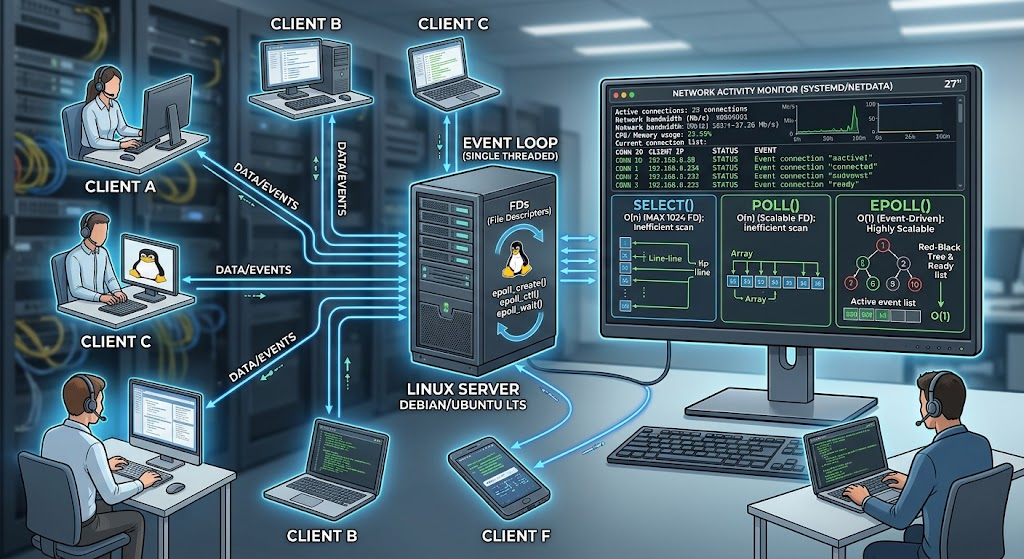
When an application communicates with many clients, it must have an efficient way of monitoring several network connections. There are some I/O multiplexing mechanisms implemented in UNIX and Linux which enable one thread or one process to read multiple file descriptors. Select(), poll(), and epoll() are the most popular mechanisms. These interfaces are used to inform the application if the socket becomes ready for an operation like read or write.
This enables servers to keep a number of connections without having to make continuous operations on each socket. All three mechanisms allow for I/O multiplexing, but they have different interfaces, scalability features, and operating system support. It is helpful for developers to know these differences in order to select the most suitable method to use for their applications. It depends on the portability requirements, how many ports are needed, performance requirements and the operating systems the software supports.
Using select()
The select() function monitors multiple file descriptors to determine whether they are ready for reading, writing, or reporting exceptional conditions. It accepts sets of file descriptors and a timeout value, then waits until an event occurs or the specified time expires. When a socket becomes readable, the application can receive available data without blocking. Similarly, writable sockets can be used to transmit pending information.
The function is supported by many UNIX-like operating systems, making it useful for portable network applications. However, select() has important limitations, including the FD_SETSIZE restriction on the number of descriptors it can monitor in typical implementations. It also requires applications to rebuild and scan descriptor sets during repeated calls, which can become inefficient when managing large numbers of connections.
Using poll()
The poll() function provides another way to monitor multiple file descriptors. Unlike select(), it uses an array of pollfd structures to specify the descriptors being monitored and the events of interest. Each structure contains a file descriptor, requested events, and returned event information. This design avoids the traditional fixed-size descriptor-set limitation associated with select(), making poll() more flexible for applications managing larger numbers of sockets.
It can monitor whether connections are ready for reading, writing, or have encountered certain error conditions. However, poll() still examines the supplied descriptor array during each call. Consequently, its processing overhead can increase as the number of monitored descriptors grows, particularly when only a small number of sockets are active at any given moment.
Using epoll() on Linux
The epoll interface is a Linux-specific I/O event notification mechanism designed to support applications that manage large numbers of file descriptors. It provides three main operations: epoll_create1(), epoll_ctl(), and epoll_wait(). The first creates an epoll instance, the second adds, modifies, or removes monitored file descriptors, and the third waits for available events. Unlike select() and poll(), epoll allows applications to maintain a persistent collection of monitored descriptors instead of rebuilding a complete descriptor list for every wait operation.
It supports both level-triggered and edge-triggered notification modes, giving developers flexibility when designing event-driven applications. This makes epoll particularly useful for high-concurrency Linux servers, reverse proxies, and messaging systems. However, developers must handle edge-triggered notifications carefully to avoid leaving unread data or unwritten output in socket buffers.
Comparing select(), poll(), and epoll()
Although these three mechanisms solve the same general problem, they have different strengths and limitations. select() is widely portable and relatively simple to understand, but its descriptor limits and repeated set processing make it less suitable for large-scale applications. poll() offers a more flexible descriptor interface and avoids select()’s traditional fixed-size descriptor-set restriction, but it still scans the monitored array. epoll() is designed for efficient event notification on Linux systems and performs particularly well when applications manage many connections but only a smaller number are active at a given time. However, epoll is not a portable replacement for select() or poll() because it is Linux-specific. Developers should consider operating system compatibility and workload characteristics before choosing an I/O multiplexing mechanism.
| Feature | select() | poll() | epoll() |
| Operating system support | Widely portable | Widely portable on UNIX-like systems | Linux-specific |
| Descriptor management | Fixed-size descriptor sets | Array of descriptors | Persistent event registration |
| Descriptor limit | Traditional FD_SETSIZE limit | No equivalent fixed-size set limit | Limited by system resources |
| Event processing | Scans descriptor sets | Scans descriptor array | Reports ready events |
| Scalability | Limited for large workloads | Better flexibility than select() | Designed for high concurrency |
| Triggering modes | Readiness-based | Readiness-based | Level-triggered and edge-triggered |
Simple UNIX TCP Client-Server Programming Example
A practical way to understand UNIX networking APIs is to examine a basic TCP client-server application written in C. In this example, the server creates a TCP socket, binds it to a local port, listens for incoming connections, and accepts a client request. It then receives a message and sends a response through the connected socket. The client creates its own socket, connects to the server, transmits a short message, and receives the server’s response.
This example demonstrates the basic relationship between socket(), bind(), listen(), accept(), connect(), send(), recv(), and close(). It uses IPv4 and a local loopback address, making it suitable for testing communication between programs running on the same computer.
TCP Server Example
The following code demonstrates a simple TCP server that listens on port 8080 and responds to a connected client. It uses standard UNIX networking functions and checks important system call results to identify errors. The server creates a listening socket, configures the local address, binds the socket, and waits for a client connection. After accepting a connection, it receives a message, prints the received information, and sends a response. The example handles one client at a time to keep the basic communication sequence understandable. Production servers would require additional features such as concurrency, input validation, timeouts, stronger error handling, and resource limits before being deployed in real environments.
#include <stdio.h>
#include <stdlib.h>
#include <string.h>
#include <unistd.h>
#include <arpa/inet.h>
#include <sys/socket.h>
int main(void) {
int server_fd, client_fd;
struct sockaddr_in address;
char buffer[1024] = {0};
const char *response = “Message received by server”;
server_fd = socket(AF_INET, SOCK_STREAM, 0);
if (server_fd < 0) {
perror(“Socket creation failed”);
return 1;
}
memset(&address, 0, sizeof(address));
address.sin_family = AF_INET;
address.sin_addr.s_addr = htonl(INADDR_LOOPBACK);
address.sin_port = htons(8080);
if (bind(server_fd, (struct sockaddr *)&address,
sizeof(address)) < 0) {
perror(“Bind failed”);
close(server_fd);
return 1;
}
if (listen(server_fd, 5) < 0) {
perror(“Listen failed”);
close(server_fd);
return 1;
}
printf(“Server listening on port 8080…\n”);
client_fd = accept(server_fd, NULL, NULL);
if (client_fd < 0) {
perror(“Accept failed”);
close(server_fd);
return 1;
}
ssize_t received = recv(client_fd, buffer,
sizeof(buffer) – 1, 0);
if (received > 0) {
buffer[received] = ‘\0’;
printf(“Client: %s\n”, buffer);
if (send(client_fd, response,
strlen(response), 0) < 0) {
perror(“Send failed”);
}
} else if (received < 0) {
perror(“Receive failed”);
}
close(client_fd);
close(server_fd);
return 0;
}
TCP Client Example
The client program establishes communication with the server by creating a TCP socket and connecting to the loopback address on port 8080. After connecting successfully, it sends a message and waits for a response. The client uses inet_pton() to convert the server’s IPv4 address into the binary representation required by the socket address structure. It then uses send() to transmit the message and recv() to receive the response. Like the server, the client checks important function results and closes its socket when communication is complete. This example illustrates how a client initiates a TCP connection and exchanges information with a server using the same fundamental UNIX networking interfaces.
#include <stdio.h>
#include <stdlib.h>
#include <string.h>
#include <unistd.h>
#include <arpa/inet.h>
#include <sys/socket.h>
int main(void) {
int sock;
struct sockaddr_in server_address;
char buffer[1024] = {0};
const char *message = “Hello from TCP client”;
sock = socket(AF_INET, SOCK_STREAM, 0);
if (sock < 0) {
perror(“Socket creation failed”);
return 1;
}
memset(&server_address, 0, sizeof(server_address));
server_address.sin_family = AF_INET;
server_address.sin_port = htons(8080);
if (inet_pton(AF_INET, “127.0.0.1”,
&server_address.sin_addr) <= 0) {
perror(“Invalid server address”);
close(sock);
return 1;
}
if (connect(sock, (struct sockaddr *)&server_address,
sizeof(server_address)) < 0) {
perror(“Connection failed”);
close(sock);
return 1;
}
if (send(sock, message, strlen(message), 0) < 0) {
perror(“Send failed”);
close(sock);
return 1;
}
ssize_t received = recv(sock, buffer,
sizeof(buffer) – 1, 0);
if (received > 0) {
buffer[received] = ‘\0’;
printf(“Server response: %s\n”, buffer);
} else if (received < 0) {
perror(“Receive failed”);
}
close(sock);
return 0;
}
Compiling and Running the Programs
To test the example, developers need a UNIX-like environment with a C compiler such as GCC. The server and client should be saved in separate source files, for example, server.c and client.c. Each program can then be compiled independently using the GCC compiler. Start the server first so that it can bind to port 8080 and wait for incoming connections. After the server reports that it is listening, run the client in another terminal. The client should connect to the server, transmit its message, and display the response returned by the server. This simple exercise demonstrates the complete TCP communication process and helps developers understand how UNIX socket functions work together in a real application.
gcc server.c -o server
gcc client.c -o client
# Terminal 1
./server
# Terminal 2
./client
The example is intentionally simple and should not be treated as production-ready code. It handles only one client, does not implement application-level message framing, and does not guarantee that every byte is transferred in a single send() or recv() operation. A production implementation should use loops to handle partial transfers, validate incoming messages, configure appropriate timeouts, and manage multiple clients through processes, threads, or an event-driven architecture. Developers should also consider using getaddrinfo() for hostname resolution and implementing suitable logging and connection cleanup. These additional measures make applications more reliable when exposed to real network conditions, where connections can fail, clients can disconnect unexpectedly, and communication requests may arrive simultaneously.
Building Scalable Network Applications
Scalability refers to an application’s ability to maintain acceptable performance as the number of users, connections, and communication requests increases. A network server that performs well with ten clients may struggle when thousands of clients attempt to connect simultaneously. Developers must therefore design their networking architecture around efficient resource management, concurrency, and event handling. UNIX provides several approaches, including process-based servers, multithreaded servers, and event-driven architectures using non-blocking I/O.
Each approach has different resource requirements and implementation challenges. For example, creating a separate process for every client provides isolation but introduces process-management overhead. Thread-based designs can reduce some overhead, while event-driven designs can handle many connections through fewer execution threads. Selecting the appropriate model requires understanding the application’s workload and expected traffic patterns.
Process-Based Concurrency
Process-based concurrency allows a server to handle multiple clients by creating separate processes for individual connections or groups of connections. In UNIX systems, the fork() system call creates a child process that can handle a client independently of the parent process. This approach provides strong isolation because each process has its own address space and execution state. If one client causes a problem, it may not directly affect other client-handling processes.
However, creating and managing many processes consumes memory and operating system resources. Developers must also handle process termination and prevent zombie processes by collecting completed child processes appropriately. Process-based concurrency is useful for applications that require isolation, but it may become inefficient when servers must support extremely large numbers of simultaneous connections.
Thread-Based Concurrency
Thread-based concurrency allows multiple execution threads to operate within a single process. UNIX systems support POSIX threads, commonly known as pthreads, which developers can use to create and manage concurrent tasks. A multithreaded server may assign separate threads to individual clients or use a fixed-size worker pool to process incoming requests. Threads share the process’s memory space, which makes communication between them relatively efficient compared with separate processes.
However, shared memory introduces synchronization challenges. Developers must use appropriate synchronization mechanisms, such as mutexes and condition variables, to protect shared resources and prevent race conditions. Thread pools are particularly useful because they limit the number of active worker threads, reducing the overhead associated with creating unlimited threads as new clients connect.
Event-Driven Architecture
Event-driven networking allows applications to respond to socket activity instead of dedicating a separate thread or process to every connection. The application registers sockets with an event notification mechanism and waits for events indicating that communication operations can proceed. On Linux, epoll() is commonly used to implement this architecture. When a socket becomes ready for reading or writing, the application processes the event and returns to monitoring other connections.
This approach can support high concurrency with relatively few execution threads, making it suitable for modern web servers, network proxies, and messaging platforms. However, event-driven applications require careful state management because connections may become ready at different times and operations may complete only partially. Developers must design their event loops to handle these conditions without losing data or blocking the entire application.
Practical Considerations for High-Performance Networking
Creating a network application involves more than selecting a protocol and calling socket functions. Developers must consider operating system resource limits, network reliability, memory consumption, concurrency, and security. Each active connection consumes resources such as file descriptors, socket buffers, and memory used to maintain application state. If these resources are not managed carefully, a server may become unable to accept additional connections or process requests efficiently.
Applications must also account for slow clients, temporary network failures, unexpected disconnections, and malicious input. Performance optimization should therefore involve measuring actual application behavior rather than assuming that a particular networking technique will always be faster. Monitoring connection counts, request latency, CPU utilization, memory usage, and error rates helps developers identify performance problems and make informed improvements.
Managing File Descriptors and Resource Limits
UNIX systems impose limits on the number of file descriptors that a process can open simultaneously. Since network sockets are represented by file descriptors, these limits directly affect how many connections a server can manage. Developers can inspect process limits using tools such as ulimit and examine system-level resource restrictions when investigating connection failures. Applications should close sockets promptly after communication ends and avoid retaining unnecessary descriptors.
They should also handle descriptor exhaustion gracefully because functions such as socket() and accept() can fail when resources are unavailable. Another important consideration is memory consumption, since every connection may require buffers and application-specific state. Setting sensible connection limits, controlling buffer sizes, and monitoring resource usage help prevent applications from exhausting available system resources under heavy workloads.
Improving Network Performance
Network performance depends on several factors, including protocol selection, data size, buffering, connection management, and the efficiency of application code. Developers can improve performance by reducing unnecessary network round trips, reusing established connections where appropriate, and avoiding excessive data copying. Buffer sizes should be selected carefully because very small buffers may increase system call overhead, while excessively large buffers can waste memory.
Applications should also avoid performing slow operations inside critical networking event loops because doing so may delay communication with unrelated clients. Techniques such as connection pooling, asynchronous processing, and efficient serialization can further improve throughput. However, performance improvements should be evaluated through realistic testing and benchmarking because the most effective optimization depends on workload characteristics and the underlying network environment.
Securing UNIX Network Applications
Security is an essential consideration when building network applications because communication channels can expose sensitive information and create opportunities for unauthorized access. TCP and UDP provide transport services, but neither protocol automatically encrypts application data or verifies the identity of communicating users. Developers should therefore implement suitable security mechanisms depending on the application’s requirements.
Transport Layer Security (TLS) can protect TCP communication by providing encryption, authentication, and data integrity. Applications should also validate incoming data, enforce access controls, and avoid trusting information received from remote clients. Network services should expose only the ports and interfaces they actually require. Additional protections, including secure configuration, regular software updates, and appropriate logging, help reduce vulnerabilities and improve the overall security of network communication.
Using TLS for Secure Communication
Transport Layer Security (TLS) protects network communication by encrypting information exchanged between applications. It helps prevent unauthorized parties from reading or modifying data while it travels across a network. Developers commonly integrate TLS into TCP-based applications using established libraries such as OpenSSL rather than implementing cryptographic operations themselves. TLS can also authenticate servers through digital certificates, helping clients verify that they are communicating with the intended service.
Applications handling sensitive information should use properly configured TLS versions, validate certificates, and protect private keys. Developers must also understand that encryption alone does not solve every security problem. Authentication, authorization, secure session management, input validation, and appropriate error handling remain important parts of a complete network security strategy.
Validating Incoming Network Data
Network applications should treat all incoming data as untrusted because remote clients may send malformed, unexpected, or excessively large messages. Developers should validate message lengths, check data formats, enforce protocol rules, and reject requests that exceed reasonable limits. Applications must also avoid copying incoming data into fixed-size buffers without checking the available capacity. Failure to validate input can lead to memory corruption, application crashes, or unauthorized access to resources.
Rate limiting can help prevent individual clients from overwhelming a service with excessive requests, while authentication and authorization ensure that users can access only permitted operations. These protections should be implemented consistently across communication paths, including both TCP connections and UDP datagrams, because neither transport protocol guarantees that application data is safe.
Common Challenges in UNIX Network Programming
UNIX network programming introduces several challenges that developers must understand when designing reliable applications. Network delays, packet loss, connection failures, resource exhaustion, and unexpected client behavior can all affect application performance. A program that works correctly in a local testing environment may behave differently when deployed across networks with higher latency or unstable connections. Developers must also account for differences between operating systems, especially when using platform-specific interfaces such as epoll().
Another challenge involves concurrency, where multiple clients may access shared resources simultaneously and create synchronization problems. These issues cannot always be eliminated, but they can be managed through careful architecture, comprehensive error handling, realistic testing, and continuous monitoring. Understanding common failure scenarios makes it easier to build applications that remain stable under changing network conditions.
Handling Interrupted System Calls
System calls can sometimes be interrupted by signals before completing their requested operations. In such situations, a function may return -1 and set errno to EINTR. Developers should understand which operations can be safely retried and implement appropriate handling where necessary. For example, a server waiting for incoming connections may need to repeat an interrupted accept() operation rather than terminate unexpectedly.
However, retrying every failed system call without examining its error condition is not good practice because some errors indicate permanent problems. Applications should distinguish interrupted operations from temporary resource conditions and genuine failures. Correct handling of EINTR improves application stability, especially in UNIX environments where processes may receive signals during normal operation.
Preventing Connection Exhaustion
Connection exhaustion occurs when an application or operating system reaches the limit of resources available for managing network connections. This can happen when clients open connections faster than the server can process them or when completed connections are not closed correctly. Developers can reduce this risk by enforcing maximum connection counts, applying timeouts, and limiting the amount of memory allocated to individual clients.
Servers should also avoid allowing inactive connections to remain open indefinitely. Monitoring active connections, file descriptor usage, and system resource consumption helps identify potential exhaustion before it becomes a major failure. When necessary, applications can use load balancing and multiple server instances to distribute incoming traffic across available resources.
Conclusion
UNIX network programming provides developers with the tools needed to build reliable, responsive, and scalable network applications. Through socket APIs, applications can establish TCP and UDP communication, implement client-server architectures, resolve domain names, and exchange information across different systems. Understanding connection management, non-blocking I/O, and event notification mechanisms such as select(), poll(), and epoll() is particularly important when developing applications that must handle multiple simultaneous connections.
However, high-performance networking also requires careful attention to timeouts, resource limits, concurrency, error handling, and security. By combining appropriate networking interfaces with efficient application architecture and thorough testing, developers can create network services that perform reliably under different workloads. These principles provide a strong foundation for building modern UNIX and Linux applications, including web servers, distributed systems, messaging platforms, and other network-dependent software.