Introduction
Artificial Intelligence (AI) and automation are reshaping the way banks interact with their customers, solve issues, and provide financial services. In the past, customers were required to call, write letters and visit branches to get help with their card problems, account balances, failed transactions, and banking problems in general. They are still relevant but may come with waiting times and a lack of access. In the modern day and age, banks are employing AI-powered chatbots, virtual assistants, and automated customer service systems to deliver quicker and more convenient support to their customers. These technologies can serve as the solution to answering simple questions, monitoring transactions, detecting fraud and suggesting relevant financial products. For instance, banks can leverage the capabilities of AI-powered chatbots to enhance their digital communication and streamline repetitive customer interactions. But reliable information, data protection and human representatives for more personalized help when needed are necessary for successful implementation.
AI and Automation in Banking Customer Service
AI’s ability to handle tasks traditionally performed by humans such as language understanding, pattern recognition, information analysis, and response generation. Automation is using technology to do repetitive tasks, with a limited amount of manual work. In banking, these functions complement each other to enhance customer service by way of mobile apps, websites, messaging channels and telephone systems. For example, a chatbot can understand a query regarding a recent payment from the customer and send them relevant information, while an automated system accesses the bank’s records to find the details of the payment. More sophisticated systems can determine the cause of the grievance, forward it to the relevant section of the business and alert the consumer to progress. These technologies can lessen the load on customer service staff and drastically simplify the handling of numerous requests by banks. However, even with AI, human intervention is still required, especially in cases of unexpected financial difficulties or when customers need more empathetic support.
AI-Powered Chatbots and Virtual Assistants
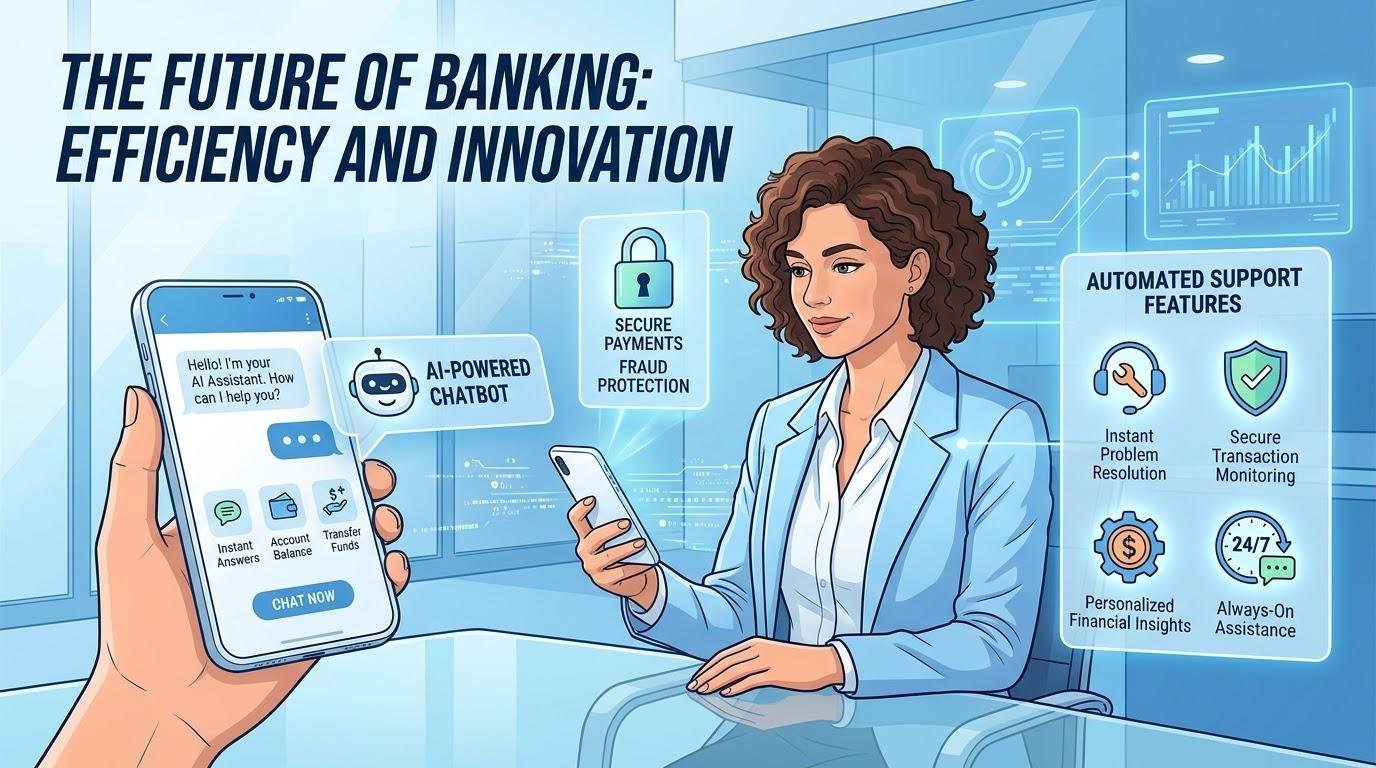
One of the most apparent uses of AI in the banking sector is the use of artificial intelligence (AI) powered chatbots. They communicate with customers via text or phone and answer inquiries regarding the customer’s accounts, procedures for transactions and banking services, branch locations, replacing cards and other standard banking-related transactions. Unlike traditional automated menus where customers need to input specific options, a conversational chatbot is able to understand your customers’ natural language and determine their probable intent. For instance, a customer requesting the reason why his/her transfer has not been received might be given instructions to check the status of the transfer or to alert in case of a delay. Virtual assistants can offer these types of support services and help customers follow a few steps to apply to a program or find a statement, among other actions. These tools can help to streamline regular queries and free up time for human representatives to focus on more complex matters. However, they are only as effective as their information and their ability to know when they don’t have the answers to a question.
Providing Banking Services 24 hours a day
Customers may need assistance outside the hours of business and it can be difficult with the fixed hours of traditional customer service departments. AI chatbots can work around the clock, providing simple help to customers during holidays, weekends, and evenings. This can be particularly beneficial for those with non-standard work hours or those who are located far from banking services. You might get advice on resetting passwords, service charges, transaction protocols, or lost card. There are some automated systems that can also trigger secure processes to block cards or report suspicious transactions. But having a chatbot available at all times doesn’t imply that all the banking services can be completed at the same time. Requests can be subject to further processing and/or human interaction if there is a need to verify identity, secure regulatory approval or investigate the request. Banks should thus have to inform what services can be automated and how they can contact a representative if a problem cannot be resolved through automation.
Automating Complaints and Service Requests
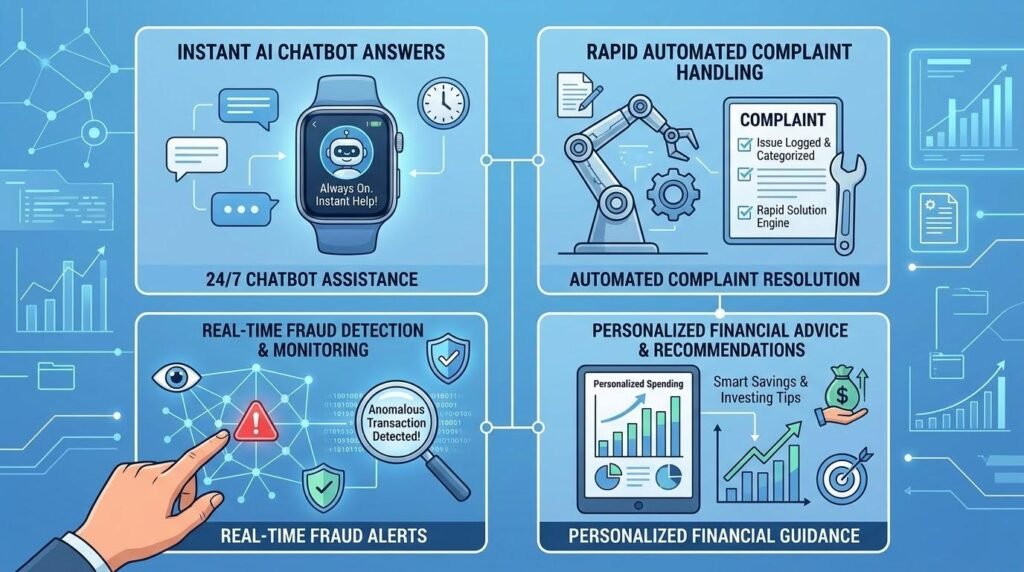
Failed transfers, unauthorized deductions, delayed payments, disputed charges and inaccessible accounts are all complaints that banks receive. It can become inefficient when staff have to classify each and every request and then pass it on to another department, and update the customer one by one. Content-based classification, automatic progress notifications, department identification, and automatic assigning of reference numbers are examples of features provided by AI-supported systems. They also can sense recurring complaints about a given service, which can help banks look out for common technical issues. For instance, when multiple customers voice an inability to transfer, the intelligent system can identify the trend and look into it more carefully. Complaint handling can be more consistent and can diminish administrative delays with the use of automation. However, sometimes the automated classification can be incorrect with respect to an explanation provided by a customer or can place the complaint in the wrong team. Banks need to offer their customers the ability to fix information, escalate unresolved issues, and consult with trained personnel. Financial losses can be very serious, particularly if there is the potential of some form of misconduct, and it is important that a detailed investigation is carried out, not just automated responses.
Customized Recommendations and AI Customer Support
AI can process the data of customers who have been given permissions, such as transaction history, account activity, and past preferences, to better deliver relevant services to these customers. For instance, an intelligent banking app can alert a customer they have a regular savings habit and provide them with details on the banking products that offer the best return for their savings or alert an eligible customer to a suitable banking product option. Automated assistants can also offer you budgeting insights, spending summaries and reminders about upcoming payments. These features can make banking easier for the customer, enabling him to easily find helpful banking services without navigating through several menus. Recommendations, however, are to be transparent, lawfully established and appropriate. A system may not presume that when an individual’s spending is up a loan is required, nor may the system suggest a financial product as appropriate without taking into account appropriate factors. Banks should refrain from making manipulative recommendations and decisions that discriminate. Customers should be aware of the reason behind an offer and be given the right to say NO to an unrequired product.
Fraud Alerts & Proactive Customer Protection
AI also enhances customer service by assisting banks in identifying suspicious transactions and notifying customers promptly of these risks. Machine learning systems can be used to explore transaction values, locations, frequency, device and other signals to determine if they have any activity that deviates from the known patterns. If a transaction looks ‘out of the ordinary’ the bank will send a message to you, ask for further verification or temporarily block some transactions until a transaction is confirmed. For example, a customer could be alerted to an unknown card charge and who to contact to report the charge. Automated monitoring can make it easier for banks to react to threats as they arise in a timely manner when compared to a manual-only review process. But not all suspicious activity is related to the fraud. Normal transactions can cause false alarms and more sophisticated attacks can go undetected. Banks need to offer safe methods to verify transactions, dispute erroneous alerts, and alert them to any unauthorized transactions. In response to unsolicited messages purporting to provide assistance customers should never provide a password, personal identification number (PIN), or one-time verification code.
The Benefits of AI and Automation in Banking
AI-powered customer service offers several benefits, including increased speed, availability, and efficiency. Any repetitive query can be answered by an automated system, which can cut down on waiting in lines and give the customer information without having to wait for a staff member. When systems rely on accurate and up-to-date information, consistent answers can also help to enhance the quality of their services. The banks may have reduced administrative tasks, better complaint tracking and better knowledge of repetitive customer complaints. Additionally, digital assistants can facilitate customers to better navigate through the services, especially when the interface is providing clear language and easy customer support. The advantages are greatest when automation is used in conjunction with human skills. By implementing chatbots, a bank could save on hiring more employees, but if there are any unusual issues, it can leave customers mad. Therefore reliable technology, proper employee training, continuous monitoring and a service strategy which focuses on customer needs and operational efficiencies are essential to the effective implementation.
Limitations and Risks of AI in the Banking Sector.
The answers and/or understanding of AI systems aren’t always correct. A chatbot could misunderstand an issue with a transaction, tell an incorrect fee, or provide a confident answer that is wrong. Confusion can result and financial damage may occur if customers follow incorrect directions. Banks should restrict automated systems to suitable activities, link it to trusted sources of information, regularly test automated systems and express uncertainty. It is important that customers confirm crucial details with official banking methods; particularly before making financial choices and/or taking actions which will impact their account security.
Addressing Privacy, Security, and Algorithmic Bias
AI-driven banking solutions could handle such sensitive personal and financial data, leading to privacy and cybersecurity issues. The use of a system that is poorly secured, too much data collected or access to the system by unauthorized individuals can lead to the disclosure of customer information. Encryption, access control, appropriate authentication, data minimization and proper retention time should be applied to banks. Another area of concern is algorithmic bias, as algorithms that are designed and trained on incomplete or unrepresentative data sets could lead to unequal results for some groups. For instance, an automatic eligibility system might give a disadvantaged treatment to those whose financial situation is not in line with the financial patterns used for training. These risks are minimized by regular independent testing, accountability, human review and provision of complaint procedures. Customers should also not provide excessive and sensitive details to the chatbots and should only use trusted banking apps or sites.
Complaints and the need for Human Judgment
There are banking issues that are not solvable by using scripted instructions and/or automated analysis. The cases of disputed transfers, suspected identity theft, frozen accounts, bereavement, financial hardship and complex regulatory cases may involve a detailed investigation and empathy. It may also be difficult for customers to communicate with the chatbot if they have unusual situations to explain each time they ask it for something. Banks should offer easy ways to escalate, such as calling customer service, sending secure messages, and making an appointment at the bank if applicable. Human representatives may interpret and ask questions about exceptions, decisions, and make judgment calls within the confines of policies. Automation, not replacement, should help these employees organize the information they might need, and ease the burden of repetitive administration tasks, but not remove the customer’s need for personal assistance.
Human Banking Representative
When customers are unable to have a chatbot solve a problem after a reasonable amount of effort, the answers the chatbot provides are inconsistent, and a financial problem has severe ramifications, customers should seek human assistance. If your transactions are unauthorized, suspected scams, account restrictions, repeated payment failures or disputed charges occur, it’ll be necessary to communicate directly with the bank’s official support team. Personal assistance should also be provided when the customer requires an explanation of a complex decision, a challenge on an outcome of a complaint or situations that an automated system can’t fully grasp. If they believe there is fraud, they should contact the bank using phone numbers on the bank’s website or app and not using links in emails or texts they didn’t expect. Never give the password, PIN or one-time passcode to someone who asks for it in an inappropriate way. Human help should be readily identifiable and banks should ensure that their customers can pass on the information that has been shared with them without having to repeat it.
Conclusion
Conversational chatbots, virtual assistants, automated complaint handling, personalized recommendations and intelligent fraud monitoring are touching the lives of customers in banks through AI and automation in customer services. The technologies enable banks to offer more rapid answers, offer basic help outside of banking hours, and control basic requests in a more effective way. But, their advantages require the proper information, responsible data handling, equitable decision making and secure systems. These are all examples of situations where automated systems are unable to replace human interaction, such as incorrect answers, privacy concerns, biases in the algorithms, and the inability to manage complex complaints. The best solution is to use technology as well as human resources that are easily available. Banks can use AI to enhance rather than replace customer service, resulting in more responsive, secure, and trustworthy customer experiences, and providing customers with personalized support when needed.
Get more well researched information about AI in banking customer service here.