In Brief
A good natural anti-aging supplement is not the one with the longest ingredient list or the boldest promise. It is the one whose ingredients are clearly dosed, backed by research, traceable, and suited to your age, diet and goals. Before buying, check five things: the active ingredients and their doses, the form (some are absorbed far better than others), the quality guarantees (third-party testing, clean label), any regulated health claims, and possible interactions with medication. Supplements support an anti-aging lifestyle built on sleep, movement and a varied diet; they do not replace it.
What makes an anti-aging supplement “natural”?
Aging is driven by a handful of well-studied processes: oxidative stress (free radicals damaging cells), low-grade chronic inflammation (often called inflammaging), the gradual loss of collagen in skin and joints, and a slowdown in cellular energy production. A natural anti-aging formula targets these mechanisms with plant extracts, vitamins, minerals and nutrients the body already knows how to use.
“Natural” is not a regulated term, though. In practice, a credible natural formula should:
- Use ingredients of plant, marine or mineral origin, with the botanical name and the extracted part stated (e.g. Curcuma longa, root).
- Specify standardized extracts (e.g. “95% curcuminoids”) rather than vague “powders”.
- Avoid unnecessary additives: artificial colours, titanium dioxide, excessive fillers.
- Rely on antioxidants with documented roles: vitamin C and vitamin E contribute to the protection of cells from oxidative stress; zinc and selenium do too.
- Be transparent about sourcing and manufacturing (country, certifications, batch testing).
The goal is not to “stop” aging, which no product can do, but to give the body what it needs to age well: healthy skin, steady energy, and resilience against everyday oxidative stress.
Key natural anti-aging ingredients at a glance
| Ingredient | Main role | What to check on the label |
|---|---|---|
| Vitamin C | Contributes to normal collagen formation for the function of skin, and to protecting cells from oxidative stress | Dose per serving, ideally from a natural source (acerola, camu camu) |
| Vitamin E | Contributes to the protection of cells from oxidative stress | Natural form (d-alpha-tocopherol) rather than synthetic (dl-) |
| Zinc | Contributes to the maintenance of normal skin, hair and nails | Bioavailable form (bisglycinate, gluconate), dose within recommended intake |
| Selenium | Contributes to the protection of cells from oxidative stress | Form (selenomethionine), never far above daily reference intake |
| Turmeric (curcumin) | Plant antioxidant widely studied for inflammaging | Standardized extract + absorption enhancer (piperine, phospholipids) |
| Resveratrol | Polyphenol studied for cellular aging pathways | Trans-resveratrol, origin (Japanese knotweed, grape) |
| Marine collagen | Structural protein of skin and joints | Hydrolysed peptides, daily amount in grams, fish origin traceable |
| Coenzyme Q10 | Involved in cellular energy production | Ubiquinol or ubiquinone, dose in mg |
No single ingredient does everything. A well-designed formula combines a few complementary actives at meaningful doses rather than dozens at trace levels.
7 criteria to choose the right natural anti-aging supplement
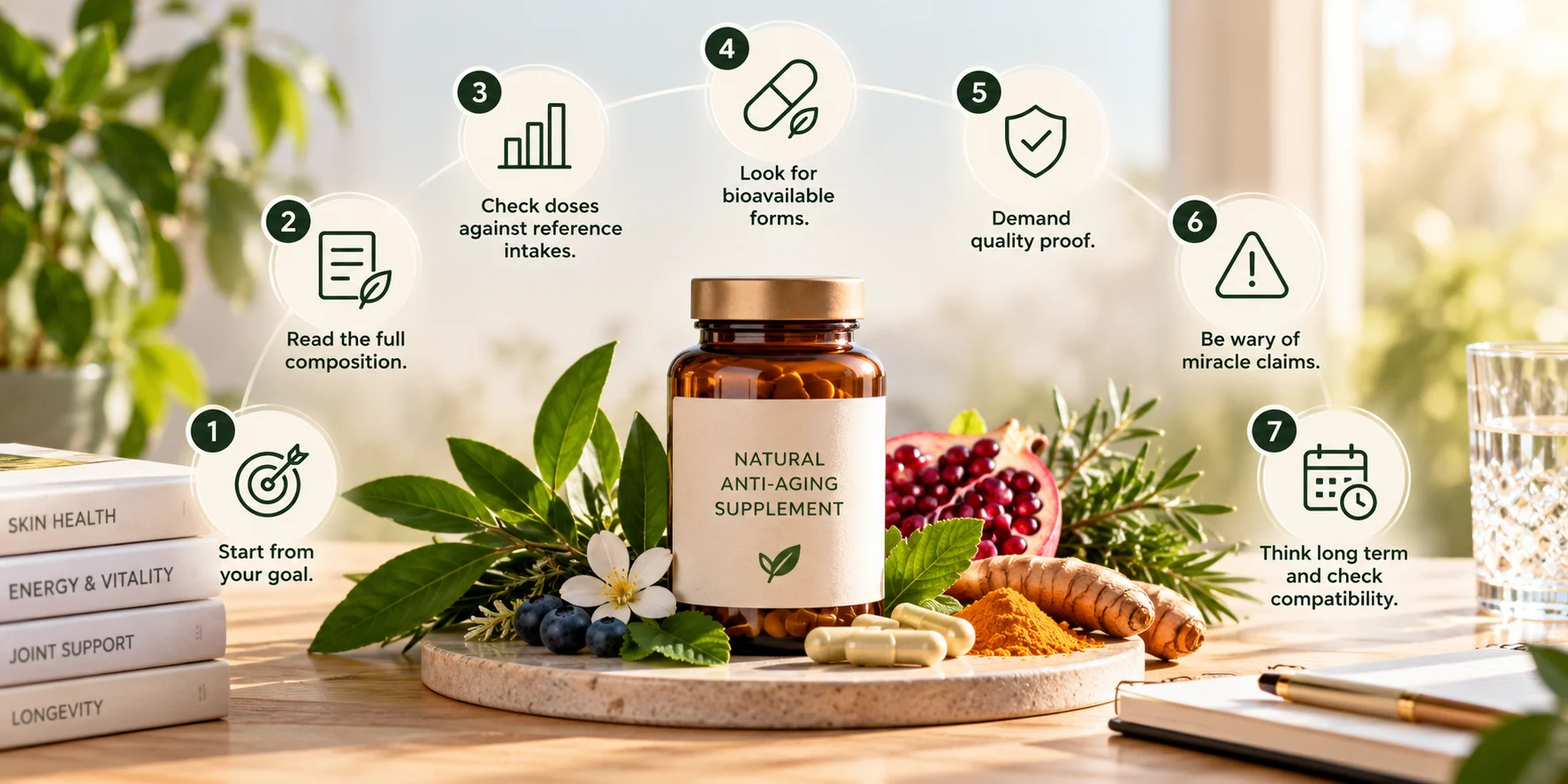
- Start from your goal. Skin radiance and firmness, energy, joint comfort or overall longevity do not call for the same actives. A clear goal narrows the choice.
- Read the full composition. Every active should be listed with its exact dose per daily serving, not hidden in a “proprietary blend”.
- Check doses against reference intakes. Vitamins and minerals should sit close to the Nutrient Reference Values (NRV); megadoses are rarely useful and can be counterproductive.
- Look for bioavailable forms. Bisglycinate minerals, natural vitamin E or curcumin paired with an absorption enhancer make a real difference.
- Demand quality proof. Third-party lab testing, GMP-certified manufacturing, heavy-metal and contaminant checks, traceable sourcing.
- Be wary of miracle claims. “Reverses aging”, “erases wrinkles in 7 days” or “cures” are red flags. Serious brands use authorized wording such as “contributes to”.
- Think long term and check compatibility. Benefits build over 2 to 3 months of regular intake. Ask a pharmacist or doctor if you take anticoagulants, hormonal treatments or other medication.
Brands like AISA Care design their formulas around these principles: plant-based actives, clearly stated doses and a holistic approach to aging well.
Red flags at a glance:
- Undisclosed doses or “secret blends”
- Before/after photos presented as guaranteed results
- More than 20 ingredients in a single capsule
- No information on manufacturer or country of production
- Aggressive countdown timers and “last chance” pricing
FAQ
At what age should you start taking a natural anti-aging supplement?
There is no fixed age. Many people start around 35 to 40, when collagen production and antioxidant defences decline more noticeably. The priority remains a balanced diet; a supplement fills specific gaps.
How long before you notice results?
Usually 8 to 12 weeks of regular intake, especially for skin, hair and nails, which renew slowly. Quick “visible in days” promises should make you cautious.
Is a natural supplement safer than a synthetic one?
Not automatically. Natural ingredients can also cause side effects or interact with medication (turmeric and anticoagulants, for instance). Quality, dose and your personal situation matter more than the label “natural”.
Can I combine several anti-aging supplements?
Yes, but watch for overlaps: two products containing zinc or selenium can push you above safe intakes. Add up the doses before combining.
Do anti-aging supplements replace skincare?
No. They work from the inside, while skincare and sun protection work from the outside. The two are complementary.
What lifestyle habits make a supplement more effective?
Sleeping 7 to 9 hours, moving daily, eating colourful plants and oily fish, limiting sugar and alcohol, managing stress and not smoking. A supplement amplifies good habits; it cannot compensate for poor ones.
This article is for information only and does not replace the advice of a healthcare professional.