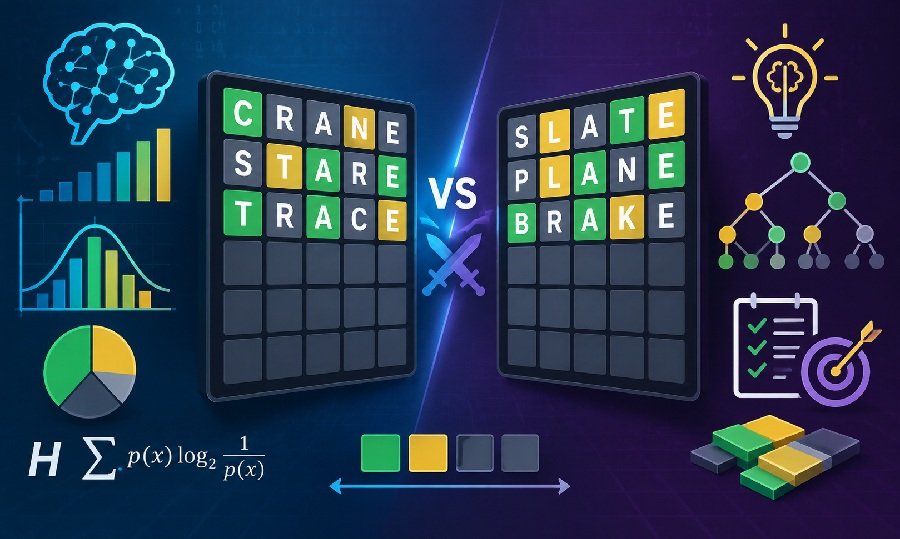
Wordle looks like a vocabulary game, but under the colored tiles it is a compact exercise in information theory. Every guess is a question, every color pattern is an answer, and the best solvers are the ones who ask the most efficient questions. Put a second player on the same board and the math changes in ways that surprise most people
Worduel, a free Wordle duel game, does exactly that. Two players take turns on one shared board, 45 seconds a move, and whoever types the hidden five-letter word first wins. This article walks through the numbers behind the classic format, the scoring algorithm that produces the colors, and the game theory that takes over once your guesses help your opponent as much as they help you
A Guess Is a Question With 243 Possible Answers
Each of the five positions can come back green, yellow or grey, so a single guess has 3^5 = 243 possible color patterns. Five of them can never occur: if four letters are green, the fifth cannot be yellow, because the only free position is its own. That leaves 238 patterns a guess can actually produce
Information theory measures uncertainty in bits. Worduel’s English game draws its answers from a list of 1,088 words, so before the first guess the uncertainty is log2(1,088), about 10.1 bits. A guess could deliver at most log2(238), roughly 7.9 bits, and only if every pattern were equally likely. Real guesses do worse: on the original Wordle answer list, the strongest openers average a little under 6 bits, which is why a well-played game usually ends after three or four guesses
For a solo player the lesson is to choose guesses that spread the remaining candidates as evenly as possible across many patterns. Words such as CRANE or SLATE are popular openers for that reason, since they test common letters in common positions
How the Colors Are Calculated
Repeated letters are where most people’s intuition breaks, so it is worth looking at the scoring rule itself. Wordle-style games, Worduel included, use green-first scoring: exact matches are marked first, and only the copies of a letter that are still unmatched can turn yellow
from collections import Counter
def score(guess, answer):
    colors = ["grey"] * 5
    unmatched = Counter()
    for i in range(5):
        if guess[i] == answer[i]:
            colors[i] = "green"
        else:
            unmatched[answer[i]] += 1
    for i in range(5):
        if colors[i] != "green" and unmatched[guess[i]] > 0:
            colors[i] = "yellow"
            unmatched[guess[i]] -= 1
    return colors
Score the guess LEVEL against the answer HOTEL and you get grey, grey, grey, green, green. The first L and the first E stay grey even though both letters are in the answer, because HOTEL holds one copy of each and both copies are already matched. The Worduel journal has a longer walkthrough of green-first scoring with more examples
Two Players, One Board: Where Game Theory Takes Over
In solo play, information is pure profit. In a duel, every pattern you uncover lands on a board your rival reads before their next move. The question stops being how much you can learn and becomes how much you can win, and how much you hand over in the process
A simple model makes this concrete. Call S the set of words still consistent with the board. If you guess a word from S, you win at once with probability 1/|S|. If you miss, your rival moves with whatever smaller set your guess leaves behind, and the smaller that set, the better their chances
Now take a three-word endgame. Guess one of the three and you win a third of the time. What happens on a miss depends on whether your guess tells the two survivors apart:
- It separates them: your rival knows the answer and wins, so your total chance is 1/3
- It does not separate them: your rival faces a coin flip, and you take the last word if they miss, so your chance is 1/3 + 2/3 × 1/2 = 2/3
Same number of guesses, double the win rate, purely because of what the board leaked. That is the core skill of a word duel: among the guesses that can win, prefer the one that reveals the least
Sometimes no such guess exists. With CRANE, CRATE and GRATE left, whichever word you pick, its colors tell the other two apart. Here a word built from letters that cannot separate the survivors works like a pass: it hands the same uncertain board back to your rival, and if they then guess, your chance rises from 1/3 to 2/3
The Clock and the Skip Rule
Worduel adds a constraint the solo game never had: 45 seconds per move. That is enough to reason about a handful of candidates but not to enumerate hundreds, so the duel rewards good heuristics over brute force. A turn that runs out is skipped, and the fourth skipped turn loses the match. A timed-out turn is technically a pass too, but spending skips carelessly leaves you one mistake away from defeat
Why Every Language Needs Two Word Lists
The model above depends on the size of S, and that depends on the dictionary. Worduel keeps two lists per language: a curated set of answers that players can reasonably know, and a much broader set of accepted guesses, so valid words are never rejected. In English the split is 1,088 answers against 14,855 accepted guesses
Languages with rich inflection look different. Polish accepts 29,739 five-letter words and Russian 20,085, a gap that reflects how many valid forms a single noun or verb can take, while their answer lists stay close to a thousand words. That widens the supply of legal probes from the previous section. Play Wordle in Russian and you feel it at once: it is usually easy to find a legal word that tests exactly the letters you want
Putting It Into Practice
- Open with a word that tests common letters, but remember that the result is shared
- In the endgame, count the candidates before you type and ask whether your guess separates the ones you leave behind
- If every candidate gives the answer away, look for a legal word that reveals nothing about the survivors
- Treat your three skips as a budget, not a safety net
Conclusion
Wordle turned information theory into a morning ritual. A shared board turns it into a game of risk: every bit you learn is a bit your opponent learns too, and the winning move is often the one that teaches the board the least. The math fits on a napkin, but applying it under a 45-second clock is what makes a word duel worth replaying. Worduel is an independent game, not affiliated with The New York Times’ Wordle, and every idea in this article can be tested there for free