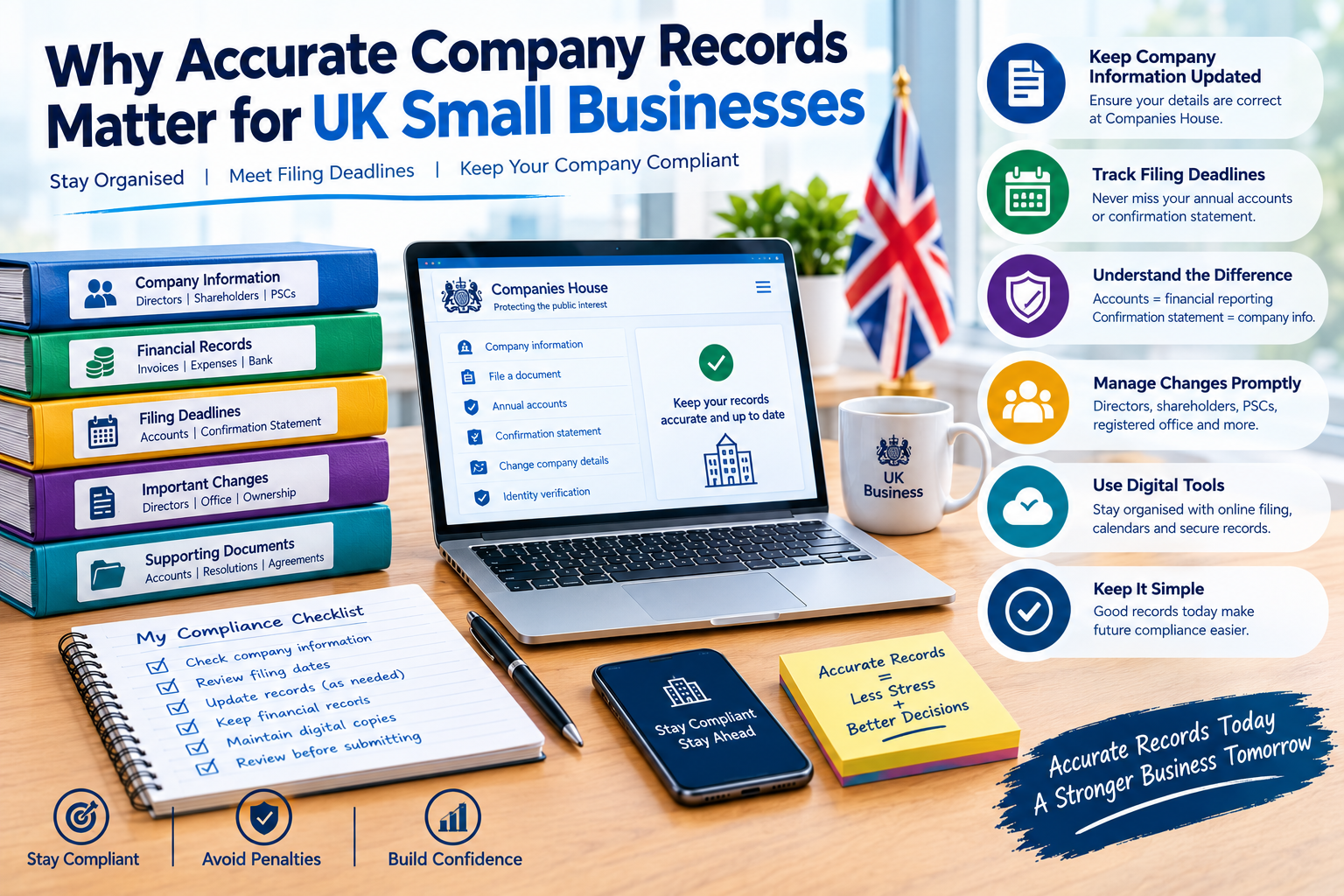
For a small UK company, keeping accurate records is more than an administrative exercise. Company information supports financial reporting, regulatory filings and everyday decision-making, while accurate records can make it easier for directors to deal with Companies House requirements.
As more company administration moves online, maintaining reliable information throughout the year has become increasingly important. Directors can now complete many filing tasks digitally, but the information submitted still needs to be correct.
For businesses with limited administrative resources, a straightforward record-keeping routine can make annual compliance much easier.
Company Records Are More Than Financial Information
When people think about company records, they often think primarily about invoices, expenses and bank transactions.
Financial records are certainly important, but a limited company’s records also include information about its structure and registration.
This can include details relating to:
- directors and company officers;
- shareholders;
- people with significant control;
- registered office details;
- company activities;
- share information;
- accounting periods; and
- previous filings.
Keeping these details organised gives directors a clearer picture of the company’s current position.
Financial Records and Companies House Information Serve Different Purposes
A useful distinction for directors is the difference between financial reporting and company information.
Annual accounts are prepared from the company’s financial records and report its financial position for the relevant accounting period. Companies House requires companies to file annual accounts, including companies that are dormant or not trading.
A confirmation statement has a different purpose.
It confirms that the information Companies House holds about the company is accurate and up to date. Every company must file at least one confirmation statement every 12 months, even when there have been no changes during the review period.
Understanding this distinction can help prevent directors from assuming that completing one filing automatically deals with the other.
Why Accurate Records Make Filing Easier
Many filing problems begin before a director actually opens an online filing form.
If records have not been reviewed for months, the director may need to work out whether information about the company is still correct.
For example, the company may have changed its registered office, appointed a new director or changed information relating to its shareholders or people with significant control.
Companies House advises companies to check their details before filing a confirmation statement and update information that is incorrect or out of date.
Keeping a basic record of changes throughout the year can make this review considerably easier.
Confirmation Statements Should Be Part of the Annual Routine
The confirmation statement is sometimes treated as a formality because it may not involve financial figures.
However, it plays an important role in maintaining the company’s public record.
Before filing, directors should review relevant information and make sure the company’s details are accurate.
Companies House currently requires directors to complete identity verification requirements and provide their Companies House personal codes as part of the confirmation statement process.
Once the necessary information has been reviewed, directors can use an online service to file confirmation statement information as part of their annual administration.
Dormant Companies Still Need Good Records
Record keeping remains important even when a company is not trading.
A dormant company may have little financial activity, but Companies House states that companies still have annual accounts responsibilities even when they are dormant or not trading.
For a company that qualifies to file dormant accounts, maintaining the necessary information throughout the year can make the annual process more straightforward.
Directors who need to file dormant accounts should still ensure that the company’s underlying records are accurate and that the correct filing applies to its circumstances.
Keep Track of Changes as They Happen
One of the easiest ways to improve company administration is to record important changes when they happen rather than trying to remember them later.
A simple internal checklist can be useful.
For example, when a director changes, the business can record the date and make sure the appropriate Companies House update is handled.
The same approach can be used for changes involving the registered office, company ownership or people with significant control.
This creates a useful history of the company’s administrative changes and reduces the amount of information directors need to reconstruct before an annual filing.
Digital Records Can Improve Organisation
Small businesses do not necessarily need expensive company-secretarial software to maintain useful records.
A secure digital folder, accounting system or organised spreadsheet can provide a practical starting point.
The important thing is consistency.
Documents should be stored in a way that allows directors or authorised advisers to find them when needed. Important deadlines can also be added to a digital calendar, with reminders scheduled well before the actual filing date.
Companies House allows directors to check confirmation dates and filing deadlines through the company information register and also offers email reminders for confirmation statements.
Accounting Records Are Also a Continuing Responsibility
Company accounting records should not only be prepared when annual accounts are due.
Companies House guidance states that every company must keep accounting records, whether it is trading or not. These records include information about money received and spent and records of the company’s assets and liabilities.
For private companies, accounting records generally need to be retained for at least three years from the date they were made.
This makes regular record keeping important throughout the year rather than only at the end of the accounting period.
A Simple Record-Keeping System for Small Companies
A small business can create a straightforward system by separating records into a few categories.
Financial records:
Keep invoices, expenses, bank information and other accounting documents organised.
Company information:
Maintain current details about directors, shareholders, PSCs and the registered office.
Filing dates:
Record annual accounts and confirmation statement deadlines separately.
Company changes:
Keep a record of important changes as they occur.
Supporting documents:
Store documents that may be needed by the company’s accountant, directors or other authorised advisers.
This approach can reduce the amount of administrative work required when a filing deadline arrives.
Do Not Leave Everything Until the Deadline
A common source of unnecessary pressure is attempting to complete every administrative task immediately before a deadline.
This can be especially difficult when a director discovers that information is missing or outdated.
A better approach is to spread the work throughout the year.
A quarterly review, for example, can provide an opportunity to check company information, review upcoming deadlines and organise financial records.
The exact frequency can depend on the size and complexity of the company, but the principle remains the same: regular maintenance is usually easier than a large annual clean-up.
Accurate Records Support Better Business Administration
Good records are useful beyond compliance.
When company information and financial records are organised, directors can more easily understand the company’s current position and provide accurate information to accountants, advisers, banks and other relevant parties.
For businesses that become dormant and later return to trading, well-maintained records can also make the transition easier.
The administrative value of accurate information therefore extends beyond Companies House filings.
Creating a Sustainable Compliance Habit
Small business administration does not need to become an overwhelming process.
Directors can start with a few practical habits: keep financial records organised, record company changes promptly, monitor filing dates and review Companies House information regularly.
It is also useful to understand the purpose of different filings rather than treating every Companies House requirement as the same type of paperwork.
Annual accounts deal with financial reporting, while the confirmation statement focuses on the company’s registered information. Dormant companies may have specific accounts requirements, but they do not simply become free from administrative responsibilities because they are not trading.
With a consistent digital record-keeping system, these responsibilities can become a normal part of running a UK company rather than a task that only receives attention when a deadline is approaching.
For small businesses, the objective is straightforward: keep the information accurate, keep the records organised and deal with company filings at the appropriate time.