Introduction
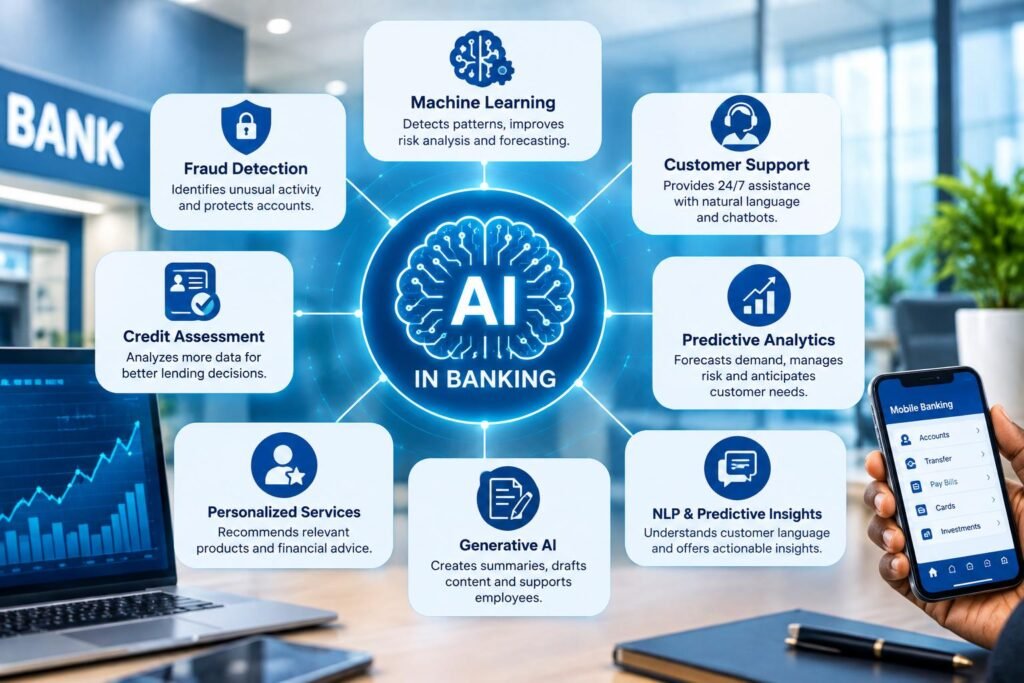
Artificial Intelligence (AI) is transforming the way banks and financial service providers to operate, communicate, evaluate risk and make decisions. Intelligent digital systems can increasingly take over what used to be a manual, paperwork-intensive process and multiple interactions with employees. It’s not just in chatbots; AI is now playing a role in various aspects of financial services, ranging from mobile banking apps to online lending platforms. An obvious example is the automated customer service feature, which enables financial institutions to respond to standard customer inquiries, walk customers through procedures and help customers whenever they need it. Meanwhile, AI is also playing a behind-the-scenes role in spotting dubious transactions, evaluating and analyzing financial behaviors, better credit assessments, and predicting customer needs. These developments are far from just replacing the current banking processes. They are transforming the way work is performed, speeds of service rendered, and the way customers relate with financial institutions.
Track the Progress of Machine Learning and Smarter Banking Operations.
Machine learning is one of the most crucial technologies for the adoption of AI in banking. Machine learning systems can be trained by analyzing vast amounts of past and present information to discover patterns and enhance their accuracy. Banks could use these systems in transaction monitoring, risk analysis, segmentation, operational forecasting, etc., where the large quantities of data hold some useful signals. For instance, a banking platform can inspect the trails of transactions and discover activity that does not line up with the common pattern of a customer’s activity. Machine learning can also be used to predict future demand for services, identify any suspicious accounts and prioritize cases for further investigation. The more relevant data that models consume as input, the more likely they are to be able to detect repeating patterns, but their effectiveness will rely on the quality, relevance and governance of the information fed into the models to train them. However, the results and the decision on the use of automated recommendations are important, which is why human expertise is still needed.
Customer Service & Digital Support powered by AI.
One of the most noticeable ways customers can experience the impact of AI is through the customer service area. Conversational systems, virtual assistants and intelligent help tools are becoming common tools in the financial landscape that answer intuitive queries on account access, card services, fees, transfers, balances and other common financial procedures. These systems can interpret natural language, which means they can understand customers’ words rather than them having to engage in impenetrable menus or commands. Today, AI assistants can also provide context in some portions of a conversation, eliminating extra steps for customers to finish simple tasks. For banks, it can alleviate stress on their customer service staff, since repetitive requests are taken care of by the bot, and leave their employees to tackle more complex, sensitive requests. But providing good customer support isn’t all about quick responses. Financial queries may be related to personal information, conflicts, fraud issues, or major decisions – situations in which the robot should detect that the conversation needs to be passed to a human representative for the business.
Fraud Detection & Transaction Monitoring
Another significant use case of AI in financial services is fraud prevention, as financial institutions handle vast amounts of transactions daily. Many traditional fraud detection systems rely on static rules, which mean that if a transaction goes against a rule, such as those that involve large amounts of money or addresses that are outside of the norm, it will be blocked. AI can be used in conjunction with these methods to look at multiple signals, at once and pick up on patterns that could indicate potentially fraudulent activity. When evaluating if an activity is unusual, a system may use the frequency of transactions, transaction amount, time of transaction, information about the device, account history and more. By leveraging machine learning models, financial institutions may prioritize suspicious transactions for investigation, which could help investigators focus on the areas that need their attention the most. AI can also aid with ongoing monitoring, rather than just regular checks. That does not necessarily mean that unusual activity is fraud, however. Automated systems face the challenge of detecting legitimate transactions while avoiding false alarms and blocking legitimate accounts. The challenge is to strike the balance between detection and preventing false alarms and blocking legitimate accounts as legitimate customers may change their spending habits, travel or make unusually large purchases.
Credit Assessment and Risk Management with AI
AI can also impact financial decisions through credit assessment. Another aspect of financial decision-making where AI can play a part is credit assessment. The usual factors that banks consider when evaluating an application include income, repayment history, obligations, employment history and credit history. Greater information can be fed into AI and predictive analytics, allowing them to uncover connections that can aid institutions in better predicting credit risk. These systems can be used for loan screening, risk classification, portfolio monitoring, and/identifying accounts that might need attention. In certain environments, the automatic analysis can shave time off processing and enable financial institutions to deal with application size. But, there’s no guarantee that the pace will ensure accuracy or fairness. When training data has historical bias, a model may exhibit the same or accentuate the patterns found in the data. Financial institutions are thus faring better with robust model governance, the right tests, explainability systems and human oversight. Consumers must also have some ways to make sense of decisions that have a significant impact on access to financial products.
Personalized Financial Recommendations
AI has also been able to drive more personalized banking and digital financial experiences. AI systems can process information from a customer’s account activity, preferences, financial objectives, and interactions to look for similar services and products that may be relevant. Rather than delivering the same messages and product recommendations to all customers, AI systems can use data from a customer’s activity, preferences, financial objectives, and interactions to identify potentially relevant services and products. A banking app could remind you of an upcoming payment, maybe offer a look at your spending habits, and make a recommendation to budget, or even find a way to save! More sophisticated systems might be able to provide customers with organization of financial information and explanations that take individual circumstances into account. While personalization is a key element to adding relevance to digital banking, it also raises some relevant consent and data usage questions. A personal financial recommendation made based on personal information should be provided to meet a customer’s need and should not just be a means to an end to further sales. Transparency is especially crucial given that customers may not always understand how or what information was taken into account when a suggestion is made, or why it is a particular one.
Generative AI Changing the Role of Employees.
Generative AI is broadening the scope of intelligent systems’ abilities to generate and paraphrase text, interpret information, help with research, and aid employees in generating content. In the banking sector, generative AI can be used to generate content, summarize lengthy documents, streamline internal knowledge, sum up meetings, and enable staff to locate pertinent data more rapidly. It can additionally assist with software development and in-house procedures, permitting teams to create or audit routine substance. The technology isn’t necessarily going to make banking staffers superfluous. Instead, many jobs will undergo transformation as workers reduce the amount of information they use in routine ways and spend more time making judgments, working with relationships, investigating and applying specialized problem solving. While AI can produce accurate content, it also has the potential to include incorrect information, miss important details, or even provide an answer that is more confident than the facts warrant. Banks will still need to monitor the use of generative AI since it may include inaccuracies, lack important details or offer an answer that is overly certain compared to the underlying facts. Financial communications and decisions require the human touch.
Importance of Natural Language Processing (NLP) and Predictive Analytics in Boosting Customer Satisfaction.
Together with other AI tools, NLP and predictive analytics can broaden the financial services industry’s ability to glean insights from structured and unstructured data. Natural language processing (NLP) enables systems to process/capture written content from customers, facilitate conversation, documents, feedback, and other information, which has a language basis. This can be useful for the identification of common complaints, categorization of service requests, summarization of conversations or to route cases to the right team. Predictive analytics, on the other hand, takes previous and existing data to forecast future results, like the volume of money that will be required, how customers are likely to pay, how much work will be required in the system, or what potential financial risk exists. These technologies can offer banks a wider picture of their service and their customers when used appropriately. They can also provide additional data to employees when they need it the most to assist them in making decisions. But no prediction is a certainty. Historical patterns are not necessarily reliable because of economic conditions, customer behavior, regulatory changes and unexpected events; so financial institutions need to continually monitor the performance of their models, not take the guesswork out of the job of predicting that the historical accuracy will hold true forever.
Privacy, Security, Accuracy, and Human Oversight
As AI becomes more prevalent, there are opportunities to tackle challenges, but also a need for responsible governance. Banks process very sensitive data, such as identification and account details, transaction history, financial behavior, and more. The systems that use AI to process this data should be secured from unauthorized access, use, manipulation and leakage of information. There should be clear rules in the privacy policies and internal controls on the collection, storage, sharing and usage of customer data for automated analysis. Security is also crucial, as an AI system can be the target of an attack for financial information or to try to affect the automated decisions made by the system. Another difficulty lies in the level of accuracy. Models can give false positive or false negative results, or generate outdated predictions or wrong responses. Human intervention is also vital for the protection of important decisions, Exception Analysis, challenging decisions that do not make sense and helping in the event of unexpected system behavior. Technology, governance, security, testing and accountability must all go hand-in-hand for responsible AI.
Conclusions
Artificial Intelligence has shifted its status from a futuristic technology to a reality of today’s banking.AI is no longer a thing of the future, but an everyday reality in banking. Patterns in transactions and risk data can be captured using machine learning, communication and service delivery can be enhanced with natural language processing, institutions can better predict the future by using predictive analytics, and employees can be helped with information heavy tasks by using generative AI. The applications can enable financial services to be more responsive, faster and more personalized, and can benefit banks’ large and complex operations. Meanwhile, AI doesn’t replace the importance of making thoughtful decisions. Poor system design or inadequate supervision can have serious consequences due to privacy, cyber security, biased and incomplete data, false predictions, false fraud alerts, and false content generated. The future of banking will thus rely on the advancement of AI as well as the responsible use of it by financial institutions. The smartest way to do this is to have intelligent technology helping your customers and employees but having a human element in vital financial decisions.
Get more well researched information about Artificial Intelligence in banking here.