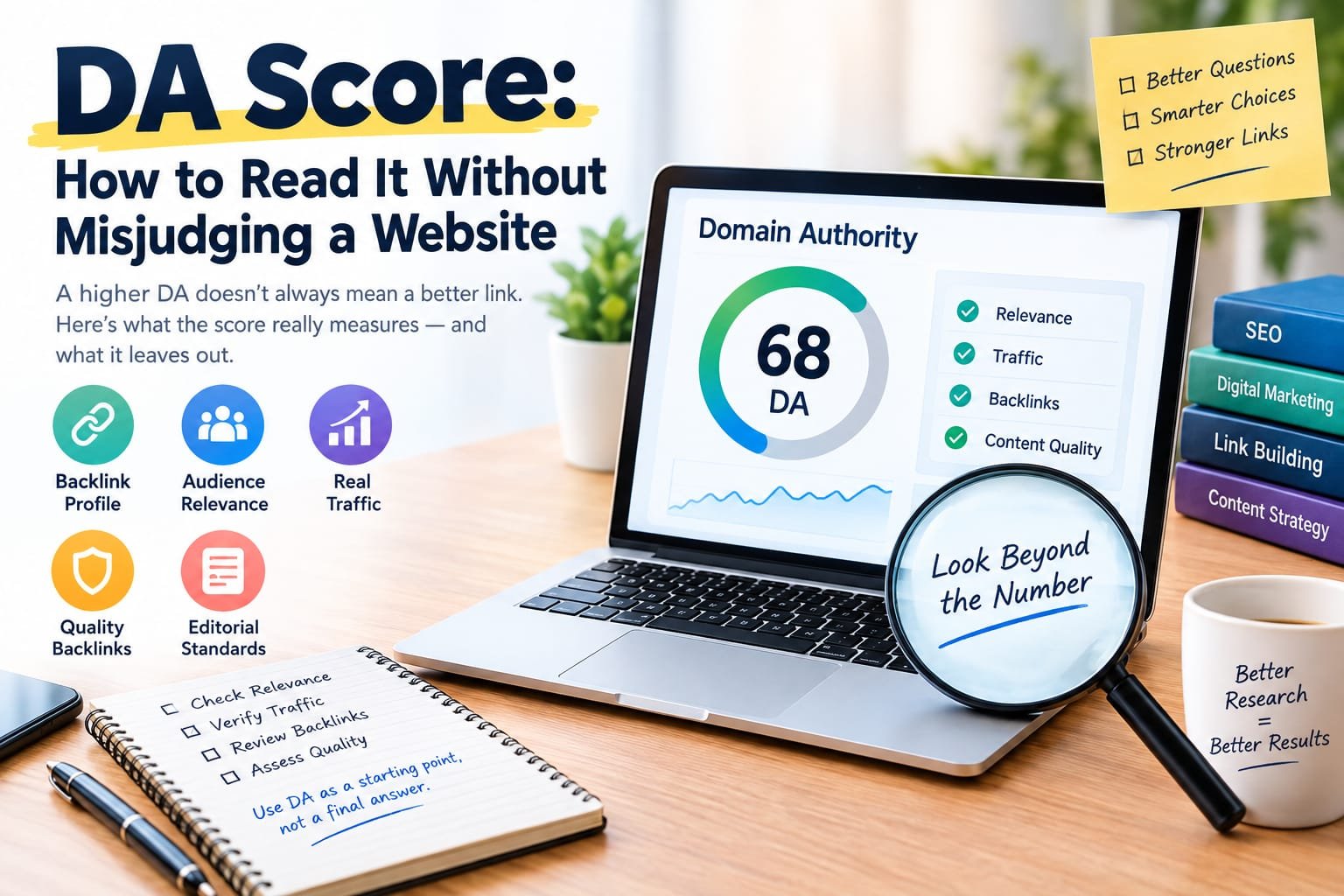
A website with a high authority score can look like an obvious choice for a guest post or backlink. But a single number rarely tells you whether a site reaches the right audience, attracts real visitors, or offers a link worth pursuing. Understanding what a DA score measures—and what it leaves out—helps marketers make better decisions instead of treating a third-party metric as a guarantee.
Domain Authority, usually shortened to DA, is a score developed by Moz to estimate how likely a website is to rank in search results compared with other sites. It is useful as a comparative research tool, but it is not a Google ranking score. The distinction matters: DA can help you sort and investigate potential websites, but it cannot tell you on its own whether a link will improve your search performance.
What a DA Score Actually Measures
Moz calculates DA on a logarithmic scale from 1 to 100 using signals from its own link index and predictive model. In broad terms, the score reflects the strength and quality of a site’s backlink profile. Links from relevant, reputable websites can contribute to a stronger profile, while a large number of low-quality or unrelated links may not provide the same value.
Because the scale is logarithmic, moving from 20 to 30 is not necessarily as difficult as moving from 70 to 80. Scores are most useful for comparing sites in similar circumstances, such as two publications in the same industry, rather than setting a universal threshold for what counts as a good website.
DA is also a Moz metric, not a direct measure of Google’s view of a domain. A page can rank well with a modest DA, and a site with a strong DA may have pages that attract little search traffic. Treat the number as a clue for further investigation, not as a verdict.
Why the Score Can Change
A DA score may rise or fall even when a site owner has made no obvious change. Moz regularly updates its index and models, and its ability to discover links changes over time. Competitors’ link profiles can shift too, affecting how a site compares with the wider set of domains in the model.
Changes to a website’s backlinks are another possible cause. New links may be discovered, existing links may disappear, and some links may be assessed differently as data is refreshed. A small fluctuation is not necessarily evidence of a penalty or a sudden improvement in search visibility. Look at the direction over time and check what has changed in the site’s link profile before drawing conclusions.
DA, DR, and Authority Score Are Not Interchangeable
Other SEO platforms provide their own authority-style metrics. Ahrefs Domain Rating (DR) estimates the strength of a website’s backlink profile using Ahrefs’ data and methodology. Semrush Authority Score combines backlink signals with other considerations, including organic traffic and signs of manipulation. Moz’s DA uses Moz’s index and model.
These measures may all be expressed as numbers, but they are not calculated in the same way. A domain can have noticeably different DA, DR, and Authority Score results without any tool necessarily being broken. Each platform sees a different portion of the web and applies its own weighting. For a fuller explanation of what a DA score means and how the metrics differ, compare the definitions and data sources rather than trying to convert one score into another.
How to Evaluate a Website for Link Building
Use DA as an initial sorting signal, then check whether the site is a sensible place for your content or link. A practical review should include several questions:
- Does the audience fit? A relevant site can bring readers who care about your subject, while a high-scoring site in an unrelated niche may offer little real value.
- Is there evidence of genuine traffic? Review estimated organic visits and, where possible, the pages and topics attracting them. Traffic estimates are imperfect, but they can help distinguish an active publication from a domain that looks strong only on paper.
- Are the backlinks credible? Look at the kinds of sites linking to the domain, whether those links appear relevant, and whether the profile seems natural. A high score built on questionable links is not a sound reason to pursue a placement.
- Is the site maintained and useful? Check recent publishing activity, the quality of its articles, and whether its pages serve readers rather than existing mainly to sell links.
For guest posting, editorial standards and audience relevance are especially important. A placement that brings qualified readers and supports your reputation may be more useful than one chosen only because its DA crosses an arbitrary number. Keep notes on the reasons for each prospect so that decisions remain consistent across a campaign.
When It Makes Sense to Hire Help
Researching prospects, checking link profiles, and preparing outreach can take time. If you hire a freelancer to help, define the work before comparing candidates: specify the niche, the research method, the number of prospects, what information each record should include, and whether outreach is part of the task. That makes it easier to judge the work on its usefulness rather than on a vague promise to “build authority.”
Clear scope matters on a freelance marketplace such as Osdire, where buyers can compare services across categories including writing, marketing, and programming. Looking at freelance offer examples can help buyers understand how deliverables, pricing levels, and expectations are presented before placing an order. A well-defined brief also helps freelancers price the job accurately and reduces misunderstandings about what counts as a completed result.
Use the Metric as a Starting Point
A DA score is most helpful when it prompts better questions. It can narrow a list of possible websites and provide one way to compare them, but it cannot replace checks for relevance, real traffic, trustworthy backlinks, and editorial quality. Compare like with like, watch for meaningful trends rather than small movements, and use other authority metrics as separate perspectives instead of interchangeable grades. This approach makes link-building decisions more grounded—and keeps one attractive number from doing more work than it should.