Introduction
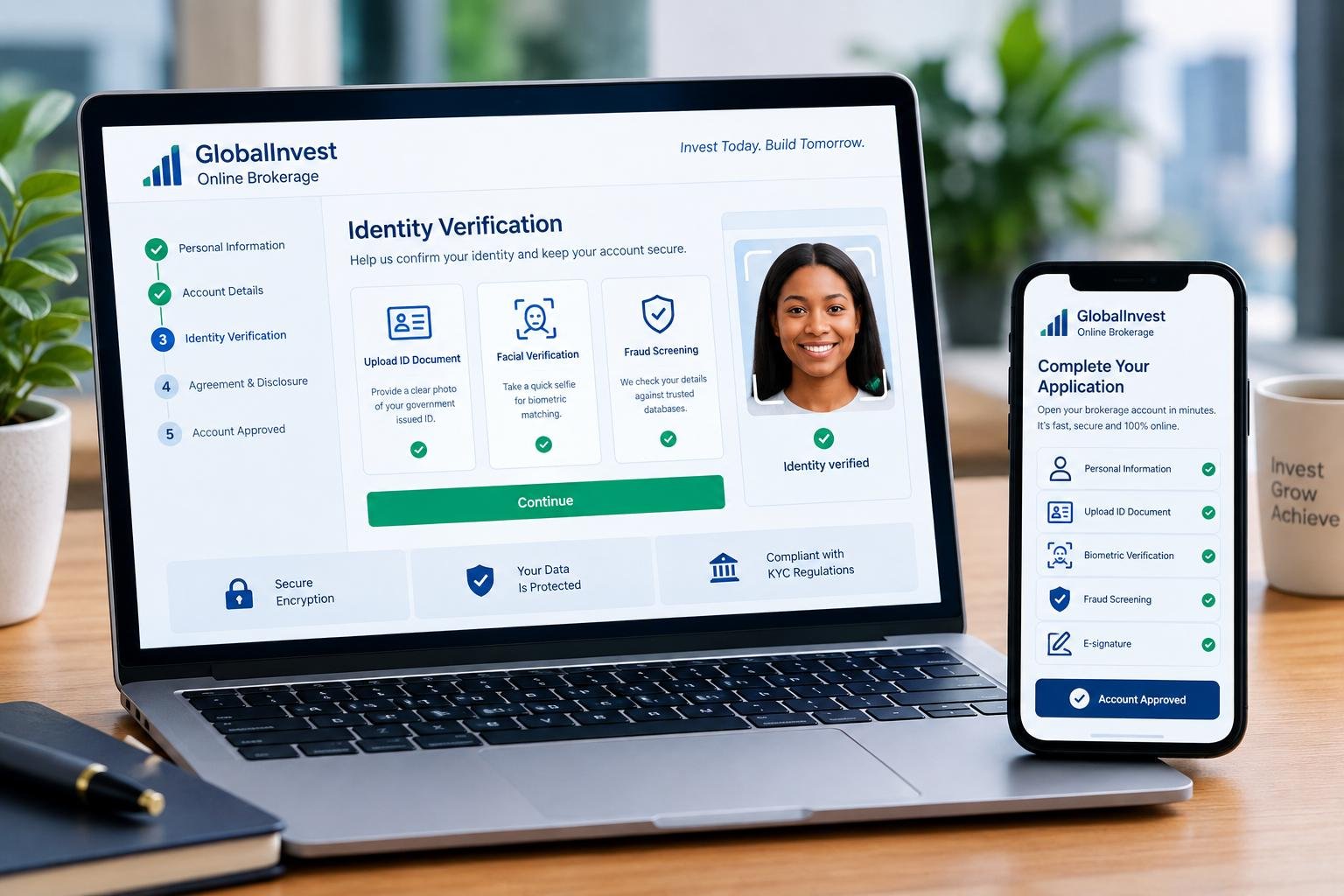
When opening an online brokerage account it used to require paper and physical signatures, and sometimes a trip to the branch or office. Digital onboarding has revolutionized that experience, enabling potential investors to do much of the process on a computer or from their mobile device. An individual may provide their personal information, submit identification, confirm an identity, agree to an account contract and receive a decision on those account terms without using the traditional paper application. This convenience isn’t the same thing, however, as being able to take away safeguards for financial accounts. Rather, lots of those checks have been transferred to interconnected electronic systems. Biometric technologies, automated data checks, document analysis, fraud detection and electronic signatures are all now available on modern platforms and can be used to provide a smooth customer experience while ensuring that an applicant is a ‘real person’. Effectively, the combination provides a possible onboarding procedure that is more streamlined and easily accessible while maintaining advanced controls in the background.
Making an Account Opening Process easier with Digital Forms
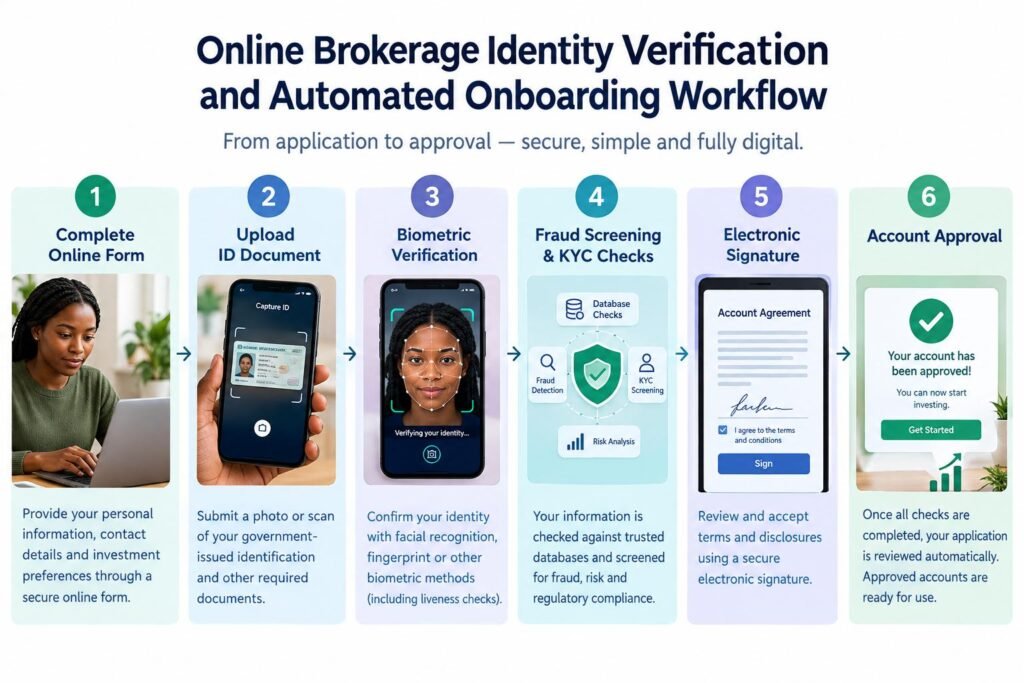
The initial step in getting started with digital brokerage is typically an online application form to collect the information needed to open an account. An applicant enters data directly into a website/mobile application as opposed to printing pages and writing by hand. Common field types may be a legal name, date of birth, address, contact information, tax identification numbers, employment information and financial information pertinent to the account. The site might also inquire about the investor’s investment goal, experience, risk-tolerance or the account type desired by the investor. Digital forms can help improve the process if they can check that required fields are filled out before they are submitted, and minimize handwriting or manual data entry errors. The information can be passed on straight into the brokerage firm’s systems, helping to minimize the time that employees devote to retying application details. This will provide a uniform beginning for checks and compliance audits, and eventually account management.
Most of the Paperwork is Eliminated in Electronic Document Submission.
Digital onboarding can also enable customers to provide supporting documents digitally. The applicant might submit an image or scan of a government-issued identification card, and other information required to verify the applicant. A mobile app may be able to direct the customer to take a picture of the front and back of the ID card, and a computer program can analyze the picture to check it for readable information and any alterations. Some platforms can scour documents and add the data without the need for multiple inputs. It is not enough to submit just a photo and take what it has. Verification systems can cross-check the contents of the document with what has been inputted into the application, and highlight any discrepancies that need to be checked. If the application is not identified with a high degree of certainty, it may be sent to a human, and not approved, instead of the automated review process.
Ensure that the Applicant is a Genuine Applicant.
The biggest problem with opening an account from a distance is to know if it’s the person who filled out the application that’s actually opening the account. So, the brokerage firms use documentary and non-documentary methods to confirm identification. A digital platform can check an ID card, run a search on the information that has been supplied and check against trusted databases to determine if it matches up, and determine if the information is consistent. The following additional questions or checks may also be used to complete some processes when information needed is not provided. A fraudulent applicant may be able to fraudulently open an account otherwise. Brokers in the United States are required to implement Customer Identification Program (CIP) which involves obtaining identifying information, within reasonable time verifying identity, maintaining records of identity verification, and notifying customers of the need to provide information for identity verification. Digital onboarding doesn’t abrogate these obligations, it just shifts the way that businesses perform and document them.
Adding Biometric Technologies for Extra Verification
Biometric verification can be used to link a Digital Application to the person who is trying to access the account. Biometric systems can be based on facial features, fingerprints, voice patterns, or any other measurable characteristic of the human being. One method for remote onboarding is for the applicant to take a selfie or video and compare it to the photo of the person on a photo ID. Some of these systems also employ “liveness detection” to help determine if the camera is capturing a real person or a picture or recording. While biometrics can help make it more challenging to impersonate, they aren’t foolproof against identity fraud. Facial images and other biometric information is sensitive information and today’s methods of fraud can use bogus media or fake identities to fool a verification system. Hence, biometric checks are most effective used in conjunction with other elements of an identity and security system.
Know Your Customer Beyond Customer Identification.
KYC, more than just verifying the name on an ID card, is a much wider process. Process aids financial institution to know who their customer is and to evaluate information for regulatory and risk considerations. On the brokerage side of the equation, it may include gathering details regarding identity, place of residence, occupation, financial situation, investment experience, and plans for using the account, to name a few, depending on the account and rules. KYC data can also be used for post-account monitoring as the activities of customers could require the post validation of the information provided during account opening. A digital platform thus forms a structured application profile of the customer and not only a completed application. If information is not consistent, or is unusual, the system may ask for more documentation or refer the application to a compliance specialist. This can be beneficial to a company that wants to review a lot of applications, but not all customers as the same case.
Fraud Detection goes Hand in Hand with Identity Verification.
While identity verification addresses one key question, brokerage firms need to ask second question as well – whether the application exhibits symptoms of fraud. The pattern-matching capabilities of fraud detection systems can help identify patterns which the human reviewer might not be able to detect when dealing with thousands of applications. For instance, a service might discover frequent telephone numbers, addresses, email addresses, bank information and so on, related with various names. It can also review unusual application usage, such as unusually fast completion or activity that looks like it’s automated or making it appear as if the applications are being used by automated systems. Depending on the systems of the firm and legal requirements, other risk indicators may be provided by the device information, network signals, transaction relationships and the history of the accounts. Even if a red flag is triggered, it doesn’t mean that the applicant is necessarily a fraud. Rather, it could lead to more investigation into the application. In its practices, FINRA has identified the use of technology to identify red flags that might be associated with fraudulent account opening, and the integration of automated practices with extra review where necessary.
Ensure the Electronic Signature Process is Completed and Comply with E-signature Regulations and Requirements.
Once a person has submitted the necessary information and made the required checks, the old paper account form handwritten signature may be substituted with electronic signatures. An electronic signature provides an electronic means by which a customer is able to affirm the customer’s acceptance of terms and disclosures and other documents. The system may give a record of the time that the signature was made and relate the signed agreement to the customer’s application record. This helps to eliminate the need to print, scan, mail or physically deliver documents and can eliminate a significant time delay in opening your account. Digital onboarding also is a good fit for electronic signing as the customer can equally finish the application on the same device. But a signature is no replacement to the proof of identity. Normally, the signature is the last step in the process, and it could be a person who signed with another person’s information, so the signature step is after or in conjunction with steps taken to establish the identity and authority of the applicant to open the account.
Connect the Different Checks with Automated Approval Workflows.
Best results are achieved when a number of onboarding technologies are woven together into a single workflow. The platform can automatically share details with the document verification, identity databases, fraud screening, KYC check, and more. At each stage, they can provide a result which can be used to inform the next stage. It may be a low-risk application that has consistent information and go through the workflow quickly and be automatically approved. An application that has conflicting information, or is unclear or indicates risk might instead be held in abeyance and submitted to a specialist for manual review. This will enable a brokerage firm to process large numbers of applications, without having to go through each field again. It also generates a record of any checks conducted and if further action is needed, it documents this. The aim is not just to speed but to ensure that while routine cases are dealt with efficiently the human element is there to look over more extensive cases.
Security Continues After the Account Is Approved
A successful onboarding is just the first line of defense in protecting the account. After a customer becomes an investor, the brokerage site will hold the investor’s personal data, money and investment activity. Multifactor authentication may provide additional security using an authentication method other than a password and biometric authentication may be possible with supported devices. Firms can also track account activity for unusual activity which may be an indication of account takeover or other types of fraud. This is important because criminals could impersonate you through phishing, have your credentials stolen, commit social engineering, create a fake identity, and use fake media to attack financial accounts. Therefore, a robust onboarding system should be able to tie into the brokerage firm’s overall cybersecurity and fraud-management system. Customers also have a significant part to play, namely in using robust authentication, ensuring their devices are secure, avoiding unsolicited links and contacting the brokerage firm in a secure way where they receive a security message that they don’t expect.
Conclusion
Digital onboarding has revolutionized the customer journey of becoming a brokerage customer by shifting a lot of the activities traditionally conducted in a branch to software. Online filling out of forms, electronic submission of documents, checking of identity across several data sources, added biometrics and paperless completion of agreements provide several options for completing forms without paper. These stages can then be used in automated workflows to have them connect these stages and decide if an application can move forward or needs to be attended to by people. But the ease with which the responsibility can be avoided should not be interpreted as convenience. A brokerage firm is an organization that deals with personal and financial information, so it is crucial that this information is accurately identified and can be safely prevented from being misused by others. Effective digital onboarding systems are built on the basis of control and speed. The marriage of automation and KYC, document verification, biometric verification, fraud detection, electronic signatures and human verification can streamline the account opening process for investors while simultaneously using the best of all resources to guard financial accounts.
Get more well researched information about Digital Onboarding and Identity Verification here.