Introduction
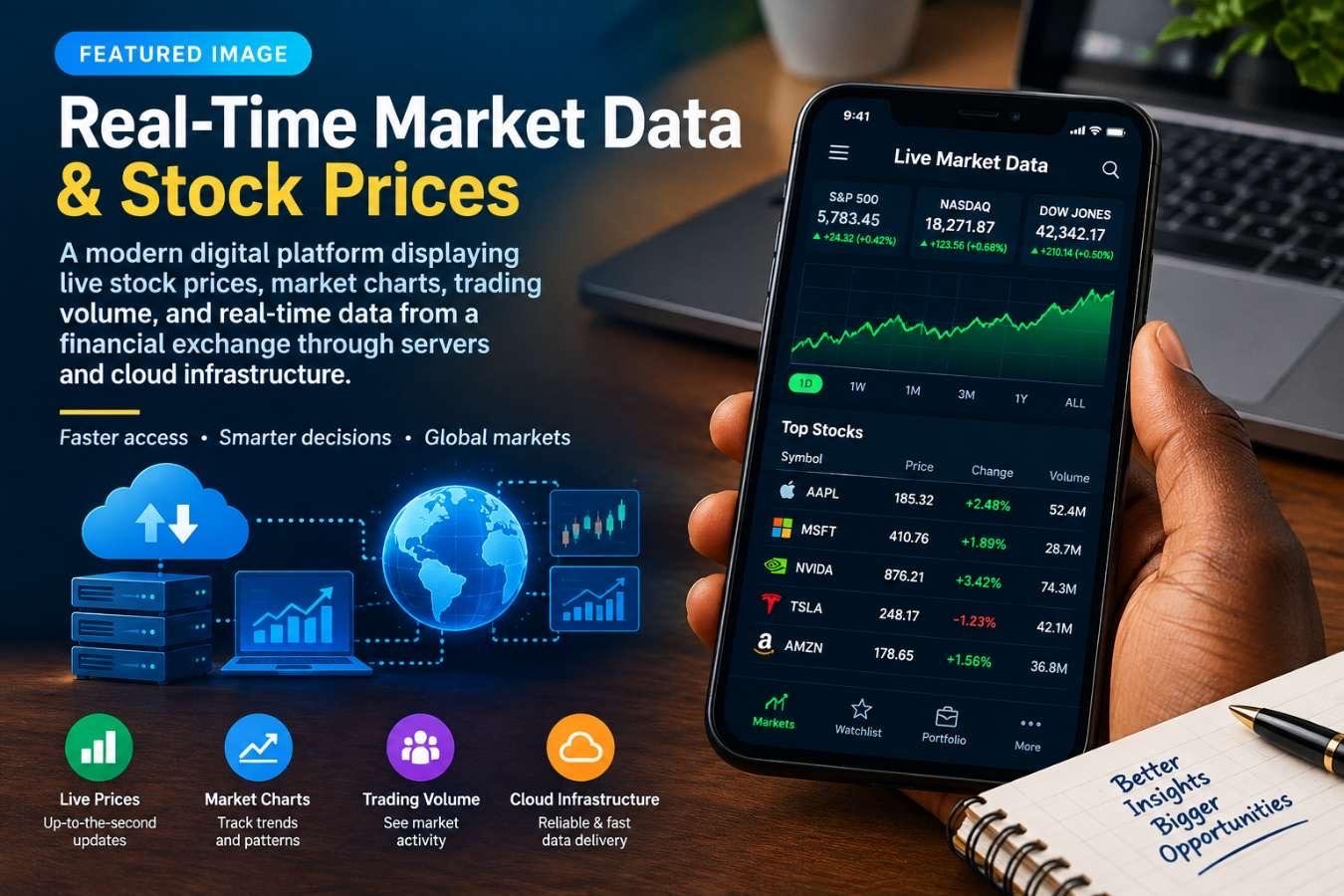
Today’s investors will experience real-time investment information whenever they trade, but this experience requires complex technology infrastructure to be put in place behind the scenes. A good example of how market information is put out is the financial platforms, available to readers who want to take advantage of information that is updated in real-time. The numbers on the brokerage app or financial site don’t originate from the app itself. These come from exchanges or other sources of market information, traverse a specialized system and are processed before being delivered to an investor’s device. The price, volume, bid, ask, depth, news and other information can be sent via different feeds. The goal is to gather, further refine, validate and share these shifting metrics as quickly as possible.
Categorizing Financial Data Related to Stocks.
Most real-time securities data begins at a securities exchange or trading venue where securities orders are matched. The venue logs the security, price, quantity and time of the transaction once a buyer and a seller agree to the deal. Exchanges also provide data on the interest in buying and selling various securities, such as bid and ask prices and, if available, several layers of the order book. This information is provided via “market data” feeds that are intended for delivery to financial institutions, brokers, data vendors and authorized users, and on a very short timeframe. The data from an exchange can be directly provided to a brokerage platform or provided by a third party vendor, or multiple sources. There are also market-specific reporting requirements, technical standards and licensing requirements that will impact how data is presented before it is displayed in the markets.
Market-Data Feeds and their Operation
A market-data feed is simply a continuously streaming stream of market-event data that is structured. A feed can send messages containing the new prices on a stock, an updated quote, an order-book update, or a correction message, rather than sending a complete webpage each time there is a price change on a stock. These messages are processed swiftly, as many messages can be generated in a market during busy times. A feed can include any information that can be useful for maintaining event order in receiving systems, such as timestamps, identifiers, prices, quantities and sequence information. Data vendors and brokers will typically have relationships with multiple feeds, to provide different markets and asset classes. They need to also be aware of missing messages, deal with duplicate messages, recover if the system crashes and maintain a consistent record just all the time.
From Feed to Screen
As soon as market information hits the brokerage or financial-data-provider servers, they work on it and do not let customers know what they’re seeing. These servers can validate incoming messages, translate identifiers, convert formats, and apply market rules, calculate derived values, and distribute results to various services. Order-book updates can generate a market-depth screen, and a trade message can be the next price next to a stock symbol. Servers also maintain information that is requested in quick memory, in order to be able to deliver it to the requesting party without having to load it again from the slower memory. There may be lots of users asking for the same information at the same time. An efficient server architecture can support a multitude of applications from one incoming stream without sacrificing accuracy, capacity or time delays between market events and viewing their results on an investor’s screen.
The Role of Data Servers
Data servers play a vital role between the outside world (the market) and the application investors’ use. They’re able to take in a lot of messages, structure them, and share the information with various parts of a monetary platform. Certain services might require the most recent quote, historical prices, order-book data or charting data. These services can be optimized to respond efficiently by utilizing fast memory, optimized databases, message-processing systems and load-balancing technologies. Redundancy is also significant since a failure of one server doesn’t necessarily disrupt the data service. In a larger financial platform, multiple stages of financial market information could be transmitted to various server groups, before being passed through to the customer interface. This multi-layered design enables platforms to marry the aspects of speed, scalability, and reliability.
How APIs Connect Data to Investment Apps.
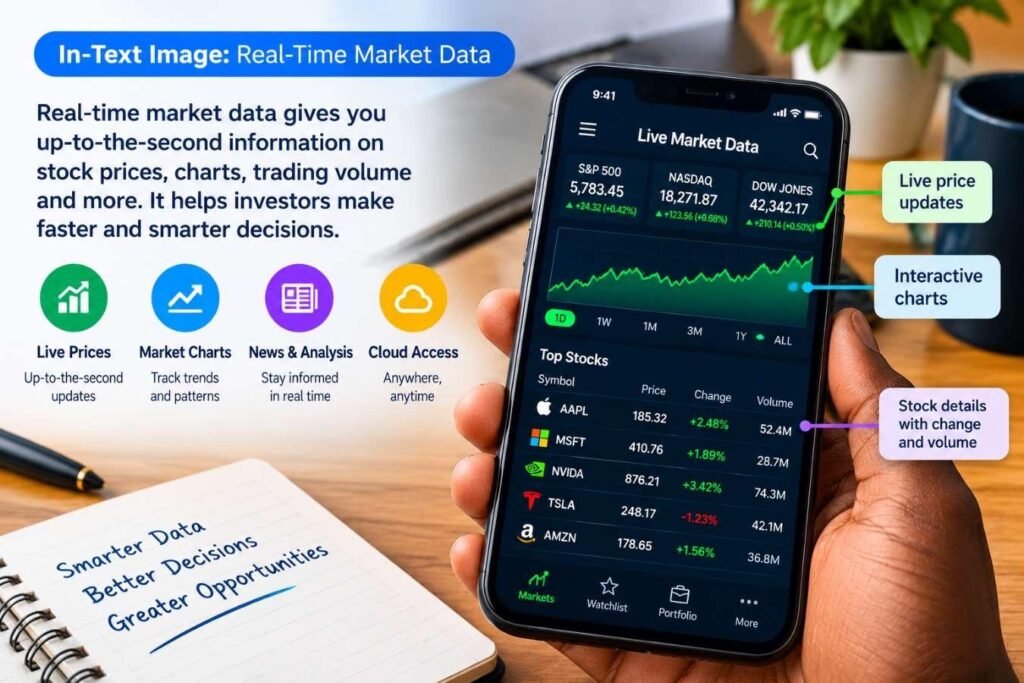
Real-time data delivery also comes with another layer, known as application programming interfaces (APIs). API enables two or more software systems to exchange data and information with each other under certain technical specifications. APIs are used for several applications such as brokerage, where one can get quotes and historical prices, company information, value of their portfolio, news, and more. Persistent connections, for example, WebSocket communications, may be used in some real time systems, allowing for the passing of updates to an application as they happen, instead of waiting for the same application to request them. This minimizes the network traffic and enables interfaces to quickly react to market changes. APIs also help to decouple the UI from the database. The investor is presented with a chart or quote screen and services are provided in the background, including authentication, data retrieval, calculations, and communication with market-data systems.
The Importance of Cloud Infrastructure
One of the ways to provide financial information at scale is using cloud infrastructure. Distributed computing, databases, storage, networking, and scaling tools can be used in place of serving only one physical server to handle the workload of financial technology companies. This architecture could help platforms manage the surge in demand, such as during busy periods of big announcements, or active trading. The processing of data may also take place in several geographic areas, in the event of regional distribution, minimizing the geographical distance between users and the servers on which the data is processed. Just because a data service is on top of cloud infrastructure doesn’t make it an instant service. Delay can be caused by network congestion, exchange processing, licensing, exchange application design, data-center location. The purpose is not to get a zero latency, but a good pipeline with low latency in both processing and transmission. This equilibrium is particularly crucial in case many investors are using the identical information.
Latency and the Race against Time
Latency in financial markets is the time lag between the occurrence of an event and its reporting to a system/user. Time lags can be significant if prices fluctuate quickly. A normal trip might consist of recording a transaction, sending a message, vendor or broker receiving the message, processing the message, sending it out to other internal servers, across the web, and finally to the investor’s device. There can be a delay in each stage. However, for professional trading companies, they might invest in specialized networks and close servers as their trading may rely on a quick response. It is not required for retail investors, but it provides them with an efficient system since quick information gives them a sense of responsiveness, such as charts, quotes, portfolio value, and alerts. A displayed price is not a real-time price, but is a price that is delivered quickly.
The Processing of Market Depth and Trading Volume
Investors watch only part of the information stock price. Volume of trading transactions reveals the number of shares and/or units traded over time and market depth can display a range of interest for buying and selling at various levels. The systems need to handle market messages and keep an up-to-date order book to produce such displays. Changes to the orders themselves (order modifications, execution and cancellation) may affect visible market depth. Those events need to be applied in the proper order and the proper way. It can then determine the quantities at every level, and publish them on a depth chart or order book. This is a challenge, especially for highly-traded stocks, because they must be updated regularly. The system needs to be more accurate and fast because if the state of the order book in the system is wrong, it will lead users to think that the situation in the system is different than it actually is.
News and Other Financial Data
The price information is often displayed in tandem with news, economic data, company news, calendars and financial data on investment platforms. These sources may not necessarily flow across the same pipeline as exchange quotes. Specialists can be the source of news, or corporate disclosures can come from regulatory filing systems or announcements. The government agencies or other official institutions can publish economic data. A financial platform serves as a hub of information that aggregates various streams, with varying formats, timeliness, licensing and update frequency. These inputs can be normalized by software services for the users. A breaking announcement could be associated with a firm and pop up next to its most recent price change. It integrates this data into the investment system making it easier for investors to correlate the market activity with information that could be the reason of, or context to, the market action without having to monitor a separate system.
How the Chart and Portfolio Values are updated.
The numbers shown on an investment application may take more work than merely copying over the current exchange rates. A charting service can be input with trades and quotes, be capable of grouping trades into intervals of time and compute opening, highest, lowest and closing values. It can also process indicators like moving average, or percentage change etc. Portfolio applications do calculations by taking the price and the holdings on an account. The platform can also multiply the stock prices by the number of shares and add them together to give the investor an estimate of the value of his or her stock portfolio if the investor has several stocks. It may be required to convert currency if the transaction involves different currencies. These calculations may be repeated if new information is received, as the prices vary. The processing of displayed portfolio values is efficient so as to not overload the system, but still keep the portfolio values current with available data. This illustrates that an even basic portfolio figure can rely on a number of continually recurring calculations.
Maintaining Data Quality, Security and Reliability
While speed is important, the reliability and data quality are also essential to the technology of finance that occurs in real-time. It’s better to be so fast at returning an incorrect price, than to be so slow at returning a correct price, but one which is disclosed. Market data systems, then, employ validation checks, sequence numbers, redundancy, and recovery procedures in order to determine if there are missing or abnormal messages in the stream. Financial systems may be vulnerable to unauthorized access, disruption, or manipulation and brokers and data providers require security controls. Infrastructure providing financial services is protected by authentication, encryption, network protection, access controls, logging, and monitoring. Capacity is also a key factor in exceptional activity. These systems need to be able to manage high surge volumes without any data inconsistencies. The simple quote from a phone is thus a significant technical facility, operational planning and ongoing monitoring. Reliability is especially significant since the investor may rely on information that he or she believes to be up-to-date and accurate.
Conclusion
While brokers’ platforms can seem like they’re instant, it should be understood that every number on the display screen has an origin, steps taken to process the information, and a time of display. Some services offer real-time data and others quoted may be historic depending on market or license. Different sorts of information can move at different speeds on a platform. The update cycle of news, fundamentals, charts, quotes and market-depth information can be different, therefore. Data can be delayed as it is transmitted through the Internet and then processed by the various devices in use. These restrictions aid the user in understanding the information which is being presented. What is important to note is the difference between a real-time feed, a delayed feed and information that is calculated or refreshed periodically from an underlying feed. It’s helpful to understand this difference when comparing facts on various financial sites, brokerage apps and market data services.
Get more well researched information about Real-time market data here.