Introduction
Stock exchanges are one of the most important elements of modern financial infrastructure, as they are responsible for making securities available for listing, placing orders, executing trades and disseminating information about the market. There are many layers of trading platforms, databases, communication systems, clearing mechanisms, settlement systems and data services behind the visible trading and buying and selling of stocks. However, these systems need to be available and accurate, or they can impact brokers, investors, listed companies, financial institutions and many others involved in the market. Cyber security is thus not just a matter of information technology for exchanges. It plays a crucial role in ensuring market reliability, the security of sensitive data, and the trust and confidence of financial transactions. Any exchange security system should be protecting against external attacks, internal risk factors and not interrupt legitimate trading.
Why Cybersecurity is Relevant for Stock Exchanges
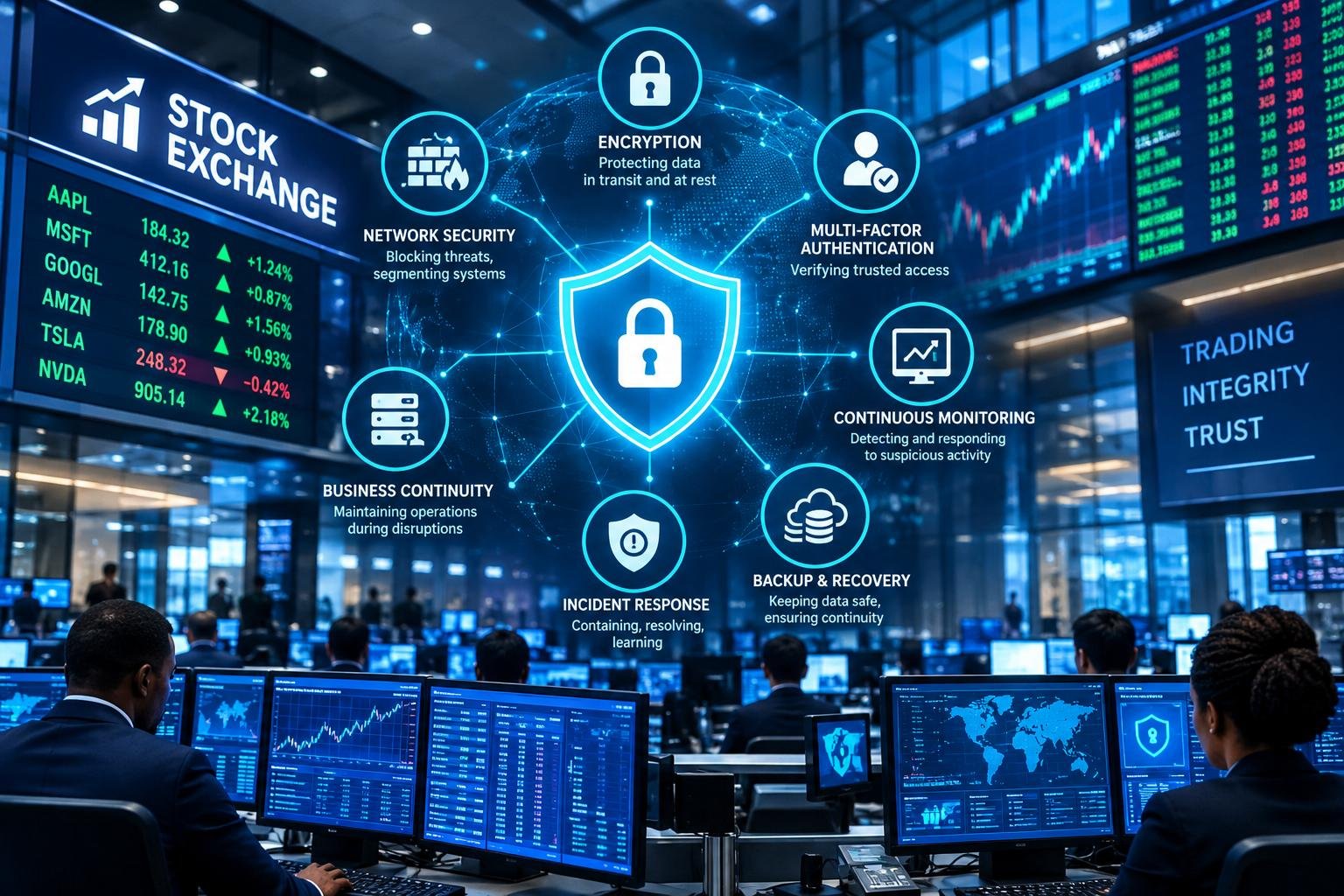
The value of financial-market infrastructure’s information to criminals and others is very high. Trading systems are the systems used to manage account information, transaction records, market information, authentication credentials, financial instructions and more sensitive information that could be exploited if accessed or altered improperly. As such, the security goal of confidentiality is important, and is considered along with integrity and availability. Confidentiality of systems prevents unauthorized disclosure and integrity prevents improper modification of orders, prices, records and other information. Availability makes sure that systems are available to authorized users when they need them. If an exchange is compromised, the hackers may be able to disrupt trading, cause the information to be misrepresented, compromise sensitive information, or cause a loss of confidence in the market. To that end, exchanges do not rely on any one security product but have layered security and technical controls.
Network Security and Segmentation
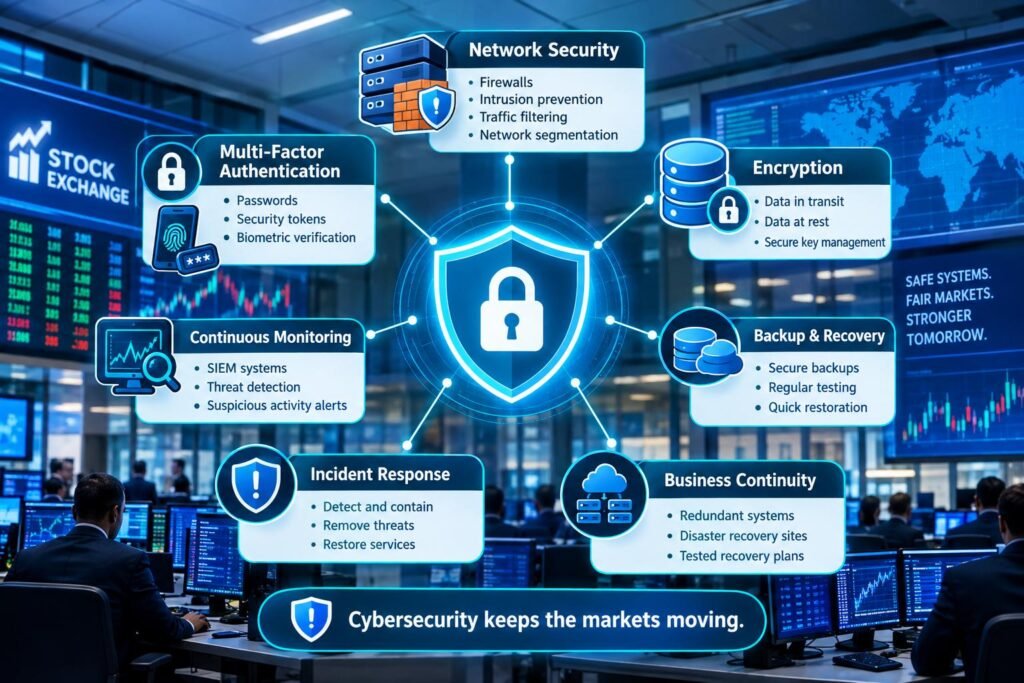
Network security is one of the initial defense levels in exchange infrastructure protection. Firewalls, intrusion prevention technologies, secure gateways; traffic filtering and other measures are all installed in financial-market organizations to control financial communications that flow in and out of sensitive areas. Network segmentation is especially important because it helps to prevent an attacker from spreading once one segment is compromised. By implementing trading systems, employee devices, databases, administrative tools and public facing services on different networks, an organization can isolate and control the communication between its critical environments. This approach minimizes unnecessary exposure and enables security teams to be able to narrow down that suspicious activity. Secure communication channels and well-managed relationships with brokers, data suppliers, clearing organizations, and other members of the exchanges can also be employed. The aim is to not just stop all communications, but to provide a controlled and monitored path for legitimate financial-market communication.
Protecting Critical Trading Environments
Trading systems need extra security, as they may have very stringent performance and availability requirements. Security controls, therefore, have to be designed in a manner that does not cause unnecessary delays, or lead to an unnecessary point of failure. Network configuration can keep unrelated services talking to each other, and access to critical areas can be limited to authorized systems and people. Development, test, admin and production can also be different environments, ensuring that changes to the code during the development process do not directly affect the live trading environment. An outdated software, unnecessary services, and improperly configured devices can provide opportunities for attackers, so this is another important control for secure configuration management. Frequent vulnerability assessments and security testing can help to uncover potential vulnerabilities before they can be exploited. All this forms several layers of defense around the markets processing systems.
Encryption and Security of Financial Data
Other key cybersecurity technologies are those employed to safeguard information processed by financial-market infrastructure, such as encryption. Encryption transforms readable information into a secure and protected form that will not be easily understood without the cryptographic key. It can be used in the development of information systems that move data between systems, as well as in securing sensitive information where it is stored in databases, servers, backups and other places. Encrypting data in transit helps to prevent unauthorized access to data, and encrypting data at rest helps to minimize the impact of unauthorized access to data. However, good encryption relies on good key management, as weak encryption keys can render a well secured system vulnerable. Financial organizations need to decide what information to encrypt, what information to secure with encryption, how to generate and store keys, and who to give access to the keys. These controls ensure the security of sensitive financial data and contribute to the overall goals of confidentiality and integrity of data.
Protect Authentication and Access to the System.
Strong authentication facilitates the protection of access to exchange infrastructure by restricting access to it to authorized people and systems. In more sensitive environments, traditional passwords might not be enough to protect credentials, especially if they can be compromised by phishing, malware or other attacks. Multi-factor authentication may involve a user supplying another form of identification, such as a security token, authentication application or biometric factor. Then, what an authenticated user can actually do is determined by access controls. However, this is significant as establishing identity does not imply entitlement to unrestricted access. Exchanges can implement role-based access controls, thus providing users, such as employees, administrators, developers, security personnel, and other users, with the access rights they need to perform their tasks. Privileged accounts are given special focus since they can grant a lot of control in a system. Additionally, organizations can periodically audit permissions, and revoke access when duties evolve or staffs leave the company.
The Principle of Least Privilege
In financial-market cyber security, the principle of least privilege is of utmost value. This would mean that only those permissions are given that are required for the users and systems to do their job. Administrative control of trading infrastructure should not be given to a member of the employee group who is responsible for reporting market information. Restricting permissions will minimize damage to systems if credentials are compromised or if someone accidentally makes a change. Approval processes for sensitive changes, separation of duties, privileged-access monitoring, and detailed audit logs are examples of other access controls that could be considered a strong access governance framework. These provisions establish accountability associated with key activities and facilitate the investigation of unusual behavior. Access controls can thus not only prevent unauthorized activity, but can also provide evidence that can assist security personnel in determining what occurred during an event. Just as financial systems are becoming increasingly interconnected, the need for careful control of who or what has access to critical systems is becoming an integral part of maintaining the operational trust.
Keep an Eye on Potential threats and Monitor them.
Despite the best of preventive controls, it is impossible for an organization to be guaranteed a cyber-incident never will occur. Therefore, it is necessary to keep a close watch on those who are acting suspiciously as soon as possible. Security teams are able to gather and analyze data from infrastructure, network devices, servers, applications, authentication systems, databases and more. Security information and event management technologies can help consolidate these records and enable analysts to see strange patterns. This can be such as multiple unsuccessful logins, access to sensitive systems that shouldn’t be accessed, unusual network traffic, changes to the configuration that are not authorized, or activity at unusual times. Automated detection technologies can be used to prioritize threats and human analysts can be engaged as necessary to investigate events that need more context. Monitoring can also be helpful with detecting insider threats and compromised accounts. The aim is to detect it early, so that security groups will be able to stop it before it becomes a bigger operational issue.
Ensuring a Redundant and Resilient System
Another aspect of cyber security for exchanges is making sure that the systems remain functional if any element of the system fails. Redundancy provides other parts of systems or other systems that could be used if the first system is unavailable. This may consist of duplicated servers, network connections, storage systems, power supplies, data centers and communication links. High-availability architectures can enable workload to failover to another component to lower the workload’s dependency on a single system. Another layer of protection can be geographic redundancy that is, locating critical infrastructure at different physical sites. That’s important because outages may be caused by a cyberattack, hardware failure, software issues, power outages, telecommunications issues, or physical incident. Resilience is therefore related to the wider concept of operational risk management, which also links with cyber security. A secure exchange should not only be protected against attacks where appropriate, but also should maintain critical services should there be any system failures.
Utilize Backup and Recovery Systems.
Another key aspect of preventing data loss or loss of system and ransomware and other disruptive events is backups. Important information can be duplicated to different stages of storage to be recovered in case the primary systems are damaged or unavailable. But it doesn’t guarantee effective recovery to have only backups. Backups need to be secure against any changes that are made by the unauthorized user and need to be tested on a regular basis to make sure they can be restored. There may be more than one copy, and they can be stored in various ways and places, so that if one incident causes the loss of both copies and the operational data, there are still other copies available. Procedure should also include identification of the priority of restoring systems and dependency issues among systems. Frequent recovery exercises can identify recovery process gaps before an actual event. Reliable backups can thus serve as a tool to aid in financial-market infrastructure cybersecurity and operational continuity.
Incident Response & Cyberattack Management
Exchanges require a well-defined incident-response process when there is confirmed suspicious activity. The usual process of incident response is to determine what type of incident it is and how far is its reach, contain affected systems, remove the threat, restore services and post incident review. Responses can include security teams, information technology teams, legal personnel, senior management, communications teams and outside agencies (where appropriate). Clear responsibilities are important as there is a risk of delay of containment and recovery in case of confusion during an incident. Organizations can have pre-established procedures for various situations, e.g., credential compromise, malware, unauthorized access, denial of service attacks, or data breach. Another important part relates to communication – currently there may be a need for relevant stakeholders to be informed of service interruptions and recovery efforts in a timely manner. Following an incident, organizations can analyze logs, and other evidence, to find out how the attack was made and how to improve. A successful incident response will therefore shift the nature of cybersecurity from simply preventing an incident from occurring to being a practice of preparing, responding and learning.
Business Continuity & Disaster Recovery
Business continuity planning (BCP) is a strategy that helps ensure that important financial services continue functioning during critical events. Business continuity is concerned with how critical business operations can continue in various scenarios and situations, whereas cybersecurity mainly is about preventing and countering malicious operations. Alternate processing systems, alternate communication systems, preplanned recovery plans and staffing arrangements to ensure critical functions are maintained are part of disaster recovery arrangements. Exchanges and other market institutions can set up recovery goals that establish the pace of recovery of critical systems, and acceptable data loss under specific conditions. The plans need to be tested regularly as an untested plan could fail at the time when it is most needed. These exercises can reveal gaps in technological, staffing, communication and decision-making. Business continuity also adds to the resilience because, if a major disruption does occur, it isn’t necessarily a prolonged period where the market ceases to function.
The Human Element in Exchange Cybersecurity
Financial-market infrastructure can’t be fully protected through technology. Every employee, contractor, administrator, developer and other authorized user who accesses systems on a regular basis can potentially make accidental mistakes and/or use them for their own purposes. Training on security awareness can assist staff to identify phishing emails, suspicious attachments, social-engineering attacks and more. The organizations can also set processes to report on anything unusual and how to deal with sensitive information. Examples of insider-risk controls include monitoring of privileged activities, separation of duties, processes that are run in the background as appropriate and timely removal of access. Meanwhile, security measures must be implemented in a way that is easily followed by workers. An elaborate control, which most users will easily avoid, might offer less security than a simple control, which is consistently adhered to.
Conclusion
Stock exchange cybersecurity requires several layers to safeguard the availability, integrity and confidentiality of the financial-market infrastructure. Network segmentation and security measures limit access to the network, and encryption keeps sensitive data safe while it is at rest or in transit. Continuous monitoring detects suspicious activity, and strong authentication and least-privilege access controls restrict users’ access to critical systems. When failures or attacks happen, redundant infrastructure, secure backup, incident-response plans, and business-continuity plans offer further protection. There is no single technology to fully eradicate all risks in the cyber world, especially in the face of the ever-changing nature of the threats and the growing interconnectedness of financial systems. Layered security with regular testing/monitoring, employee awareness and improvements is therefore the better way to go. Technical defenses, operational controls and recovery options can work together as a team to bolster the capacity of financial-market organizations to maintain the continuity of the trading services they provide, while safeguarding the information and transactions they handle.
Get more well researched information about Stock Exchange Cybersecurity here.