
Memory management is one the most basic functions of a programming language and its runtime system. Whenever a program creates a variable, calls a function, constructs an object, opens a data structure, or temporarily stores a calculation, it requires memory to store the information related to that. While often programming is as simple as using variables and objects, the computer continuously needs to determine where and how long to store these values, and what actions to take when they are no longer required.
When discussing memory management, a number of things may become obvious: some programs consume a lot of RAM for their operation, some grow slower over time, and bugs in memory management can lead to crashes, unhandled exceptions or security issues. Allocation and deallocation of memory also vary greatly between programming languages, so it is also worth studying if you are learning software development.
What is Memory Management in Programming?
Memory Management: The processes of assigning, structuring, accessing and releasing the memory space needed to run a program. Each application that runs is assigned a virtual address space that it uses for instructions and data by the operating system. Then, the programming language, compiler, run-time and operating system cooperate to build a picture of how information will be stored when the program is running. Some values have predictable lifetimes and can be efficiently allocated on the stack; other values must be kept alive for an undetermined amount of time and are typically allocated in dynamically managed memory, known as the heap. Memory management is far from just assigning some place to a variable. It also includes monitoring of ownership, object lifetime management, invalid access prevention, memory reclaim and efficient resource utilization to ensure that an application is responsive and reliable.
Memory management can be understood as a workspace used for temporary storage when we consider a program as a temporary workspace. The program could require space for function calls, local variables, objects, collection, strings, buffers, and more information at any time. Some of that information may be lost immediately after a function completes, and other information may have to last for minutes, or even for the entire duration of the application’s life cycle. Efficient memory management means that the data that is stored for a short period of time does not have to take up any space, and the data that will be stored for a long time will be stored for as long as it is necessary. The memory-management issues that may result from poor memory management range from memory leaks to dangling references, invalid memory access, too much memory allocation, fragmentation, and garbage collection. These can impact on the speed and stability of the application, particularly where the application has to process large data volumes, serve many users or is running continuously.
Stack Memory and How to Allocate Memory to the Stack.
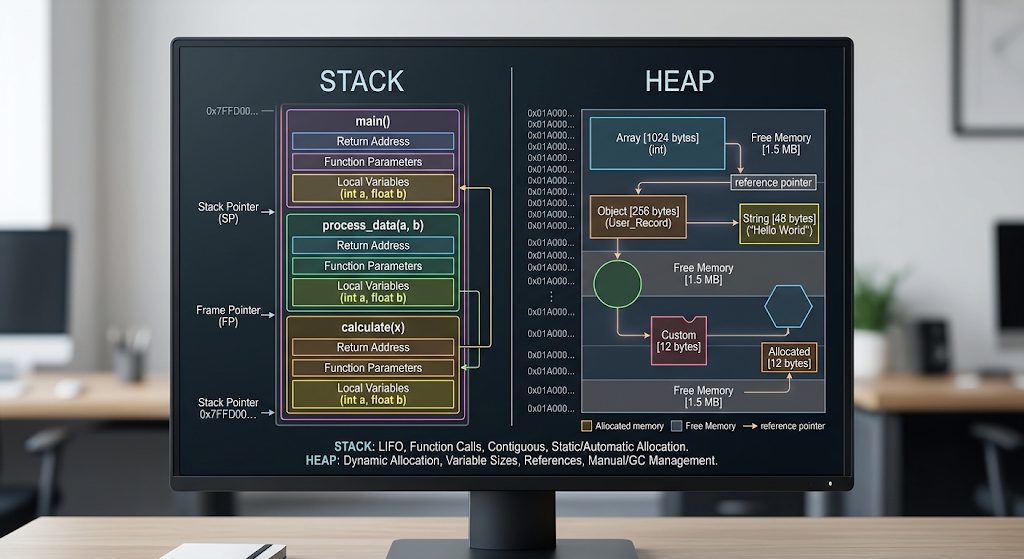
A stack is a portion of memory that is typically used to store relatively short-lived data and function calls. A program might create a stack frame when it calls a function, including any local variables, function parameters, return information, etc., and also any other information about the execution of the function. The stack frame for the function may often be cleaned up automatically when the function returns since the program no longer needs the data it accesses during that function call. This LIFO behavior is predictable and stack allocation is very efficient. A function which calls other functions adds another frame on top of the current one, and on returning from the new function the new frame is removed, and the caller resumes execution after the removal. The actual implementation may differ between languages and compilers, but this principle is still helpful to grasp the organization of temporary execution data.
With stack memory, data is allocated and freed as the function call is made and returned, respectively.Stack memory is especially appropriate for data whose existence is closely tied to a function call. A local variable might not need to outlast the function in which it is defined, for instance. Normally, the system doesn’t have to run a scan through memory looking for local values to extract, as stack allocation and deallocation happens in a predictable way. This simplicity helps to speed up function calls and local-variable management. However, the stack memory is typically small compared to the amount of memory available for an application, and too many recursive calls can use up an application’s stack space. If a program continues to call functions without ever returning, it may eventually result in a stack overflow. This is a good example of a memory-managing principle: although memory management is done automatically, it still has practical limits, and programmers must understand the lifetime and size of data that their program creates.

Heap Memory and Dynamic Allocation.
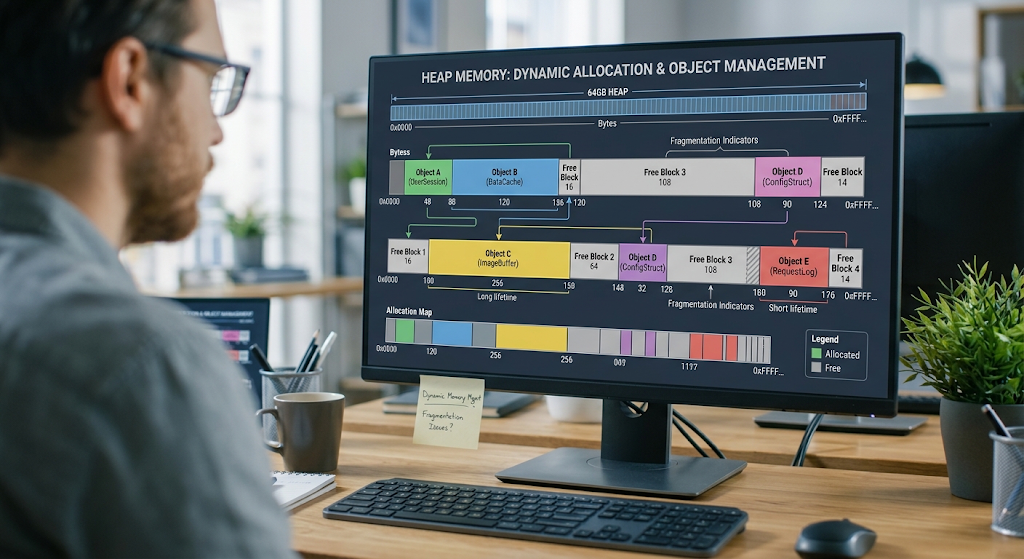
Typically, it is used to store dynamically allocated data that has an unknown size and/or lifetime that is not easily associated with a particular function call. The runtime or memory allocator may store an object, collection, dynamically sized structure or other data that live after a certain stack frame in heap memory. The heap allocation does not have a LIFO structure like the stack. A program may have one object, and then create several more objects, and release some of them without releasing other objects. This flexibility is crucial for complex applications, but brings its own challenges in memory management, as the system must decide when dynamically allocated memory can be safely reused.
If the application size of data to be processed is variable and unpredictable, heap allocation can offer needed flexibility, but it can also cause extra overhead. Many small objects allocated and deallocated can be more expensive than simple local values, and lots of small allocations could cause memory fragmentation or runtime overhead depending on the language and memory-management system. However, sophisticated allocation strategies are used by modern runtimes to minimize these costs, and certain languages feature performance-oriented data structures and allocation methods for high-performance applications. So, programmers should know the difference between behaviour on the stack and on the heap even if the language does not expose it. For example, if an operation creates dynamic objects, this information can be useful if some memory is consumed and/or performance changes are observed.
Pointers and References
Pointers and references give a way to deal with data without always having to make copies of it. A pointer usually points to another piece of data or a memory address from which another piece of data can be retrieved. Programming languages like C and C++ allow the direct manipulation of pointers, in some cases, pointer arithmetic, and explicit control over dynamically allocated memory. A more abstract way of dealing with this is by using references, which can be higher-level objects that point to another without revealing many of the address-management details. These have different meanings and limitations in different programming languages, hence the distinction between a pointer and a reference must be interpreted in the context of the specific language.
Indirect access is very effective since programs can work well with large structures and common data. A program can pass a reference to the same object whenever it is passed from one component to another. But this also brings up issues of memory management. If an invalid pointer is used, it may point to a memory space that has already been freed, creating a dangling pointer for manually managed languages. Dereference of an invalid pointer may lead to run-time errors and/or undefined behavior. Generally, references in a managed language offer more safety, but they can also impact object lifetimes, since objects that are reachable via a reference will continue to use memory. Therefore, it is crucial to understand how the references relate to each other in order to understand automatic memory management and garbage collection.
Manual Memory Management
Manual memory management has a lot of burden on the programmer to allocate and deallocate memory that is dynamically used. Programmers can also request memory dynamically and later free it when it is no longer required with the help of mechanisms offered by the languages such as C. This can be very useful in systems programming, embedded systems, operating systems, games, and other performance critical environments and provides a lot of control over memory usage. The programmer may make conscious choices on when memory should be allocated and released, thereby minimizing the time requirement for more automated methods. There is, however, a lot of responsibility involved with that control – each allocation must be handled properly and the program should not free memory as another part of the application is still using it.
Manual memory management can yield a number of challenging classes of bugs. A memory leak is when a program allocates memory and then forgets how to free up or reuse it and continues to use it, thereby wasting space. Use after free error is the case when software still accesses the memory after it’s been freed and double free error is when the same memory is freed twice. Another source of errors is Buffer errors when a program attempts to write to memory beyond the allocated space in a data structure. The issues that arise from these can cause crashes, data corruption, vulnerability, or unpredictable application behavior. Consequently, using manual memory management mandates proper ownership rules, strict programming habits, testing and sometimes specialized debugging tools.
Automatic Memory Management
Automatic memory management allocates most of memory-management and memory-recovery to the language runtime or memory-management system, rather than to programmers. The runtime can track objects that are still reachable and reclaim memory when necessary without having to explicitly release every dynamically allocated object. The language/implementation of this model includes Java, C, JavaScript, Python, Ruby and others, but with varying rules and implementations. In .NET, automatic memory management refers to how the runtime keeps track of the “disposal of memory,” as it is explained in Microsoft’s documentation.A run-time system that manages dynamically allocated objects by using a garbage collector, as in the NET platform. This can greatly minimize frequent memory management mistakes as a programmer doesn’t have to calculate exactly when each object is safe to be destroyed.
Automatic memory management does not imply that programmers should not pay any attention to memory. Applications can still use too much memory if they keep objects in their memory which are no longer needed, if they generate many temporary objects in memory, if they retain collections that grow continuously, or if they hold references for a longer period than necessary. The garbage collector can recover objects that are truly unreachable, but it is not able to decide that an object is conceptually unnecessary, when there is still a program-defined reference to it. The garbage collector may be functioning normally, and yet objects being stored in a cache continuously without a proper eviction policy may use up a lot of memory. Developers must therefore be familiar with the concepts of object lifetimes, object references, patterns of object allocation and resource management in automatically managed languages.
How Garbage-collection Works.
Garbage collection is a method for automatically recognising memory used by objects that cannot be reached by the program at a particular time and recovering it for later use. The typical garbage collector starts by making a list of references called roots. The roots may be one of active local variables, execution context, static references and other runtime-managed references, depending on the language and implementation. The collector traces back from those roots to find out what is still accessible. Objects not accessible via the appropriate reference relationships are deemed reclaimable. While there are many different algorithms in various runtimes, the common theme is to distinguish objects that are still potentially usable from objects that are no longer accessible by the running program.
The new garbage collectors have various techniques like tracing, generational collection, compaction, etc. or a mixture of these techniques. The observation that many objects become unreachable relatively soon after they are created and other objects survive for much longer is the basis for generational collectors. The runtime can thus assign objects to generations and garbage collect newer ones more often than long lived ones. Compaction might also help to minimize fragmentation by bringing the remaining objects together and increasing the amount of memory available. These operations can help in allocating efficiency, but garbage collection takes processing time. For some runtimes and applications, collection activity may sometimes demand more CPU resources than application execution, so allocating behavior is significant when it comes to the performance of the software.

Garbage Collection & Application Performance.
While garbage collection can make development easier, it isn’t without cost. If there are a lot of temporary objects created by a program, the run-time system might have to run the collection more often. A program that allocates and discards objects continually can thus create more memory-management jobs. A large object may also need special treatment depending on the run-time. Garbage collection itself does not necessarily account for performance issues — it could be due to poor algorithms, overly large data structures, too much caching, or bad object-lifetime decisions. When troubleshooting performance problems related to memory, profiling is important because memory assumptions can be incorrect of what the application is doing.
With managed development, developers can optimize memory management by avoiding unnecessary allocations, using reusable objects and buffers where appropriate, limiting the lifetime of large data structures, and choosing efficient collections to fit the workload. Meanwhile, optimization should be done on the basis of measurement and not guesswork. When done correctly, the profiling process can help a programmer determine that, when he or she is investigating memory usage problems, it is not the component he or she is trying to optimize that is using up the bulk of memory. Patterns can be found with the help of memory profilers, runtime diagnostics, allocation tracking and performance monitoring tools. The aim isn’t just to reduce the number of objects produced, but to produce and retain objects in a manner appropriate to the true needs of the application.
Memory Leaks in Managed and Unmanaged Languages
Memory leaks can happen in both manually managed and automatically managed programming environments, but may be different. A leak typically occurs in a manually managed language when the program does not free memory that it has allocated dynamically. If objects are still reachable, even if the program is no longer using them, a garbage-collected language can still have what is often called a logical memory leak. Typically, these are growing collections, incorrectly managed caches, subscription of events keeping objects alive, static references, and long-lived objects holding references to large structures. The design faults with regard to object retention are not guaranteed to be fixed automatically by the garbage collector because the rules of the runtime determine whether memory is reachable or not.
Leaks are especially dangerous in applications that are expected to run for a long period of time like web servers, background services, desktop programs and database systems. As usage grows increasingly persistent, the application can eventually find itself in a situation of intense paging, slow performance, allocation failure, or OS or runtime termination. Trending memory consumption over time may provide some insight into these trends. It can be a temporary increase in memory, but it is not necessarily a leak as apps can allocate memory for normal working loads and then reuse it. The crucial issue is whether memory is stored forever if it is no longer necessary for logical purposes. Developers can explore this through object graphs, allocation histories, heap snapshots, and through relationships of long-lived objects and the data they access.
Events that Impact Memory Safety and Reliability
Memory management is directly related to software reliability and software security. A program can access memory incorrectly, leading to corrupted data, program failure or vulnerabilities that may be exploited by attackers. Since memory safety is a stronger requirement than it seems, a language with a better memory safety property tries to prevent memory safety errors at runtime by using any of the following methods: runtime checks, systems based on ownership, systems based on borrowing, or systems based on managed references. Others offer more low-level control, and will impose stricter rules to prevent invalid access. Both of those approaches don’t remove the need for careful software engineering, however, as memory safety is just one aspect of application reliability. There are some practices which remain important from the data handling, input validation, concurrency control, error catching and secure resource use point of view irrespective of the language being used.
The concept of memory safety can also guide the selection of appropriate tools and techniques in various projects. For a high-level business application being developed by a developer, a managed runtime may be helpful, as it will manage a lot of the memory lifecycle. There may be times when someone wants to allocate and layout memory more directly in the construction of a low-level operating system component. Modern languages are trying to merge performance with safety and offer better compile-time guarantees, or safer abstractions over low-level operations. The important point to be made is that memory management isn’t just some implementation detail below the programming language. It is a factor in development of data structures, object life time management, identification of data performance issues and software reliability.
Stack vs Heap: What’s the Difference?
The stack and the heap have different uses and understanding their differences is a good starting point to understanding memory management. Function execution and data with a predictable scope of lifetime are typically linked with stack allocation, which is also easy and quick to manage. Heap allocation is intended for data that is created dynamically, which may be needed for a longer time than a single function call, or whose size is not so easy to determine in advance. As in most other architectures, stack memory is typically handled by the operation of a stack pointer and the addition and removal of stack frames, and heap memory needs a more dynamic allocation method. The difference exists conceptually as well as practically: the behaviour can vary depending on the language, the compiler, the runtime and the optimizations made.
Remember also that the term “stack versus heap” is not a general guideline for all variables in all compilers. There are ways of optimizing values that would change the model into something less precise and other languages might use different strategies for allocation or representations at runtime. A variable can be used to represent an object that is not stored in that variable itself, but rather, a reference to that object is stored in the variable. Other values that can be optimized into registers or even removed can also be optimized when the compiler finds it is not necessary to create them in memory. The stack-and-heap model should thus be considered as a convenient mental model of normal runtimes, and not as a complete definition of all instructions running in all programs.
Importance of Memory Management for Developers
Memory management is important because all applications run in a limited amount of computation resources. The more efficient use of memory allows a program to process workload more reliably, respond faster, and provide more users without the excess use of hardware resources. The opposite can be true when an application’s memory usage is inefficient, such as allocating large amounts of data, storing objects that are not needed, or allocating and cleaning up expensive objects multiple times. Knowing about memory is also useful to developers for interpreting run-time errors and measurements of performance. If a program runs into an out-of-memory situation, such as, knowing where objects are being allocated and retained and then using that knowledge to investigate the problem is much easier than assuming that memory is an invisible resource.
The subject is also more significant with the growing complexity of software. In many modern applications, databases, APIs, caches, background tasks, user interface, networking elements and large amounts of data are all used together. Each component can produce objects and that can be a reference that affects memory usage in the entire system. Understanding memory lifetimes can help developers to understand when to create data, when to keep it in memory, and when to free resources. These skills are useful regardless of the memory management strategy employed by the language (manual allocation, garbage collection, reference counting, etc.). The same question is asked: What data is the program going to need, where is the data going to be stored, and how long should the data be available for?
Conclusion
Memory Management is the basic concept of the storage and retrieval of information by the Programs during its running. Stack memory is used for the storage of data used for function calls and predictable lifetimes and it is an efficient memory block; heap memory is used for the storage of data whose size and lifetime is more flexible. While pointers and references provide an alternative way to access data, they also have significant concerns relating to ownership, reachability, and object life. Manual memory management gives fine-grained control, but forces programmers to deallocate memory appropriately and prevents memory leaks and other memory management errors. Many of these risks are mitigated with automatic approaches, where the runtime takes care of object lifetimes, and garbage collection detects unreachable objects and frees their memory.
These principles enable programmers to have a better understanding of what’s going on when they use variables, objects, and data structures. It also highlights why apps might become memory leaky, allocate too much memory, slow down and crash without any obvious reason, even if the source code is very simple. Developers are not required to be experts in the implementation of each runtime; but they should understand the relationship between allocation, references, object lifetime and reclamation. This basic knowledge helps programmers select the right data structures, identify memory issues, create better and more dependable programs, and make the best performance decisions as their code grows more complex and larger.