Introduction
The world of Forex trading has come a long way from simple human trading methods and are now increasingly shifting towards automated systems that can process market data and carry out trades based on that information. It is the practice of using forex trading bots, for instance, which are software programmes that execute the trading strategies in a predetermined method without the need to count on a trader to make all of the trades. Robo trading systems can track currency prices, analyze technical indicators, determine the conditions as programmed, and execute trades via a web-connected trading platform. A trading bot, however, isn’t just a piece of software that promotes itself as a profitable trading device that can identify the markets without your aid. It’s a program that takes instructions and how those instructions are executed, the information that it has access to, the trading situation it finds itself in, and the controls placed over it will all affect its performance.
What Is a Forex Trading Bot?
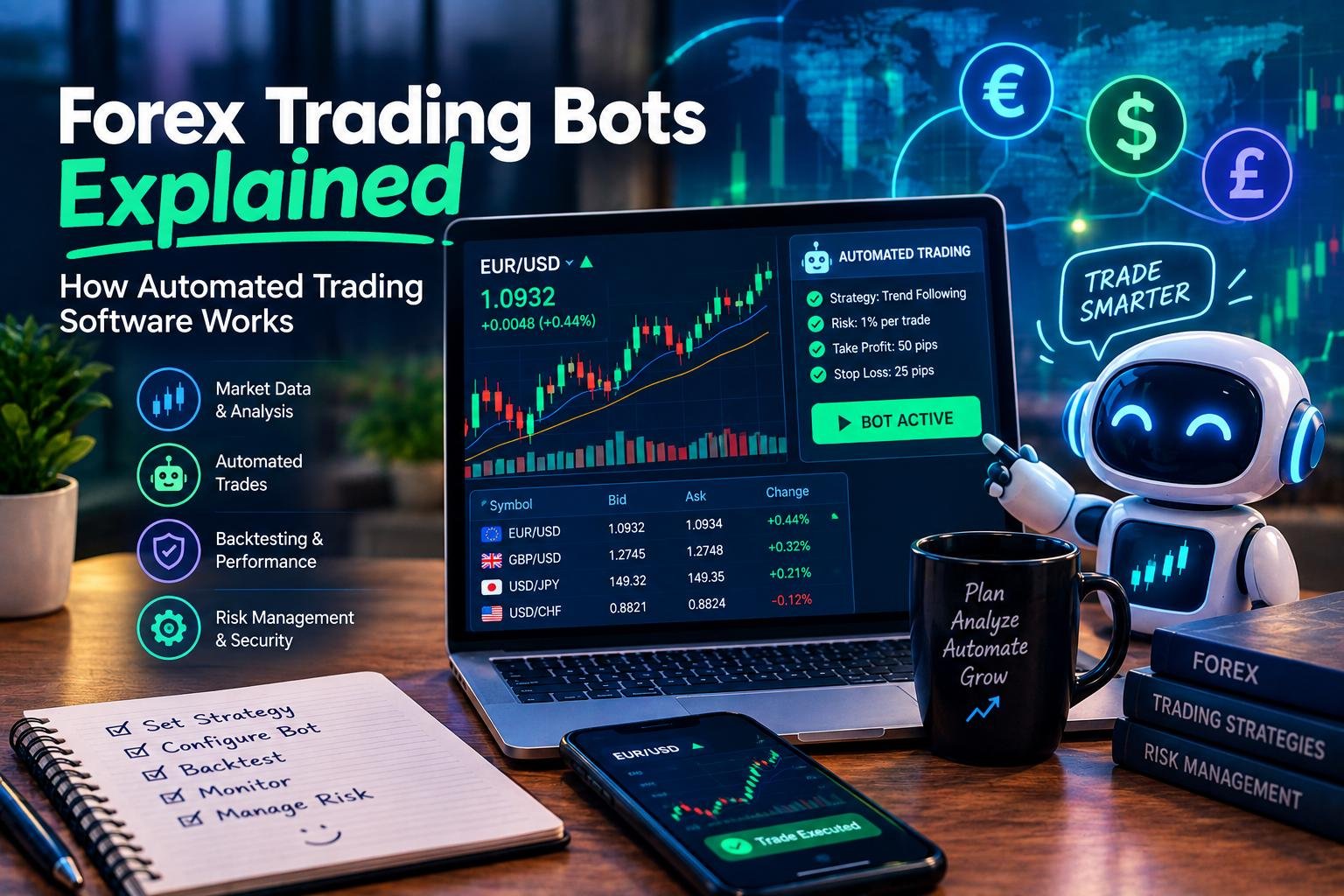
A Forex trading robot is software that is all set to carry out a portion of the Forex trading process or all of it. A chart watcher can omit the step of making a decision about when to buy or sell based on the chart, and let software do the work for him instead. For instance, a simple bot might be set up to look for a moving average crossover, triggering a buy or sell signal based on the cross of two moving averages. Other, more complex systems might use more than one of these measures, along with price trends, volatility, time parameters, and risk-management criteria, to help determine if a trade should be taken. What’s important for the novice is that the bot will not automatically know what to do next. It is able to manipulate the information it has available and execute actions based on information it has been programmed to act on.
How Automated Forex Trading Works
Connect the Bot to a Trading Platform.
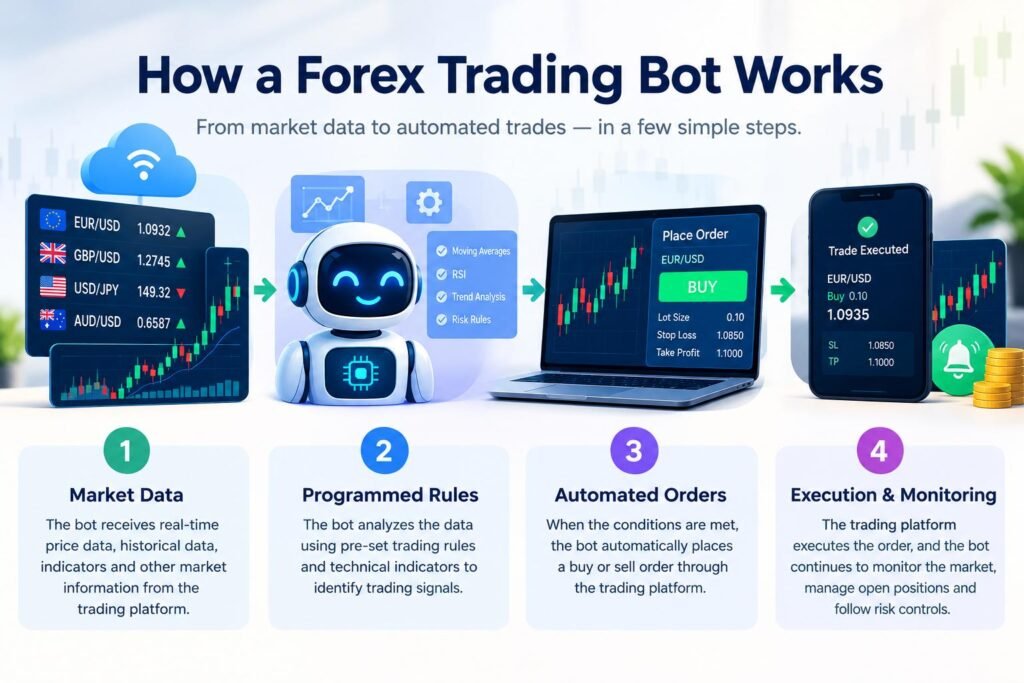
Before a trading bot can keep track of prices, or execute trades, it must have access to a trading environment. This connection can be made via the broker’s application programming interface, an integrated trading platform or any other connection supported by the software. The platform offers details like current rates, instruments offered, account balances, open positions and the status of orders. If the situation identified by the bot is similar to the strategy, the bot can transmit an instruction over the connection to ask for an order. The broker/trading platform is then responsible for actually executing it, based on the market conditions. This implies that the bot is different from the broker. The bot is programmed with a trading strategy, and its strategy tells it which action to take; the trading infrastructure connected to the bot processes the trading instruction.
Reads and Receives Market Data.
One of the most crucial inputs that the automated trading system requires is the market data. A bot can be programmed to get the latest bid/ask prices, historical price data, trading volume (if it is available), spreads, timestamps and other metrics provided by the trading system. It can then convert this information into signals that the strategy can comprehend. For instance, a new price will be averaged over a series of prices, or a period of prices will be used to calculate the volatility. There are some bots that base their operation on relatively simple data input while others process several indicators at the same time. Data connection speed and reliability can also be important as when the data takes longer, or the data is not complete, a bot could end up responding in the market with condition that has already shifted.
Apply the Programmed Trading Rules.
Once the bot gets the market information, it will then analyze the information against the conditions programmed into the strategy. These conditions may be rather simple or complex. A no-nonsense approach could be to make use of a system that says “when the shorter term moving average crosses the longer term moving average, then it is time to trade. An enhanced strategy may necessitate a specific direction of the trend, a certain range of volatility, a specific trading session, a specific level of spread, and confirmation by several indicators before an order could be made eligible. These conditions are not necessarily the same as a human trader would see on a chart. Rather, it checks out numerical rules and logical instructions. Based on the given conditions, the software goes to the next step of the process. If they are not happy, it will keep watching the market until they get back to a set of conditions.
Submitting Orders Automatically
If the strategy triggers a trading signal, the bot is able to make a trading decision and can place the order without having to wait for the trader to click a button. They might indicate the currency pair, positioning, trade size, entry triggers, stop loss, take profit and more parameters for the orders that are supported by the platform. After the order is placed, it’s the trading system that processes it and it can be executed at a price that isn’t the same as the price it saw. This can be due to the continual movement of the currency market, the spread, liquidity, execution speed and market conditions. The advantages of automation are thus that it eliminates the need for manual order entry, but does not make the realities of market execution any less. While a bot is able to make quick decisions, it cannot make the market offer a specific price, nor can it guarantee that an order will be executed as intended.
Types of Forex Trading Bots
Forex trading bots can be classified based on their strategies and techniques. Trend-following bots look for trends in the price action and make trades based on specific trend rules. Range-trading bots are automated trading software that is employed in situations where there is a repetition of price action between two known supports and resistances. Other bots might target breakouts, momentum, news situations or statistical connections between various instruments. There are also systems that utilize several strategies and change between these based on market conditions. A bot’s technology is no guarantee of a successful underlying strategy. Even a very sophisticated program can fail to generate a good result, when the assumptions used in the program’s strategy are not applicable to the market. Therefore, it is crucial for novices to grasp the strategy for trading with a bot rather than relying on its looks, sophistication, or promises.
Setting up a Forex Trading Bot
Typically, traders will set up parameters for a bot to define its operation before it can be used. The settings can involve currency pairs, trading hours, position sizing, simultaneous trading numbers, indicator periods, trading conditions, stop loss distances, take profit distances, risk limits and more. There are some systems that will also enable users to set the amount of account capital that can be applied to a specific trade or what the bot should do when it loses a series of trades. The value of configuration lies in the fact that a change in one may substantially affect the behavior of a strategy. The frequency of the trading bot’s actions can lead to completely different results compared to the same strategy that only trades during specific market hours. It’s important for beginners to know all the essential settings before letting an automated system run.
The Importance of Backtesting
Testing a Strategy with Past Data
Backtesting enables traders to see how an automated trading strategy would have performed in the past based on market data. The software conducts a backtest, which means it executes the strategy using historical price data and keeps track of potential trades as they would happen based on the strategy. The resulting information may contain the trading volume, winning and losing opportunities, drawdowns, average profit and other metrics. Backtesting may be useful to uncover programming errors and to see how a strategy performs under varying historical conditions. But, past performance does not guarantee future performance. The market environment evolves and a strategy that has worked well in one context will act in a different way in another context such as when the volatility, liquidity, trends or other conditions have shifted. Back testing should thus be seen as a testing and research product and not as a predictor of future performance.
Avoiding Over-Optimized Strategies
Over-optimization or curve fitting is one of the widely used issues in automated trading. When a strategy is modified over and over again to yield spectacular returns on a specific set of past data, but not so much on new data. A trader might try and tweak the indicators until the bot mimics past price movements nearly perfectly, for instance. The backtest may appear to be a nice one but those are just historical numbers and not necessarily a long-term market relationship. A more robust testing process can involve different periods for developing and evaluating the strategy, and for testing in various market conditions. Traders can also test the software with data that the software was not specifically trained on by using forward testing or paper trading. These methods can’t remove the uncertainty, but they can give a more realistic picture of the response of a strategy when it is tested beyond its testing environment.
Monitoring an Automated Trading Bot
Simply turning on an automatic trading system and letting it run is not the definition of automation. The bot may have some technical issues, lose connection with a trading platform, get unexpected data or act differently from what the trader wants because of a programming error. The assumptions used to create a strategy may also change as a result of market conditions. Monitoring is still a crucial element of automated trading, however. Traders should review open positions, account exposure, execution reports, system logs, internet/server connection, and if the bot is running in the predefined limits or not. Some systems will be able to send alerts when trades are opened, when losses are met, or when technical issues arise. When the software is faced with situations not covered in the software development or testing process, human supervision can add another layer of control.
Importance of Security Measures when Trading with Bots.
Security is also a factor to consider since automated trading software may need access to a trading account or an application programming interface. Traders should be aware of what features the software needs and refrain from granting unnecessary access to sensitive account actions. Any authentication details such as login credentials or API keys should be kept securely and not be given to random services or developers. Software should also be from a reliable source and if applicable, updated regularly. If there is a problem with the account, or an unsecured connection, this could pose risks unrelated to the trading strategy itself. Traders should also be wary of services that require excessive account access or promise promises of instant earnings or profits. Good security practice should not be an after-thought of the overall automation process.
Common Risks of Poorly Designed Trading Bots
When using real money, there are several risks to consider that beginners need to learn about automated trading. Sometimes, a programming mistake might let the bot make uncalled-for trades, enter larger trades, or start trading when it shouldn’t. Another way is that there may be markets that were not well reflected in the strategy’s development or testing that it performs poorly in. Spreads and transaction costs can cause the downside of strategies that rely on frequent trading, and execution problems can be significant when prices tend to move rapidly. But there’s the danger of getting too confident. Since a bot can perform instructions quickly and precisely, a trader might think that a poor strategy is more secure when executed by a trading bot. The truth is, in the absence of proper safeguards, automation can introduce errors at a much higher rate and on a larger scale.
Risk Management in Automated Trading
Risk management should be built into the rules of the bot, not be an add-on. Limits can be applied to a system, like position size, maximum daily losses, overall account exposure, number of trades in the system at the same time, or the amount of money in a strategy. If appropriate, stop-loss instructions can be used as well, but they may still be influenced by market conditions. It is important for traders to realize that in some cases, risk controls will not ensure that losses stay within a specific amount. The outcomes may vary due to rapid price movements, conditions for execution, gaps, and others. The intent of these controls is to define parameters of the strategy’s activity and to minimize the risk of just one random event or software error to one account.
Are Forex Trading Bots Profitable?
Don’t see a forex trading bot as a guaranteed way to get rich. The results rely on its strategy, its assumptions, market conditions, transaction costs, execution quality, configuration and the reliability of the software and trading infrastructure. A bot may take consistent actions and make them quicker than a person, but its speed and consistency do not necessarily result in a profitable trading strategy. It is important to review any claims made by a specific bot for guaranteed and/or reliable returns. Traders need to pay attention to the numbers and how they were achieved; costs were considered or not; the historical time frame tested; whether the strategy was tested during other market conditions. Trading instructions are executed differently under automation, but not the uncertainty and financial risk that exist in Forex.
Conclusion
Forex trading bots are basically computer programs which perform automated sections of a trading procedure. They are linked to trading platforms, fetch market data, analyze pre-programmed rules, produce trading signals, and even can place trades automatically when specific conditions are satisfied. Trend following, range, breakout, momentum and other strategies can be used, and the settings dictate whether the bots are aggressive or not, and when. Back testing can be used to analyze past performance, but that does not mean it will replicate future performance. Despite the fact that the trading process is very much automated, monitoring, security, and testing, as well as risk controls, are still required. These concepts provide a foundational understanding of what trading bots are and how they can be used by beginners.
Get more well researched information about Forex trading bots here.